
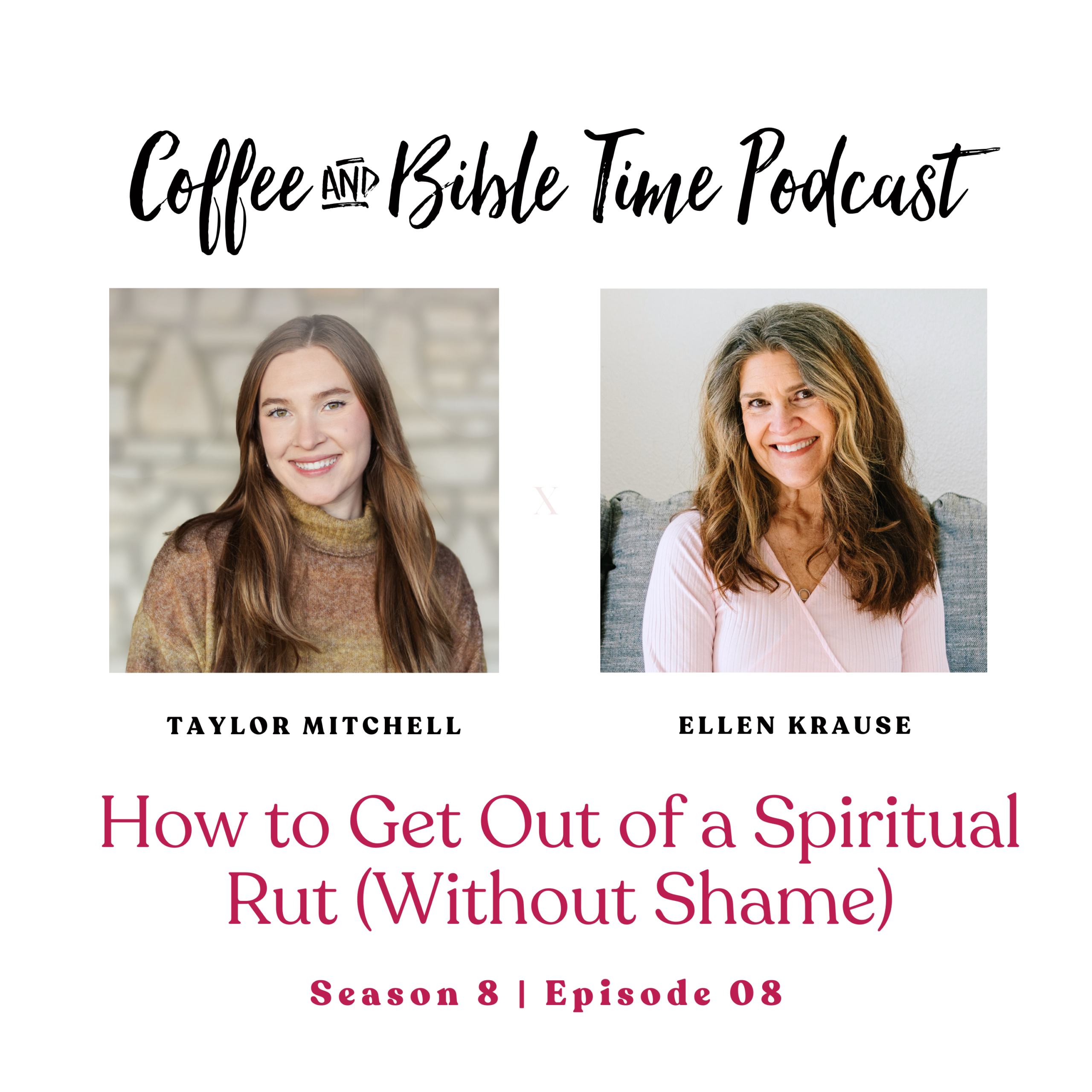

About this episode:
Have you ever been in a place where you felt stuck? Ellen and Taylor have, and today they’re talking about how to get out of the rut—whether it’s emotional, mental, or spiritual.
In this conversation, Taylor and Ellen chat about the struggles they’ve been facing recently, their advice for how to get out of the rut, and encouragement for your faith as you do so. Listen and be encouraged by Paul’s words in 2 Corinthians 12:9: God’s power is made perfect in weakness.

 Apple Podcasts
 Spotify
TIMESTAMPS:
00:00 “Give Yourself Grace”
03:05 What We’ve Been Going Through
07:52 Reframing Slumps as Invitations
11:54 Taking Small Steps Get Out of the Rut
16:53 The Role of Prayer and the Holy Spirit
20:46 The Importance of Community
26:42 How to Get Out of the Rut
29:11 Closing Thoughts and Encouragement
Ellen Krause:
Welcome back to the Coffee and Bible Time podcast. Joining me today for this discussion is my Coffee and Bible Time co-creator, Taylor. Welcome.
Taylor:
Thank you so much for having me here. I’m so excited to talk today with you.
Ellen Krause:
Awesome, me too — with you.
Well, have you ever woken up and thought, why does everything feel stuck? Even my faith?
Ruts in our lives come in all shapes and sizes. Oftentimes, many things are going well in our lives, but maybe one aspect of your life is off. Or maybe you can’t exercise consistently. Or maybe you’re having trouble getting a good meal on the table each night. Or maybe you want to grow in your relationship with God, but you feel unmotivated, distracted, or just plain blah.
If any of this sounds familiar, you are not alone. And more importantly, you are not failing.
Today we’re talking about helpful habits to get out of a rut. I’m not talking about the hustle habits, do-more-for-God type things, but gentle, grace-filled practices that can help you reconnect with God, reset your mind, and take one small step forward in whatever rut you are stuck in.
So whether you’re in a spiritual pothole, an emotional low point, or just a life-is-a-lot-right-now rut, this episode is for you. Grab your coffee, take a deep breath, and let’s talk about how God meets us and helps us in these situations.
Alrighty, Tay, how about if we both start out with some authenticity here? What are some ruts that you’ve either been in the past or are now?
Taylor:
Thanks for opening the floor, Ellen, for me to just air my dirty laundry immediately as we start this podcast. I’m just kidding.
I actually was just going to say I came out with a YouTube video recently on a night routine that I do when I’m having mental health struggle days. So if you’re interested in hearing more about some other tips that I talk about that we aren’t going to be talking about here in today’s podcast, I have plenty too.
That was kind of something that inspired this podcast, actually, because I am currently going through a little bit of a rut — and actually I’d say I’m coming out of it.
So for me, sadness has been looming over me the last month because our sweet little kitten died. OK, he’s not a kitten anymore. He’s four years old, but at that—
Ellen Krause:
He was six.
Taylor:
Well, that makes it a little better. He was six. Okay, so I was wrong about that. Time flies.
But that was really sad for me. You know, it just kind of hit me. And many of you guys can relate to this on a different level, I’m sure, with maybe a loved one that isn’t a pet — or maybe a pet.
When you see someone that you love suffer, it’s hard. And that can take a toll on you, whether it is your pet or it’s a loved one or a friend or whatever. Seeing somebody you love suffer is hard when there’s nothing you can do about it.
And so there’s that helpless feeling of just waiting on God. God, what are you going to do in this situation?
And we long to live at peace. So sometimes for me, those ruts are like, I’m not feeling peace.
And then also, it came at a time of just PMSing for me. So I was already, on top of that, feeling kind of low. And that is obviously cyclical. So every month I think I do kind of have a period where I’m in a little bit of a rut or a lower moment.
It used to be worse. I will say it used to be worse. But the sadness cloud comes over me those weeks, and I have low energy, low momentum, low vibrance for life. And even just doing simple tasks are hard. Like cleaning. Like, I need to clean, you know what I’m saying?
Maybe some of you can relate to that. Your house is a disaster, and it’s just like, how do I get the energy to do the things I need to do to take care of this place?
Yeah, those are some of the ones for me. Ellen, what about you?
Ellen Krause:
You know, for me, this has been a season of adjustment. Having raised kids for 30 years and now with everybody being out of the house, it has kind of been a mental rut of sadness — just that people aren’t around, you guys aren’t around as much.
Taylor:
That totally makes sense.
Ellen Krause:
So that for sure. And probably tied into that for me has been exercise.
I mean, I spent three and a half years going to CrossFit five days a week. And then last March, I stopped because every joint in my body ached. And I just kind of fell apart as it relates to that. So that’s a rut that I’m currently in that I keep telling myself, you know, you’ll feel a lot better if you can just do something.
Taylor:
But you’re totally right about that because exercise in itself gives you a lot of dopamine and a lot of energy. And it’s something that you do that’s consistently good for yourself that builds rapport with yourself, you know?
Ellen Krause:
Yeah, yeah. And I think the challenge living in the Midwest is it’s been so cold or icy, and I don’t want to get a broken wrist out of it. So excuses, excuses. I could be riding the stationary bike in our basement. And I did make an attempt to clear out a whole area. So I felt like that was my one little step. I just need to take the next little one.
But if you’re listening to this thinking, yeah, you know, I’m in some kind of a rut too, you’re not alone. This is just part of the human experience.
And even in the Bible, we see biblical figures that experience various seasons, whether it was discouragement or waitingness or they were weary wanderers. I’m sure that they felt like they were in a rut oftentimes.
But what if we reframe the rut and we actually think of it as an invitation and not a failure?
Taylor:
An invitation to explore, I think, something — explore non-judgmentally.
Okay, listen, I’m not trying to be a counselor over here. I only went to school for it for a little bit. But a really big piece that I learned that’s really helpful and necessary, honestly, to do for yourself as you’re struggling, is to take it as an invitation to be curious in a non-judgmental way about whatever’s going on.
Because like Ellen said, it is absolutely normal to fluctuate in life, be it mentally, hormonally, through seasons of whatever’s going on.
And instead of immediately hovering your hand over the big red shame button — because we love to press that button and, you know, feel real bad about ourselves when we’re not accomplishing, accomplishing, accomplishing — just be like, okay, take a step back. I’m gonna just take this time to be curious about why I feel the way I feel or why this is going on. And give yourself grace.
Ellen Krause:
Yeah, yeah, absolutely.
Taylor:
I know even for me, like this past week, I was like, okay, why am I feeling this way? I’m PMSing. Okay, well, that makes sense. Then why all of a sudden do I feel sad and down and like there’s a big cloud above me? Of course it was snowing nonstop. And like Ellen said, and many of you guys probably experienced a giant storm just making its way across the country. You can’t get out and you feel stuck or trapped or whatever that feels like for you. And those things add layers on top of it.
And there would have been a time in my life where, if I was struggling to do work, I would have labeled myself as lazy or incompetent or just a failure for not being able to do things, instead of being curious. Why am I struggling?
And Ellen, you can relate to this and maybe some of you listening too. When you struggle a little bit with ADHD or focus, that can play a big piece too of the puzzle of feeling in a rut with maybe focusing on your Bible time or focusing on your work. Focusing can be so hard.
And when it’s like you tell yourself, I should be able to do something as simple as focus, and you can’t, then you bring your hand and hover it over the big red shame button again. Do you relate to that at all, Ellen?
Ellen Krause:
Well, I was actually thinking of something else, and that is avoidance. There are certain things with ADHD that I avoid like the plague, even though I know I have to do them. But I want to approach this in that when you do start with maybe one thing that can help, one tiny little thing — and for me, I avoided doing the bills. Most of our bills are automated, but there are some that come in like medical bills or random things that you still have to open the mail and maybe make a payment.
So the one tiny little thing I did was ask your dad, would you just sit with me while I do this? He literally opens all the envelopes, lays them all out. The first time we tried it, he was like, okay, here you go, and left. And then I still didn’t do it. So then a week later, I was like, I think you need to sit with me until I actually go in and do it.
It sounds a little bit crazy, but I think if we start with maybe one tiny assessment that resets things, that can be helpful.
Taylor:
I agree. For those of you that are listening, this is kind of one of the first takeaways that we want you to have as you listen to this. If you’re in a rut, take a small step. A small step toward a habit or a routine or whatever. Because taking a small step helps you build rapport with yourself. If you can do one small thing and succeed at it for yourself instead of setting a big goal and not even accomplishing half of it because it’s too overwhelming.
For instance, cleaning. For me, when I’m stuck in a rut, lately I will say this — and I’m proud of myself — I’m more consistent reading my Bible than I was in the past. But just because I’m more consistent reading my Bible doesn’t mean all these other areas of my life are going good too. Back in the day I would have thought if I did perfect quiet time or whatever, then everything else in my life is going to perfectly fall into place. While I’m still a human being.
And cleaning is one of my kryptonites, if I’m using that term correctly. I have one of those mental blocks where it’s like, okay, I’m overwhelmed. The kitchen — if I want to make a good meal — the kitchen is going to become a disaster. That’s just how it is with all the pots and pans and everything.
And a tip that you told me, Ellen, one of the tiny steps that you can take, was to tell yourself, I’m just going to put three things away. I’m just going to put three things away. So anytime I pass through the kitchen, I’m just going to put three things away. And then I’m not focused on the fact that I actually need to put 300 things away. I’m just going to put three.
Immediately I notice my brain feels like I did a great thing for myself. I get a little bit of that dopamine of I succeeded at something. I’m checking off a mental box. I put away three things, and I feel good about myself because I did that, even though it’s little. It’s something that makes an impact over time.
And to bring it back to Bible reading — because some of you might be listening to this and thinking, I honestly do struggle with Bible reading and I haven’t been consistent — a small step that I’ve been encouraging people to take is to go to the Psalms and read a couple verses. Just a couple verses. Don’t even challenge yourself to read two or three chapters. A couple verses until it resonates with you, and then pray to the Lord about what resonated with you. Praise Him for who He is.
Let that be your quiet time. Simple. Something that you can feel positive about. Build rapport with yourself that you can take these steps. And something I encouraged people with in my last video was to not put the weight of the world on your shoulders to have a huge theological discovery every time you open your Bible. That’s not realistic.
Because we fluctuate mentally, hormonally — we’re human beings, we’re frail, we’re dust. We can’t have the capacity to have perfect mental robustness all the time. God knows that. There’s not that pressure there. Just come and delight in Him.
Ellen Krause:
Right, right. I love that suggestion of starting with the Psalms. And even another Psalm idea is maybe writing down what you learn about God. Because you start to see over and over again in the Psalms so many incredible qualities about God — how big He is. It helps put things into perspective.
God is so big — creating the universe, knowing me inside and out, the number of hairs on my head. He can do anything. So He can also help us get out of a rut.
Which is why I think prayer is such a critical part. We have the Holy Spirit. If you’re a believer, the Holy Spirit is within you from the moment you accepted Christ. Additionally, we need to be asking God to fill us fresh and new each day with His Spirit.
Part of the struggle about reading the Bible might be that we haven’t invited the Holy Spirit into the process to help us understand it, to help make God’s name clear to us. It’s a simple thing we can do, but it has powerful impact.
Your thoughts on prayer?
Taylor:
Yeah. If you’re not careful like me, you can go into your quiet time and treat it like a box to check off. You’re not really thinking about the fact that you want to delight in the Lord.
Take a moment to realize how incredible it is that the Holy Spirit lives inside of you. Jesus said it would be better for Him to go away because He’s putting His Spirit in you. Let that settle as confidence inside of you as you go to read God’s Word.
And I want to encourage those of you who might be feeling seasonally blue — because it’s winter, or part of your cycle — but also those of you going through long periods of depression. Something clinical. Something not as simple as snapping your fingers or waiting for the next sunny day. I want to validate that that’s real.
There was a time in my life from high school to college where I was definitely depressed, especially spiritually. I was reading the Bible and not feeling anything. I was worried. Why am I not feeling the power of Your Holy Spirit inside of me?
If I could go back and give advice to my younger self, it would be two things.
Number one, be patient and gracious to yourself. You may be feeling a lack of feelings right now because you just can’t muster it up. This is a season. It doesn’t mean it’s the rest of your life. Even if it’s long. Even if it’s a couple years. Be gracious to yourself.
Don’t lie to yourself and say this is who you are or that there’s something wrong with you and you could never connect with God. That’s not true.
And number two — like Ellen said — something that helped me when I was struggling with self-deprecating inward introspection and feeling negative about myself because I wasn’t accomplishing things, is to shift your focus off yourself during quiet time.
Take it off yourself and focus on the character of God. Look for God in His character as you’re reading Scripture. As you’re reading the Psalms. Maybe just a couple verses. Highlight the character of God.
Know who you are putting your trust in. Who will never fail you. Who will always be by your side. Who understands that you are frail.
I love the picture that God is our shepherd and we are the sheep. Sheep aren’t the smartest animals. They need guidance. They need protection. Think of yourself as a sheep with a loving Shepherd. He doesn’t value you any less because you’re having a bad day or bad week or bad month. Look to Him and His character. Stay close to your Shepherd.
I think that’s important as you guard your heart in whatever season you’re in. Store up Scriptures that teach you about who God is and how He can help.
Ellen Krause:
Absolutely. When you have that stored inside you, there are going to be many times when you don’t have a Bible with you. You’re sitting in a dentist’s chair. I’m kidding. But it does come in handy. I’ve used it there many times.
Something else I want to touch on is the importance of community in getting out of a rut. The beauty of community is that you can bring that to like-minded people who can share your burden, pray for you, and bring Scripture that relates to what you’re going through.
Lately in our Coffee and Bible Time community, we’ve seen the delight in women who have taken the step to be in a small group. It’s changing their lives. There is so much isolation going on. My first suggestion would be to be part of a group where you can meet directly with people. But that’s not always possible.
Online communities can really help people. Taylor, you’ve been helping get these small groups up and running. What have you seen?
Taylor:
For those of you listening who are struggling with community — maybe your church doesn’t have a women’s group — our online community is filled with women who want to know God more and study His Word.
What I’ve noticed is when women feel seen, they soar. Their confidence grows. They’re understanding Scripture better because other women help them. There are no dumb questions. Everyone is learning together.
Small group is a great place to have accountability and to feel known and seen by people who will walk with you through whatever you’re going through.
People are struggling. And if you feel like you’re struggling, you are not alone. Sometimes Satan wants to isolate us and make us feel like we’re the only ones dealing with a rut or depression or anxiety or difficulty getting into the Word. That’s not true.
There are so many women looking for connection, accountability, and growth. And it’s possible. Even if you’re like me and a little socially awkward.
Ellen Krause:
It most definitely is. We weren’t meant to carry life and its burdens alone. We were wired for community — to talk, share, confide, and encourage one another.
We want you to be in some type of community where you can bring your rut to the forefront, have people pray for you, and take that one tiny step forward that may change the trajectory of where you are.
Do you have any closing thoughts, Tay?
Taylor:
Remember that God is not waiting for you to get your life together. He’s not looking down at you shaking His head because you’re imperfect. God’s mercies are new every morning.
He wants to meet you where you’re at, not after you pull yourself together. Talk to Him like you’re talking to a friend.
Take one little baby step. One baby step is enough today. That one little baby step matters.
Ellen Krause:
Absolutely. Let me share a verse to close our time. 2 Corinthians 12:9 — “My grace is sufficient for you, for My power is made perfect in weakness.”
I pray that you will trust God when you feel weak and that He will give you the power to tackle your ruts one step at a time.
Thank you so much for joining us today. If you think of someone who might be encouraged by this message, we would love it if you would share this podcast with them. We look forward to being with you again next week. Have a blessed day.
If you’ve been feeling stuck, and wondering how to get out of the rut, you’re not the only one.
Sometimes the rut is spiritual.
Sometimes it’s emotional.
Sometimes it’s as simple—and as frustrating—as not being able to clean your kitchen, open your mail, or focus during your quiet time.
On a recent episode of the Coffee and Bible Time Podcast, Ellen and Taylor had an honest conversation about what it looks like to feel stuck—and how to take steps to get out of the rut.
If you’re finding yourself caught in a loop of shame and struggle, here are some reminders (rooted in Scripture) that will help you get out.
First: It’s Normal to Feel Stuck
Taylor said something that reframes everything:
It is absolutely normal to fluctuate in life, be it mentally, hormonally, through seasons of whatever’s going on.
Taylor Mitchell
One of the biggest barriers to learning how to get out of the rut is believing you shouldn’t be in one at all.
We often hover our hand over what Taylor called the “big red shame button.” When we’re not accomplishing, achieving, or feeling spiritually vibrant, we assume we’re failing.
But Scripture shows us that fluctuation is part of the human experience. Even faithful believers experienced seasons of:
- Waiting (1 Samuel 1:1-7)
- Discouragement (Numbers 11:1-25)
- Weariness (1 Kings 19:1-18)
- Grief (Matthew 26:36-38)
A rut is not proof of spiritual failure. Instead, it may be an invitation: to rely on God instead of our own power.
How to Get Out Of The Rut
Step 1: Get Curious, Not Condemning
If you want to know how to get out of the rut, start here: curiosity instead of criticism.
Taylor explained:
Take [your struggles] as an invitation to be curious in a non-judgmental way about whatever’s going on.
Taylor Mitchell

Questions to Ask When You’re Struggling
Instead of saying:
- I’m lazy.
- I’m a bad Christian.
- I should be doing better.
Ask:
- Why am I feeling this way?
- Is this grief?
- Is this exhaustion?
- Is this hormonal?
- Is this loneliness?
For Taylor, grief over losing a beloved pet layered with PMS created a perfect storm of sadness and low energy. For Ellen, an empty nest season and stopping regular exercise contributed to feeling stuck.
Understanding the root doesn’t fix everything—but it removes shame.
And removing shame is the first step in learning how to get out of the rut.
Step 2: Take One Tiny Step
One of the most practical answers to how to get out of the rut is this: do something small.
Ellen shared how ADHD tendencies sometimes led her to avoid tasks like opening mail to pay the bills.
Her solution? She asked someone to sit with her while she did the task. And that act of support—even though it was small!—helped her move forward.
Taylor shared a similar strategy for cleaning overwhelm:
I’m just going to put three things away. Not three hundred! Just three.
Small steps build momentum.
If you’re asking how to get out of the rut, stop looking for a dramatic overhaul. Look for one faithful action:
- Read a few verses instead of three chapters.
- Put away three dishes.
- Pray one honest sentence.
- Answer one text.
Momentum often begins with what feels almost too small to matter.
But it matters.
Step 3: Simplify Your Bible Time
Many women searching how to get out of the rut are actually experiencing a spiritual slump. You want to read your Bible—but you feel distracted, numb, or unmotivated.
Taylor offered this practical reset:
Go to the Psalms and read a couple verses. Just a couple verses till it resonates with you and then pray to the Lord about what resonated with you. Praise Him for who He is.
That’s it.
No pressure to have a huge theological breakthrough.
No expectation to feel fireworks.
Just presence.
Ellen added that the Psalms repeatedly highlight God’s character—how big He is, how sovereign, how faithful. Refocusing on who God is shifts attention away from our inadequacy.
And that shift is powerful when learning how to get out of the rut spiritually.
Step 4: Invite the Holy Spirit Into the Process
Sometimes the reason we struggle to get out of the rut spiritually is that we’re trying to power through alone.
Ellen reminded listeners:
If you’re a believer, the Holy Spirit is within you from the moment you accepted Christ. Additionally though, we need to be asking God to fill us fresh and new each and every day with His Spirit.
Ellen Krause
Before reading Scripture, pray:
Lord, help me understand.
Help me see You clearly.
Fill me fresh today.
You are not doing this alone.
And Scripture confirms God’s heart toward weakness:
My grace is sufficient for you, for My power is made perfect in weakness.
2 Corinthians 12:9
If you feel weak in your rut, you are positioned for God’s strength.
Step 5: Shift Your Focus Off Yourself
When stuck, it’s easy to spiral inward.
Taylor reflected on a past season of depression where she felt spiritually numb:
If I could go back and give advice to my younger self, it would be two things. Number one, be patient and gracious to yourself.
And second:
Shift your focus off of yourself during your quiet time… just focus on the character of God.
Highlight who God is.
Notice His faithfulness.
Remember He is your Shepherd.
We love the imagery of Jesus as our shepherd…but we’re reminded that sheep aren’t strong or self-sufficient. They need guidance. They need help.
And that image teaches us that you are not less valuable because you’re struggling. You are simply a sheep in need of a good Shepherd.
If you’re searching for how to get out of the rut, remember: the Shepherd does not abandon tired sheep.
Step 6: Don’t Isolate Yourself
Another major takeaway on how to get out of the rut: community matters.

Join Our Online Christian Community!
More than a membership, our online Christian community is your home for Christian fellowship, women’s online Bible study support, and a Bible study guide you’ll actually use.
Experience meaningful spiritual growth with a Christ-centered group of women passionate about daily Bible study and prayer.
Ready to deepen your walk with God?
Be part of the community.


Ellen emphasized:
The beauty of community is that you can bring [your burdens] to like-minded people who can help share your burden, who can pray for you.
Ellen Krause
Isolation intensifies ruts.
Community lightens them.
Whether it’s a small group at church, an online Bible study, or one trusted friend — don’t carry your struggle alone.
Sometimes the step out of the rut is simply letting someone sit beside you while you open the envelopes.
God Is Not Waiting for You to Fix Yourself
If you feel stuck, spiritually dry, emotionally low, or exhausted, hear this clearly:
God is not waiting for you to get your life together.
His mercies are new every morning.
He meets you where you are — not where you think you should be.
Learning how to get out of the rut is not about self-improvement. It’s about:
- Replacing your shame with curiosity
- Taking small steps
- Choosing community instead of isolation
- Trusting God instead of your own strength
If you’re feeling stuck, let us reassure you: taking one small baby step today is enough.
And His grace is sufficient for you.
Listen to the full episode of Coffee and Bible Time for deeper insights and actionable steps to encourage you as you move forward today.
Leave a Reply