
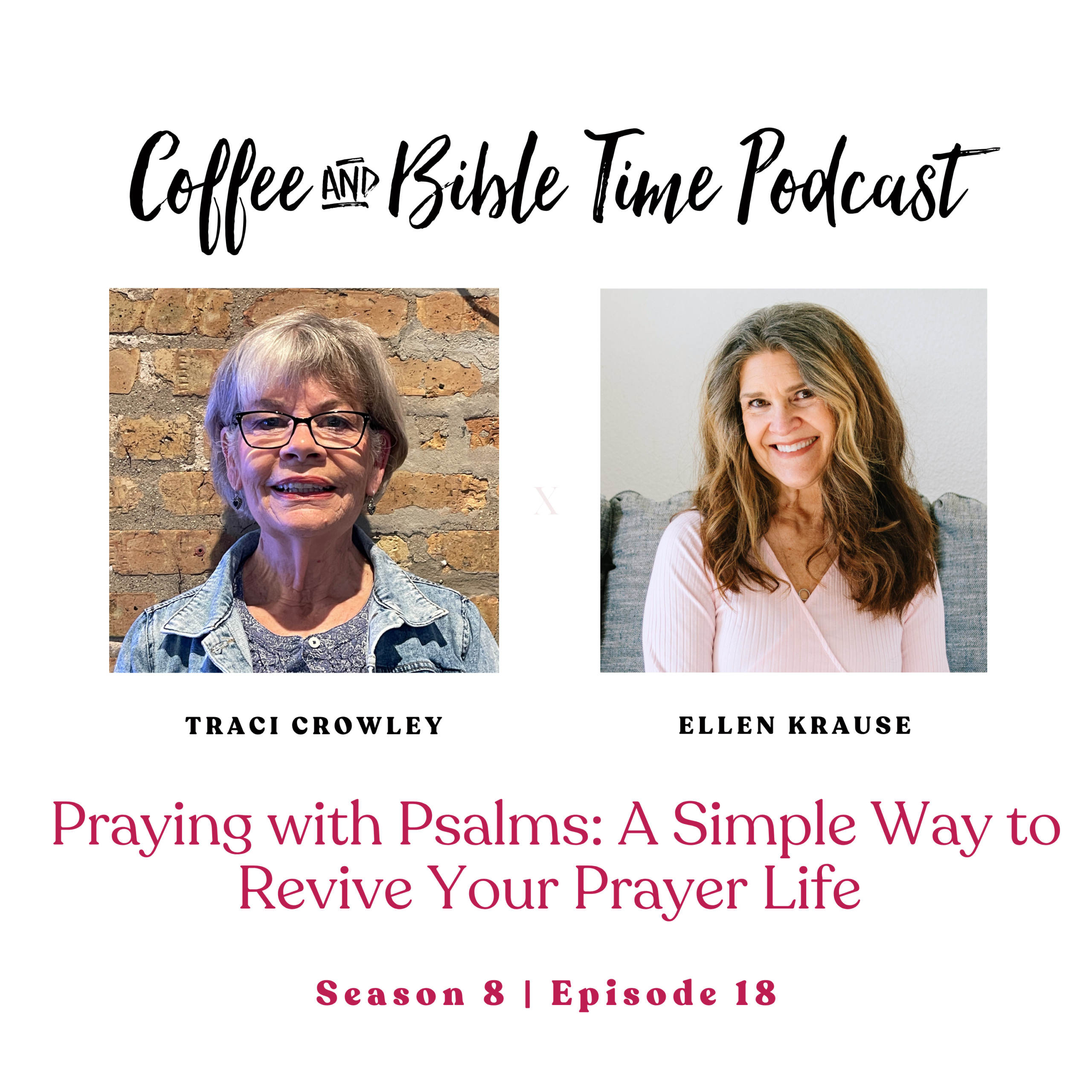

About this episode:
If prayer feels hard right now, you might not need better words…just an open Bible.
Today, Ellen talks with longtime friend Traci Crowley about how praying with Psalms can completely transform your prayer life—giving you words when you feel stuck and helping you reconnect with God in a simple, meaningful way.
 Apple Podcasts
 Spotify
TIMESTAMPS:
00:59 The Importance of Prayer
06:09 Common Prayer Struggles
10:28 Praying the Psalms: A Practical Guide
18:21 Psalms of the Day Approach
25:12 Benefits of Praying the Psalms
31:11 Traci’s Bible Study Tools
34:53 Final Encouragement
Traci Crowley (introduction): Praying the Bible provides me with direction. And granted, some Psalms are going to be harder to pray than others, but all of them are God-breathed, right? Because I’ve been doing this for so long, I have memorized a lot of the verses that I pray. And because I’ve prayed these prayers—not just from the Psalms, but a lot from the New Testament as well—I’ve hidden them in my heart. And it teaches me to not just see God and see how big He is, but to learn to praise Him.
Ellen Krause: Welcome back to the Coffee and Bible Time podcast. I’m Ellen, your host. And today we’re talking about something that is such a central part of our relationship with God. But if we’re honest, it can sometimes feel a little difficult, and that is prayer.
The Bible teaches us that prayer is one of the main ways that we get to know God. We can bring our concerns before him. It helps us grow in our faith. But a lot of us have seasons where prayer feels repetitive or boring, or it’s filled with distractions.
So today we are going to talk honestly about that, and also really practically, about an amazing way that you can bring fresh life into your prayer time. And to help me with this conversation, I have invited one of my dearest friends, Traci Crowley.
Traci is a longtime friend of mine who’s been walking with the Lord for many years. She actually came to faith in college through Campus Crusade for Christ, which is now CRU, and then spent decades working on their staff—even serving overseas before eventually settling back here in the States. Traci loves teaching God’s Word. She is a fellow coffee lover—yay!—and she’s also a wife, mom, and grandma. Traci, thank you so much for joining me.
Traci Crowley: Yeah. Thank you, Ellen. Love being here.
Ellen Krause: I’m so excited. So we have to tell our listeners just a smidget of how we met, which was on staff at Village Church. Do you want to elaborate?
Traci Crowley: Sure. So we both went to the same church for many, many years. You’re still going to that church. I have moved around, so I had to leave that church. But we were on staff together. I was the women’s director, and you were the director of an incredible ministry at our church called Moms, reaching out to young moms who really needed encouragement.
So we shared the same office. And I was on staff there for about seven years. So I think you were there most of that time. And we fought about the lighting in the office in a very congenial way. We teased each other about the lighting. I wanted less; you wanted a lot more.
But we became good, good friends as we served together. And we’ve stayed friends ever since, which I am thrilled about, because that was a long time ago.
Ellen Krause: Yes, yes, absolutely. And we actually formed a wonderful group of friends that we still get together with on a regular basis, all through those ministries there. So what a joy it is to have you, Traci.
And Traci also is involved in Coffee and Bible Time now, writing blog posts and teaching in our live community. So you can also find her there. Well, Traci, you’ve been walking with Jesus for a long time.
Traci Crowley: Mm-hmm.
Ellen Krause: How has prayer life changed for you over those years?
Traci Crowley: You know, Ellen, I think I have always— I was just thinking back on this—I think I’ve always loved to pray. I can’t remember actually a dry time.
When my daughter was in elementary school, I found a group called Moms in Prayer. And this was a group of ladies who got together weekly to pray—not just for the children, but for their school, the administrators, and the teachers. This really appealed to me. So I actually hosted a group in my home as we prayed for them.
And this was the first time I was exposed to praying Scripture—incorporating Scripture into our prayer lives. I’d never encountered that before, and I was intrigued. I was hooked.
And so, because I had loved the Word for a very long time, to marry the Word with my prayer just seemed like a perfect fit for me. So that started back then when I was exposed to it, and it just has evolved and been a real love of my life ever since then—for many years.
Ellen Krause: I love that. You know, the praying back Scripture has been, for me as well, Traci, transformational in my prayer life. So I want to know how you came across this book initially called Praying the Bible by Donald Whitney, because that’s really what we’re going to be talking a lot about.
Traci Crowley: Right.
Ellen Krause: His method of praying Scripture. So how did you find out about it? Because you ended up giving it to me.
Traci Crowley: I did, and I was so thrilled. I know when I first encountered this book, I was so excited about it. I think I just kept passing it out.
But Praying the Bible by Donald Whitney—it’s a very small book. So it’s like, I don’t know, not very many pages at all, maybe 90 pages. It resonated right away with the first quote on the first page. Let me read it to you. It’s by John Piper.
He says, “If I try to pray for people or events without having the Word in front of me guiding my prayers, then several negative things happen. One is that I tend to be very repetitive. I just pray the same things all the time. And another negative thing is that my mind tends to wander.”
So when I read that, I thought, my goodness—
Ellen Krause: Yes.
Traci Crowley: I tend to be very repetitive. I say the same things over and over again every week for the same people.
And then a little later, the author, Donald Whitney, talks about boredom. So a little bit later on that page, he says, “When you’ve said the same old things about the same old things a thousand times, how do you feel about saying them again? Not very excited.”
And then Whitney goes on and says, “Did you dare think the B word—bored? You becoming bored with your prayers?” He says, “We can be talking to the most fascinating person in the universe about the most important things in our lives and be bored to death.”
So that stopped me in my tracks. Yes.
Ellen Krause: Yeah, I love his honesty. Yes.
Traci Crowley: Yeah, and it stopped me in my tracks, and I thought, my goodness, if I were to be honest with myself and with my Lord, I would say I’m bored with these prayers. And I wonder—does God get bored with me saying the same things over and over again?
And then Whitney says later, “If this mind-wandering”—John Piper mentioned his mind wandering—“if this mind-wandering boredom describes your experience in prayer, I would argue that if you were born again, then the problem is not you; it’s your method.”
So I could relate with both—both saying these things: repetition and boredom. And so that is his whole premise in this book, to lay out this method that I’ve fallen in love with.
Ellen Krause: Yes. And it’s so incredible, because I think another problem—at least that I’ve had, and people in our community have reached out to me and said—is, “I don’t know what to say.”
Like, we know that we should be praying, also praising God and giving Him thanks. But this person in the community—I loved how honest she was—because she’s like, “I just run out of things to say.”
And so I had given her, thanks to this book—
Traci Crowley: Mm-hmm.
Ellen Krause: I was able to say, start in the Psalms, and you will not run out any longer. So we’re going to kind of jump into that a bit in a moment.
Let’s talk about another problem that people have—and you touched on it. Our minds tend to wander, which mine totally does. And how did praying Scripture, Traci, change that for you?
Traci Crowley: For me, because I was staring at Scripture and reading it as I was praying, it kept my mind focused. I just have not had a lot of problem with mind-wandering when I pray.
But I’ve noticed that when I pray Scripture—when I’m reading it as I’m praying—it really gets me to be laser-focused on what I’m reading. Because I’m reading God’s Word, and I’m praying God’s Word back to Him, so I better pay attention. I better stay focused.
And so that has really helped me.
Ellen Krause: Yes. And Traci, that was the one thing that really stood out to me when reading this again—was the fact that if you think about it, when we read Scripture, God’s talking to us, and your mind is very engaged in that.
What does God want to say to me today? And then you’re thinking back, how am I going to respond to God based on that?
So—
Traci Crowley: Thank you. Thank you.
Ellen Krause: For me, who has ADHD and my brain can be a thousand different places at one time, it’s incredible. It’s, for me, life-changing for sure. For sure.
Traci Crowley: Yeah, yeah. I really think that that’s very true. So I’m really glad to hear that.
Ellen Krause: So let’s jump in now to praying the Psalms, because in this book, Donald Whitney says that the best place to start learning how to pray the Bible is in the Psalms. So tell us a little bit about the example and what you learned from him going through Psalm 23.
Traci Crowley: Yes, so is so good. He’s very practical. Donald Whitney is very practical. And at the same time, he gives his readers a lot of wiggle room. He lets us be very personal and use this as a framework. But you don’t have to do every single thing that Whitney encourages us to do.
So I really like that. And I have found over—and I’ll talk about this in a little bit—but I found over the years I’ve really tweaked this method. But I did start out this way. So, for instance, I’m gonna just give you an example of—won’t read the whole Psalm—but this is an example he uses from Psalm 23.
We—if you’ve been in the Bible any length of time—you’re very familiar with Psalm 23: “The Lord is my shepherd.” And so he starts out and says, “Lord, I thank you that you are my shepherd. You’re a good shepherd. You have shepherded me all my life. And great shepherd, please shepherd my family today. Guard them from the ways of the world. Guide them into the ways of God. Lead them not into temptation. Deliver them from evil. Great shepherd, I pray for my children. Cause them to be your sheep. May they love you as their shepherd as I do.”
And so—and then he goes on through the whole Psalm. So he makes it very personable.
Ellen Krause: Absolutely. Absolutely. So can you walk us through what that actually sounds like for you—an example, perhaps, of how you’ve done that?
Traci Crowley: So I, like I said, I am—I’ve tweaked this method a little bit. And what I will often do as I turn to Psalm 23 is I will say things like, when I hear about a death in somebody’s family or some of these awful incidents that are happening in wars all over the world, I’ll just stop—and as I’m reading the newspaper, I’ll stop—and say, “Lord Jesus, would you shepherd them through this valley of the shadow of death? Would you be their shepherd? Would you comfort them? Would you minister to them?”
So I will do that. I’ll take that line. And I can be spontaneous because I’ve memorized it, basically.
Another thing I do too is—for instance, I was telling you about this yesterday, Ellen—I was having my quiet time yesterday, and all of a sudden this name pops into my head. Long-time-ago friend, knew her in college. I don’t even know where she is or if she’s even alive, but I felt like I wanted to pray for her.
So I picked out some things from Psalm 23: “Father, if she is needing green pastures today, would you lead her to green pastures? Would you lead her beside the still waters of your Word, and would you nourish her soul with the living water of your Word?”
And so I was able to pull some things out of Psalm 23 just spontaneously and pray for her. So that’s—I often use that.
And if I’m praying for somebody—like I have a list of people—I pray for certain people on Tuesdays, I pray for certain people on Wednesdays. And if the Wednesday gal I haven’t heard from in a while, surely she needs some green pastures and still waters. Surely she needs to hear that goodness and mercy are following her all the day long—are nipping at her heels all the day long.
So I will often pull lines out from different Psalms and pray those, if not necessarily the whole Psalm.
Ellen Krause: Oh, that’s incredible, because when you have that Scripture stored up in your repertoire of knowledge, you can just kind of pull that out and do what he does, which is turn it back into a prayer.
Well, I thought I would give our listeners just a little bit of an example of one of the prayers that I have written here in my journal. It’s from Psalm 77, verse—
Traci Crowley: Mm-hmm.
Ellen Krause: I’m going to read verses two, and then eight and nine, and then I’ll share my prayer. But one of the things that stuck out with me that he said was, it’s okay if, like, after you read the Scripture and you start praying it back, that if it springboards into any number of different things—not even related—that’s okay, right? Because God just wants us to commune with him and talk to him through prayer.
Traci Crowley: Right.
Ellen Krause: Let me share this example. Psalm 77, verse two says—and this is David speaking—“In the day of my trouble, I seek the Lord. In the night, my hand is stretched out without wearying; my soul refuses to be comforted.”
And then verses eight and nine: “Has his steadfast love forever ceased? Are his promises at an end for all time? Has God forgotten to be gracious? Has he in anger shut up his compassion?”
And so my prayer here is a reflection back on one of the difficulties that I’ve gone through in my life—which listeners of the podcast have heard about snippets of here and there—but just with our oldest daughter, Ashley, moving and taking our grandson to Puerto Rico, which—
Traci Crowley: Mm-hmm.
Ellen Krause: Definitely God’s calling on their life, but it was a very, very hard time for our family to be separated. And so this is my praying back to God from these verses.
I said, “Lord, when I was distressed about Ashley moving so far, I sought you. My heart was sad. The tears would not stop. How could you take my grandson from me? But I confess it’s not about me. You reminded me it’s about making your name known. You showed me how you are blessing them there. You gave me a peace about it that can only come from you. Your love is behind every good and hard part of life. Your promises are great, faithful, and true. Your grace astounds me daily and lavishes me with your love. Your compassion bears the heart of the Most High—tender, loving, pure, and holy. God, there is none like you.”
Traci Crowley: Mm.
Ellen Krause: So I was feeling a lot of those frustrations, and actually later in this Psalm, David turns everything around and is recalling God’s faithfulness as well. But I would never, ever have come up with a prayer like that without using the Scripture—ever.
Traci Crowley: Right. And I love it, Ellen, that you were lamenting, right? And so you weren’t hiding your feelings from God. I mean, he knows them anyway. But you weren’t hiding your sadness and your sorrow—you admitted that.
But you also, like David, turned it around. You turned it around to, “But God.” You know, “Here’s how I feel. Here’s what’s happening in my life. Lord, I’m very sad, and I don’t understand it or the timing—but you do. But Lord, you are…” or “you do…”
And that’s beautiful. That’s just beautiful. Thanks for sharing that with us. That was great.
Ellen Krause: Well, thank you for sharing this book with me.
Okay, so as we continue, tell us a little bit, Traci, about Don’s Psalms of the Day approach, because he actually does give some great guidance specifically for people who want that.
Traci Crowley: Right, and this is what I really appreciate about him—he’s very practical in this. So this is how it works.
Whitney bases this method in the Psalms because they were Israel’s songbook. Psalms means “book of praises” in Hebrew. And God knew that His children would need guidance in how to praise Him, right? So that’s why He wrote the book of Psalms.
So Whitney came up with a systematic approach for praying through a psalm every day. And this keeps us from simply going to the middle of our Bible and picking a psalm—whatever psalm we feel like praying that day. Maybe we go to the same psalm over and over again. If we do that, then we omit many psalms that we will just simply miss.
Plus, hunting for a psalm that way to pray through can waste precious time of my devotional time, right? I don’t want to do that.
So Whitney suggests that you take 30 seconds and scan five psalms, and pick the one that best leads you to pray for whatever—or whoever—you want to pray for.
This is based on taking the 150 psalms and dividing them by 30 days, because most months have 30 days. So that results in looking at five psalms a day.
So—very practical—here’s how it works. Today is the 23rd. So I turn to Psalm 23 and I scan it. If nothing jumps out at me—of course, something’s going to jump out at me, at us, from Psalm 23—but let’s say it doesn’t. Then you go to the next psalm, which is not Psalm 2—you flip over 30 more psalms and go to 53.
Right? So again, how do I get to 53? I took Psalm 23 and added 30. That’s Psalm 53. If 53 isn’t quite appropriate, then I skip another 30 psalms and go to Psalm 83, and so on, until you’ve looked at five psalms.
There is a very helpful chart that Donald Whitney puts in the back of his book. If you cannot do the math—right? Like if I’m trying to do it and I haven’t had my coffee yet—then I need something to help me with the math.
And then—so what if you come to the 31st of the month? There’s not very many months like that, right? So what psalm do you pick on the 31st? He suggests Psalm 119.
And even though Psalm 119—which is the longest chapter, the longest psalm in the Bible—and interestingly enough, it’s right in the middle, smack in the middle of your Bible—even though this psalm is also listed in the list of the five psalms starting with day 29 of the month, it’s so long that you can just pick a portion that you have not prayed yet and go through that.
So that is the Psalms of the Day in a nutshell.
Ellen Krause: Yes, those who really like the structure—you’ve got the chart, you can just have that stuffed in your Bible and use that, and it’ll give you a lot more variety.
Well, Traci, if someone wanted to try this tomorrow—so they’ve already learned how to find their psalm for the day—then…
Traci Crowley: Okay.
Ellen Krause: …what would be the next steps after that?
Traci Crowley: Okay, so tomorrow, let’s say you turn to Psalm 24, because tomorrow is the 24th. And you scan it and you say, “Oh, I don’t know, this doesn’t really grab me.” So you go 30 more, and you land on Psalm 54, and you go, “Ah, okay, here’s some things I can pray for that I need to pray today.”
So looking at Psalm 54, I wrote out a little prayer. And you can start out by praising God.
“Father, thank you that you have saved me.” Because he says—this is written by David—and David says, “God, save me by your name and vindicate me by your might. God, hear my prayer. Give ear to the words of my mouth.”
And so I said, “Father, thank you that you have saved me. It is only by your powerful and awesome name that I have eternal life, and I’m completely forgiven. Lord, I know that you hear me and that you give your ear to the words of my mouth. Thank you that I don’t have to go to a certain place or pick a certain time slot to talk to you. I can talk to you anytime, anywhere.”
And then a little later he talks about, in verse three: “For strangers have risen against me; ruthless men seek my life. They do not set God before themselves.”
And so I said, “Father, I feel like the enemies of doubt and discouragement are seeking my heart today.” David says right here—because he says a little bit later that God is his helper—“Behold, God is my helper; the Lord is the upholder of my life.”
David says right here that you are his helper. “Be my helper today, Lord. Help me see these circumstances through your eyes—to see the world through the lens of your truth.”
And then a little later he says, “The Lord is the upholder of my life… I will give thanks to your name, O Lord, for it is good.”
“Lord, you are good, and you do good. You cannot help but do good to your children. You have delivered me over and over in the past, and I ask you to do it again. May my eye look in triumph over this discouragement today. In your powerful and good name, I pray, amen.”
Ellen Krause: That’s beautiful, Traci. And it’s something that, yeah, we can each do that. It’s not hard. It’s not rocket science, right?
Traci Crowley: No, no, it’s not hard at all. And what I liked—
Ellen Krause: It’s putting thought.
Traci Crowley: Exactly. And what I liked about Whitney’s approach too is, you know, we kind of recoil from these Psalms that talk about, you know, “beat my enemies up,” or, you know, “rid them from the earth forever and ever.”
But Whitney turns it into enemies of our souls. You know, what is the enemy who is lurking about, seeking those whom he wants to devour? What is he trying to do in my heart today?
And so taking that—and that was a revelation to me—I thought, wow, I can even turn those prayers into something personal that I want God to do in my heart. And so I really, really like that about the book.
Ellen Krause: Yes, I couldn’t agree more. Well, for someone who’s thinking about this, Traci, what would you say then kind of are the overall benefits you’ve seen from praying the Bible in this way?
Traci Crowley: I would say it provides me with direction. You know, it helps me—if I want to pray the Word, the Scriptures, the Psalms—it helps me to avoid just going willy-nilly to the Psalms and wasting time trying to find something to pray. This way, if something doesn’t click, I just go 30 more psalms.
Also, this plan enables us to personally and systematically encounter all 150 psalms. And granted, some psalms are going to be harder to pray than others, but all of them are God-breathed, right? Every word that we read in the Word is God-breathed.
So we will encounter, with this method, all 150 psalms—which is exciting.
And another benefit that I found is—and I mentioned this earlier—because I’ve been doing this for so long, I have memorized a lot of the verses that I pray. And I told the story of yesterday, when this friend’s name popped into my head.
And because I’ve prayed these prayers—not just from the Psalms, but from a lot from the New Testament as well—and Whitney has a chapter in there on the rest of the Bible, and how to look at the New Testament and how to pray things from the New Testament…
But Paul’s prayers, like Colossians 1, verses 9 through 12, I think it is—just wonderful for ourselves. That’s a great prayer for ourselves or for someone, a fellow Christ follower.
So those are some of the benefits: memorizing—I’ve hidden them in my heart—it provides me with direction, and then I regularly go through the Psalms.
Ellen Krause: Yeah, I love all those. I think for me as well, one of the things that’s really changed me is having so many qualities of God that I wouldn’t normally just pull out.
And something that I had done in another activity in the past is just going through the Psalms and writing down everything I learned about God—like just all of His qualities. And before you know it, I mean, you have pages full of so many incredible things about God.
For me, it gives me the comfort of knowing that my God is big. He does have everything under control.
Traci Crowley: Mm-hmm.
Ellen Krause: He is with me. He does love me. So it really expands the way that you see God—would you agree?
Traci Crowley: Right. I totally agree. And it teaches me to not just see God and see how big He is, but to learn to praise Him. I have always been very weak in that regard—just how do I praise God?
And all praise is telling God back what you read in the Word about who He is and what He does and how He is—giving that praise back to Him. The Psalms are full of that. And so I think I’ve learned too how to praise Him.
Ellen Krause: Yes. And in the book—which you started to elaborate, I think, a little bit earlier—when this was written, God wanted His people to be praising Him. And He didn’t leave it a mystery. He gave them the Psalms so that they could know about Him, that they would know what to praise Him for.
I love that thousands of years later, we have that, and we can still do that.
Traci Crowley: Right.
Ellen Krause: Well, Traci, if someone’s listening to this who is feeling discouraged about their prayer life—maybe they haven’t prayed in a long time or are just kind of feeling in the dumps about it—what would you say to them?
Traci Crowley: I would say, if they can, go buy the book and start with this method. Give it time. And I would encourage someone to give it at least a week, if not two weeks—every day—and just jump in and force yourself to do it and see if you like it.
The thing about Donald Whitney that I like so much—and we alluded to this earlier—is that he gives us lots of latitude. If the whole Psalm doesn’t jive with you, then pick out maybe a couple of sentences that you can pray.
And Whitney is so funny. At one point in his book, he says, if you’re reading a Psalm and it’s not really jiving with you, and you see the word “mark”—M-A-R-K—like “God marked the heavens and the earth,” and you know somebody named Mark, then pray for Mark, you know?
Because he says the Holy Spirit is praying with us and for us, and He’s directing our thoughts as we read Scripture, right? And so just pay attention to the words and what’s going on in your mind. And I love that.
But anyway, I would say just go ahead and start, and just force yourself to do it for a week, if not two.
Ellen Krause: Yes.
Traci Crowley: And again, give yourself lots of leeway. You don’t necessarily have to pray through every line of every psalm, but just pick out things that you really resonate with that day.
Ellen Krause: Yes, I couldn’t agree more. Yeah, especially if you’ve been stuck for a while. You know, we don’t want this to feel like a whole big, heavy new set of expectations. But honestly, I think you’ll find it to be just life-changing.
And it’ll bring a whole new joy to your prayer life that you haven’t yet experienced, because it’s definitely different than coming up with them all on your own.
Traci Crowley: Amen.
Ellen Krause: Well, we will make sure that we include a link to this book in our show notes for any of you that are interested in it. And Traci, before I let you go, I have to ask you some of our favorite Coffee and Bible Time questions.
The first one is: what is your go-to Bible, and what translation is it?
Traci Crowley: My go-to Bible is an ESV translation, and it’s a large print. And I like it because of the size. I was using, for a long time—and still am—the ESV Study Bible with notes. That thing is gigantic, and it just got—it’s too cumbersome to take places. So I leave that at home, and I take this Bible with me to Bible studies and church.
Ellen Krause: Sure, yeah, okay. Yeah, and that’s a wonderful translation. Do you have any favorite Bible journaling supplies, or would you like to tell us how you Bible journal?
Traci Crowley: Yes, I’m very simple. I love spiral notebooks and colored pens or pencils if I want to highlight something.
I have found that the older I get, the more I forget. And so I got really tired of having a great quiet time at my desk, standing up, going to the bathroom, brushing my teeth—and forgetting what I just read. I got really tired of that.
So I started writing down what I was seeing and what I was learning. And that tends to keep my mind not only engaged, but remembering.
And so I’ll go through the day, and then at night, as I’m brushing my teeth again, I’ll try to remember what I read in the morning. And I started doing this a long time ago when I bought one of those electric toothbrushes, and it takes two minutes to brush your entire mouth.
And I don’t want to just waste two minutes thinking about my teeth. And so I thought, how can I use this time better? So I try to think about either a verse I’m memorizing—I try to rehearse it then—or I’ll try to remember, what did I read this morning? What did I learn?
Ellen Krause: Great tip! Love that, Traci. Okay, excellent. Lastly, what is your favorite app or website for Bible study tools?
Traci Crowley: I love, love, love Bible Hub. I use it all the time. There’s tons of information on there. I can see the different translations of the Bible. Like, I will often look at either New Living Translation or Amplified—it’s sometimes very helpful.
You can also see the original language, the original words, what they mean. So I do that. And also, there’s access to very good commentaries on there, and it also points to what this verse is—what does this verse actually mean? And so I’ll read through that too. But I use Bible Hub quite a bit.
Ellen Krause: Yes, they are a great resource. And I love that you mentioned the Amplified Bible, because I’ve kind of been using that a little bit more recently—like through an app—just because it’s so helpful. It really is. All right.
Traci Crowley: I’m tired.
Ellen Krause: Have you? Yeah.
Traci Crowley: Yeah, it used to drive me crazy because they had so many words. It’s like, well, just, you know, don’t have so many words—but now those “so many words,” I really like.
Ellen Krause: Yes. Well, Traci, thank you so much for being here and sharing with us today. I just appreciate this lovely conversation so much.
Traci Crowley: You are welcome, Ellen. Thank you for inviting me. And it was a pleasure, because I love this method, and I love that you love it. So thank you.
Ellen Krause: Mm-hmm. All right. And to everyone listening, if your prayer life has felt a little dry or difficult lately, I hope today reminded you that you’re not alone, and that God has given us His Word as a place to begin again.
So if you enjoy this episode and you would like me to invite Traci back again, let us know through the link in the show notes. We would love to hear from you. So thank you again for joining us, and we’ll see you next time on the Coffee and Bible Time podcast. Have a blessed day.
If you’ve ever sat down to pray and thought, “I don’t even know what to say anymore,” you are not alone.
Many believers go through seasons where prayer feels repetitive, distracted, or dry. You want to pray—you just don’t always have the words.
In this conversation from the Coffee and Bible Time Podcast, Ellen Krause and Traci Crowley explore a simple, biblical practice that has transformed many prayer lives: praying with psalms.
This approach is not complicated or intimidating. It is deeply rooted in Scripture and offers a practical way to reconnect with God when your own words fall short.
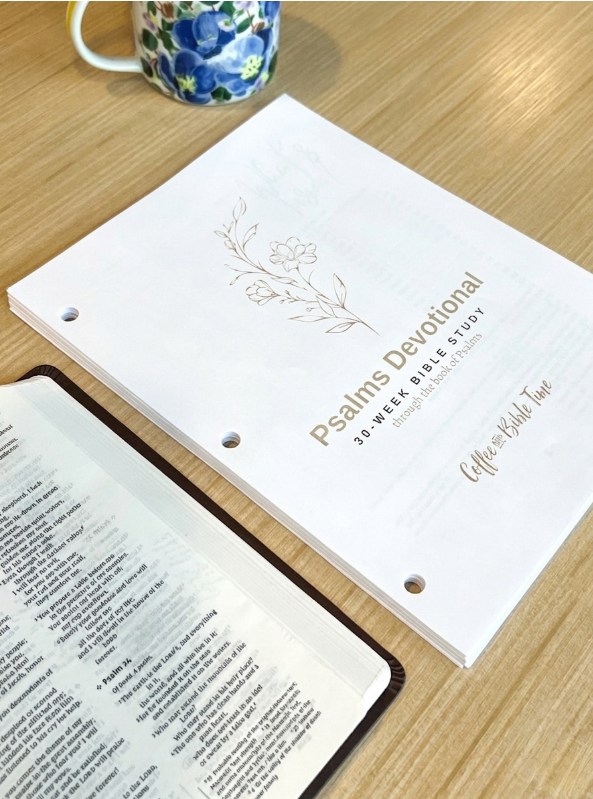
Discover the Beauty of Psalms with the Coffee and Bible Time Psalms Devotional
Walk through the Psalms with short daily readings, simple prompts, and space to pray. Find language for your feelings—and rest in God’s unshakable character.
What Is Praying with Psalms?
At its core, praying with psalms means using the book of Psalms as your prayer guide. Instead of trying to generate your own words, you take God’s Word and turn it back into conversation with Him.
I’ve noticed that when I pray Scripture—when I’m reading it as I’m praying—it really gets me to be laser-focused on what I’m reading. Because I’m reading God’s Word, and I’m praying God’s Word back to Him, so I better pay attention. I better stay focused.
Traci Crowley
The Psalms were originally the songbook of Israel, filled with expressions of praise, lament, repentance, and trust. Today, they provide believers with a complete vocabulary for prayer in every situation and season of life.
Why Praying with Psalms Changes Your Prayer Life
If you’re like Ellen and Traci, one of the biggest challenges of prayer is getting distracted or bored by repetition.
These struggles are common. In the introduction to Donald Whitney’s book Praying the Bible, John Piper writes:
“If I try to pray for people or events without having the word in front of me guiding my prayers, then several negative things happen. One is that I tend to be very repetitive…And another negative thing is that my mind tends to wander.”
John Piper
If we were to be honest with ourselves and the Lord, we would admit that we are bored of these prayers!
This is where praying with psalms becomes life-giving. Instead of relying on your own limited language, you begin praying God’s inspired word back to Him.
A Simple Method for Praying with Psalms
The method involves praying through the Psalms systematically instead of randomly selecting one.
Whitney suggests dividing the 150 Psalms into a 30-day cycle. This means each day you scan about five Psalms.
For example:
Over time, you engage with all 150 Psalms rather than returning repeatedly to the same familiar passages—and no longer have the pressure of trying to “come up with” what to pray.
What Praying with Psalms Sounds Like in Real Life
Using Psalm 23 as an example, Traci demonstrated how Scripture becomes personal prayer:
“Lord, I thank you that you are my shepherd… please shepherd my family today. Guard them from the ways of the world.”
She also described how Scripture shapes spontaneous moments of prayer:
“If I hear about a death in somebody’s family… I’ll just stop and say, ‘Lord Jesus, would you shepherd them through this valley of the shadow of death?’”
When you start praying with psalms, the Bible becomes internalized—it moves beyond a structured practice into a way of thinking and responding throughout the day.
How Praying with Psalms Helps When You Feel Stuck
A common struggle among believers is simply not knowing what to say in prayer.
Ellen shared a message from someone in the Coffee and Bible Time community:
“I just run out of things to say.”
This is exactly where praying with psalms becomes transformative. Instead of searching for words, you step into Scripture and let God’s Word guide your prayer life.
Traci explained:
“I have memorized a lot of the verses that I pray… I’ve hidden them in my heart.”
Over time, this practice makes Scripture part of your internal thought life—not just something you read, but something you pray naturally throughout your day.
Practical Takeaways: How to Start Praying with Psalms Today

5 Tips to Start Praying with Psalms
If you want to begin praying with psalms, here are simple steps you can try this week:
Final Encouragement
If your prayer life feels dry or difficult, you don’t need more pressure—you may just need a new rhythm.
Praying with psalms offers a simple, biblical way to reconnect with God through His Word. It gives you words when you feel stuck, focus when your mind wanders, and depth when prayer feels shallow.
And perhaps that is the invitation of this practice—to learn again how to pray, not from emptiness, but from the richness of God’s own Word.
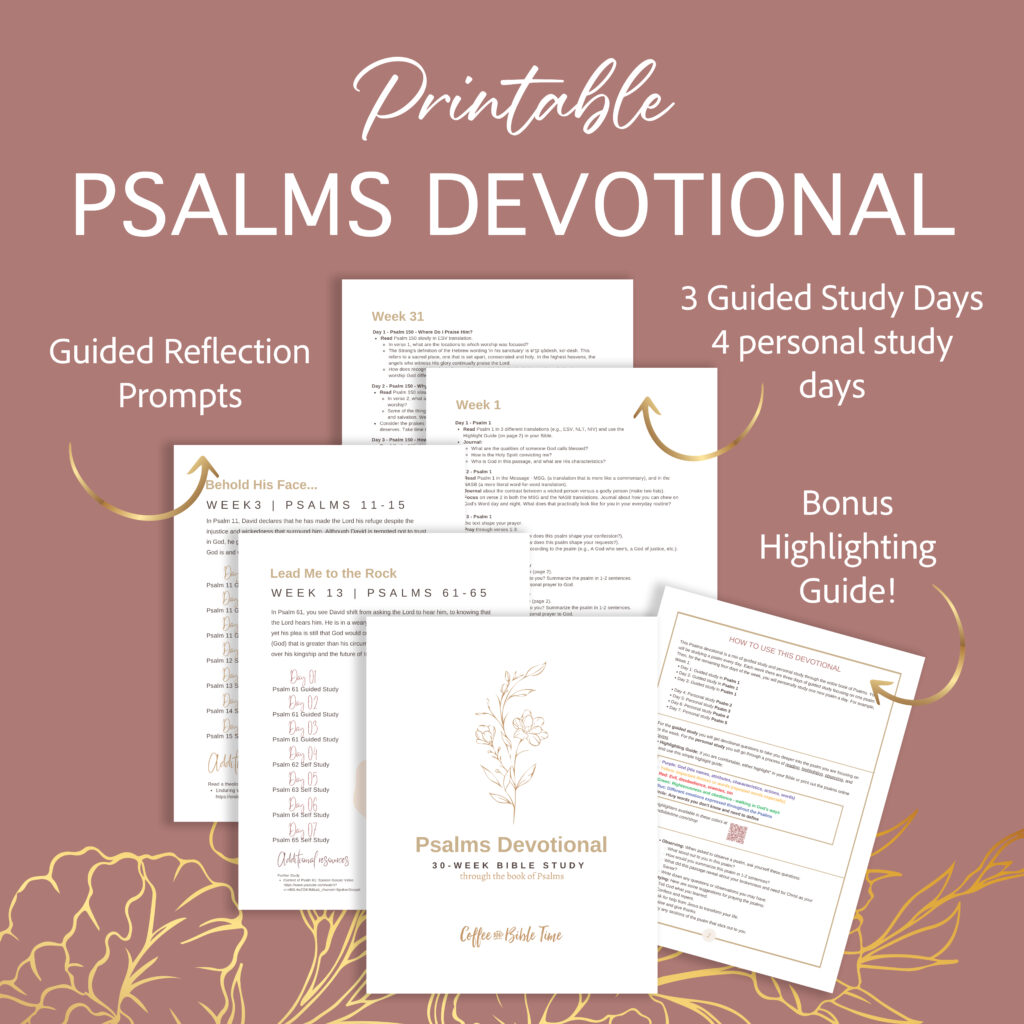
Psalms Devotional: 30 Day Study
Grow deeper in your faith with this 30 week Psalms devotional PDF for women, designed to help you build a consistent, meaningful quiet time with God.
Part of the Coffee and Bible Time devotional series, this is the condensed digital download version of the full physical notebook—perfect for flexible, everyday use.
Leave a Reply