

About this episode:
Have you been trying to carry more than God ever intended? So many women feel overwhelmed by endless responsibilities, constant pressure, and the guilt of never quite measuring up.
In this encouraging conversation, Ellen Krause is joined by theologian and author Kelly Kapic to learn how how embracing our God-given limits can lead to greater freedom, deeper trust in Christ, and lasting peace.

 Apple Podcasts
 Spotify
TIMESTAMPS:
00:00 You Were Never Meant to Do It All
01:04 Why We Feel Overwhelmed
05:37 What the Bible Says About Our God-Given Limitations
11:17 How to Stop Feeling Guilty for Resting
14:19 How to Know When You’re Doing Too Much
20:03 Letting Go of “Doing It All”
22:43 Resources & Bible Study Tools
26:25 Your Worth Is Not Found in What You Accomplish
Kelly Kapic [introduction]: You can’t do everything. You can’t know everything.
To be finite is to be limited, but there’s a Christian word for that. And the Christian word is creature. Even in the church, we feel guilty for being creatures. And that’s really what I’m concerned about.
One of the things that drives me is when you and I say to someone, “I’m just so exhausted. I feel crushed. I feel overwhelmed.”
The Christian response has very often been exactly like the world’s. We sit down, we try and show compassion, but basically we give you time management advice. And I’m just convinced we don’t have a time management problem; we have a theological and pastoral problem.
Ellen Krause: Welcome back to the Coffee and Bible Time podcast. I’m Ellen, your host.
Have you ever gone to bed feeling like, “I just didn’t do enough today”? No matter how much you accomplish, there’s always one more thing to do, one more person to care for, or one more expectation to meet. And for many of us, that constant pressure leaves us feeling exhausted and wondering if we’re somehow falling short.
But what if our limits aren’t something to overcome? What if they’re actually part of God’s good design?
Today we are joined by Dr. Kelly Kapic, professor of theological studies at Covenant College and an award-winning author. In his newest devotional, You Are Never Meant to Do It All, he explores the biblical truth that God never intended us to live without limits, and that embracing them can actually lead to greater joy, freedom, and dependence on Him.
So if you’ve ever struggled with busyness, guilt over resting, or feeling that you just can’t keep up, I think this conversation will be a real encouragement to you.
Kelly, thank you so much for joining us today.
Kelly Kapic: It’s a delight to be with you. Thanks for having me.
Ellen Krause: It feels like there’s so much pressure in our world to keep up, and especially for women who are trying to faithfully juggle so many obligations.
Kelly Kapic: Mm.
Ellen Krause: Why do you think we’re so uncomfortable with our own limits?
Kelly Kapic: I mean, there’s no short answer, but I’ll just give you a couple of things.
One of the things—and you kind of mentioned this or alluded to it in your introduction—is that our imaginations have been shaped in certain ways, especially over the last fifty to a hundred years, and intensified in the last thirty, where the values of productivity and efficiency continue to rise.
And what’s happened is we’ve taken good values. Being productive can be a good gift, a beautiful thing. Being efficient can be helpful, can be loving. And yet both of those things can also undermine love and relationships and goodness and our humanity.
So part of what’s happened is we’ve taken good gifts and made them ultimate. And we’ve devalued all kinds of other things.
Ellen Krause: Well said. So what do you think is driving our inability to slow down, then?
Kelly Kapic: It’s interesting, even putting it that way. Just thinking, as we were just talking, alcohol—you know, yeah, I don’t know where your listeners are at, but by and large, you know, Jesus has wine. You have these kind of things. Alcohol’s not a problem, but if you move it to where you remove the limits, it becomes really problematic, right?
And so there are all kinds of obvious things, whether it’s drugs or whatever, where we think, “Look at how bad that is.”
But what’s interesting is, especially in the Western world—we have, and the church has done this—we have baptized certain Western values in our current age and made them Christian when they’re not necessarily, and they mess us up.
So the big idea for me is that finitude is not sin.
Now, most listeners are like, “I don’t even know what that word means,” or certainly don’t use it a lot. But finitude, or finite, is just a fancy way of saying limits—limits in space, time, knowledge, power, right?
You can’t be everywhere at the same time. You can’t do everything. You have diminishing energy levels. You can’t know everything, no matter how hard you study.
So to be finite is to be limited, but there’s a Christian word for that. And the Christian word is creature.
And when I say finitude is not sin, I’m deeply concerned because even in the church, we feel guilty for being creatures. And that’s really what I’m concerned about.
One of the things that drives me is when you and I say to someone, “I’m just so exhausted. I feel crushed. I feel overwhelmed.”
The Christian response has very often been exactly like the world’s. We sit down, we try and show compassion, but basically we give you time management advice. And I’m just convinced we don’t have a time management problem; we have a theological and pastoral problem.
Ellen Krause: That’s so fascinating, especially when you consider that Scripture tells us that God never grows weary, but we certainly do.
Kelly Kapic: Yeah.
Ellen Krause: And like you said, when most of us hear the word limitations, we immediately think that we’re weak or failing.
I know, for me personally, I really struggle in this area. Or I think the other part of it, too, is I’m excited about so many things, want to do so many things. Maybe God didn’t call me to do all of those by tonight, you know?
Kelly Kapic: Yeah. Yeah. Yeah.
I mean, it’s funny because, in some ways, the truths that we’re talking about, we all know, certainly Christians, but boy, do we have a hard time embracing.
So the basic idea is God is actually very comfortable being God. And He’s very comfortable with Kelly and Ellen not being God.
And that sounds funny. If you ask someone, “Do you think you’re God?” we all say no.
But in practice, right? We think, “Well, I didn’t get my daughter to those six things today,” or, “If my kid is not in four sports, what are they gonna do?” Or if they’re not strong enough, they’re not keeping up.
Our imaginations have been really formed in such a way that we think being a creature is a problem. And God does not need us to repent for being a creature.
You do not have to repent for being a creature. You have to repent of your sins. But that is not the same thing as not having all the energy, power, etc.
And when you start to put this into practice, it really can make a difference. But until we can disentangle those things, we’re doomed to days of grief and mourning and just shame every day.
Ellen Krause: Hmm. Well then, how does Scripture invite us to think about our limitations differently?
Kelly Kapic: Yeah.
A great example is, I remember when I was working on this, one of the things that helped me think through it was sleep, and to realize there really is a theology of sleep.
You know, I’m in my fifties now, but when our kids were younger, and in different seasons of life, I would probably, like many listeners, wake up at two or three in the morning, and my mind is racing with all the things I need to do, all the anxieties I have, concerns for my kids, my wife, etc.
And so often I would go to bed thinking, “Kelly, why didn’t you get more done today?”
To realize that, actually, part of the beauty of how God made us is that every day when we go to sleep, it is an act of faith. It is us saying to God, “This far and no further.”
It’s kind of like if you think about a soldier in war. If you’re on the front lines, you cannot sleep unless you have someone who has your back.
And there is a sense in which, if you don’t believe that there is a God who’s sovereign and good and trustworthy, how can you ever sleep?
But every day we are practicing being reminded that we’re creatures, dependent on God, and we trust Him. And so every night, that is a practice.
And yet, even in Christian circles, people glorify, “I only need four or five hours of sleep.” We should stop glorifying that.
I mean, we have different bodies or different seasons of life, but let’s not romanticize dehumanizing practices.
And then the other thing, just as a really practical thing, the Bible has a one-in-seven pattern—a day of rest.
If you grew up in a legalistic context, talking about Sabbath is gonna freak people out. But if you are just a Christian living in the West and you’re like, “I feel crushed. I feel overwhelmed,” and you hear someone say, “You know, what if God actually made a day where you’re supposed to sleep, and then you go and join His people in worship, and you feast with others, and you maybe take a nap and enjoy His good creation, and invest in relationships, and you do not work?”
It sounds too good to be true, which shows, even as Christians, how off we are.
But we need that. We are made to work. We are made to work hard. But we’re not made to work endlessly.
Ellen Krause: Absolutely.
And I know, for me personally, that day of rest—or specifically taking that time for things that fill my soul, like doing some type of creative artwork or something—when I allow myself to do that, I feel so regenerated that I’m probably more productive than I would have been trying to work all seven days.
Kelly Kapic: Yeah.
It’s one of those… There actually is some evidence that some of these things do end up increasing productivity, which I both appreciate and which makes me nervous.
Because even if you’re not more productive as a result of it, it’s still just good.
Because when you talk about it being regenerating, I think actually, in a sense, what you’re saying is, “I felt more human.”
Part of slowing down, doing creative art, taking a walk in the woods—you get reconnected with your body. You get reconnected with God. You get reconnected with people.
And that can sound weird. Like, “What do you mean, reconnected with your body?”
But the way the world is right now, we can live in our heads. You can sit in front of a screen all day.
And there is a reason why the book by a psychologist that was never meant to be a big popular book, called The Body Keeps the Score, is still a New York Times bestseller.
Because we’re pretending our bodies can be ignored, and they cannot.
Ellen Krause: You’re absolutely correct.
Well, Kelly, many of us feel so guilty whenever we take time to slow down and rest. How do we overcome that guilt?
Kelly Kapic: Yeah. This is where I’m saying I actually think it’s a theological and pastoral problem.
I’d encourage your listeners to take some time this week—and this is gonna sound like a weird thing to do—but sit down with a piece of paper and try to answer these questions. Make yourself write them out, because sometimes when we write, it’s almost like we’re looking at our hand going, “I didn’t even know I thought that.”
But try to answer these questions:
What does God expect of you in a day?
What does He expect of you in a week?
What does He expect of you in a month or a year?
And in a lifetime?
If you ask someone, “Hey, do you think God has unrealistic expectations of you?” we’d almost always say, “That’s a weird question, but I guess not.”
But actually, what surfaces is what we really believe.
And often we do treat God like He’s a cruel taskmaster. It can come from problems in our childhood, from problematic preaching, or culturally, from our own inner voices.
But to actually start to believe that God made us as creatures, and all of that is good.
The shortest way I know how to talk about it is humility.
I hope all listeners know that, as Christians, we should be humble.
One of the things I found, though, is if we ask Christians, “Why should we be humble?” our gut response is often, “Well, we should be humble because we’re sinners.”
I’m a theologian. I think we’re sinners. And the fact that we are sinners should contribute to our humility.
But Adam and Eve, before there was any sin or fall—should Adam and Eve have been humble?
And the answer is actually yes.
Even before they sinned, even before there was any fall, they should have been humble because they were created to be dependent on God, to be dependent on each other—their neighbor—and to be dependent on the rest of creation.
Dependent on God, neighbor, and the rest of creation.
Now here’s the thing.
Think about it. If after this interview someone talks to me and says, “Hey, you spent some time with Ellen. What did you think?” and I say, “She’s great. I mean, it seemed like she was really dependent on a lot of people.”
In our culture, that’s never a compliment, right? It sounds like it’s a bad thing that you would be dependent.
And the question I have for Christians is, how in the world can you grow in Christian discipleship when fundamental to growing as a Christian is increasing a healthy dependence on God, a healthy dependence on neighbor, and a right acknowledgment of how dependent we are on the rest of creation?
And so it really is a theological problem.
If you’re ever going to get free from this, it’s not going to come because you get a better email program that’s more efficient. It’s not going to come because you wake up a little bit earlier.
Those things might help, but fundamentally you also need to reconsider who your God really is and how He made us.
And what you find in Genesis is God’s saying, “You’re good.”
Part of that goodness is our limits, our finitude. That’s not a bug; that is a feature, because it’s what fosters relationships. Right?
Ellen Krause: So to the person who’s listening to this and saying, “Gee, he’s got a great point. I need to slow down. I need to accept who and how God made me.” But how do I teeter-totter? What’s the right balance? Like, how do I know too much is too much? Or, you know, the contrast between the sluggard and the…
Kelly Kapic: You could still be slothful. Yeah. Yeah. Yeah.
I’ve kind of landed on this: I just don’t think we’re actually very good judges of ourselves.
My wife—we always joke because if I’m working at night and I shouldn’t be… You know, I often say, listen, historic farmers are a good example where, when it’s harvest time, they might have to work a twelve- or fourteen-hour day because it’s harvest, and you’ve got to get this done. And there’s nothing immoral or problematic about that. That’s not a problem.
The problem is we’ve taken harvest time and made every day harvest time.
And because of technology—and by technology I mean simple things like light bulbs—now you can work at 11:30 at night or whenever, right? And so there’s no end. The kind of natural rhythms, when it gets dark, are taken away from us. So we think every day is harvest. And that’s a massive problem.
So my wife might see me working at night, and to be honest, if it’s not a harvest season, it’s not legitimately a time where I need to be doing that, she’ll be like, “Stop it. Go for a walk. Be free. Go watch ESPN.”
But if I would go into the bathroom five minutes before she said that to me, and I looked at myself and said, “Kelly, you’ve put in a full day of work. Be free. Go for a walk. Rest. Whatever.”
I’d think, “You lazy…” Because some of your listeners will struggle with that. We are cruel to ourselves.
So what I would say is you need one to three people—sometimes it can be a small group—who really know you, whom you trust, and with whom you can be honest.
And I think this is really helpful for everyone, but it is interesting. As I’ve talked about this in different groups, women particularly, especially women with children, have talked about how helpful this is.
Because when you tell someone, “Let me tell you about my day and my week,” and you say, “Well, I’m taking the kids, and I drop them off at this time, and I have to do this…” a sane person, hearing that, will often go, “Okay, that’s amazing. It’s too much. So we’ve got to figure out what to cut.”
And that same woman, if she heard her friend say everything that was just being done, she would say, “Whoa. Too much. It’s not good for you. It’s not good for your kids, your relationships, etc., your body. We’ve got to…”
And it’s not just cutting out bad things. Sometimes we’ve got to cut out good things.
And yet she might give that grace to someone else, but we find it so difficult to give it to ourselves.
Or it might be that someone tells their friends, “Here’s what my day, my week looks like,” and the group might say, “Actually, it seems like our community, or your children, or whatever, are impoverished because you’re not contributing enough.”
It could be that the trusted people say, “Actually, you are struggling with sloth. You’re disengaged.”
So it’s not always “do less.”
But I just think the wisdom of others who know us and whom we trust is really helpful.
And then they also give us the courage to be able to say no or to be able to say yes.
And I do think it’s not hard to start cutting the bad things out. I mean, it can be hard. But where maturity comes in is cutting legitimately good things out. That’s where it’s really hard.
Ellen Krause: Hmm.
Exactly. Right. Because we can have opportunities for so many good things, but we just can’t do them all.
Kelly Kapic: Yeah. And also, I was just going to say, just to add to that, sometimes it doesn’t mean you can never do it. But there are seasons of life.
When you have little kids at home, that is a different season that should have different expectations than when you’re an empty nester.
My wife and I are empty nesters now. Our level of freedom is radically different than it was. And so that’s good. Your season is not all seasons.
Ellen Krause: Yes.
It kind of reminds me of my daughter, who’s married and doesn’t live here anymore, but she came back to visit and she’s like, “Mom, you need to declutter.”
And I was like, “I do? I like everything the way it is,” you know?
And then she’s like, “Trust me.”
So she went through this process and decluttered my kitchen. And when she was done, I was like, “It does feel just more peaceful and calm.”
Kelly Kapic: That’s a beautiful example. I love that.
Ellen Krause: And I feel like that’s the same way with our lives and our schedules—that if we can just let some of that go, we’ll have much more peace.
Kelly Kapic: Yes. And I’m sure everything that she removed, you’re like, “No, no, no. I need that. I use that sometimes.”
Ellen Krause: I did. I did!
Kelly Kapic: I think that is a fantastic example. That’s really…
Ellen Krause: Well, you know what? And to your point about the accountability partner, she was the best person that could do that.
Because my husband would have been like, “You like that? You should keep it.” You know what I mean?
Whereas she’s like, “No, you haven’t used this in X months. It doesn’t need to be on the counter.”
So it’s that tough love…
Kelly Kapic: Tough love. Yeah.
Ellen Krause: …can be exactly what we need and can drive us to this point of freedom that God wants.
Kelly Kapic: That’s great. Yeah. So good.
Well, if every woman who’s listening to this conversation truly believed that God never intended her to do it all, what do you think would change about the way she lives?
Kelly Kapic: I actually think there is radical freedom that liberates you to start celebrating and enjoying other people.
I think when these kinds of expectations are on us, even if it’s not at the conscious level, we kind of instinctively view everyone as competition.
Which is partly why, even though we never want to admit it, even when a friend we love has something really good happen or things are coming together, we kind of don’t love it.
And it’s this unhealthy response because we’ve been told, “You should win. You should always be the strongest. You should be the best.”
It’s really good for your kids not to be great at everything. They’re never meant to be. And you’re not a bad parent, and they’re not a bad kid.
And we always think, “Well, yeah, but they need to be the best at something.”
Actually, most of us are not the best at anything.
You know, I’m better at some things than others.
But anyway, I think it allows you, when you really feel God’s warm welcome and His hospitality, to extend it to others.
And then you can also celebrate others—whether it’s a spouse, it’s children, or friends, even enemies, actually.
You don’t lie about what they are, but you look for genuine gifts that God has given, and you celebrate them.
I just think it allows you to be less self-absorbed in ways that are just so fun and freeing.
Ellen Krause: Hmm. That should definitely be a good motivation for all of us who are listening. We certainly would want that.
Well, what’s one simple practice that you hope listeners will try this week as they begin to embrace the limits that God has given them?
Kelly Kapic: Goodness. That’s a great question.
Maybe because we talked about it, I think when you go to sleep, when you’re laying your head on your pillow, thank God for the day.
You can repent of things if you said something cruel or, you know, whatever. But then also, “God, help me to get more realistic expectations of what faithfulness looks like. And free me from the guilt of just being a creature. Help me to start to learn the goodness of being a human.”
A basic prayer of that kind when we’re going to sleep, I think, can start to be a way to weave into our lives this very fundamental reality that somehow we’re becoming unmoored from, and we need to get back to this grounding.
Ellen Krause: Absolutely. And prayer is definitely the best avenue to our direct access to our Creator, who we know hears our prayers and wants to answer that for sure.
Kelly Kapic: Mm. Mm.
Ellen Krause: Well, you know, one thing that I really loved, Kelly, about your devotional, You Were Never Meant to Do It All, are those questions that you asked people to ask themselves.
If you feel like maybe you’re stuck in this area, this 40-day devotional, I think, would be so incredibly helpful to kind of help… It’s like having someone walk with you hand in hand through sort of this process of analyzing yourself.
Kelly Kapic: Yeah, thanks.
It’s maybe related to some of the things we’ve talked about. Some of the ways I’ve heard about people finding it really helpful… Obviously people read it on their own, but a lot have read it in small groups, women’s groups, mixed groups, couples’ groups. Some have gone through it in Sunday school.
So the idea is basically everyone’s reading it together, but once a week they’ll get together to talk about those things.
And there really is something about that slow… It comes from a larger book called You’re Only Human, and then the devotional is trying to make this more accessible.
Part of what we’ve discovered is something about the devotional, where you’re thinking about it over a long time—over 40 days. And especially if you can do it with others, it really thickens it, and it increases the chances that it can really start to affect our lives in really practical but meaningful ways.
Ellen Krause: Absolutely. And then you have that built-in accountability that you were talking about.
Kelly Kapic: Yeah, and encouragement.
Ellen Krause: Yeah, yeah, absolutely.
Well, I absolutely loved it. Where can our listeners go to learn more about you, Kelly, and your devotional, You Were Never Meant to Do It All?
Kelly Kapic: Yeah, thanks.
I’m a dinosaur. I’m not on social media or anything, but the one compromise with publishers is I have a website, KellyKapic.com.
You can see articles and books on there. So, KellyKapic.com.
Ellen Krause: Excellent. We will make sure we include that link in our show notes.
And Kelly, before I let you go, I have to do our rapid-fire Coffee and Bible Time questions.
Kelly Kapic: All right. Here we go.
Ellen Krause: All right. What is your go-to Bible, and what translation is it?
Kelly Kapic: Hmm. I tend to use the ESV, and in recent years it is a bigger-print ESV.
Mine has less side margin than I would like, but yeah, I love it.
Ellen Krause: Excellent choice.
Okay. Do you have any favorite Bible journaling supplies? Do you like to Bible journal or journal?
Kelly Kapic: I do.
I have one of those—back in the ’80s or ’70s—you know, those four-colored clicking pens. Now they’ve gotten fancier, and now I have like five colors.
I often have one of those, and then I will actually have different-colored highlighters. So my Bible’s kind of marked up.
Ellen Krause: Cool.
Okay, lastly, what is your favorite app or website for Bible study tools?
Kelly Kapic: I probably use YouVersion almost every day for the listening parts.
I will often take some time and listen to Scripture.
Something for listeners: if you can do like three or five Psalms a day as a listening thing, that’s really great.
But I also use, sometimes, when I’m looking up stuff as a scholar, a thing called Accordance and one called Logos.
Ellen Krause: Okay. Well, we’re big fans of Logos here. We absolutely love it.
Kelly Kapic: There you go. Yeah.
Ellen Krause: And we’ll include a link to that as well because it’s pretty phenomenal.
But I’m going to have to check out the other one you suggested there as well.
Well, Kelly, thank you so much for taking the time to join us and just provide wisdom on this topic and encouragement for everyone.
Kelly Kapic: Thank you so much. It’s been great being with you.
Ellen Krause: And to everyone listening, we hope today’s conversation reminds you that your worth isn’t found in how much you accomplish, but in whose you are.
Jesus’ invitation is still the same today: “Come to me, all who labor and are heavy burdened, and I will give you rest.”
May you find freedom this week to embrace the good limits God has given you, trusting that His grace is sufficient and His strength is made perfect in our weakness.
Thank you for listening, and we will see you next time on the Coffee and Bible Time podcast.
Have a blessed day.
Ellen Krause: One last thing, guys. I will be giving away my copy here of this book by Dr. Kelly Kapic.
So please send us a message in the fan mail—you can find the link in the show notes. Give us your email, and you will be entered to receive my copy that I personally used and marked up. But it’s okay—you’ll like my highlights.
Thank you so much. Hope you have a blessed day.
Feel Overwhelmed? What God Really Expects of You
Many women feel overwhelmed by a pressure that feels inescapable: to keep up with an ever-growing to-do list, meet the expectations of our job, spouse, or families, serve others…and stay healthy, fulfilled, and socially active while we’re at it!
It feels like there’s always another area where we wonder if we are doing enough.
But what if the problem is not that we’re failing at something? What if we were never actually meant to do it all?
In this conversation on the Coffee and Bible Time podcast, theologian and author Kelly Kapic shared a powerful reminder: God never intended His children to live as if we have unlimited time, energy, or ability.
When we feel overwhelmed, the answer is not always better organization or greater productivity. Sometimes, the answer is understanding who God created us to be.
Why So Many Christians Feel Overwhelmed
We live in a culture that celebrates productivity, efficiency, and achievement above all else.
And while those things can be good gifts, they become harmful when we treat them as ultimate goals.
“We’ve taken good gifts and made them ultimate. And we’ve devalued all kinds of other things.”
Kelly Kapic
It’s easy to feel overwhelmed when we believe that our worth is tied to how much we accomplish.
When you’re constantly trying to prove yourself through what you do, it’s almost impossible to ever set the work down.
But Scripture gives us a different picture of humanity.
Genesis 1 reveals that God didn’t make us to be slaves or machines. He also didn’t make us into mini-gods who can do everything ourselves.
God made us His image-bearers. We were made to work, but we were also made to rest.
We were created with limits because we are dependent on God.
As Kelly put it, “Finitude is not sin.”
In other words, not being able to ‘do everything’—finish your to-do list, care for the neighborhood, carry your family on your back (and still make time for self-improvement)—isn’t something you need to apologize for.
Having limits is not a failure. Being human is not a problem God needs us to overcome.
What Does God Expect From You?
One of the deepest reasons we feel overwhelmed is because we often carry expectations God never placed on us.
Now, you may be protesting, “I know I’m not God! I know He doesn’t expect me to do it all!”
Kelly encouraged listeners to ask themselves these questions:
These questions can reveal what we truly believe about God.

Free Mini-Course “Transform Your Heart”
When was the last time you slowed down long enough to really listen for God’s voice?
If your heart’s been running on empty or your faith feels stuck in “busy mode,” this free 4-day mini-course, Transform Your Heart, was created just for you.
Sometimes we feel overwhelmed because we imagine God as a demanding taskmaster instead of a loving Father.
We assume God expects endless productivity, but Scripture shows us a God who invites His people into rest.
Jesus says in Matthew 11:28:
“Come to me, all who labor and are heavy laden, and I will give you rest.”
When you feel overwhelmed, remember that Jesus isn’t telling you to work harder to earn His love. He’s inviting you to set aside your worries, admit your limitations, and come to Him.
Rest Is Not Weakness—It Is Trust
Many of us feel overwhelmed because resting feels impossible. There is always something else to complete, someone else to help, or something else to improve.
But Kelly offered a beautiful perspective on sleep and rest:
“Every night when we go to sleep, it is an act of faith. It is us saying to God, ‘This far and no further.’”
Kelly Kapic
Rest is a declaration that God is still in control when we stop working.
When you feel overwhelmed, rest reminds you that the world does not depend entirely on your effort. God is faithful even when you are tired.
Psalm 127:2 says:
“It is in vain that you rise up early and go late to rest, eating the bread of anxious toil; for he gives to his beloved sleep.”
God does not ask you to destroy yourself trying to accomplish everything. He invites you to trust Him.
You Were Never Meant to Do It All
A major reason women feel overwhelmed is because we are trying to do too many good things.
Kelly explained that maturity does not only involve removing bad things from our schedules. Sometimes it means letting go of good things because we recognize that it’s beyond our capacity.
He shared:
“It’s not hard to start cutting the bad things out…Where maturity comes in is cutting legitimately good things out. That’s where it’s really hard.”
This is an important reminder. Feeling overwhelmed does not always mean you are doing something wrong. Sometimes it means you need wisdom to recognize your current season of life.
Ecclesiastes 3:1 says:
“For everything there is a season, and a time for every matter under heaven.”
Something that may have been possible for you in a different time of life might not be feasible now.
That doesn’t mean that you’ll never be able to do that task, set that goal, or sign up for that activity…it just means you can’t do it right now.
Your season matters. Your limitations matter. Your need for rest matters.
Practical Ways to Respond When You Feel Overwhelmed
If you feel overwhelmed today, here are a few practical steps you can take:
1. Ask God what faithfulness actually looks like
Instead of asking, “How can I do more?” ask, “God, what are You asking of me right now?”
This shifts your focus from proving yourself to following Him.
2. Identify unrealistic expectations
Write down the things making you feel overwhelmed. Ask:
3. Invite trusted people into your life
Kelly emphasized the importance of having people who know you well enough to offer honest wisdom.
Sometimes we feel overwhelmed because we cannot accurately see our own limits. Trusted friends, family members, or mentors can help us recognize when we are carrying too much.
4. Practice receiving God’s gift of rest
Rest is not something you have to earn after completing everything. You will never finish everything.
Set a time each night when you must stop working (whatever ‘work’ looks like in your current season). When the time comes, close your laptop, set aside homework, ignore the laundry hamper, and pray something like this:
“God, thank You for this day. Please give me a realistic expectation of what faithfulness should look like for me right now. Free me from the guilt of just being a creature. Help me to learn the goodness of being a human. Amen.”
Your Worth Is Not Measured by Your Productivity
If you hear nothing else, hear this: your value does not come from your accomplishments.
You may feel overwhelmed because you are measuring yourself by what you complete instead of remembering who you belong to.
“Your worth isn’t found in how much you accomplish, but in whose you are.”
Ellen Krause
That is the truth we need when we feel overwhelmed.
God is not asking you to become limitless. He is inviting you to trust Him within the limits He lovingly designed.
You do not have to do everything.
You do not have to be everything for everyone.
You can rest knowing that God is faithful, His grace is sufficient, and His strength is made perfect in your weakness (2 Corinthians 12:9).
When you feel overwhelmed, remember this: you were never meant to do it all.
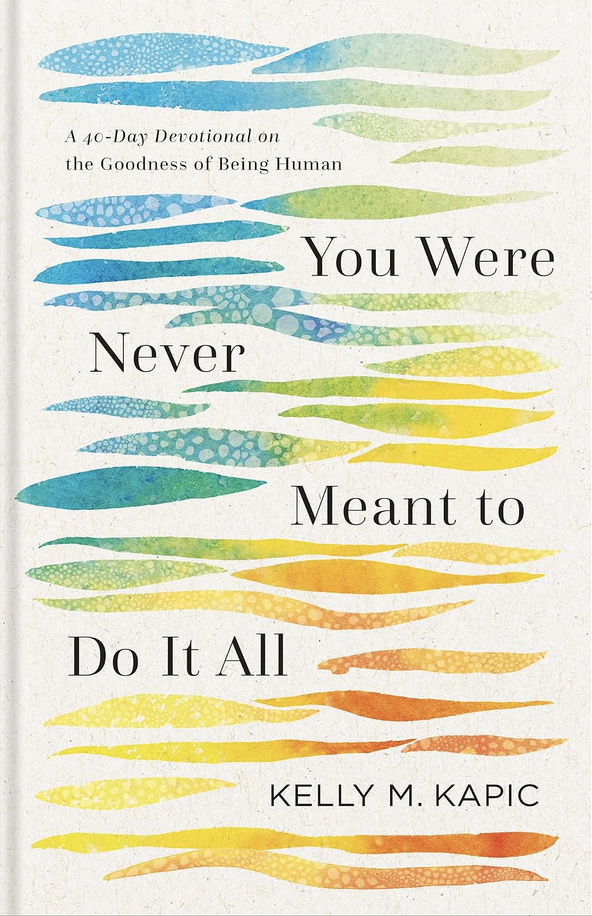
You Were Never Meant to Do It All: A 40-Day Devotional
Are you exhausted, anxious, and sick of feeling like you should always be doing one more thing?
In this 40-day devotional, award-winning author Kelly Kapic helps you embrace the truth that God never intended for you to do it all.
Leave a Reply