
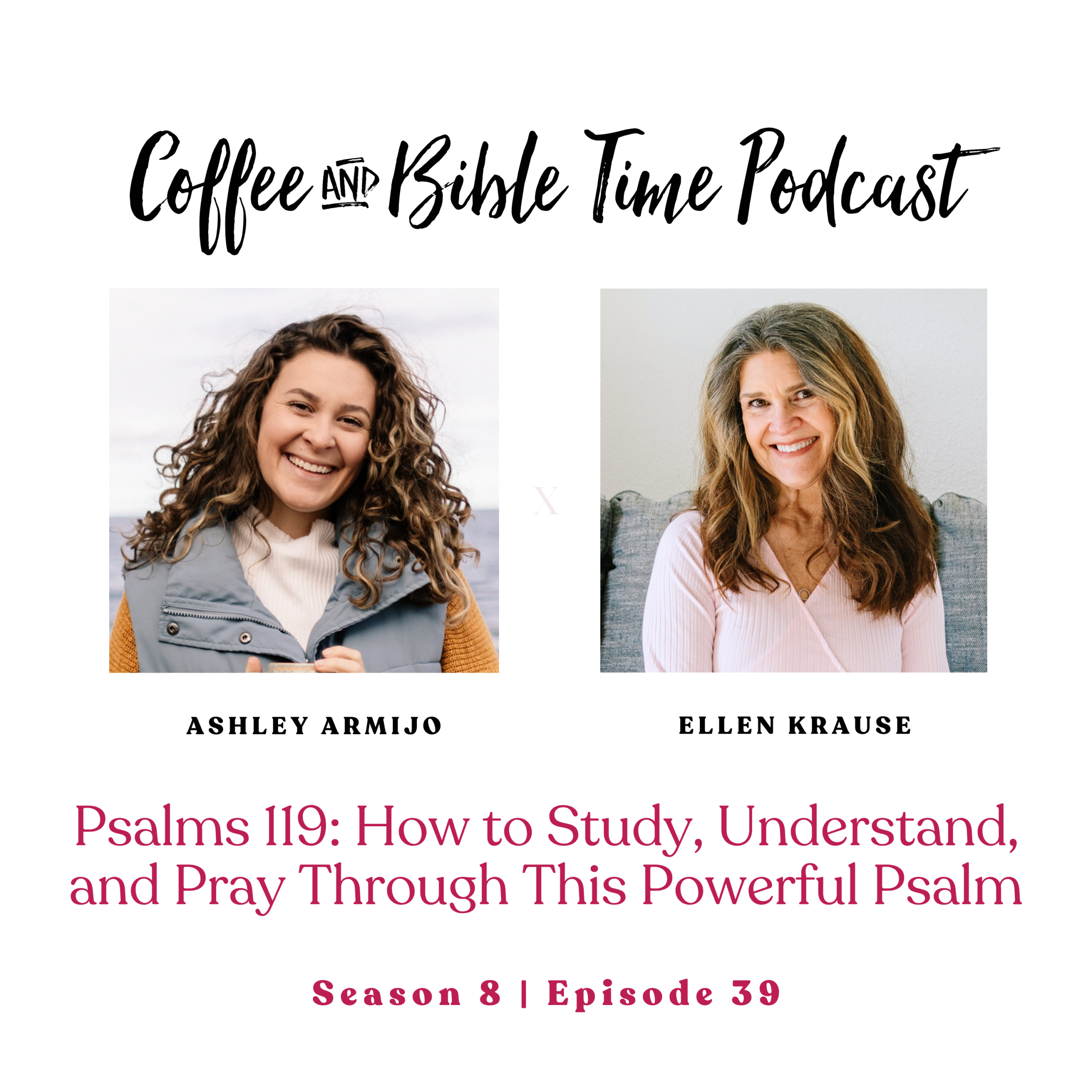

About this episode:
Do you want to grow closer to God…but aren’t sure how to get more from your Bible study?
In this episode, Ellen and Ashley dive into Psalms 119 and explore how studying God’s Word can deepen your relationship with Him.
Whether you’re new to Bible study or looking for a fresh way to engage with Scripture, Psalms 119 offers encouragement to keep showing up, studying God’s Word, and growing in love for Him.
Subscribe & Listen on:
 Apple Podcasts
 Spotify
TIMESTAMPS:
00:00 How to Start Studying the Bible
01:15 Why Psalms 119 Is So Meaningful
03:34 What It Means to Love God Wholeheartedly
05:31 The Main Themes of Psalms 119
07:08 Knowing God Through His Word
11:30 The Eternal Nature of God’s Word
14:42 Laws, Statutes, Testimonies, and Precepts
18:06 How to Create a Psalms 119 Study Binder
20:44 Theme Tracing and Praying Through the Psalms
24:53 How to Study Psalms 119 When It Feels Overwhelming
Ashley Armijo: We want you to be getting into God’s Word yourself. We want you to open it up. We want you to dive into it and highlight and annotate.
If you’re new to it, there might be a little bit of hesitation and fear at the beginning, but don’t let that keep you back. You’ve got to try it, and you’ve got to jump right in, kind of like jumping off the diving board at a pool.
You kind of just have to do it to start. And then once you start doing it, you’ll gain the confidence.
It takes time to learn how to swim. It takes time to learn how to study the Bible as well.
You know what’s beautiful about the Psalm? He’s talking about, “Give me understanding.” So if you’re struggling with understanding, all you have to say is, with the Psalmist, “Lord, I’m confused. Teach me. I don’t understand.” Join the words of the Psalmist and take heart, you know.
Ellen Krause: Welcome back to the Coffee and Bible Time podcast. I’m Ellen, your host, and today I am so excited because we have Ashley, my daughter from Coffee and Bible Time, joining me. Thanks for being here, Ashley.
Ashley Armijo: Thanks for having me on.
Ellen Krause: Well, I’m so excited because we are gonna talk about Psalms 119, which I know has had a special place in your heart for so long.
Why don’t you just start out by telling us why is that the case? What made you fall in love with Psalms 119?
Ashley Armijo: I’m honestly trying to remember when I started really liking it, but I just remember God gave me such a strong love and desire for His Word at a really young age.
And I never knew that there was a whole chapter in the Bible about someone who has a strong love and desire for God’s Word.
When I did discover it—I discovered it years ago, probably at the end of my high school years or maybe, you know, when I was nineteen, around that age.
But I was just blown away that, my gosh, there’s a whole chapter of the Bible that’s about God’s Word. It’s this person who loves God’s Word with his whole heart, and it’s the longest chapter in the entire Bible. And it’s right at the center of God’s Word, like smack dab in the middle of the Bible.
I felt like I was the only person who’s ever discovered it, and I needed to tell the entire world about it. [laughs]
Ellen Krause: [laughs]
Ashley Armijo: So I would be talking about it all the time on Coffee and Bible Time. And it’s just captivated my heart ever since.
It’s my favorite Psalm, and it’s my favorite chapter of the Bible.
Ellen Krause: Aww. And you know what? I have seen how that even has extended into your own life, maybe without you even knowing it, because I’ve seen you talk to Theo, which is my grandson, your son.
He’s two, and I’ve seen you say, “I love you with my whole heart.” That’s one of my favorite phrases in Psalms 119. My whole heart.
Ashley Armijo: Yeah.
Ellen Krause: You know, for someone who doesn’t know about Psalms 119, what does it mean to love God with your whole heart?
Ashley Armijo: I really think that the Psalm shows what it means to love God with your whole heart because the Psalm is—let me look so that I tell you the exact number correctly.
It is 174 verses. 176 verses. And it goes through the entire Hebrew alphabet through an acrostic poem. So each alphabetical word gets eight verses.
So, for example, if we were reading this in English, an acrostic poem would be something like, “Apples are delicious, apricots are tasty, asparagus is incredible.”
But this is a poem about God’s Word, and he starts every verse with the Hebrew alphabet, going like A, A, A, A, A, B, B, B, B, B, C, C, C, C, C, D, D, D, D, D.
And he does the entire alphabet from—our alphabet is A to Z, but he does the entire Hebrew alphabet from beginning to end.
And to me, that shows your whole heart because he’s pretty much saying, in our language, from A to Z, this is how much I love God’s Word. Completely, wholly.
Over and over and over and over again. It’s so repetitive. I love God’s Word wholeheartedly.
Like, I was talking in my teaching session for this course, because we created a Psalms 119 course. I remember in school we had a poetry unit, and we had to do poems that were like ten verses long, and that felt hard. This is 176 verses.
Like, he loved God’s Word. He was up in the middle of the night studying God’s Word. He was talking about it to all his friends. It says he’s wiser than his teachers, than his enemies, than those who’ve lived on this earth double, triple the amount of time as him, and how he’s just immersed himself in God’s Word with his whole heart.
Ellen Krause: Well, Psalms 119 has some additional themes sort of built into that structure. Tell us about some of the other themes as well, and what stood out to you in particular?
Ashley Armijo: Well, first, this is a coffee chat, so I wanna know what you like about Psalms 119.
What stands out to you? When did you first discover it? ‘Cause everyone loves you and wants to know more about you.
Ellen Krause: You’re so sweet, Ashley.
You know, I think Psalms 119, honestly, because I was probably the first time when I read my entire Bible from beginning to end.
And usually the Psalms are fairly short, you know, and then you get to Psalms 119, and you’re thinking, “I’m just gonna read this in one sitting,” and it just keeps on going and going and going.
And so I think for me, it just was part of the reading through the Bible and recognizing, wait a second, this Psalm is different. It’s powerful.
And like you said, it allows us to connect on a very personal level to God. And I think that that’s what I love about it.
And like you said, when we were going through making a course for this and just kind of tracing through, highlighting and annotating, for example, the qualities that we learn about God throughout the Psalm.
And looking at even the Psalmist and how he’s praying, he uses it as a way of interacting with God as well, telling Him, you know, “If I hadn’t had Your law, I would have perished.”
So truly, it’s deep in his heart.
Ashley Armijo: Yeah, and I love that you asked about themes. Like, the biggest theme is God’s Word. That’s like the diamond, the jewel that the Psalmist is looking at and studying and meditating on.
But it would be sad to read this Psalm and to think it’s only about God’s Word. I believe that it points to the heart of God.
The Psalmist doesn’t separate knowing Scripture from knowing the God who speaks through Scripture. And he sees God’s Word as a door to know the heart of God more.
It’s a picture of what it could even look like for us to pursue a relationship with God because we can’t see God physically. We can’t hear Him.
Like, I can’t go to a coffee shop with Jesus and sit down and talk to Him and listen to Him. That would be amazing. I wish I could do that.
But He didn’t just leave us to sit and wonder about Him. He gave us an entire book, huge, Genesis to Revelation, that is from His heart and teaches us about who He is.
He’s the central character of the whole Bible. The biggest theme of the entire Scripture is He is. And so that is what this Psalm is saying: Do you know the God of the Bible? Do you love Him? Do you love His words?
And so I think it’s really important to read it in that light. Because if you only read it in the light of, “God, I have to obey Your rules,” which is important—obedience is important—but if you strip away the relationship with God, then you’re looking at a very legalistic faith of, “No, God, I have to live up to Your perfect standard, and I know I’m gonna fail every time.”
Which the Psalmist does acknowledge. He says, “I need You” over and over again, but he understands that He’s in a relationship with God, a covenant relationship, and the only way he can obey God’s Word is through that relationship with Him.
You can read this Psalm and feel a very heavy burden of, “Oh no, how am I gonna live up to God’s Word?” But I love that the Psalmist is so real, and he talks over and over again: “I can’t. I can’t do it without You. I’m so lost, and I need You, God.”
We can relate to that. All humans can. And we know that we have a God who seeks us and pursues us and helps us obey Him and obey His Word.
I love—I feel like I rediscovered even the last verse of this Psalm when I was studying for the course. But the last verse is 176, and he says, “I have gone astray like a lost sheep.” And then he asks God, “Seek Your servant, for I do not forget Your commandments.”
And so, to me, that sums up the Psalm perfectly of, like, “I’ve gone astray like a lost sheep. I can’t do this. But I know You, God, will seek me. I’m Your servant. I want to follow You. Seek me.”
And then it even points to Christ being our shepherd, of us being His sheep that are prone to wander. And we need Christ to seek us, because we’re so lost.
I love that we see his heart that he really wants to follow God, but he’s struggling. And I think that’s all of us.
Ellen Krause: Yes. I completely agree. It’s very relatable. It’s, you know, not a Pharisee perspective of, “We have to be so perfect,” but yet he’s saying, “I can’t. I can’t.”
Ashley Armijo: Right.
And there is that reality of, to be in God’s presence, He does—He’s holy, and He requires a holy standard from us.
But that’s the beautiful part about reading this Psalm through the lens of Christ and through the lens of His grace for us: We couldn’t live up to the law. We couldn’t accomplish it perfectly, but Christ did that for us.
And so we can rest in that.
Ellen Krause: And that’s how God sees us, right? Our sins have been washed away as far as the east is from the west. And to me, like, that shows the true love of our God. The fact that Christ’s great sacrifice allows God to see me like that.
And that does my heart good, especially knowing, you know, that I’m a sinner.
Ashley Armijo: Yeah.
Ellen Krause: You know, Ash, one of the interesting themes that I pulled out when I was doing my part of the study was the eternal nature of God’s Word.
And I feel like for those of us who do study and delight in God’s Word, that gives us such comfort, security, knowing that God’s Word is eternal. It’s been established forever. It always was and always will be.
How about for you? Does that aspect of God’s Word and His faithfulness stand out to you?
Ashley Armijo: Yeah, that was actually a theme that I had, like, really highlighted in here, especially towards the end of the Psalm. I’ll read a few.
It says, “Your righteousness is righteous forever. Your testimonies are righteous forever.”
And then it says, “Long have I known from Your testimonies that You have founded them forever. The sum of Your Word is truth, and every one of Your righteous rules endures forever.” That’s just a few.
And it gives me peace, for sure. I mean, gosh, our world is shifting and changing, and people’s perspectives on what is true are always changing.
We live in a world where people are defining what truth is, and they define it how they want to define it.
But I like—I find peace in knowing that, okay, this is God’s Word. It’s true. No matter what the world is telling me, I’m gonna always come back to God’s Word.
And it’s been true forever. It will be true forever. That gives my heart peace to know, okay, I’m not basing what I’m believing on shifting sand or on another person’s opinion or on whatever.
I don’t know, I’m just like, it seems so foolish to base my truth on even what a human would say is true because we’re here today, gone tomorrow.
Ellen Krause: Yeah.
Ashley Armijo: Our brains are puny, like, I want to put my trust and my hope in the God of the universe who says this is what’s true.
Yes, it requires faith, but it gives me a lot of peace. And I love the confidence of the Psalmist. He just was like, “This is true, and I believe it, and I’m following it. Period.”
Ellen Krause: Yes, absolutely. And that’s—
Ashley Armijo: Period. This is true.
Ellen Krause: That’s the faith I want to have too. I’m gonna read two verses, 89 and 90, also covers this.
It says, “Forever, O Lord, Your Word is firmly fixed in the heavens. Your faithfulness endures to all generations. You have established the earth, and it stands fast.”
Those would be great verses to memorize, I think—
Ashley Armijo: Yeah.
Ellen Krause: —just when you’re, like you said, when you watch the news and all of a sudden you’re like, feel like everything’s exploding.
Ashley Armijo: My gosh, I know.
Ellen Krause: Like, we can have confidence that God is standing firm.
Ashley Armijo: Yeah, “Your faithfulness enduring to all generations.” Man, I need to, like, get that tattooed on my…somewhere. [laughs]
Ellen Krause: I love that you asked Coffee and Bible Time followers on Instagram and YouTube what questions they had about Psalms 119. And they actually had some great questions.
Ashley Armijo: Yeah.
Ellen Krause: One of them: What is the difference in meaning between all the words used for God’s statutes? Or is there a difference, right? We have laws, statutes, testimonies, precepts, and on and on.
Ashley Armijo: Yes.
Yeah. So we came out with a course, the Psalms 119: How to Grow Closer to God course. And we dive into that in the course, especially in our introduction section.
And the Psalm pretty much—almost every single line of this Psalm mentions a synonym for God’s Word. And they each do have a unique meaning to it.
So, for example, Torah, that really does point to the first five books.
The Pentateuch of the Bible, is the Torah: Genesis, Exodus, Leviticus, Numbers, Deuteronomy. It’s usually translated as “law”.
It refers to more than just legal rules, although, yes, it does refer to God’s legal rules. It can describe a particular command or an entire body of God’s revealed instructions.
When I first started studying this Psalm, I was confused about, is this Psalm only about the law, like the rules? Is it only about Genesis through Deuteronomy? Is it only about, like, the Torah, like I was saying, the first five books of the Bible?
But I think as the years went by, and as I studied it more, I came to realize—and even just reading different scholars’ perspectives on this Psalm.
That Psalms 119, and we talk about this in this course, is like a giant quilt with all these different patches—truth about God’s Word, right?
And so we just said law, Word, judgments, testimonies. All of these are synonyms for God’s Word, and you can zoom in really close and be like, okay, God’s law is Genesis through Deuteronomy. It is His rules, it is His commandments and promises and ways.
But if you zoom out and look at the entire quilt, right, it’s God’s inspired instruction to us. It’s talking about the wholeness of God’s revealed Word to us.
And so for the Psalmist, he obviously did not have the New Testament yet, right? Because he was still living within the Old Testament.
And I’d be curious to know who wrote this and at what time period, right? How much of the Old Testament did he have? For sure, he probably had Genesis through Deuteronomy. But how much more? You know, how many other books of the Bible did he have?
But for us as believers living after the cross, we believe that Genesis through Revelation is the entirety of God’s Scripture.
And so as I read through Psalms 119, I’m thinking about the entirety of the Bible. Like, this is God’s Word, His revelation to us.
And as a whole, all of these—law, Word, judgments, testimonies, commandments, statutes—if you zoom out, they point to a bigger picture of God’s heart towards us, which I had touched upon earlier.
We do get into the definitions of each of those within the workbook that we give, which it is fun to study. What do all these specific synonyms of God’s Word mean? ‘Cause they do all mean something specific as well, which is cool.
Ellen Krause: Yes, yes. I remember when I studied it at one point, I had looked them all up too, because—
Ashley Armijo: Yeah.
Ellen Krause: —I wanted to know as well, like, how are they the same yet different?
Ashley Armijo: Yes.
Ellen Krause: And it does help give you a wholer perspective on how they’re used within the context of the whole Psalm itself.
Okay, let’s talk about what someone else asked, which I thought was super fun. They said, “Do you have any advice on how to organize a Psalms 119 study binder?”
And I love that they asked that because you’ve created a 78-page Bible study that kind of starts them off. Tell us about that.
Ashley Armijo: Yeah, I think they asked that as well because I’ve been showing sneak peeks of it on the YouTube channel, and I will—I will give a tour of it soon on the YouTube channel.
But yes, in the Psalms 119 course, we give you a huge workbook that gets you started on the journey of creating a Psalms 119 binder.
Pretty much, we have a whole introduction, going through all the context of this Psalm, and then going through a detailed four-week study through Psalms 119.
So this is all in the Coffee and Bible Time course, and you would get your highlight guide to get into all the different themes of the Psalm, and you’d be able to pray through the Psalm and journal through the Psalm.
But for me personally, in my binder, not only have the workbook, because I printed it out and put it in mine as well, but I also just have regular notebook paper. And I shared this on the YouTube channel as well.
I’ve, for years, have been just slowly praying through Psalm 119, and I’ll pray through one verse a day.
So I’ll just, you know, right at the top of the notebook page in my binder, let’s say verse 73: “Your hands have made and fashioned me; give me understanding that I may learn your commandments.”
And then I’ll just pray through that. You know, something like, “Thank You, God, for making me and fashioning me and being my Creator and creating me with a heart that can understand You and know You and be like You,” and whatever, right? Whatever God puts on my heart.
So that’s a section in my prayer binder.
I go on to Bible Gateway, and you can print out passages of Scripture, so then I can just highlight and annotate and write notes next to God’s Word. So I have that.
I’ve printed out different sections of commentaries. If a commentary really stands out to me, I’ll just put a little blurb of that within here.
What else? I mean, I just, like, if I’m scouring on the internet and find something that I really like, I’ll just print it out and put it in here if I don’t want to forget it.
Ellen Krause: Love that.
Ashley Armijo: Yeah, it’s just kind of a place where I put all my thoughts and my heart for this Psalm in one place.
And then also theme tracing, which that is something I love to do with Psalms 119. It’s so much fun. And we have this as well in the new course.
But it’s where you specifically study the Psalm and look for one theme. And we give you guys examples of themes you can look at. Like, one is the nature and character of God in the Psalm.
And so what you can do in your binder is spend time just reading through the Psalm and write down all the times you see that theme come up within Psalms 119.
And so I have a list, if you’re watching on YouTube, you can see it. And then from that list you can study, okay, overall, what is God’s character in Psalms 119?
And I created a fun chart. This is how much of a Bible nerd I am. But it was just fun to see, okay, sixteen times in Psalms 119, it talks about God being the giver of life.
Which I was like, wow. I didn’t even, like, just by reading it, I wouldn’t have known that. Twelve times it talks about God being our teacher, eight times Him being Savior, seven times it talks about His steadfast love, six times about how He gives understanding, six times about how He is to be feared.
One thing I think is cool is the most is 171 out of the 176 verses, every time it mentions His Word, it says it’s His Word.
And so I just think that speaks to the beauty of kind of what I was saying earlier about not separating these rules from the heart of God.
‘Cause that’s really what it’s all about.
Ellen Krause: Yes. And I want our listeners to really think about this in terms of Psalms 119. It’s not like, let’s say, getting a thin washcloth wet and you read it once and you’re done.
No, you want it to be like soaking in, like a sponge.
Ashley Armijo: Mm-hmm.
Ellen Krause: You need to take your time, walk through it, look at the themes and pray it back—
Ashley Armijo: Yes.
Ellen Krause: and let it really touch your heart and change—
Ashley Armijo: Yes. And I know someone asked a question. They asked, “How do you pray the Psalms?” And Mom, I know you have great podcasts on that.
Ellen Krause: Yes. We have an entire podcast on praying the Psalms. So I will make sure we include the link in the show notes. And essentially—
Ashley Armijo: We’ll link it. Yeah, yeah.
Ellen Krause: Ashley, you were just—you gave that example of as you read it, God puts things on your heart.
Ashley Armijo: Yes.
Ellen Krause: And what I love about praying through the Psalms is that it gives you things, first of all, it reminds you to be grateful and thankful to God.
Whereas a lot of times when I’m just praying unaided by Scripture, it’ll be all about me, right? Like, can you do this for me today? Can you help me with this or that?
Ashley Armijo: Right.
But instead, I love how it forces me to look at my Creator, to thank Him for whatever I’m reading about in that Psalm, the Creator of the universe, the fact that we are chosen and we are His. There’s so much to be thankful for.
Ashley Armijo: Yeah, and you have—you’ve been praying through the Psalms in your own quiet time, which is cool.
Ellen Krause: Yes. Yes. So yeah, the other podcast that we did was actually with a dear friend of mine, Traci. And she was the one who gave me the book years ago on how to pray through the Psalms.
And so she and I did the podcast together. It was so much fun, where we really walk through, like, how to and examples and stuff. So we’ll definitely link that below.
Ashley Armijo: Yeah.
Ellen Krause: Well, Ashley, as we start to wrap things up here on Psalms 119, what would you say as a word of encouragement for someone who has maybe never read it before, or maybe they’re apprehensive because it’s so long, or they’re worried there’s big words in there they don’t not gonna understand? How would you encourage them?
Ashley Armijo: I would encourage you to, if you’re feeling overwhelmed by it—I mean, I get it, it’s a lot. It’s big. 176 verses.
Take it one verse at a time. Maybe, like, pull out—that’s what I’ve been doing for the last few years—is pulling out one, reading it, and then talking to God about it.
Try to read it with a friend. Grab someone and just read eight verses together and talk about it.
Or you can get our Psalms 119 course, where we walk with you through it step by step. And we kind of hold your hand and teach you, teach you the context, teach you, what do all these big words mean?
Teach you a little bit about the Psalmist and teach you a little bit about the themes.
And then also, we walk with you through the entire Psalm doing the EASY Bible study method. So if you’re looking for something that is a little bit more easy, and you just want to get into God’s Word practically yourself:
E, entering into the story; A, assessing the main idea; S, seeking God and His character; and then Y, yearning for a heart change.
We have that whole method within the workbook and within the course so that you can study this for yourself.
Because I really think that’s the goal of Coffee and Bible Time, as we teach you and as we bring you through courses and bring you through books of the Bible, is that we want you to be getting into God’s Word yourself.
We want you to open it up. We want you to dive into it and highlight and annotate.
And if you’re new to it, there might be a little bit of hesitation and fear at the beginning, but don’t let that keep you back. You’ve got to try it, and you’ve got to jump right in, kind of like jumping off the diving board at a pool.
You kind of just have to do it to start. And then once you start doing it, you’ll gain the confidence.
But it takes time. And it takes time to learn how to swim. It takes time to learn how to study the Bible as well.
But don’t let that keep you from starting. Just do it, right? You’re not gonna understand everything.
Honestly, when I first started reading my Bible, I probably didn’t understand 99%. But God still used the 1%.
And then as the years went by, maybe I understood 2% more, and 3% more. It just takes time.
You know what’s beautiful about the Psalm? He’s talking about, “Give me understanding.”
So if you’re struggling with understanding, all you have to say is, with the Psalmist, “Lord, I’m confused. Teach me. I don’t understand.”
Join the words of the Psalmist and take heart, you know.
Ellen Krause: I would love to hear from our listeners as well. If you’re listening to this or watching it on YouTube, tell us what God put on your heart after reading Psalms 119.
I would love to hear that. You can leave it in the show notes. There’s a link to leave a message.
So, yeah, tell us. Tell us about what you’re learning as well.
Well, thank you, Ashley, so much for joining us. I loved having you on the podcast. What a great joy.
Ashley Armijo: So much fun.
Ellen Krause: For our listeners, thank you so much for being here. I hope you feel encouraged that even if you take a small step today—one verse a day, one of the sections of Psalms 119—just do it. Step into it.
If you have questions, send us a message at info@coffeeandbibletime.com. We would love to help you.
We also have our Psalms 119 course that will walk you through everything from beginning to end. And we would love to go on that journey with you together.
So, all right, everyone. Well, thank you for being here. Have a blessed day, and we’ll see you next time on the Coffee and Bible Time podcast.
If you’ve ever opened your Bible to Psalms 119 and thought…“This is a lot,” you are not alone.
With 176 verses and around 2,445 words (depending on your translation), Psalms 119 is the longest chapter in the Bible.
And for many of us—especially those who are struggling to make time for God’s Word, or new to Bible study—it’s a very intimidating passage.
But ultimately, Psalms 119 is not a long, repetitive chapter to work your way through. It is a beautiful outpouring of love and worship to the God Who makes Himself known through His Word.
As such, it becomes an invitation for us to know God, love His Word, and grow in a deeper relationship with Him, too.
In a recent conversation on the Coffee and Bible Time Podcast, Ellen Krause and Ashley Armijo discussed why Psalms 119 is so meaningful, how to study it, and how it can encourage anyone who wants to grow closer to God.
Why Is Psalms 119 So Important?
For Ashley Armijo, Psalms 119 has held a special place in her heart for years. She remembers discovering it when she was around the end of high school or about nineteen years old.
“I was just blown away that, my gosh, there’s a whole chapter of the Bible that’s about God’s Word,” Ashley explained. “It’s this person who loves God’s Word with his whole heart, and it’s the longest chapter in the entire Bible.”
What makes Psalms 119 particularly unique is its structure.
The Psalm is an acrostic poem that follows the Hebrew alphabet. There are 22 sections, corresponding to the 22 letters of the Hebrew alphabet, with eight verses in each section.
For Ashley, that structure communicates something important about the Psalmist’s love for Scripture.
“He’s pretty much saying, in our language, from A to Z, this is how much I love God’s Word. Completely, wholly.”
Ashley Armijo
Psalms 119 repeatedly connects God’s Word with knowing and loving God Himself—beyond seeing the law as rules to follow, the psalmist sees God’s laws and commands as an extension of His heart.
Psalms 119 Is About More Than God’s Rules
Psalms 119 teaches us that it would be incorrect to view Scripture simply as a list of instructions for how to behave.
“The Psalmist doesn’t separate knowing Scripture from knowing the God who speaks through Scripture.” Ashley explained.
This gives us an important perspective when studying Psalms 119. God’s Word is not merely information. Scripture reveals who God is and invites us into a relationship with Him.
We can’t physically sit down at a coffee shop with Jesus and have a conversation with Him. But God has not left us wondering who He is.
“He gave us an entire book, huge, Genesis to Revelation, that is from His heart and teaches us about who He is.”
Ashley Armijo
That means one practical way to approach Psalms 119 is to ask not only, “What does this verse tell me to do?” but also:
The Many Words for God’s Word in Psalms 119
If you’ve spent much time reading Psalms 119, you’ve probably noticed that the Psalmist uses many different words to describe God’s Word. These include terms such as law, testimonies, precepts, commandments, statutes, judgments, and word.
Ashley explained that these terms have specific meanings, but they can also be understood together as pointing toward God’s revealed Word.
She compared Psalms 119 to “a giant quilt with all these different patches—truth about God’s Word.”
When you zoom in, you can study the individual meanings of words such as Torah, law, statutes, or commandments. But when you zoom out, you see the larger picture: God’s revealed instruction and revelation to His people.
For Christians today, reading Psalms 119 can therefore point us toward the whole of Scripture—from Genesis through Revelation.
Psalms 119 and the Eternal Nature of God’s Word
Another major theme in Psalms 119 is the eternal and unchanging nature of God’s Word.
Ellen highlighted this theme during the conversation, pointing to Psalms 119:89-90:
“Forever, O Lord, your word is firmly fixed in the heavens. Your faithfulness endures to all generations. You have established the earth, and it stands fast.”
These verses can provide tremendous encouragement when everything around us feels uncertain.
Ashley described the peace she finds in knowing that God’s Word does not change with the shifting opinions of the world.
“This is God’s Word. It’s true,” she said. “No matter what the world is telling me, I’m gonna always come back to God’s Word.”
She continued, “And it’s been true forever. It will be true forever.”
Amid the shifting circumstances in our lives and on the world stage, Psalms 119 reminds us that God’s faithfulness is not limited by the powers of the world.
How to Study Psalms 119
If you want to study Psalms 119 but don’t know where to begin, you don’t have to read all 176 verses in one sitting.
Ashley recommends taking it one verse at a time.
“Pull out one [verse], read it, and then talk to God about it.”
Or, pull in a friend to study Psalms 119 with you. Choose one of its sections, read the eight verses together, and discuss what you notice.
Try Theme Tracing in Psalms 119
Another approach to studying the Bible is theme tracing.
Theme tracing means reading through Psalms 119 specifically looking for one particular theme.
For example, you could trace everything the Psalm says about the character of God.
As you read, write down every verse that reveals something about God. Then step back and look at the larger picture.
Ashley created a chart while studying Psalms 119 and discovered how frequently different aspects of God’s character appeared.
She found references to God as the giver of life, teacher, Savior, and the One who gives understanding. She also noted the repeated emphasis on God’s steadfast love.
This type of study helps you slow down and notice things you might miss when simply reading quickly through the chapter.
How to Pray Psalms 119
Psalms 119 is also an excellent passage to pray through.
Instead of just reading the words, let the verses inspire your own prayer. For example, Psalms 119:73 says:
“Your hands have made and fashioned me; give me understanding that I may learn your commandments.”
Ashley described how she might use that verse as a personal prayer, thanking God for creating and forming her and asking Him for understanding.
Praying Scripture can also redirect our attention away from ourselves and toward God.
Ellen explained that when she prays without Scripture, her prayers can easily become focused on her own needs. But praying through the Psalms reminds her to look at her Creator and thank Him for who He is.
As you study Psalms 119, try pausing after each verse or small section and asking, “How can I pray this back to God?”
What If Psalms 119 Feels Overwhelming?
Ashley offered this encouragement to anyone who feels intimidated by the chapter:
“If you’re new to [studying the Bible], there might be a little bit of hesitation and fear at the beginning, but don’t let that keep you back.”
Ashley Armijo
She explained that when she first started reading the Bible, she probably understood only a small portion of what she was reading. But God could still use what she did understand.
“It’s kind of like jumping off the diving board at a pool. You kind of just have to do it to start. And then once you start doing it, you’ll gain the confidence,” she said. “It takes time to learn how to swim. It takes time to learn how to study the Bible as well.”
That is an important reminder: Bible study is a skill that develops over time.
You don’t have to understand everything before you begin. Start with one verse. Ask God to teach you. Write down what you notice. Pray the verse back to Him. Then come back tomorrow and do it again.
A Simple Way to Begin Studying Psalms 119
If you want to start studying Psalms 119 today, try this simple approach:
Ashley summarized the heart of the approach beautifully: “We want you to be getting into God’s Word yourself. We want you to open it up. We want you to dive into it and highlight and annotate.”
Let Psalms 119 Teach You to Love God’s Word
Ultimately, Psalms 119 is an invitation to slow down and develop a deeper love for God’s Word.
It reminds us that Scripture is not simply a collection of rules. God’s Word reveals His character, His faithfulness, His promises, and His heart toward His people.
And when we struggle to understand, Psalms 119 even gives us words to pray: “Give me understanding.”
You don’t need to be an expert Bible student to begin. You don’t need to understand every verse. You simply need to open the Bible and take the next step.
Start with one verse of Psalms 119 today. Read it. Study it. Pray it. Let it sink in.
As Ashley said, “Join the words of the Psalmist and take heart.”
For Further Study
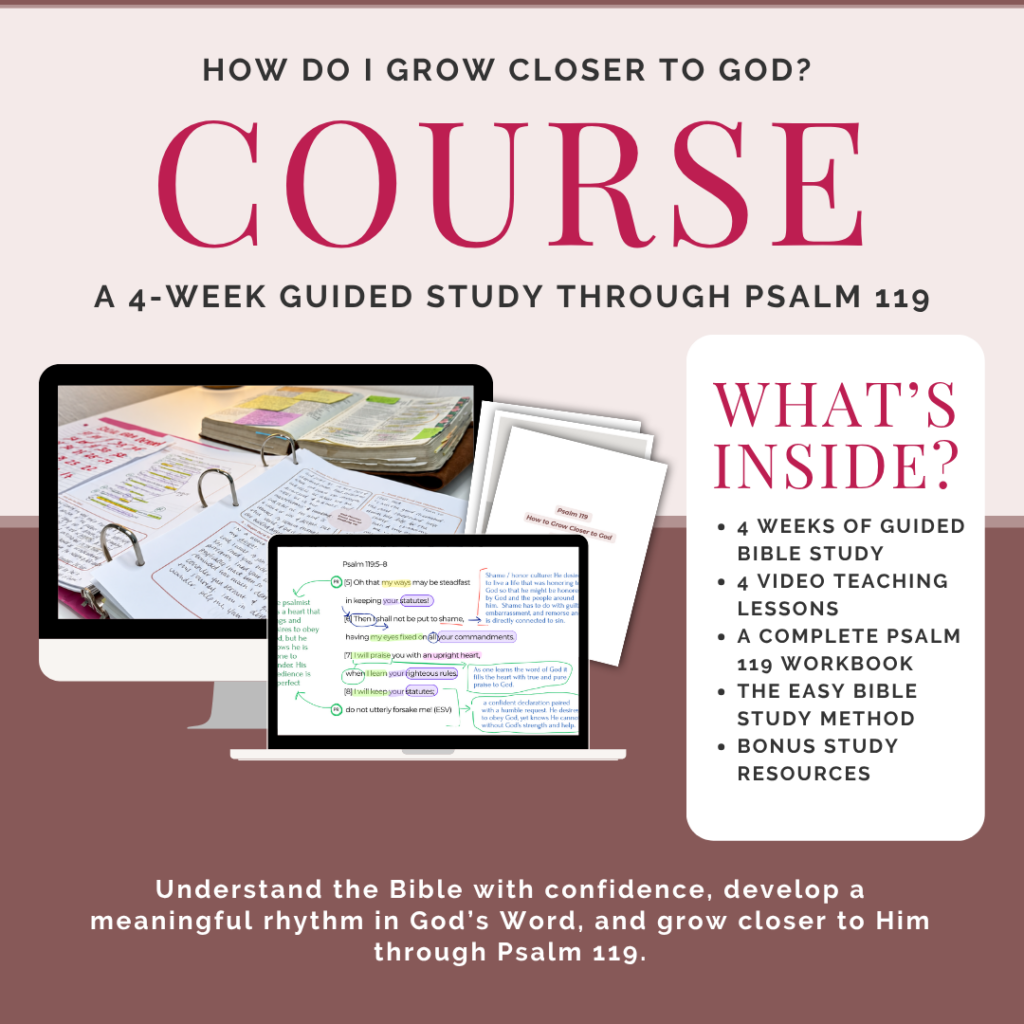
How Do I Grow Closer to God? In-Depth Psalms 119 Course
Do you want to grow closer to God but aren’t quite sure where to begin?
This course is a 4-week Bible study designed to help you slow down, dig deeply into Scripture, and strengthen your relationship with God.
Rather than simply reading Psalm 119, you’ll study the entire Psalm using the EASY Bible Study Method and learn practical tools you can continue using in your own Bible study.
Leave a Reply