
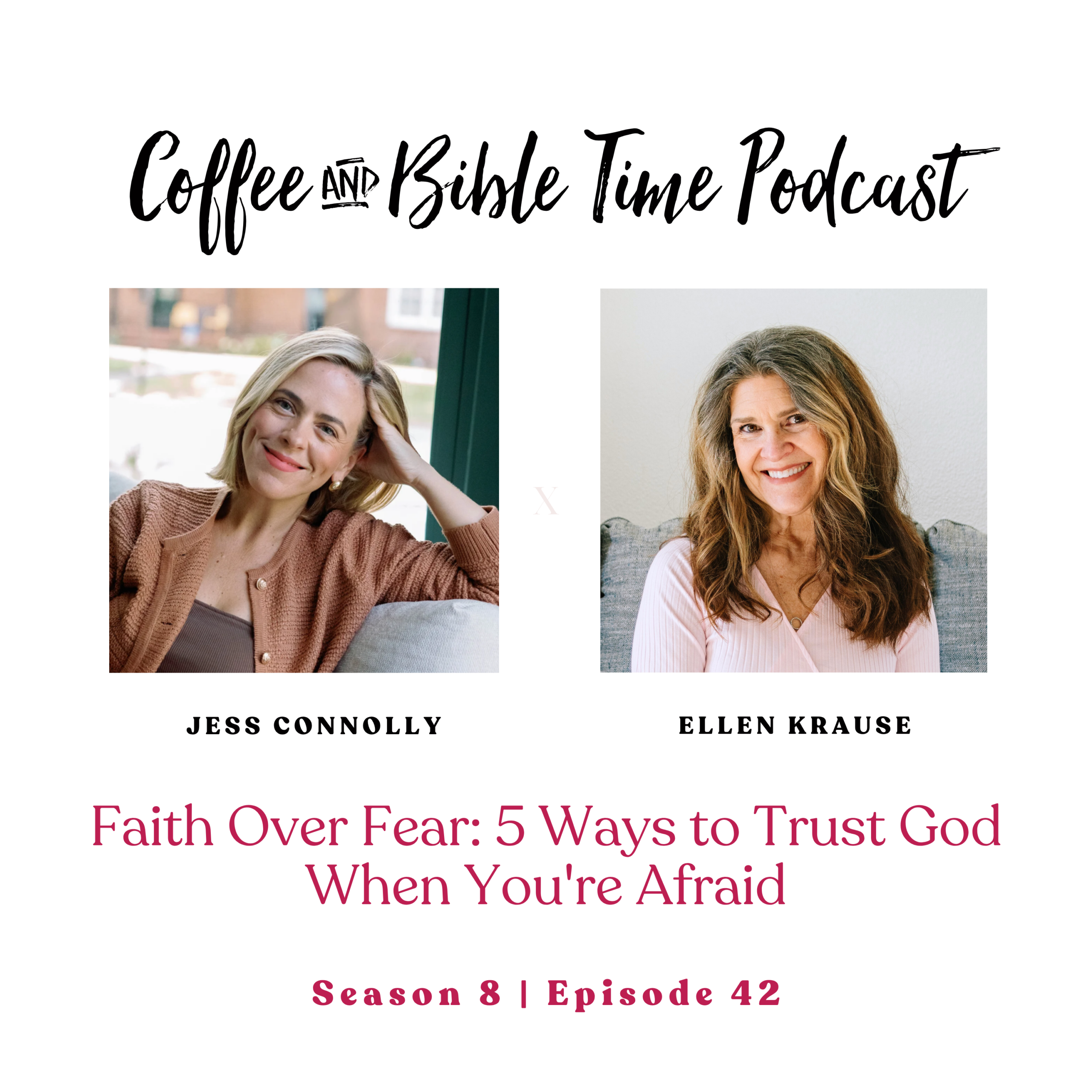

About this episode:
You don’t have to stop feeling scared before making a faithful choice.
Learn how to stop letting fear call the shots and find courage in God’s presence, even when life feels overwhelming. Join Ellen Krause and guest Jess Connolly to choose faith over fear.

 Apple Podcasts
 Spotify
TIMESTAMPS:
00:00 Can You Be Afraid and Courageous at the Same Time?
02:16 Jess Connolly’s Journey Through Anxiety and Fear
04:27 Feeling Fear vs. Obeying Fear
06:38 What Scripture Teaches About Facing Fear
10:14 Recognizing Fear in Your Daily Decisions
12:04 How to Name Your Fears
14:33 The Fear of Man vs. the Fear of God
18:47 Growing in Awe of God
20:18 Practical Advice to Find God’s Peace in Anxiety
22:40 Closing Encouragement & Bible Study Tools
Jess Connolly: Oftentimes, we do think of fear as this binary switch: you’re either afraid or you’re brave. You’re either scared or you’re courageous.
And what’s true in the kingdom, what’s true physiologically, what’s true biblically, is that those two things happen simultaneously a lot more than we’d like.
We can actually be experiencing fear and experiencing faith at the same time. They’re not mutually exclusive.
Ellen Krause: Welcome back to the Coffee and Bible Time podcast. I’m Ellen, your host.
Fear is something that so many of us deal with on a daily basis. We wake up anxious or lie awake at night worrying about situations that are beyond our control, and that worry can feel all-consuming.
But what if there’s another way? What if we don’t actually have to obey our fear?
Well, that’s what we’re talking about today. And I’m especially excited for this conversation because our guest has walked this road personally and spent years helping women grow in courage, knowledge of God, and spiritual health.
Jess Connolly is an author, speaker, church planter, and the host of the Jess Connolly Podcast. She and her husband, Nick, planted Bright City Church in Charleston, South Carolina, where they’re raising their four kids.
Jess, welcome to the podcast!
Jess Connolly: Thank you so much for having me. It’s a joy to be here.
Ellen Krause: Well, I’m so glad that you’ve joined us.
You know, we talk a lot about fear, but one thing that we don’t really talk about is bravery.
How about for you personally, Jess? Can you tell us a little bit more about your own story and what that’s looked like in your life?
Jess Connolly: Yeah, absolutely. Well, I lived with fear kind of on the surface of my life. I was just the kind of girl who would start crying or my hands would start shaking. I would have a very visceral response to fear.
But I started struggling with anxiety, and it really kind of cemented and solidified in the post-pandemic season.
I felt like, as a believer and as a Christian leader, I needed to have a better handle on this. I needed to have the right answers for it. I just needed to trust God. I just needed to pray through it.
Because I couldn’t process it, my body was experiencing it and internalizing it in a really profound way. And so I began struggling with pretty debilitating anxiety for a season.
I also felt a lot of shame about it, so I didn’t know how to talk about it, and I didn’t know how to kind of let it hit the air.
Truly, honestly, I would say a lot of my passion to study this and understand it came when I saw other people in my life that I really love struggling with anxiety—people that I knew were incredibly faithful, people that I knew really trusted the Lord, and people that I knew really spent time in the presence of God.
It was only once people would come around those people that I loved and maybe start to hand them platitudes or say, “Well, have you tried praying this verse? Have you tried reading this, or have you tried doing this?”
And I would look and be like, “They’re doing everything. They’re doing everything they can do.” So there’s got to be something more here.
Once I began really to start to name my fears out loud, to trace them, to track them, and to ask what courage would look like in the face of them, that’s when I started to see a path out of the debilitating sense of “I can’t help what’s happening to me.”
I started to see my fear as a formation place, that God wasn’t necessarily trying to rid me of fear, that He wasn’t waiting for me to be a fearless believer, but that He wanted to use my fear as a place to incite supernatural trust in me and to call courage out of me.
Ellen Krause: You know, Jess, you mentioned the pandemic, and I feel like that was a time when I started to see fear in people that I didn’t even know had fear.
Jess Connolly: Totally.
Ellen Krause: And I think that helped others of us understand that, you know what, a lot of people have various fears and anxieties of different kinds.
Jess Connolly: Yeah.
Ellen Krause: You know, Jess, you distinguish between feeling fear and being obedient to that fear. What does it look like to experience fear versus actually being controlled by it?
Jess Connolly: Now that we’re already talking about it, Ellen, I’ll stick with the pandemic example because I feel like that’s actually a really helpful example.
I think a lot of times when we think about this idea of obeying fear, we might see it one particular way. Like, well, if you’re scared of something, then you would immediately maybe run away from it, and that would be obeying fear.
But what’s interesting is that I think obeying fear can almost look courageous sometimes.
So what we may have even seen, if we look back at the pandemic, is people who were actually very scared—scared about the world around them, scared about what was happening, scared about what was happening in their communities.
And maybe they didn’t even look like they were scared. But maybe that unexpressed or unprocessed fear might have started to look like pride, or even anger, or even extreme self-assuredness.
Because sometimes we’re so scared of our fear that we don’t even want to name it, and so it shows up in different ways. That can be one way we begin to obey fear.
I would say that the distinction for me between naming and processing our fear and obeying it is that we can’t look at just what it looks like from the outside, because it can look a variety of different ways.
Some person can be obeying their fear and look very wise. They can look really patient. They can almost even look content sometimes, and maybe, truly, they’re just obeying a fear that’s keeping them from going, you know.
And then sometimes somebody could be obeying a fear and they might look loud or frustrated, you know, or timid. It could look like a variety of different things.
I think the distinction between processing our fear and obeying our fear is this: Are we naming it with the Lord? Are we asking Him where that fear came from? Are we asking what courage might look like in the face of that fear?
And the great thing about that process is that it’s individual to each of us, and it’s actually incredibly enjoyable to explore that with the Lord.
It sounds terrifying, but when we remember that He’s a good Father and He’s a good Shepherd, it can actually be a really enjoyable process.
Ellen Krause: Yes, absolutely. And Jesus Himself in the Bible was an excellent role model of how we’re to respond.
What can we learn from the way that Jesus responded to His disciples when they were afraid?
Jess Connolly: What we see in the New Testament is that Jesus actually asked way more questions than He answered.
I believe one reason He did that is because He used questions as a form of formation, asking things like, “Do you know what you think about this? Who do you say that I am? What is it that you want?”
He would ask those questions so the person He was with, often His disciples, could process where they were at and where they wanted to be.
And so what we see Him do with the disciples very often is ask, “Why are you scared? Why do you have little faith?”
What’s really beautiful and interesting when we look at this pathway Jesus used for formation through asking questions is that if we read those biblical stories through a lens of shame, we might hear them and think He’s immediately rebuking His disciples, saying, “Why are you scared? What’s wrong with you? Why are you scared, Peter, that you are drowning out here in the middle of the water?”
But when we shake our heads a little bit and remember that Jesus doesn’t ever use shame as a tool, that He loved His disciples, and that they were His friends, we can see it differently.
Actually, when we study the original Greek, it distinguishes when Jesus rebukes and when He’s just speaking. In the Greek, every time Jesus would ask His disciples about their fear, He was just speaking. He was speaking conversationally to them.
Taking the example of Peter when he’s drowning in the water, after he’s started to walk out to Jesus, Jesus says to him, “Peter, why are you so scared?”
What I think is so beautiful is that when we look at it again, not through a lens of shame but through a lens of remembering that Jesus had come to die and save His friends, to rescue them for eternal and abundant life, we see things differently.
If He’s looking at Peter, who’s facing a very real threat of drowning and losing his life, it’s very rare that we would imagine Jesus would be shaming him for that.
Jesus never asked anyone to pretend that life and death didn’t matter. In fact, He loved us so much that He came to die for us, to purchase us with His life.
All that being said, I think what we learn from the way Jesus interacted with His friends is that He asked them to process their fear. He asked them to name it, and He sat with them while they did it. Oftentimes, He rescued them as they did it.
Giving that example of Jesus and Peter, He actually grabs him so he doesn’t drown. He saves him first, and then He does the processing with him.
I think Jesus was really curious about His disciples’ fear, and I think He wanted them to process it because that’s where the formation came in.
Ellen Krause: Absolutely. And, you know, I can remember even my dad saying, “Well, what is it that you’re afraid of?”
Jess Connolly: Yeah.
Ellen Krause: And forcing me to look internally to try to identify what exactly it is, and then perhaps having him help me understand that I didn’t need to be afraid because of God, who’s bigger than, you know, every possible fear that I could have.
Jess Connolly: Absolutely, absolutely. And what’s so beautiful is, you know, this concept is kind of wrapped up in the title of the book, You Can’t Be Brave Until You’re Scared.
Because I think oftentimes we do think of fear as this binary switch: you’re either afraid or you’re brave. You’re either scared or you’re courageous.
And what’s true in the kingdom, what’s true physiologically, what’s true biblically, is that those two things happen simultaneously a lot more than we’d like.
We can actually be experiencing fear and experiencing faith at the same time. They’re not mutually exclusive.
Ellen Krause: Yes, so true. Well, let’s talk a little bit about fear in daily life.
One of the things that makes fear so tricky is that it’s not always obvious, and it can actually be a subtle motivating factor for decisions that we make.
How can we start to discern what’s really happening in our hearts?
Jess Connolly: You know, a lot of times, I like to ask the question, “Who am I honoring here? Who is getting the honor here? Who is getting the reverence here?”
And a lot of times, if I’m honest, something that might look wise, or something that might even look thoughtful, might actually be motivated more by me giving reverence to my preference, or me giving reverence to my comfort, or even me giving reverence to other people through the means of people-pleasing.
But again, at the same time, sometimes something might look the same from the outside, but in my heart, I might be giving wild reverence to the Lord, you know? I might be truly deciding that it’s His voice I want to obey.
And I love that you’re asking such thoughtful questions, Ellen. I think it’s interesting that we keep going back to this idea.
The crazy part is that we don’t get to dictate what this looks like for anybody else from the outside.
We don’t get to look at anybody else’s life and say, “Look, they’re so courageous,” or, “Look, they’re so wise.”
And that doesn’t mean that we shouldn’t honor and speak life over people. But oftentimes, it is more of an internal barometer, and it does take a lot more internal checks that we have to process with the Lord.
Ellen Krause: You know, one of the internal checks that we do is assessing what the fear is. And you’ve sort of come up with this phrase, “Naming it is 90%,” and you use that a lot, right, when you’re counseling and discipling women.
Jess Connolly: Yeah, yeah.
Ellen Krause: Why is there so much power in actually naming our fears?
Jess Connolly: Yeah, good question. I think there’s a ton of power in it, precisely because what we won’t name, we can’t see healed. And we’ll continually repeat what we don’t repair.
It would be wild for us to constantly hope that God will bring us into courage or bring bravery to us if we’re just not really willing to share with Him what our fear is.
But what’s so powerful about naming it is that I think a lot of us can’t even imagine the jump to processing our fear with the Lord, because we just couldn’t imagine saying it out loud.
We couldn’t imagine saying it out loud, to even ourselves or writing it in our journals.
And so the process is incredibly transformative just to purely name what we’re scared about and to do it without a lens of shame, to do it without condemnation for ourselves. That’s the main reason why.
But I would say a follow-up reason why it’s so transformative is that oftentimes, once we name our fear, and if we can do it without shame or condemnation, we get to discern: Do I want to keep obeying this fear? Do I want to keep listening to it?
Once we’ve named it, we have a little bit more discernment to make that decision with our life.
Ellen Krause: So true. And that includes prayer, because I know for me, just even writing down the fears, talking to God about it, and asking the Lord to help you with whatever particular fear it is.
If someone’s listening to this and realizing that they have a whole list of fears, maybe ones they’ve never really admitted to, where do they start? What do they do?
Jess Connolly: So this actually sounds really simple, but I’ll tell you, it takes guts to even do. I would highly suggest starting with physically writing it down.
Maybe take a blank sheet of paper and just say, “For three to five minutes, I’m gonna write down every single thing I can think of that I’m scared of.”
That’s it. I’m gonna just write it down. I’m not gonna try to answer it. I’m not gonna edit myself. I’m not gonna try to fix it. I’m not gonna try to write a Bible verse beside it. I’m just gonna name it.
And then my second encouragement for them is, after they do that experiment for the first time, I would say take a deep breath and then do it one more time.
Because oftentimes, we aren’t even totally willing and ready to be honest with our fears the first time we write them down. It takes a second shot. And so I would say that could be a great follow-up thing to do.
And then from there, we get to do exactly what you said, Ellen. We get to take that list to the Lord.
Ellen Krause: You know, for me, and I think for a lot of people, the fear of man, so to speak, as it’s referenced so many times in the Bible, my fear of man can be greater than my fear of God.
Help our listeners understand the difference between the two. I remember learning this when I was a younger Christian, but it was so impactful for me.
For someone maybe who doesn’t understand, can you kind of dissect that?
Jess Connolly: Yeah. Specifically, what the fear of man is?
Ellen Krause: Yes, fear of man versus the fear of God.
Jess Connolly: Versus the fear of God. Amazing, incredible. Yeah.
Well, to be totally fair, anyone who’s listening, even those of us who maybe grew up in the church and are really familiar with those phrases, I think sometimes we can get hypnotized by the complexity of both.
Ellen Krause: Yes.
Jess Connolly: We can get so familiar with the phrases that we don’t know what they mean anymore.
So fear of man is essentially this: it is having an incorrectly ordered awe. It’s having more awe or more reverence for humans than we do for God.
Anytime we want someone’s approval or their love or even their acceptance more than we want what we already have from God in those same areas, that would be the fear of man.
On the flip side, fear of God is essentially just rightly ordered awe. It’s having an understanding of a worldview that places Him as supreme and as prime at the center of our universe.
Now, what’s really helpful for most of us to note is that, especially for most Christians, we have something that is a formal theology and then we have a functional theology.
Our formal theology is what we say we believe, what we all agree about on paper.
Most of us would be sitting here having our coffee and say, “Totally, God should be at the center of everything. We should revere God the most. Yes, we’ll rightly order it all. We’re not gonna worship people. We would never worship people.”
That’s our formal theology.
Our functional theology, however, is very different. Because very often, we will wake up and order our entire day around pleasing other people and getting their approval.
We may even do it under the banner of love, under the banner of service, and under the banner of leadership.
And so, again, it becomes one of those conversations of, do we have ruthless honesty about what’s going on internally? Is our heart and our mind, and what’s happening in our souls, all of that exposed to Him and His capacity to speak into it?
Ellen Krause: That’s so deep. And I think about the fear of man that comes into play.
I’m thinking actually of Peter, you know, before the rooster crows, “Three times you will deny me.”
I mean, you can have the strongest convictions about believing that you love God, and yet this fear of man can become almost incapacitating.
Jess Connolly: Totally.
How have you seen some of the people that you’ve counseled go from understanding the fear of man to allowing it to take its seat, so to speak? How have you seen that transformation happen?
Jess Connolly: Totally. I think for most of us, it really does start with paying attention to our own habits and the spaces where our fear of man creeps in, and then just holding it up to the Lord and confessing it.
Again, I don’t think it’s always, always, always as simple as “naming it is 90%.” But we do hear a story like Peter’s, and we look at him, you know, just so ensorcelled by this fear of man, in such a chokehold.
And it’s so confusing because, you know, chapters before, he’s just going to continually declare Jesus as Lord and say, “I’ll never leave You. I’d never go anywhere.”
Ellen Krause: Yes.
Jess Connolly: And we think, like, how could he?
But for all of us, in our hearts and in our days and in our time and in the way that we spend our money, it is so easy for us to continually place our allegiance with people and with their approval.
And so I think it starts with kind of a real Psalm 139 look at ourselves to say, “Lord, search me and know me. Find any wicked way in me. Give me eyes to see where fear of man has a stronghold in my life.
Let me not pretend that I could never struggle with this like our friend Peter, but instead, show me where I have a preference for the approval of humans more than the intimacy that I have with You.”
Ellen Krause: And then what would you say to helping someone grow in the awe of God?
Jess Connolly: Mm, such a good question. I love this question.
If we’re looking to grow in the awe of God, which is also an incredible way to get free of the fear of man, we could probably spend the rest of our lives waking up every day and saying, “Okay, I don’t want to fear people anymore. I don’t want to fear people anymore.”
But if we don’t have something to replace that with, we might never see growth. And so we absolutely want to replace our fear of man with a rightly ordered awe of God, a holy fear of God.
Some ways that we can increase reverence or awe in our lives:
Number one, when we sense ourselves being caught up in a moment, caught up in worship, or even caught up in His Word, don’t immediately rush past that.
For many of us, when we start to feel this overwhelming sense of, “He’s near,” or, “He’s moving,” or, “He’s speaking,” or, “I’m sensing His presence,” we shut it down very quickly because it makes us nervous.
So we could just linger in God’s presence and linger in awe.
I often encourage people to get their somatic experience involved, to get their bodies involved in worshiping God and in prayer.
Go on a prayer walk. Find yourselves on your knees if you’re in a worship service. Just get your body involved to come into a posture of reverence, truly, and come into agreement with what’s happening there.
Spending time in nature, spending time in silence—all of those things are incredible ways that we can increase our awe of God.
Ellen Krause: Absolutely. And I love worship music. I just love the invitation into that worship experience, doing that.
Jess Connolly: Yeah.
Ellen Krause: What does this look like in ordinary life for someone who’s, let’s say, sitting in their car, anxious about something? How does holy awe meet them in that place?
Jess Connolly: So good. I love this incredibly practical question.
Let’s say you’re driving in your car and you’re kind of working through your day and everything that’s coming up.
Maybe you’re thinking about some forms you’ve got to fill out for your kids, or that friend you didn’t reach out to who’s going through a hard time, or, “My gosh, I’ve got to get all the laundry done before we go on that trip next week.”
One thing that you can immediately work on doing is stopping that pattern of ruminating.
To interrupt that pattern of ruminating, what you could actually do, rather than pretending like all of that doesn’t matter to you, is start talking to the Lord about it.
You could start saying, “God, I feel overwhelmed. Lord, I feel overwhelmed with the laundry and the forms.
And hold on, I’m realizing I’m feeling some shame about not reaching out to that friend. Can I just pray right now as I drive, talk to You about her, and ask You to intercede on her behalf?”
Again, that is such a great question because this is a great example of where our fear becomes not our failure from faith, but the formation place of our intimate trust with Jesus.
Ellen Krause: Yes, and the recognition that we can take action as well. It’s leading us to a place, like you said, of maybe reaching out to someone or inviting them into that process as well.
Jess Connolly: Yeah.
Ellen Krause: One thing in the book, Jess, that I thought you were so vulnerable about regarding this fear of man is the experience of being a pastor’s wife, which my daughter is as well.
There’s just a lot of anxiety that can go along with that, feeling like you have expectations that you have to live up to. And I just love how vulnerable you were.
You’ve written an amazing book called You Can’t Be Brave Until You’re Scared, and I just wanted to share that one example of something that people could read in there and see how you’ve gone through that process and how you came out the other side as well. It was so encouraging to me.
Jess Connolly: So grateful. Thank you for that.
Ellen Krause: Well, as we start to close up here, I want to end with the woman who’s listening right now and maybe is just feeling exhausted, carrying all of her fears. What do you want her to hear today from this conversation?
Jess Connolly: The first thing I want her to hear is:
You are exhausted because this is an exhausting world. And you are scared because this is a terrifying world.
I do not believe that your friend and Savior, Jesus, would shame you for your fatigue or for your fear, but I do believe He wants to meet you in it, to bring supernatural courage and bravery, and also supernatural rest and shalom, maybe where you least expect it.
Ellen Krause: Absolutely. Because it’s walking through some of those darkest tunnels and then later looking back and seeing how God has miraculously worked in helping you get through it that is shaping who you’re becoming.
Jess Connolly: Yes.
Ellen Krause: I love that God can work even in our fears.
Well, Jess, tell our listeners where they can go to learn more about you and this topic of tackling your fear with the help of God.
Jess Connolly: I am Jess A. Connolly on social media, and you can find my book, You Can’t Be Brave Until You’re Scared, on Amazon or anywhere you buy books. My website is JessConnolly.com.
Ellen Krause: Well, we will make sure we include those links in our show notes for sure.
Before I let you go, I need to ask you our favorite rapid-fire questions here. Little tips for our listeners. What is your go-to Bible, and what translation is it?
Jess Connolly: I have a wide-margin NIV Bible, and I love the wide margins because I like to take a lot of notes.
Ellen Krause: Okay. Well, that leads me into the second question, then. Do you have any favorite Bible journaling supplies that you like to use?
Jess Connolly: I do like to take notes in the margin, but I also really enjoy using the Goodnotes app on my iPad.
Oftentimes, I’ll get Scripture from the YouVersion app on my iPad, research things online, and put little notes in there as well.
Ellen Krause: Mmm, that’s a great tool. Okay, last one, then. What is your favorite app or website for Bible study tools?
Jess Connolly: There is a new app that some very close friends of mine actually developed called Five Loaves. It is an incredible Bible study tool, and it has been changing the way I study the Word for the last year.
Ellen Krause: Ooh, that’s so exciting! Okay, we will make sure we include a link in our notes for that as well. We need to take a look at that. That’s so fun!
Jess, thank you so much for being here, for sharing your authentic story, and for wanting to be so encouraging to other people.
Jess Connolly: Thank you so much for having me. It was a joy to be on the podcast today.
Ellen Krause: You’re most welcome. And to our listeners, whatever you’re facing today, I hope you remember that being afraid doesn’t mean that we’re failing God, and that fear doesn’t have to be the thing that’s calling the shots in our lives.
I know that, for me personally, I am walking away from this conversation encouraged to bring my fears into the light and fix my eyes on Jesus.
Well, thank you so much for joining us, and we’ll see you all next time on the Coffee and Bible Time podcast. Have a blessed day.
Choosing Faith Over Fear In A Broken World
In the world we live in, fear is a part of everyday life. But it doesn’t have to control us.
But let’s not sugarcoat it: there’s lots to worry about. We live in a broken world, and even our own lives and minds often feel out of control…let alone world events and a future beyond our limited sight.
As Christians, we may feel guilty when we experience fear. Shouldn’t we trust God more? Does feeling afraid mean our faith is weak?
Yes, we can choose faith over fear: but that choice doesn’t mean you never feel afraid. It means learning to trust God in the middle of your fear instead of letting fear control your life.
In this conversation on the Coffee and Bible Time Podcast, author and pastor Jess Connolly shared a reframing truth: God doesn’t require us to become fearless before He can work in our lives.
Let’s explore what it means to live by faith over fear, what the Bible teaches us about fear, and practical ways to respond when fear feels overwhelming.
What Does Faith Over Fear Really Mean?
It’s easy to think of fear and faith as opposites.
We might assume that in any given moment, we’re either afraid or brave, scared or courageous. But the Christian life isn’t that simple.
During her conversation with Ellen Krause, Jess Connolly explained:
“What’s true in the kingdom, what’s true physiologically, what’s true biblically, is that those two things happen simultaneously a lot more than we’d like. We can actually be experiencing fear and experiencing faith at the same time. They’re not mutually exclusive.”
Faith over fear doesn’t mean the absence of fear. It means choosing to act out of trust in God, even when we feel afraid.
The Bible never promises that believers will live without frightening circumstances or difficult emotions. Instead, Scripture repeatedly invites us to turn toward God when we’re afraid.
Psalm 56:3 says:
“When I am afraid, I put my trust in you.”
Psalm 56:3 (NIV)
Notice what the psalmist says: when I am afraid. And the response is to place our trust in God.
We don’t have to deny our feelings, hide our struggles, or wait until we feel brave enough to approach God. We can come to Him honestly, trusting that He will meet us where we are.
Does Being Afraid Mean You Have Weak Faith?
Christians may wonder why they still struggle with anxiety when they pray, read their Bibles, and believe God’s promises.
But consider the disciples. In Matthew 14:28–31, Peter stepped out of the boat and walked toward Jesus on the water.
When Peter became frightened by the wind, he began to sink and cried out for the Lord to save him.
Jesus immediately reached out His hand and caught him.
Before anything else, Jesus rescued Peter—and then addressed his fear. He didn’t leave Peter to drown because his faith faltered.
When fear rises in your own life, remember that you can reach for Jesus just as Peter did. You don’t have to get everything right before you ask for help.
Stop Letting Fear Control Your Decisions
There’s an important difference between experiencing fear and obeying fear.
Fear becomes especially influential when it begins making our decisions for us. We might avoid opportunities because we’re afraid of failure, remain silent because we’re afraid of rejection, or refuse to take a necessary step because we cannot guarantee the outcome.
But fear doesn’t always look like fear from the outside.
Jess explained that unprocessed fear can sometimes appear as pride, anger, or extreme self-assuredness. At other times, it can look like patience, wisdom, or contentment.
This is why learning to recognize fear requires honest self-reflection.
Jess suggested asking:
“Who am I honoring here? Who is getting the honor here?”
This question can help us examine what’s motivating our choices.
We can ask God to help us respond with wisdom, love, and courage rather than allowing fear to have the final word.
The Fear of Man vs. the Fear of God
A phrase that comes up repeatedly in Scripture is the fear of man.
Proverbs 29:25 says:
“Fear of man will prove to be a snare, but whoever trusts in the LORD is kept safe.”
In Galatians 1:10, Paul writes:
“Am I now trying to win the approval of human beings, or of God? Or am I trying to please people? If I were still trying to please people, I would not be a servant of Christ.”
The fear of man occurs when we give other people’s opinions, approval, or acceptance more importance than they deserve.
Jess described the fear of man as having an incorrectly ordered sense of awe or reverence.
In contrast, the fear of God means having a rightly ordered understanding of who God is and placing Him at the center of our lives.
This distinction matters because we cannot overcome people-pleasing simply by repeatedly telling ourselves to stop caring what others think. We need something greater to shape our hearts.
When our understanding of God’s character grows, we can become more secure in His love and less dependent on the approval of others.
Galatians 1:10 challenges us to consider whom we are seeking to please: people or God.
Ask yourself:
These questions aren’t meant to condemn us. They’re invitations to bring our motives into the light and allow God to shape us.
How to Choose Faith Over Fear in Everyday Life
Understanding faith over fear is important, but what does it look like when you’re sitting in your car feeling anxious, lying awake worrying about the future, or trying to manage a hundred responsibilities?
Jess offered several practical ways to begin.
1. Name Your Fears Honestly
Jess shared a powerful principle:
“What we won’t name, we can’t see healed.”
Jess Connolly
We cannot begin to address fears we’re unwilling to acknowledge.
So start by setting aside a few minutes to write down everything you’re afraid of.
Don’t try to fix your fears as you write. Don’t judge yourself for having them. Simply name them.
The purpose isn’t to dwell on your fears. It’s to bring them into the light so you can begin responding to them with honesty and prayer.
2. Bring Your Fears to God in Prayer
Once you’ve identified your fears, talk to God about them.
You don’t have to use perfect words or pretend to feel peaceful. You can tell God exactly what’s troubling you.
Prayer doesn’t require you to pretend that your responsibilities don’t matter. It gives you an opportunity to bring them into your relationship with God.
3. Ask God What Courage Looks Like
Jess explained that she began to see her fear as a place where God could develop her trust and call courage out of her.
This shifts the question from How can I get rid of this fear? to How can I respond faithfully while I’m experiencing it?
Perhaps courage means having a difficult conversation, asking for help, taking a responsible next step, or choosing not to seek everyone’s approval.
The next faithful step may be small, but it still matters.
4. Learn to Linger in God’s Presence
Jess also encouraged listeners to cultivate a greater sense of awe and reverence for God.
When fear dominates our attention, it’s easy to become consumed by everything that might go wrong. Intentionally making space for God helps us redirect our attention toward His character and truth.
Try spending time in worship, prayer, nature, and silence rather than immediately rushing past moments when we become aware of God’s presence.
These practices don’t guarantee that fear will disappear. Instead, they help create space to remember who God is and bring our concerns into His presence.
5. Take the Next Faithful Step
Finally, remember that trusting God and taking action can work together.
Faith doesn’t require passivity. Sometimes prayer helps us recognize the next practical step we need to take.
If you’re anxious about a relationship, perhaps you need to reach out to someone. If you’re worried about a responsibility, perhaps you need to make a plan. If fear is keeping you from asking for help, perhaps courage means telling someone what you’re experiencing.
You don’t have to solve everything today.
Ask God for wisdom, take the next faithful step, and trust Him with what comes afterward.
Listen To The Full Episode
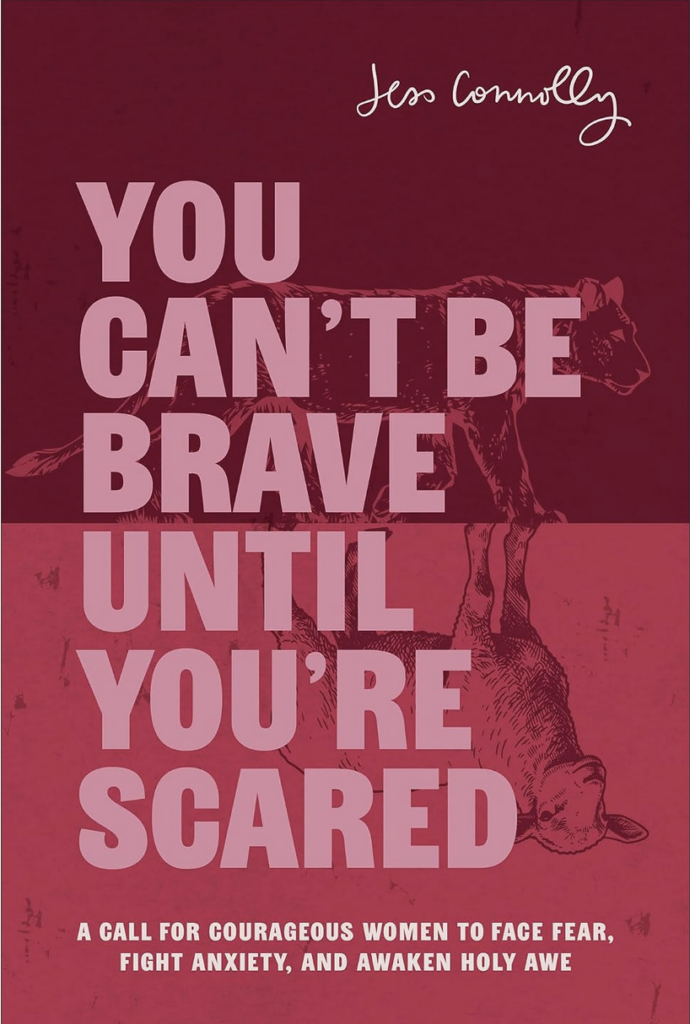
You Can’t Be Brave Until You’re Scared
At the heart of this book is a truth that most Christians have never been taught: when you learn to fear the Lord rightly, every other fear begins to lose its grip.
Jess Connolly invites you into an honest reckoning with fear and a better understanding of how it works in your mind, body, and soul.
Leave a Reply