

About this episode:
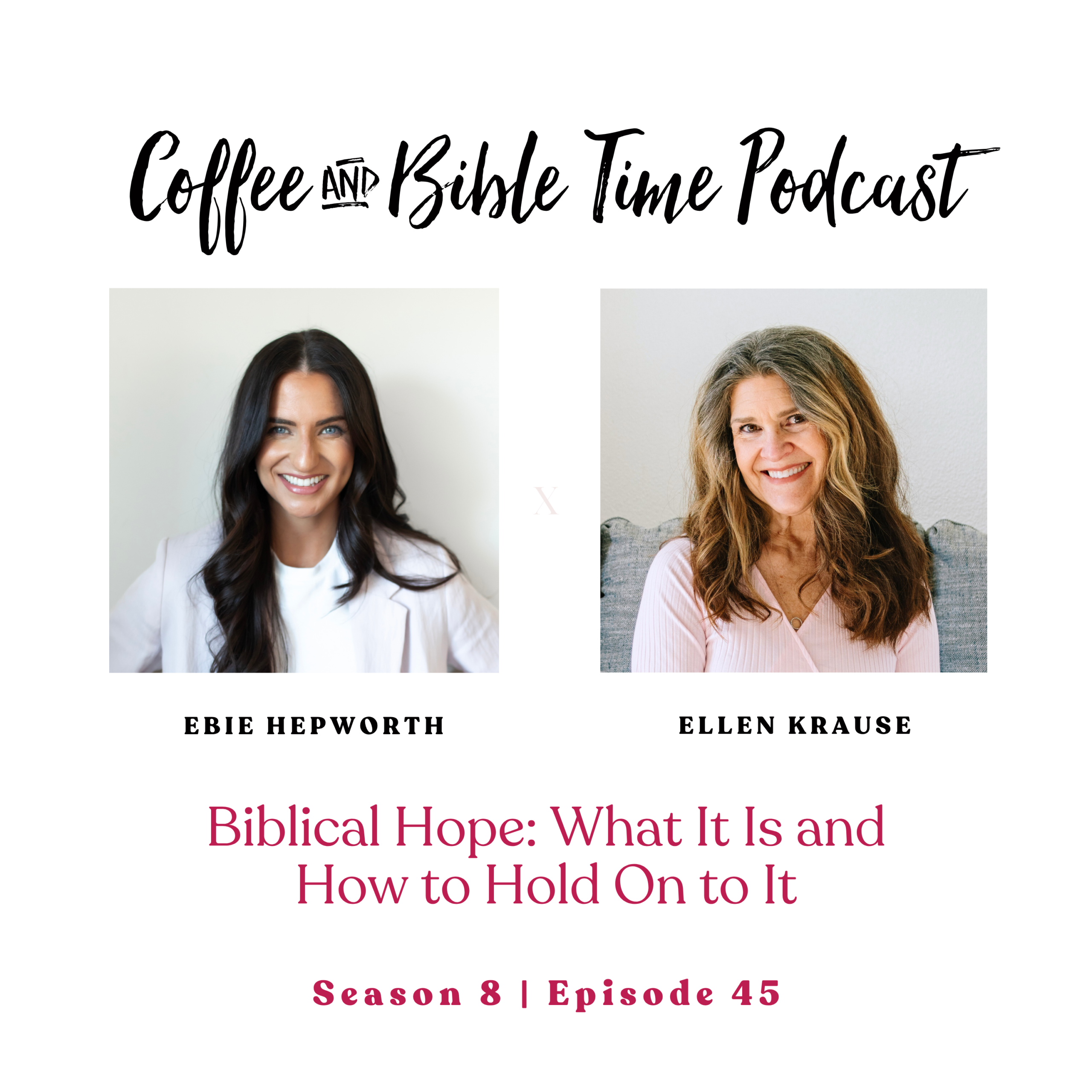
If you are exhausted from the pain of unanswered prayers, long-term struggles, or God’s silence, this is the episode for you.
Ellen Krause sits down with Ebie Hepworth to talk about biblical hope—that is rooted in Christ, not in how things turn out.

Photo of Ebie Hepworth by Isabel Wright Photography.
Subscribe & Listen on:
 Apple Podcasts
 Spotify
TIMESTAMPS:
00:00 Where Does Hope Come From?
02:28 Defining Hope: More Than Optimism
03:36 Ebie’s Story: Loss, Adoption, and a Diagnosis
06:00 The Risk of Hope
09:49 Honesty with God and the Midnight Hallelujah
12:07 Faith Fatigue and the Four Movements of Hope
15:06 Sarah: A Friend in the Night
19:06 Prayer: The Oxygen of Hope
22:59 Encouragement for the Woman Who Is Waiting
26:05 Where to Find Ebie and Rapid-Fire Favorites
Ebie Hepworth: All of us, as we’re living our lives, have to reconcile: What is hope? Where is it coming from? How do I get it?
And when it’s lost, where do I go to find it? What do I hold, so then this thing will hold me when the bottom falls out of my life?
It’s not this toxic positivity, or this optimism, or even this tangible thing that you can see. You’re like, “Wait, how am I supposed to have hope in something I can’t see?” But isn’t that the entire question of all of faith?
Ellen Krause: Welcome back to the Coffee and Bible Time podcast. I’m Ellen, your host.
Have you ever found yourself in a season where you’re praying, you’re trusting God, you’re trying to have faith, but nothing seems to be changing? I think today’s conversation is going to encourage you so much.
My guest today is Ebie Hepworth, a storyteller who has learned to look for hope in some of life’s hardest and most sacred places. Ebie has walked through pregnancy loss and adoption, and now parents her son through Duchenne Muscular Dystrophy.
And through these experiences and more, she has wrestled honestly with faith, disappointment, grief, and what it means to have hope in God even when he’s quiet.
Ebie, thank you so much for joining me today. Welcome to Coffee and Bible Time.
Ebie Hepworth: Thank you. It’s a gift to be with you, Ellen. I’m so happy to be here.
Ellen Krause: Well, the joy is all mine.
I have to tell our audience that every now and then I get one of these books that come across my desk, and I’m just blown away. And I just want to share that you have written such an incredible book about your experience, and it’s such an encouragement to others.
You talk about how you once thought of hope as being pretty similar to optimism, or maybe even just choosing not to think about a negative outcome.
I think a lot of us probably have the same idea of hope. So tell us how you would define it.
Ebie Hepworth: Yeah, for me, hope was really in the outcome: that the life I was going to be living would be seamlessly and beautifully tied with this bow.
I didn’t realize that you would be able to carry heavy, heavy, hard, devastating things and still have the capacity to embody hope.
Unintentionally, all of us, as we’re living our lives, have to reconcile: What is hope? Where is it coming from? How do I get it?
And when it’s lost, where do I go to find it? What do I hold, so then this thing will hold me when the bottom falls out of my life?
It’s not this toxic positivity, or this optimism, or even this tangible thing that you can see.
You know, Paul talks about it: it’s the unseen. And that can be hard to hear. You’re like, “Wait, how am I supposed to have hope in something I can’t see?”
But isn’t that the entire question of all of faith? You know?
And so, in the book I define it as the bridge to faith. But we can’t have faith apart from hope. It’s where suffering and joy learn to hold hands. We can’t have that apart from hope.
Ellen Krause: And that really, I think, is so important: to have this fuller perspective of what hope is.
Ebie, tell us about a season in your life. You’ve gone through a number of very difficult hardships where you really needed hope.
Ebie Hepworth: Well, you know, when I was a young girl, I walked through my mom being diagnosed with leukemia, not once but twice.
And then eventually the disruption of my family splitting: a fracture, divorce. And then my husband and I served in the anti-human trafficking space for very many years.
When we decided to start our family, you know, I’d walked through pregnancy loss, but I didn’t understand that infertility was gonna be part of my story.
And that was a tragic thing, but it kind of sparked this precious dream of, “Let’s start a family young, and let’s do it through the miracle of adoption.”
So we pursued adoption: a long and rigorous and heart-wrenching and also a gorgeous story.
And six months after we came home from Liberia, where our precious baby’s original homeland is, we received the incurable diagnosis of Duchenne Muscular Dystrophy, like you had just shared.
Of all of the battles that I’ve had to fight, navigating and carrying a terminal diagnosis has just split my life in a before and after.
And then after that started what I didn’t know would become a seven-year journey of infertility.
And there can be a hard reconciling with desiring for your body to be healed, to be able to, you know, obviously get pregnant and carry life.
But also, I had these two beautiful babies in front of me. That was a gift and a miracle.
But sometimes there can be this weird guilt that will creep into the heart when you desire more. And that was hard to reconcile: “Man, Lord, I deeply desire to carry a child biologically.”
And what do you do with that? Infertility is its own dialect of suffering.
And yeah, my story, it’s not an “and she lived happily ever after.”
Very much of this story I’m still living, specifically in regards to the diagnosis with my son. The nature of Duchenne is it’s a muscle-wasting disease, and so it only gets worse each day.
I’m not writing this from this vantage point of a mountain in which I am clear of midnights. Very much a part of my journey is, “What do I do when the night is long?”
And so, learning, “Okay, how do I hold this devastation and this disappointment, while still holding and embodying the hope of heaven?” Because it can exist.
Jesus has modeled that from the beginning to the end of the Word. He models that in the midst of heartbreak, hope has come.
Ellen Krause: Yes, for someone being so young as yourself, having to go through so much.
But it lends itself to you being able to articulate that in such an authentic way, because that’s what I felt so encouraged by: not necessarily downplaying all these difficult and hard feelings that we feel when we’re going through circumstances.
You use the phrase “hope is worth the risk.” What felt risky about hope for you in that season?
Ebie Hepworth: My word. I think everything about hope, when your life feels empty, in that mental, emotional, and spiritual thought of “Could something change?” feels so sharp.
And almost heavy, because it’s like, “Gosh, but if it doesn’t…” It’s almost like that pain of “if it doesn’t” is more painful than even hoping at all, right?
You know, we’ll mask it as wisdom and say, “I’m just gonna protect…and Scriptures say to guard my heart.”
And we’ll try and bandage it by trying to push hope, and the risk that it brings of deeper disappointment, away, because we just can’t imagine if he doesn’t come through how I imagine, which is key, then what? How on earth? You know, it’s so disorienting.
And so that is the risk of hope: that your journey, as you continue in the valley, might still be painful. That it might feel disappointing.
That it might not happen, whether it’s, maybe, the marriage reconciling, or the disease being healed, or the prodigal coming home. All of these things, they might not happen.
But the gift of hope is that the hope isn’t in the outcome of those things. The gift of hope is that your vantage point and your handlebars, if you will, are on the cross. And that is where hope comes from.
There are people with far harder, deeper, tragic stories than mine, but that’s the thing: there’s no devastation or war or anything within the heart that the hope of heaven cannot speak to.
So often I would read stories of people trying to communicate this importance of hope. And I would always come back with, “But you don’t know my story. But you don’t know what I’ve lived through. But you don’t…”
And I always had this kind of bitter perspective of, like, “Well, you’re telling it from this, you know, you got the marriage, or you got the baby, or you got the healing, or you, you know, whatever.”
So it was important for me to write testimony of someone that’s still in it. I think there’s such a beauty of sharing the testimonies of the saints that are still in it, but the miracle is that they’re not turning away from the kindness of the Lord in it.
Those are the stories that are just covered in suffering, and yet they are holding on to heaven with both hands. That speaks to the person in midnight.
I’m sorry, I’m rambling, but man, hope is risky. But the bigger risk is not hoping at all, because despair is dangerous to the soul and to the life of faith.
Ellen Krause: It most certainly is.
You know, when you were just talking about that, it did remind me of a couple at our church whose son had been tragically killed by a drunk driver.
And we saw them walk through that, and forgiving that person, and going on with their life. And that has been such a powerful testimony, because it’s a pain, right, that will just never, ever fully go away. That person can’t be replaced and brought back.
But they have that hope that one day, you know, they will be, because of our greater hope in Christ and eternal life. And it’s like you said, seeing their hope helps other believers say, “Okay, all right…”
Ebie Hepworth: “God’s got me.” Yeah. And that’s the key.
Ellen Krause: Yes, absolutely.
Ebie Hepworth: It’s that God’s got me. It’s not that I got this.
It’s that God has got me, in taking off the pressure of ourselves in hard midnights to think that we have to claw our way out of it, or that we have to pretend that it’s not painful, or minimize how dark it is.
The biggest takeaway that I hope that people take from this book is just the invitation to be honest with God about disappointments and devastations.
We can’t walk in deep connection with Him by withholding the things that crack us into half, you know?
And so, really responding to that invitation of, like, “Jesus, this is a long night, and this is so painful. Where are you?” Over and over, he always responds to that question.
You know, Dallas Willard says it beautifully. It says, “God’s address is at the end of our rope.” And I have seen that to be true. It’s like he is right there.
And it says it throughout all the Scriptures: he’s near the brokenhearted. That is where he resides.
And that, by nature, is deeply formative. Because when you’re in a long night of the soul and dawn does start to lift, because joy does come in the morning—and that is a promise—you look at the one that was near you in the dark and you’re like, “They were with me.”
And there is an allegiance and a commitment that is bonded and grafted in the night that is unmistakable in the day.
And so, being able to knit and tether yourself to the Lord in the night, it changes you. It changes generations. It changes the people around you that are watching your testimony unfold.
The hallelujah that rises before dawn, that is different than a hallelujah that rises in the day, on the mountaintop.
And when you can say hallelujah, which just means “praise the Lord,” when you can say that from the darkest night, that becomes the truest thing that you will ever know of your life.
Praise the Lord. It is by his grace alone that I have lived to tell this tale of this midnight, and that when I thought it was over, His kindness continued to bring joy in the morning.
That’s a story only God could author, and his pen does not run dry.
Sorry, I’m getting all excited.
Ellen Krause: No, no. What a beautiful explanation of that. And it’s through all of these trials and difficulties that God is strengthening us, He’s teaching us, and learning to abide in Him, whether things are good or bad.
Ebie Hepworth: Yes, exactly.
Ellen Krause: I wanna talk a little bit about having faith when we’re tired. You’ve come up with this phrase, “faith fatigue.” I love that language because I think it’s so relatable.
What exactly is faith fatigue, and how can we recognize when we’re experiencing it?
Ebie Hepworth: Man, I think sometimes we can mistake the silence for absence.
And when you’re just weary in your bones, needing him for the same thing for decades upon decades.
Maybe it’s the woman listening that’s like, “I am just believing that my marriage will wake up to its vows. And my honest, guttural prayer is that I’m tired of believing for that, because I haven’t seen any movement.”
Or maybe it’s the one in her sixties and still single and just aching for any type of movement towards a companion, because they deeply have this dream.
You know, whatever it may be, any listener can feel into that thing that they are just aching the Lord for. It can feel exhausting when you feel like you know silence a little bit better than any movement toward that thing.
And so that’s what I mean by faith fatigue: when you just feel a little bit exhausted. Not a little bit, soul exhausted, of believing for, you know, that one thing.
I break it into four movements.
My son’s diagnosis is a mutation with DNA. And so I break down the DNA of hope.
So then when you have a hope or a faith fatigue, how can you almost dance with these rhythms so then you can really start to move again?
Those four things are grieving, contending, awaiting, and thanksgiving.
And so, grieving with God is essentially learning how to be gut honest with God about what breaks your heart. Learning how to bleed in God’s direction.
So when your heart is bleeding, to push toward Him rather than pull away in private when you want to self-protect. And a huge part of that is learning how to let community in when you’re in pain.
The contending is, how do we pray and worship when our hearts are exhausted and devastated and weary?
How do we await? How do we wait with the Lord when we’re believing for something?
And the key with awaiting is, it’s not awaiting for an answer or an outcome to a specific thing. It’s learning how to await with God. You’re not awaiting something; you’re awaiting someone.
That’s how hope is cultivated: that I’m doing this with the Lord, therefore it’s not connected to an outcome.
And then the last one is thanksgiving. How do I give thanks when I just straight up don’t feel thankful?
I don’t know if I have any gratitude to give. Where do I find the scraps of my broken life? How do I offer that to him when I don’t feel that I have much to offer?
God loves our scraps. And what you think is nothing, giving him those two morsels at the bottom of your heart that is just exhausted and calcified and weary, learning how to give just the tiny bit that you have.
I love how Eugene Peterson says it in The Message. It says, “’Thank you’ is a password into my presence.” In the giving of thanks, God does come and soften and tenderize our hearts.
And then we see that our hearts start to begin to, like I said, occupy hope, actually be able to embody it, despite a long midnight or a season of a lot of dust on our prayers.
Ellen Krause: That’s such a helpful approach to process grief or whatever challenge that someone might be facing.
I loved in your book, Ebie, that you chose Sarah to weave in and out of your own story, her story. Tell us why you chose her and how she so beautifully helped you through the process.
Ebie Hepworth: Yeah. The language I use in the book is, “I found a friend in the night.”
For someone listening, they’re like, “Wait, Sarah, what do you mean?” I have these imaginary conversations with Sarah, the wife of Abraham, the mother of Isaac.
That started many, many years ago, nearly ten years ago, and I found myself on the porch, and I just prayed the simple prayer, “Lord, I want to find someone in your Scripture that is well acquainted with waiting and silence and betrayal and exhaustion, and yet found you faithful.”
And we know Sarah was in the hall of faith in Hebrews 11, but also we know that her life was very messy, that she messed up, that she took control, that she was profoundly human.
And yet the promise over her is that she would see as many descendants as the stars, you know.
And so, it’s hard to reconcile her story. Her life is just profoundly complicated, and it comes with a lot of baggage. And I thought, “That’s my kind of girl.”
And so, anyway, the Lord prompted this idea of having these imaginary conversations with her, which in the book, you know, there’s 12 or 13. In my journal, there’s well over 50.
And I want the listeners to hear very clearly: this isn’t to replace talking with God. This was because Sarah pointed me to Jesus, and her ache reflected a lot about the heart of God to me.
And I want that to be very clear, because that’s a huge, I-don’t-ever-want-anyone-to-mishear-this, I guess, literary device of trying to teach people about the kindness of Jesus.
So essentially I have these conversations with Sarah, a woman who knew a lot about absence and quiet and, “Hey, Lord, you spoke, and yet my life doesn’t reflect what you said.”
It was kind of an excuse to be brutally honest. I was trying to run from grief. I was trying to hide my pain and my needs from my community, because I didn’t want them to see how ugly it was or how messy it was.
And so these conversations with Sarah really proved to just become a really safe place for me to look to Jesus, saying, “Lord, you are true. You are hope.” And the life of Sarah reflects that.
And my hope was that by handing people the kind of narration of Sarah, they find a friend too in the long night.
Ellen Krause: Yes, oh, I definitely did. I just kind of wanted to give Sarah a hug, you know. I want to meet Sarah on my porch too. [laughs]
I loved that, because I think we can relate to her. I can relate to her. I just feel to this point of frustration where you just want to fix it yourself. And then when that happens, you see, like, “Oh no, what have I done?”
Ebie Hepworth: “I made a mess!”
Ellen Krause: Yes, my goodness. It’s just God showing us real people through the Scripture that…
Ebie Hepworth: That he chose. Isn’t that crazy? Sarah made some really bad mistakes, and she really got it wrong a lot of the time.
And yet he still chose her to be a woman that we get to look to and say, “Wow, despite how she felt, she was among the faithful.”
And I think that’s another huge takeaway of the book: I so often fall into the trap of connecting hope with my emotional state and my feelings.
But hope is not an emotion; it is not a feeling. It is a gift that is only given through the work of the Spirit.
And so, learning how to be able to live in a hard reality, but still subscribe our hearts to his reality, and actually be able to say, “This is painful. This is wrong.”
And yet Jesus died on the cross, and his promise is that he will restore everything and redeem everything. And so I know this isn’t the end of the story.
And that’s not to bypass the pain, but to know the greater point of hope is not connected to how my life plays out. It’s connected to how he gave his life, so then I will actually know true freedom.
Ellen Krause: Yes, indeed.
Tell us, Ebie, about prayer. You know, you mentioned going out onto your porch and just praying and asking God.
How has prayer seen you through times, especially when God seems silent?
Ebie Hepworth: Exactly. I think prayer is the oxygen of true hope. Apart from prayer, we will not be able to actually embody and hold the hope that Jesus gives us access to.
When our hearts are weary, it can feel a little bit daunting and almost a place of betrayal to go and talk to the one that you feel is maybe the only one that could have signed off on the thing that’s causing your heartbreak.
It can feel maybe not natural. So I think the starting place of that is learning how to listen to the words that he already says.
You know, in John it says He is the Word. And I think in everyone’s walk of faith, there comes a point where you start to question, “Is that me? Is that the Lord? What am I hearing? I don’t know if I can hear him.”
I had said that to a mentor, and she looked at me and said, “If you want to hear God’s voice, then read his Word out loud.”
It became this, “Of course, why didn’t I think of that?”
Because this is his voice. And it is not fake or inauthentic or just reciting random words, hoping that it will somehow change your life.
This is the truest thing that we know that we get to look at. And we get to point to, and we get to receive hope from.
I’m learning that there’s few places that will speak a message like worshiping through hard midnights.
And there are people that I have looked at, that I’ve watched, and I’m like, “Man, somehow they’re choosing to sing onto the Lord and to just lavish him in a hallelujah, despite what they’re walking through.”
Again, that’s not negating the grief and the pain and the sorrow that is, you know, in that story.
But like you said, your friends from your church, you watched them worship their way through that, and that left a mark on you.
And so, yeah, prayer, it’s the oxygen to true hope. Prayer is everything.
Ellen Krause: Yes. We can’t encourage our listeners enough that prayer is the door directly to our creator.
And I just think sometimes, like, I don’t want to get to heaven and be like, “I could have talked to God a lot more about all of these things.”
And I know I need to do a better job myself, or just that realization that he’s always there. You can always talk to him.
Ebie Hepworth: Always.
And I wanna speak to the listener that thinks that prayer has to sound a certain way, that we have to button up to the top and we have to mind our manners in prayer.
That is not what God asks. God asks for our honest, raw hearts.
And so, in that place of prayer, learning how to offer to him even your brokenness, the fractured pieces of your dreams that you’re like, “Why would he even want this?”
Learning how to be honest in prayer is everything. And we don’t have to pull up our bootstraps and pretend that the night isn’t painful just because we’re entering a place of prayer with the Lord.
Like you said, He’s everywhere. And so I would really encourage our listeners to get honest with God. He is not afraid of the tears or the pain or the anger. He loves our honest, honest hearts before him.
Ellen Krause: Yes, and just like the Psalms, I think so many times for me personally, after I’ve laid my heart out, my sorrow, I end up coming back, like the psalmist, ending up praising God.
Like, “Okay, Jesus says He wants to yoke our burdens with him. So okay, you know what? I’m gonna give it to you, because I can’t do it on my own. And yet I’m going to trust you.”
Ebie Hepworth: You’re so right. If you don’t know where to start, Psalm 73 would be a great prayer. We get to borrow these prayers of utter devastation. We gotta borrow them, and we get to offer them to the Lord.
And I’m so thankful for the Psalms, because they’ve given me language for lament in a way that I wouldn’t have had otherwise.
Ellen Krause: Most definitely. Oh yes, I’m locked into them for sure. [laughs]
Ebie Hepworth: [laughs] Me too.
Ellen Krause: Day in, day out.
Well, as we start to wrap things up here, Ebie, I just want to give you an opportunity to encourage the woman who is listening who feels like she’s been waiting, you know, an eternity for whatever that something might be.
What would you want her to know about how to keep going?
Ebie Hepworth: Man, I mean, first off, I would sit, and I’d probably just give her a long hug, and I would just say, “This is painful.”
And I don’t ever want to diminish that, or spiritually bypass it and hand you some sort of bandage for a soul-deep wound.
I know that’s its own shade of sorrow and its own dialect of pain, when you’re sitting in a lot of silence and you’re sitting in an absence of a dream. I know how painful that is.
And yet I would say, “Man, no one has lived your life.” Therefore, no one gets to worship and believe with the life you have that you’re actually living.
And so I would say you have a rare hallelujah that no one else can sing for you, no one else can offer for you, and no one else gets to do that for us.
And so I would just encourage her that you’re not doing it alone. There’s an intimacy that is being forged in this season that you aren’t even aware of.
And someday you’re gonna look back and think, “Man, that valley was dark, but I knew my shepherd’s voice in a way that now I don’t second-guess.”
Because it has been so fine-tuned that I know when he says walk, I walk. When he says pause, I pause.
And even if your life does turn a corner, where maybe a dream is fulfilled, the Word says that desire fulfilled is a tree of life.
And so, as God is gracious enough to give us the gifts of these various things throughout life, to remember that that’s a tree, and that you can invite others to find shade and respite under. And in a way that only you can, because you’ve lived that certain kind of sorrow.
Your story has that certain scar that someone else looks at and says, “I have that scar too.” And it can be profoundly bonding.
And so, if your story does end up having these gifts of these dreams fulfilled, being able to gather people under the shade of that and tell the story of his faithfulness.
That doesn’t mean that your pain always needs to have purpose, but it does mean that there’s a gift that your life has a special message on with that specific hardship that you get to hand people.
And that’s not something to take lightly.
Ellen Krause: No, it sure isn’t.
I loved your reference there to God as being our shepherd, and it really reminded me of Psalm 23, when it says, “Yea, though I walk through the valley of the shadow of death, I will fear no evil, for you are with me.”
You are with me.
And I know I’ve clung to those words at so many different times in my life. And if you’re listening and discouraged, that is something that you can cling to as well.
Well, Ebie, such a delight. I’m so excited for our listeners to get your book. It’s a must. Midnight Hallelujah. Where do they find it? And where can they learn more information about you?
Ebie Hepworth: Yes, what a joy to be with you, Ellen. A gift, truly.
Midnight Hallelujah is sold anywhere books are sold. You can get it at Amazon, Target, Barnes and Noble, wherever. And you can find me on Instagram, primarily, @ebiehepworth. You can find me on my website, ebiehepworth.com.
I do send out some monthly newsletters called Hope Notes, and I do also have a podcast. It’s called Let Me Ask You This. Lots of precious conversations there with people I love.
I’m embarrassingly easy to get a hold of. So I would love to hear from your listeners.
Ellen Krause: Fantastic. Well, we will make sure we include all of those links in our show notes.
Before I let you go, Ebie, we have to ask your favorite questions here. Rapid fire. What is your go-to Bible, and what translation is it?
Ebie Hepworth: Ooh, I primarily read the ESV. But this one that I started, I have a thing where every 10 years I have a different Bible, and then my plan is to give it to my children. So Esther, my oldest, gets my Bible from my twenties. And I’m currently on the Bible for my 30s, and for the 30s, I did the NLT, which has been very different.
And I already am excited to get to my 40s. But primarily when I study, it’s almost always ESV. But for my quiet time, and for the sake of giving my children something, I’m currently in NLT, which is fun.
Ellen Krause: Very good. Awesome. Okay, do you have any favorite Bible journaling supplies that you like to use?
Ebie Hepworth: Yes, I love it’s Sacred Prayer by Anne Voskamp. She’s a dear friend to me, and she came out with a beautiful prayer guide that she gives an acronym for, “sacred,” and it’s multiple points that you get to journal about throughout the day.
And one of the favorite questions that she asks is, “What are you afraid of today?” And that has really revealed and lit a match in parts of my heart that, if I wasn’t asked that question, I don’t know if I would be able to voice it.
And that also typically reveals what I’m holding on to that the Lord is asking me to surrender and trust him with. If you were to read my journal, almost every day when I answer the question, it’s typically the same answer. And so I can tell, “Ooh, this is a place the Lord is doing a deep work in the last couple of years.”
So I love Anne Voskamp’s Sacred Prayer journal guide.
Ellen Krause: Great tip. Okay, last one. What is your favorite app or website for Bible study tools?
Ebie Hepworth: That’s so great. I am a Bible Project girl. Anytime I open a new study, that’s typically where I start. But they also have all these free resources that essentially feels like a master’s program.
And so when I’m driving, it almost always is silence, because typically that’s where I try to cultivate silence and just prayer time, or the Bible Project. So I’m trying to get caught up on some of my studies there. So, for sure, the Bible Project.
Ellen Krause: Awesome. Yes. Tremendous, tremendous resource. Well, Ebie, thank you so much for being here and being willing to just share so honestly about the hope that we can all find in Christ.
Ebie Hepworth: I’m so grateful to be with you. Thank you for your time, Ellen.
Ellen Krause: And friends, if you’re listening here and you’re in a season of waiting or wondering where God is, I hope you remember today that his silence does not mean he is absent, and that hope is still possible, even when things seem dark.
And if something from today’s conversation encouraged you (I’m sure that it did), would you pass this podcast on to a friend who needs to hear this message? I think they will love you for that.
So thank you so much for being here on the Coffee and Bible Time podcast. We’ll see you again the next time. Have a blessed day.
Biblical Hope: What It Is, What It Isn’t, and How to Hold On When Your Faith Feels Tired
If you’ve been praying, trusting, and showing up for a long time, but nothing seems to be changing, you might find yourself asking where real hope comes from.
Now faith is confidence in what we hope for and assurance about what we do not see.
Hebrews 11:1
Biblical hope isn’t wishful thinking, and it doesn’t depend on how your circumstances turn out.
Biblical hope is a steady confidence in who God is…and it’s sturdy enough to hold you when the bottom falls out of your life.
In a recent Coffee and Bible Time conversation, host Ellen Krause talked with Ebie Hepworth about what makes hope so risky when we’re going through hard times—and how we can find it in our darkest nights.
What Is Biblical Hope?
Many of us grow up picturing hope as a happy ending.
Ebie described her own early view this way: “Hope was really in the outcome: that the life I was going to be living would be seamlessly and beautifully tied with a bow.”
Then she learned something different:
“I didn’t realize that you would be able to carry heavy, heavy, hard, devastating things and still have the capacity to embody hope.”
Biblical hope is rooted in God’s character and promises, not in a specific result or change in our circumstances.
…we ourselves, who have the firstfruits of the Spirit, groan inwardly as we wait eagerly for our adoption to sonship, the redemption of our bodies. For in this hope we were saved. But hope that is seen is no hope at all. Who hopes for what they already have? But if we hope for what we do not yet have, we wait for it patiently.
Romans 8:23-25
Ebie pointed out that Paul describes hope as “the unseen,” which she says can be hard to hear.
As she put it, “‘Wait, how am I supposed to have hope in something I can’t see?’ But isn’t that the entire question of all of faith?”
What Biblical Hope Isn’t
Understanding what hope is not can free you from a lot of pressure. The Bible shows this too: the people of God hoped honestly, in the middle of real pain.
1. Biblical Hope Isn’t Optimism
“It’s not this toxic positivity, or this optimism, or even this tangible thing that you can see.”
Ebie Hepworth
Biblical hope doesn’t ask you to pretend things are fine. Ebie said we don’t have to “claw our way out of it,” “pretend that it’s not painful,” or “minimize how dark it is.”
Scripture examples:
- Romans 8:24–25: Optimism expects visible good news, but biblical hope holds on to what’s unseen.
- Psalm 42:5: The psalmist doesn’t deny his ache. He directs it toward God.
Biblical Hope Isn’t a Feeling
If your hope feels low, that doesn’t mean it’s gone.
“I so often fall into the trap of connecting hope with my emotional state and my feelings. But hope is not an emotion; it is not a feeling. It is a gift that is only given through the work of the Spirit.”
Ebie Hepworth
Scripture examples:
- Romans 15:13: Hope is a gift of the Spirit, not something you have to generate on your own.
- Lamentations 3:19–24: The writer’s hope rests on remembering the Lord’s steadfast love and faithfulness, which are new every morning—not on a lift in his mood.
Biblical Hope Isn’t Tied to the Outcome
This may be the most freeing point. “The gift of hope is that the hope isn’t in the outcome,” Ebie said. “The gift of hope is that your vantage point…[is] on the cross. And that is where hope comes from.”
Scripture examples:
- Habakkuk 3:17–18: The prophet pictures a total loss: no figs, no grapes, no olives, empty fields, and no livestock. Even so, he says, “yet I will rejoice in the LORD.” His joy doesn’t depend on the harvest.
- Daniel 3:17–18: Shadrach, Meshach, and Abednego tell the king that God is able to rescue them from the fire. Then they add, “But if not,” they still won’t bow. Their trust is in God himself, whatever he chooses to do.
How to Have Biblical Hope: 5 Practical Steps
Ebie breaks hope into four movements: grieving, contending, awaiting, and thanksgiving.
Together with the other practices she and Ellen discussed, they offer a practical path for when your faith feels tired.
1. Be Honest With God About Where You Are
You don’t need polished prayers. God meets you where you are, not where you think you should be.
Try this: Set a timer for five minutes and tell God exactly how you feel, including all the disappointment, questions, and weariness. Then end with one sentence of trust, even if it’s as simple as “Lord, I’m still here.”
2. Borrow the Words of the Psalms
When you don’t have the words, Scripture does. In Psalm 73, the writer admits his confusion and envy, and the psalm ends with a turn toward God: “it is good for me to draw near to God” (v. 28).
Try this: Read one psalm out loud each morning this week, and choose one that matches where you are. Then pray it back to God in your own words.
3. Let God’s Word Speak to You
Hearing God’s voice often begins with what he has already said.
“So faith comes from hearing, and hearing through the word of Christ.”
Romans 10:17
Try this: Read a short passage out loud, slowly, and listen for one truth about who God is. Write it down and keep it where you’ll see it, like on a sticky note or your phone’s lock screen.
4. Practice Thanksgiving, Even in Small Ways
Giving thanks doesn’t deny that something is hard. It says that God is still good and still present. Think of gratitude as an invitation to notice his care, not a demand to feel cheerful.
Try this: Each evening, name three small things you’re thankful for, like a nice text, a pretty bird, or a moment of laughter. If you can only think of one, that counts.
5. Place Your Hope in God Himself, Not Just in an Answer
It’s natural to hope for a specific outcome, but a sturdier hope rests in the person of God.
Try this: When you catch yourself focusing on a result, pray, “Lord, whatever happens, I want to know you more through this.” Then ask Him what He wants you to do today, one small step at a time.
Encouragement for When Hope Feels Risky
Ebie was honest that allowing yourself to hope can feel dangerous:
“That is the risk of hope: that your journey, as you continue in the valley, might still be painful. That it might feel disappointing.”
But she didn’t stop there:
“There’s no devastation or war or anything within the heart that the hope of heaven cannot speak to.”
Ebie Hepworth
Ellen reminded listeners of Psalm 23: “Though I walk through the valley of the shadow of death, I will fear no evil, for you are with me.”
Hope is risky. But the greater risk is that we don’t dare to hope at all.
Frequently Asked Questions About Biblical Hope
What is biblical hope?
Biblical hope is a confident trust in God and his promises, anchored in Jesus and the cross, not in how circumstances turn out. It is a gift of the Spirit, not just a feeling.
Is biblical hope the same as optimism?
No. Optimism expects things to go well. Biblical hope can sit with pain and disappointment and still hold on to God, because it doesn’t depend on a happy outcome.
How do I have hope when my prayers aren’t answered?
Be honest with God about your pain, pray the Psalms, read his Word aloud, give thanks even in small ways, and hope with God instead of only for an answer.
His silence does not mean he is absent.
Listen to the full conversation here.
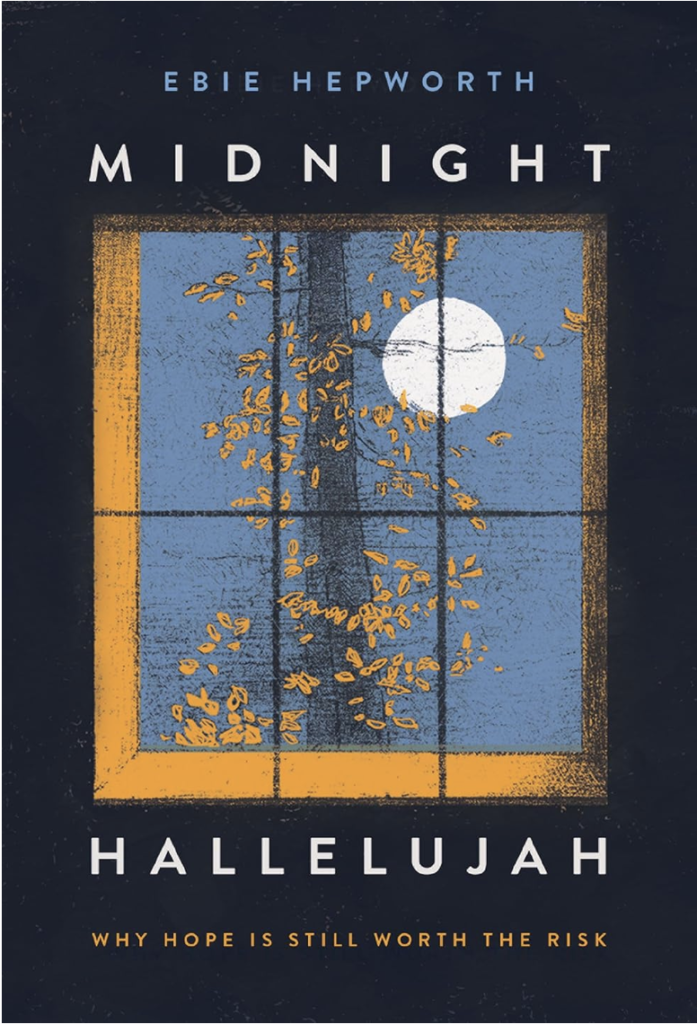
Midnight Hallelujah: Why Hope is Still Worth the Risk
If you’re disappointed with your life, struggling with faith, and frustrated with a seemingly silent God, Midnight Hallelujah dares to speak hope into the silence.
Ebie Hepworth invites you into her dark nights and imagined conversations with Sarah, the mother of Isaac, who kept her company through them as she bridges our modern struggles with timeless biblical truths.
If you have felt the ache of silence and wondered if hope is still within reach, come and rediscover real hope in Christ Himself.
Leave a Reply