


About this episode:
Do you ever feel like you need to fix yourself before God can love you?
If you’ve ever found yourself feeling guilty about your mistakes, your flaws, or not being “good enough,” you’re not alone. Here’s what it actually looks like to let God into your mess instead of hiding it. Author, actor, and filmmaker Nathan Clarkson shares his personal journey of growing up in the church, hiding behind a “good Christian” image, and how freedom finally came when he stopped pretending and started being honest with God.

 Apple Podcasts
 Spotify
TIMESTAMPS:
00:00 Introduction: “I Was Disillusioned”
01:49 The Challenge of Forgetfulness in Faith
02:59 Emotionally Drained: Christian Burnout
10:13 Experiences Across Denominations
15:34 Rediscovering Historical Hymns and Practices
24:47 The Importance of Diverse Worship Songs
30:01 Practical Spiritual Practices for Daily Life
Ellen Krause: Welcome back to the Coffee and Bible Time podcast. I’m Ellen, your host, and I am so glad that you’re joining us today. If you’ve ever felt like you needed to be a better Christian before coming to God, or you think everyone else has it together except for you, then this conversation is for you.
Today, I am joined by Nathan Clarkson, an author, actor, and filmmaker who has been featured on the Today Show, LA Times, Relevant, and more, whose work explores faith, honesty, and what happens when we stop pretending. Nathan grew up in the church, raised by beloved author and speaker Sally Clarkson, and from the outside his faith story looked pretty solid. But it was only when he came face to face with his own failures that Nathan was able to find freedom.
Today, we’re challenging the idea that we have to fix ourselves before God can fix us, and looking at what might happen when we stop performing and start being honest with God. Nathan, welcome to the Coffee and Bible Time podcast. I’m so glad that you’re here.
Nathan Clarkson: I’m glad to be here, and so thank you for having me.
Ellen Krause: What a joy. And I love the connection that you have in so many different spaces throughout. You know, we mentioned that you’re an author and an actor and a filmmaker. But what I love, Nathan, is that you’ve just poured your heart and soul into helping people get honest with themselves.
So, tell us—what made you decide to write about feeling like you’re the worst? And why do you think so many of us can just relate to that?
Nathan Clarkson: Yeah, well, this is something that I really do hope people relate to, though often I have found both in my own life and as I look into others and look at other people, that many of us kind of spend a lot of our lives running away from that acknowledgement—running away from admitting the truth about ourselves, running away from facing our own darkness and failures and fractures and flaws.
And there’s a myriad of reasons as to why, but, you know, the main one is because it hurts, and it’s uncomfortable to have to face those things. And I think many of us believe that if we did stop running and face kind of the darker parts of ourselves, that it would be overwhelming and that it would overcome us—that it would be a brick wall that we’d run into.
But the reason I wanted to write this book is because of my own life, my own journey. I have tried to do that too. I’ve tried to convince myself that I’m good, that I’m put together, that I don’t need help, that I don’t have fractures in darkness, that I’m good. And I have tried to convince myself many times in my life. And for a while it works, right? I can believe it, and I can get myself to believe it. I can get other people to believe it.
But underneath, those fractures continue to grow the longer I don’t attention to them. And multiple moments in my life, I’ve had these moments. It’s kind of been a cyclical journey where I’ll convince myself and others I’m good, and then I’ll have these moments that pop up where the reality of my fractures and my failures kind of bubble up and I have to face them. And it’s incredibly uncomfortable and very often painful.
But what I found is, like I said, the reason I was running away from them is because I believed that if I had to face them, they would overcome me—that I would be overwhelmed, that I would drown in my darkness and shame and guilt. But what I found is when I actually had to face them, when I finally found myself at the end of my rope and I was looking honestly at the reality of myself and my shortcomings, that it wasn’t a wall that I ran into that stopped my story. Rather, that moment where I had to look at myself honestly was actually the bridge to the start of a story of redemption.
So God met me in that moment. And it’s not the end of the story, but it began the story of redemption and wholeness that I took. And so that’s what I want for other people. I want encourage them with my story to say, hey, listen—admitting you’re the worst is a scary thing, but it’s a beautiful thing. Because when we actually face ourselves and our darkness of flaws, that’s where we meet God, and that’s where we begin our story of redemption.
Ellen Krause: Absolutely. There’s something so freeing about lifting something off of yourself and letting God bear this burden with you of some shame or disgust about something in ourselves that we’ve done. That is so incredibly freeing, and Christ paid the price for that.
And so while we’re here on earth, we really—if we can let that go—we’re going to be living in a much better place.
Well, Nathan, you’ve built your career in public spaces where image often matters. So how did all of this affect your view of image and performance in God’s grace?
Nathan Clarkson: You know, I think so many of us spend our lives performing, and this is not just for people who live more or less in the public eye. You know, I think there’s a high pressure on, for people who live in the public eye, to perform. But I think all of us perform to a degree.
We all wear costumes. We all wear masks. And I think we this for, again, a myriad of reasons. But I think often it’s because we need others to believe something about ourselves and for us to leave something about ourselves, because ultimately we worry that if others saw the reality—and if we saw our own reality—that we wouldn’t be loved.
I think that God has created us—one of our deepest desires and needs is be fully loved, but another need is to be fully known. And oftentimes it feels like we can’t reconcile those. We can’t. There’s a fear that if we’re fully known, we won’t be fully loved. So we opt to hide ourselves. But that means we can’t be fully loved for who we are unconditionally.
And so I think there’s, of course, a natural fear that creates that kind of performance mentality that we all—”I need to pretend to be good. I need to look like something. I need to convince people and myself and God that I’m OK.” And then I will get the affection or love or acceptance that I’m so desiring.
But the reality is, the longer we do that, the longer we keep ourselves from full love of our whole selves. You know, to be fully known and fully loved is really the goal. And I think we have that fear.
Again, you know, through the stories in my book and what I want to encourage people is when you actually are brave enough to allow yourself to be fully known—and that means by yourself, from other people, or from God—that’s where you actually begin to experience what true and substantive love actually feels and looks like.
And it can be so scary to be honest with ourselves, particularly in front of other people, even in front of God. But it’s really the conduit to us actually experiencing what being unconditionally loved actually feels like.
Ellen Krause: What did it look like for you to learn to accept the grace and mercy of God?
Nathan Clarkson: That’s a great question. And it’s one, you know, I wish I could say now I know how to do that, but this is a journey I’ve taken my whole life, and it’s one I am still on. I wrote the book, and I am still in the midst of figuring it out. I wrote the book as a way for myself to explore with others on how we take this journey of accepting God’s love.
And it’s a difficult thing, I think, for many of us. You know, for much of my life, I didn’t always struggle with faith. I believed there was a God exist. I believed he was there. I just didn’t believe he liked me all that much or he cared about me all that much.
You know, that was my journey of faith. That was the faith crisis that I had. It wasn’t that he existed; it was that he liked me or cared about me. And so that’s something I still struggle with daily.
But the one thing that kind of anchors me is a few different things that I have found that really allow me to experience God’s love. One is, you know, we talked about a little bit, is the practice of being honest about my mistakes and flaws and failures in front of God, even if it’s scary. And in my prayer times, talking to him and acknowledging the ways I failed and acknowledging my flaws and practicing that has allowed me to more comfortable with being honest before him, which actually allows me to feel his love.
The other way is to surround myself with people who are his hands and feet. So when they love me, I feel God’s love through them. You know, I have felt God’s love through my parents, through my wife, through close friends of mine. And when I am honest in front of them about who I am and I allow myself to be seen and I still feel love from them, I feel God’s love working through them. And that’s a really tangible way I can experience God’s love.
And the third way is, you know, so often we’ll have these voices in our heads, right, that aren’t true. And they’re telling us things. These voices come out of our childhoods, come out of our traumas, come out of our difficulties. But these voices aren’t always telling us the truth.
And there’s an old Christian song that I that was on the radio when I was a kid, and I loved it, called The Voice of Truth. And essentially the song was talking about learning how to listen to the voice of truth. And one of the best ways we can do that is to read God’s word.
You know, I love that even in that—what we call God’s word—we call God’s word, it means he spoke to us. And so if you want to know what God thinks about you and God feels about you, even if you’re dealing with guilt and shame and darkness and fracture and flaws and failures, if you want to know what God thinks about you and how he feels about you, read his word.
What you’ll find is that God forgives you. He loves you. He accepts you, that you are inherently valuable, that you’re made in his image. And so go to his word. That’s kind of the third thing that really grounds me. I’m forgetting and I’m listening to the wrong voices, I go back to his word. I allow the voice of truth to speak what is true into my mind.
Ellen Krause: I love all three of those suggestions. You know, I think a lot of times people just beat themselves up over and over and over again and constantly are coming back to God asking for forgiveness over and over again.
And I love when I look at God’s grace to be able to see that this is why Jesus went to the cross, because we so desperately needed him, and he paid that price so that we don’t have to keep beating ourselves up over and over again. And so I love your suggestion that just being honest, as painful as that may be, will truly, truly be freeing.
You know, a lot of people think they have to get their lives together before coming to God. How do you think that the church can better communicate that God actually meets us in our mess and not after we clean it up?
Nathan Clarkson: That’s a great question. And it’s one I’ve pondered recently as I’ve kind of gazed at the church and how we as a community interact with people who need God’s grace. And by the way, we all do. That’s all of us.
And I think one of the best ways that I could encourage the church to better offer God’s grace and love in that hand is remember, Paul talks about in scripture that we are the hands of the spirit of God. He works through us. For whatever reason, likes working through us—these fallible, imperfect humans. But he finds pleasure in that.
If we want to convey to other people God’s unconditional love, his grace, his forgiveness, then we have to be people who to learn how to love unconditionally, offer grace, and offer forgiveness. This is easier said than done.
I’m not a naturally forgiving person. I am petty. I am judgmental. I am not naturally gracious person. I can be sharp and mean. And I’m not a natural loving person. I’m selfish. I want what I want when I want. I have to work to think about other people.
But the more we can practice this as a community and as individuals in that community—if we want people to experience God love—then we have to learn how to love, because we are the hands of the of God.
And so that’s what I would encourage church to do, is become better forgivers, more gracious, more forgiving. And not out of a vacuum just to get other people, but you know how to tell us—we do this because he’s offered that to us. We have received forgiveness. We have received grace and mercy. We have received love. And so we offer that to others. We learn how to do it because we have first received it from God. And so it’s an out-proping of the thankfulness of what God has offered us that we can offer to others.
Ellen Krause: Amen to that, absolutely. You know, there may be someone listening here who, you know, feels like they’ve blown it too many times to be used by God. And truly, you know, in their hearts feel that way. How would you encourage them today?
Nathan Clarkson: Oh, that’s a great question. Well, one, I would tell you that you’re not alone. And I can—I know this for a fact, because I have felt that. I often feel that.
You know, I grew up a Christian kid and youth group. And like you said, my parents were writers, ministers, and you know, someone in public eye. And I felt often that I had fallen too far from the image of what I was supposed to be and the image of what God could use.
Very many times in my life, my failures—I believed them to be too large, and they disqualified me from being used by God. But again, that goes back to this kind of idea that there are voices that get into our heads from a myriad of places in our stories. But you have to decipher what’s true and what is untrue.
Again, going back to God’s Word, what we see is that over and over again, we see that God loves using people who we wouldn’t normally consider to be the perfect people—the ones who would be the main characters of the movie, the flawless hero. Rather, God, over and over again, from the very beginning, from Genesis all the way to the New Testament, we see that God uses incredibly flawed and fractured people.
And so if you are worried that you are too flawed or too fractured to be used by God, well, welcome to the club, because all of us technically are. But for whatever reason, God loves using flawed people to accomplish and write his story.
So you’re in good company if you worried about that. I’ve worried about that, and many of us do. But God loves using broken, hurting, flawed people to accomplish his story.
And you know, there’s an old saying about—you can see God’s light cracks. And God loves showing up and showing his beauty and his wholeness through our inconsistencies and failures and flaws, that God shines are practically loud.
Ellen Krause: That’s just—that’s so beautiful. And something I think that we all need to hear and kind of pack that away when we’re feeling discouraged.
And I know I often think about King David, you know, who in so many ways God called him a man after his own heart. And yet he—he had a man killed. And so, but we see David’s repentance and God’s love. All—it worked together, kind of just how you’ve described.
How has learning to live with these sort of unfixed parts of your story changed the way that you see God’s goodness?
Nathan Clarkson: Hmm. It’s a great question. Well, you know, I—as I get older—I’m more, I practice and work on this muscle and continue to being willing to look at these, as you say, unfixed parts of myself.
But the way I see that, and I’m so thankful for God’s presence in them, is that, like I said, when I’ve been honest about them and willing to look at them, that God is thankful to be present in them and meet me there when I’m honest about them.
And what I see is that he doesn’t leave me in my mess or in my rubble. Rather, slowly—day by day, year by year, decade by decade—he walks with me in my mess and slowly begins to me back together.
And so that’s the one of the things I love most about my faith is—and what I want to convey in this book—is that you don’t stop. You—it’s not a you don’t say, “I’m the worst,” and stop there. Once you look at your mess, that is the beginning of where God comes in and begins little by little to enact his plan of redemption and remaking.
And little by little, as you practice being honest, passing, being and being vulnerable in front of God and be willing to follow him, you’ll find all those fractured places and messy parts of your story—God is right there with you.
And over a long period of time—it’s longer than any of us want—he slowly begins to put us back together. And it’s a cooperative work. We work with him, but he’s right there with us on that story of redemption.
And it really does become a story of redemption. And which one of us doesn’t love a movie or a book and a great tale of redemption? We are made to love that. And so we actually get to live that when we are brave enough to acknowledge our dark parts. Because God steps in and begins that story—that movie, that book—redemption, and we make it, in essence.
So that’s what I really find a lot of thankfulness for, is that God is willing to step into our stories and make them not tragedies, but stories of redemption and hope—little by little, minute by minute, hour by hour, year by year.
Ellen Krause: So true. If we can get ourselves to focus on ourselves, as opposed to—I feel like I’m really good at picking out the flaws in other people. And—and I’ve kind of had to retrain my brain to say, “Hey, you’ve got to look at the plank in your own eye,” right? That Bible verse says.
And I love that you kind of call that out as well, that I think our natural inclination, right, is to find all these faults in other people. But yet, if we want to experience that beauty and that freedom, it’s—we have to look at ourself.
How can the strength of the Christian life really help us in this regard?
Nathan Clarkson: Yeah, that’s a great question. You know, I think as I—you know, you’re talking about how it’s so often—it’s so easy to see the mistakes of other people and the flaws of other people, and it’s so difficult to look at our own.
I wrote this book and pondered on that kind of reality, both in my life and others’ lives. And I remember sitting during the pandemic, and I was looking at comment sections, and I was just so surprised to see that no matter who it was, what belief system was, what group, what tribe, it seemed that everybody agreed there’s problem in the world. And everybody knew who was to blame, and it was the other person, the other tribe, the other belief, the other group, the other person.
And as I look in scripture and I kind of looked at Jesus and his interactions with people, what I found is that over and over again, when Jesus confronted them, they would often try to blame someone else for their problems, their mess, right? And that’s something that’s so relevant to all of us. I do that. I still do that.
Well, you even see it in Genesis when Adam gets caught—it’s this woman you gave, it’s her fault. You know, it’s so easy to call out and say that the problem is others.
But when Jesus interacted with them, what he ended up doing is have them pull their gaze away from other people and pull it towards themselves. You know, I think of the woman at the well, when he spoke to her and he knew her story and her hidden brokenness, and he confronted her with that—not to shame her, but to actually help her heal.
And I think that’s what God does with all of us. And that’s what our faith can allow us to do—allow us to take our vision off of the specks in everyone else’s eyes, either as an individual or as a community, when our tribe looks at, you know, the other tribe who is messing everything up.
But God has us look our own problems and patches. Those are the things you want to fix. Those are the things you want to heal—the fractures in our own lives.
And this is what I love about my faith, is that faith that encourages introspection and offers healing in that introspection. So it’s a faith that has us look inside of ourselves and confront and deal with the messy bits, like we talked about.
But it’s also my faith—Christ and God—is that he steps in there, and he’s a part of, again, the beginning of that story of healing. So that’s what I really love about my faith in the context of what it looks like to heal and to pull our gaze inward and to find our fractures begin to put back together by God.
Ellen Krause: Thank you so much for sharing that, Nathan. I just find in your—you are an incredible writer. And I just—when I was reading your book, I was thinking, wow, he is so deep and introspective. I need to learn from that, because there is such value in doing that.
And I love how you just tie it into God’s word. You know, as we wrap things up here, Nathan, the title of your book is called I’m the Worst. Tell us what you’re hoping that if someone were to pick this up today and they were to read it, what will they walk away with?
Nathan Clarkson: Hmm. My hope is that they’ll walk away with new freedom. And I think there people who don’t even know they need freedom, right? We think we’re good, we’re fine, we’re strong.
My hope is that the people who don’t know that they need freedom, don’t know that they need help, will read this and realize how much help they need and why that’s good and beautiful. Why that’s a good thing to actually have to realize that we’re flawed and fractured, because it brings us closer to.
And for the people who already feel overwhelmed by darkness and their mistakes and are swimming in shame, my hope is they too will find freedom forward—that they will realize that God is there in the midst of their messiness, and that they don’t have to live in that pool of darkness anymore, that God is offering them a way forward, is inviting them into a story of redemption.
So that’s what I hope—that no matter where people are coming from, when they read this book, they read my stories, that my stories would connect with theirs and that through an encounter with God, an encounter with themselves, that they would find a new freedom and a story forward with redemption at the hand of God.
Ellen Krause: Yes, yes—no doubt you absolutely will. Where can people find your book and more information about you, Nathan?
Nathan Clarkson: Yeah, they can find my book anywhere books are sold—Amazon, Barnes and Noble, and local bookstores as well.
And if you want to connect with me, I’m on all the socials. Just search my name, Nathan Clarkson. You can go to my website, NathanClarkson.me, and it’s there you can connect with me and tell me what you thought of the book. I love to hear from people.
And I also have a podcast called The Overthinkers that you can listen to weekly. So yeah, you can connect with me all those places. I love hearing from you, and I’d love for you to the book and tell me what you think.
Ellen Krause: Awesome. Well, we will make sure we include those links in our show notes.
But before I let you go, Nathan, I have to ask you our favorite questions here. One is, what is your go-to Bible, and what translation is it?
Nathan Clarkson: You know, I have jumped around because I’m a pastor’s kid, and so I’ve jumped around from different translations for many, many years. And so many of them have really different great strengths.
Even something like—you know, there’s a time in my life when I loved reading The Message just because it was so conversational to me. But right now, the translation that I find myself being drawn to the most or using the most currently—and it could change at any moment—but I’ve been reading the NLT.
Ellen Krause: That’s awesome. Do you have any favorite Bible journaling supplies? Do you like to journal at all?
Nathan Clarkson: Yeah. You know, I’m trying to get better at journaling. I find often when I write, I’m either writing for, you know, writing an article or a book. And I’m trying to relearn—because I used to do this more—relearn the art and the value, because there’s such value in just writing personally and relationally with God.
So I’m actually open to finding great journaling resources. But those are my journaling resources right now—a nice little leather journal and my notes app on my phone.
Ellen Krause: Perfect. Okay, lastly, what is your favorite app or website for Bible study tools?
Nathan Clarkson: You know, this is probably too, too cliche, but I love Bible Gateway, and I also love the YouVersion Bible app. They just have so many resources. I even have a few Bible studies on there from past books.
So, you know, I know it’s a little cliche, but I find I’m so happy I live in a time with such rich Bible resources that you can dive into. So YouVersion or Bible Gateway are fantastic.
Ellen Krause: Yes, both are fantastic. And I will give a plug for YouVersion as well. It is such a great resource. You’ve got plans on there. Coffee and Bible Time has plans. We actually just started up a read through the Bible in a year plan.
So hey, if you guys are listening to this, head over to YouVersion and check those out.
Well, Nathan, I’m just so grateful for your voice and for the way you point us back to humility and honesty and the love of Jesus. Thank you so much for being here today.
Nathan Clarkson: Well, thank you so much for having me. It was an honor.
Ellen Krause: And for our listeners, it’s the good news of the gospel that before we loved God, he loved us. He meets us right in the middle of our weakness, our questions, and even our failures.
So if you felt discouraged, disqualified, or you’re just tired of trying to be good enough, I truly hope that this conversation has reminded you that grace isn’t something that you earn—it’s something that you receive.
So friends, if you have enjoyed this conversation, if you have a question or an idea for a topic or guest, let us know by clicking the link in the show notes. Thank you all for listening, and have a blessed day.
Feeling Guilty When You Fall Short
Do you ever feel like you have to have it all together before God can love you?
Many of us struggle with feeling guilty—thinking we have to be good enough, holy enough, or faithful enough for God to really care about us. That sense of guilt can be debilitating, leaving us exhausted from trying to perform for God and others.
In a recent episode of the Coffee and Bible Time Podcast, Ellen Krause sat down with author, actor, and filmmaker Nathan Clarkson to talk about the freedom that comes when we stop performing and start being honest about our failures. Nathan’s story reminds us that God meets us in the middle of our mess, not after we’ve cleaned it up.
You Don’t Have to Fix Yourself Before God Can Love You
Many Christians live under the weight of perfectionism, believing that God will only accept them once they have “fixed” their lives. Nathan shares his own experience growing up in the church and trying to appear perfect (and feeling guilty because he wasn’t):
“I have tried to convince myself that I’m good, that I’m put together, that I don’t need help…and for a while it works, right? I can believe it and I can get other people to believe it. But underneath those fractures continue to grow.”
Nathan Clarkson
Because the truth is, we are sinful. We are broken. We are guilty.
But Nathan explains that facing our brokenness isn’t the end—it’s the beginning. He says:
“That moment where I had to look at myself honestly was actually start of a story of redemption…admitting [your flaws] is a scary thing, but it’s a beautiful thing because…that’s where we meet God.”
Nathan Clarkson
Scripture to remember:
“The Lord is near to the brokenhearted and saves the crushed in spirit.” — Psalm 34:18
When we are feeling guilty, it can be tempting to hide our flaws or pretend everything is fine. Nathan reminds us that God meets us right where we are—guilt, shame, and all.
Performance Keeps Us from Experiencing God’s Love
Another reason many of us are feeling guilty is the pressure to perform in our Christian lives. Nathan explains:
“So many of us spend our lives performing…we all wear masks. I think often it’s because we need others to believe something about ourselves and for us to believe something about ourselves. Because ultimately, we worry that if others saw the reality, and if we saw our own reality, that we wouldn’t be loved.”
Nathan Clarkson
But God created us to be fully known and fully loved, and these two desires are reconciled in His grace:
“When you actually are brave enough to allow yourself to be fully known…that’s where you actually begin to experience what true and substantive love actually feels and looks like.”
Nathan Clarkson
Takeaway: Letting go of performance-based faith allows you to experience God’s unconditional love, even when you are feeling guilty for your mistakes.
Practical Steps to Let God In (Even When You’re Feeling Guilty)
Nathan offers practical ways to move past guilt and experience God’s grace:
- Be honest with God about your mistakes, flaws, and failures—even if it’s scary.
- Surround yourself with people who reflect God’s love through their words and actions.
- Read Scripture to remind yourself of God’s truth, rather than listening to voices of shame or guilt.
“If you want to know what God thinks about you and how he feels about you, read his word. What you’ll find is that God forgives you. He loves you. He accepts you. You are inherently valuable, that you’re made in his image.”
Nathan Clarkson
Scripture to remember when you feel guilty:
- God forgives you
- “If we confess our sins, he is faithful and just and will forgive us our sins and purify us from all unrighteousness.”
―1 John 1:9- God loves you (even when you sin)
- “This is love: not that we loved God, but that he loved us and sent his Son as an atoning sacrifice for our sins.”
―1 John 4:10- “But God demonstrates his own love for us in this: While we were still sinners, Christ died for us.”
―Romans 5:8- You have inherent worth
- “I praise you because I am fearfully and wonderfully made;
your works are wonderful,
I know that full well.”―Psalm 139:14
Final Thoughts
If you’re struggling with feeling guilty or believing you’re not enough, Nathan’s story reminds us that freedom and grace are found not in perfection, but in honesty. God meets us in our mess, walks with us through brokenness, and begins the work of redemption in every fractured part of our lives.
“God is willing to step into our stories and make them not tragedies but stories of redemption and hope. Little by little, minute by minute, hour by hour, year by year.”
Nathan Clarkson
Let this be your encouragement today: you don’t have to clean up your life to be loved by God. Let Him into your mess, and experience the grace that frees you from feeling guilty.
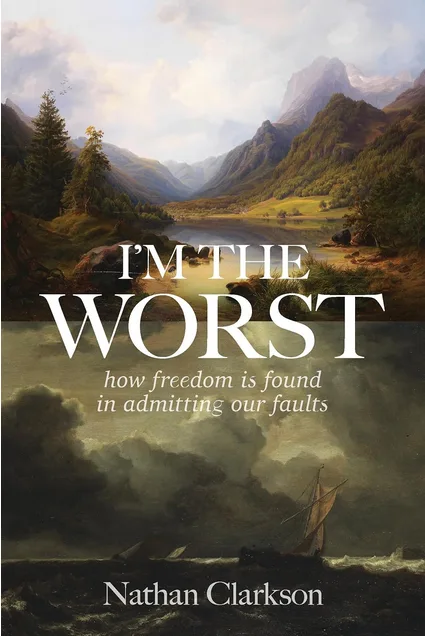
I’m the Worst: How Freedom is Found in Admitting Our Faults
When it comes to the world’s problems, it seems we know who to blame: them. The other party, team, tribe, or belief system. It’s natural to ignore the log in our own eye while seeing the specks in others’, but it might just leave us all blind and bound.
Through personal stories, cultural anecdotes, scientific data, and biblical wisdom, Nathan Clarkson invites you to join him in a different, better way of living―one that begins with admitting our own failures and faults, and leads to forgiveness and redemption.
There’s freedom in God’s grace―freedom for you and for the rest of the imperfect world too.
Leave a Reply