


About this episode:
Feeling anxious, overwhelmed, or stuck in your thoughts?
Taylor and Ellen talk about how to find peace in God when your mind won’t slow down and your circumstances feel out of control. Through Psalm 3, we walk through how David experienced real peace in the middle of fear, stress, and regret—and how you can too.

 Apple Podcasts
 Spotify
TIMESTAMPS:
00:00 God’s Stability In Trials
01:05 How to Find Peace In God
04:42 Taylor’s Anxious Prayer (at Bass Pro Shop)
09:13 Context of Psalm 3: David’s Struggles
17:15 The Consequences of Sin
19:18 Reading Psalm 3 (In Context)
23:12 Finding Comfort In God
26:54 Faith in Anxiety and Trials
29:26 God as Our Shield and Sustainer
34:17 Closing Prayer
Ellen Krause:
Welcome back to the Coffee and Bible Time podcast. I’m Ellen, your host, and today, Taylor and I are talking about how to find peace when you’re overwhelmed by anxiety and regret.
Have you ever walked through a season where you just feel overcome by your circumstances or even haunted by thoughts of past mistakes?
You can’t sleep, your mind won’t slow down, and no matter how hard you try to calm yourself, there’s this constant undercurrent of stress you just can’t shake.
In those moments, it’s easy to start feeling like God won’t hear you when you call to him. But in Psalm 3, David shows us something different.
He wrote this Psalm during one of the most anxiety-inducing seasons of his life. The consequences of his sin had caught up with him. He was betrayed by his own son, and he was literally running for his life. People were even saying, “God will not help him.”
And yet, right in the middle of all that chaos, what does David do? He sleeps.
Not because his situation suddenly got better, but because he trusted that God was still in control.
So today, we’re going to talk about the lies we tend to believe when anxiety is loud and our regrets feel too heavy.
And we’re going to contrast them with the truth we see in Psalm 3, which is that God is your shield, that he sustains you, and that real peace is actually possible, even when your circumstances haven’t changed.
So let’s jump into it, Tay. Have you ever had a moment where you thought, “God isn’t going to come through for me this time?”
Taylor Mitchell:
Well, you know, it’s just so good to be here. I just want to say hello to all of you. I love being on the podcast and talking. You know, I’m a talker. Every time I come on here, I just don’t stop, so you might have to put the reins on me here.
But absolutely have I believed that, you know, God won’t come through for me in this moment. And a lot of those times—I’m not going to lie—it is highly anxious times, either when I’m very anxious or if I’m experiencing some sort of physical discomfort.
I just think about—actually, this is kind of a random thing to bring up here, and not as crazy as what David was going through, okay? I mean, on the craziness scale, this was a 0.3% compared to him.
But just a couple weeks ago, I was at Bass Pro Shops. Okay, I was at Bass Pro Shops with my dad and actually Ashley—she was visiting home for a little bit—and I was on my period, okay? And I was cramping—well, I was starting to cramp, okay, before we left.
And… ladies, some of you get it. When you get those warning signs, you’re like, okay, I gotta take Advil now, otherwise this could be scary. Normally I try to stay on top of it, but if you have bad cramps, you know it can be scary.
So I took some Advil—three—and we were driving on our way over there, and it just kept getting worse. It just kept getting worse.
And to the point where I was like, I don’t wanna talk right now, because, like, to talk right now—I can’t, because my pain is too much.
And so we get there. I’m walking in. I’m like, I cannot handle this.
And I went and I sat down next to the fish tank. If you’ve ever been to a Bass Pro, you know they got a giant fish tank in there.
And I was sitting next to the fish tank, and I was just bracing myself. I was like, “God… please.”
Like, I was praying so much more than I normally ever do when I’m not in discomfort or super anxious. But I was starting to get really anxious because I’m like, it’s been 30 minutes—why is my Advil not working? Like, I am in so much pain right now. I feel trapped. I feel anxious. I feel like—is this going to end?
And so I told them, I’m like, “You—you guys walk around. I’m going to go sit on the couch,” because they have a couch at the front of the store.
And I just sat there, and I didn’t move a muscle. And I was praying, and I was feeling just, like, frustrated. I was really struggling, like, “God, why aren’t you helping me? Why do I feel like I have, in this moment, so much doubt that you can intercede in this moment?”
And even feelings of, like, why do I have more trust that my Advil will start to help work than, Lord, you will come supernaturally in this moment?
Throughout that next week, I was really pondering what was the spiritual lesson that God was trying to teach me in that moment of discomfort.
And I really do truly believe that I have had the most theological reflection time in my life when I am either anxious or when I’m experiencing physical discomfort.
Otherwise, I do tend to be very—I can coast through life, you know, do my Bible time study, but I don’t really deeply think about what is my faith rooted in.
Because when the storms come—of anxiety, physical ailment, discomfort—I’m really stretched to trust the Lord, that my faith in Him is beyond what He can do for me.
I don’t have faith in Him just because I need help and I’m a frail human being and I want Him to make me feel better. It’s got to be deeper than that.
And so what’s interesting here—and I told you that’s a 0.3% on the scale of what David was going through, and maybe even what you guys are going through as you’re listening to this—
If you’re going through a season of major anxiety, or you’re going through, you know, physical discomfort or ailments, you might have been where I was or where David was of, like, “God, are you hearing my prayers? I’m struggling to feel that you hear my cries.”
And so that’s why it’s so important to read passages like we’re going to be going through today in Psalm 3.
If you’re listening to this and you have time to open up your Bible app and look at Psalm 3 with us, that’d be awesome. Otherwise, we’re going to go through it with you.
Before we get started delving through this awesome passage, I just want to let you guys know that on our online community right now, we are going through the Psalms together—all of the Psalms.
We’re having accountability as a community, and we’re going through them together.
Every Thursday, me, Mentor Mama, and Ashley are going to be teaching you guys through the Psalms—going through them deeply together so that you know how to apply these Psalms to your life and you can grow that deeper relationship with the Lord.
So if you’re interested in that, I’ll have it linked in the show notes.
But in this story, David, like Ellen was saying—or Mentor Mama, I should say—he was in fight-or-flight mode. He was fearing for his life, and you see how deep the roots of his faith go when seemingly everything is turned against him.
And his hope was ultimately in God and in nothing else.
So would love to just delve into this. Mentor Mama, would you mind?
Ellen Krause:
No, that would be awesome.
And you know what? I’m thinking as a mom, as a parent, how deep, like—David not only was suffering, perhaps physically, from trying to, you know, escape the situation, but also just emotionally the pain of your own son…which I know you’re going to get into.
But I love putting myself into the story, and trying to really understand how he was feeling, and how I might feel in that situation, and just, the emotional part of it alone of my own child being against me is enough to, you know, put me through the wringer.
Taylor Mitchell:
Totally. And so I’m excited to share with all of you that are listening today what exactly Mentor Mama means by that.
So Psalm 3 begins, before you even start reading Psalm 3, it says: ‘A psalm of David when he fled from Absalom his son.’
And that’s where Mentor Mama was saying, holy cow, would that give her anxiety.
Let me give you some backdrop for this, okay, some backstory. Beginning in second Samuel, I’m gonna try to give you guys the rundown of what’s going on, because once you know what’s going on behind the scenes of this, it really opens your eyes to how messy this Psalm is.
And a lot of Psalms that you read will have intros just like that, that gives you a little bit of context of what that Psalm was about.
And if you go ahead and you look up on your computer or whatever when you’re reading the Psalms, just look up whatever that little tidbit is before you read, a lot of times it’ll tell you what story you can go back to in the Old Testament that Psalm is referring to.
So let’s give you the backstory here, okay? Who the heck is Absalom anyway? That’s not a name you hear all the time, right?
Okay, Absalom is David’s son. Now, why was David fleeing from Absalom? Well, this goes all the way back to David and Bathsheba.
This is 2 Samuel 11. We’re gonna go through 11, 12, 13, 14, and 15 together today, okay? David and Bathsheba is back in 2 Samuel 11.
If you know anything about this, this is some messy stuff, okay? David is a man after God’s own heart. David is the king of Israel.
And David has what we see in 2 Samuel 11, a lust problem that goes way too far, okay? He really entertains this in the sense that Bathsheba is a married woman to a man who is faithful. who’s in David’s own army, okay?
And David, what he does is he sees Bathsheba and he’s like, I want you. I want you no matter what the cost is.
And his lust for her went so far as to send her own husband out to the front lines of battle with the intention that he would die.
I mean, that’s really as plainly as you can put it there. Absolutely horrible motivations. I mean, sin to the core, lust is the surface of that.
At the the root of that is some major evil sin. And there was a lot of sin consequences that came along with that.
Ellen Krause:
Right.
Taylor Mitchell:
But one, result of that sin that we see, and I’m quoting here in second Samuel 12:10, Nathan the prophet tells David that “the sword will never leave your house because you despised God and took the wife of Uriah.”
Okay. The sword will never leave David’s house. That’s what you have to keep in mind here.
This is going back to the root of David’s own sin. And Nathan is prophesying that this is the result of that.
And you guys, we see the result of sin going all the way back to Adam and Eve for all of us. That we live in a sinful broken world.
This isn’t just David’s… you know, unique individual problem, that he’s a sinner and there’s consequences to his sin. We’re all experiencing the consequences of sin in our lives.
But moving forward with keeping that in mind, the sword will never leave his house.
We see issues in David’s family. So remember, Absalom is David’s son. David also has another son named Amnon.
Okay, not a very popular name probably for us here in the west, but Amnon also has a lust problem. And Amnon raped Tamar, who is Absalom’s full sister and Amnon’s half sister.
It can get a little complicated here, but point being—they are siblings.
Amnon raped his own sister, and had, I mean, horrible, evil, nasty intentions. He defiled her and he abandoned her after.
And Absalom, David’s son, is absolutely enraged by this injustice. This does not sit right with him. He is struggling to accept this, and this rage over this injustice stirs within his heart.
We see in the text that David was very upset over this, but we don’t see him do anything on behalf of Tamar. There’s no justice for Tamar, not even from her own father in this situation.
Ellen Krause:
Which is so, so surprising and so sad considering he was the king.
Taylor Mitchell:
Right? I mean, he was furious, but he didn’t do anything.
And this, I think, added even more fuel to the fire for Absalom because, you know, Absalom took Tamar into his own home to take care of her. Amnon, he raped her and he left her and this was devastating.
So Absalom, he’s not oblivious to the fact that his father did nothing. The king of Israel did nothing for his sister.
So here’s where the sword comes in. Absalom murdered his brother Amnon, and he fled.
And David, the king, is completely just broken over this, right? He’s broken over this, because his son died, but there’s also the layered effect of, you know, his other son murdered him and fled. He’s not in connection with, you know, either of his sons at this point now, and he’s completely devastated.
Over time, years go by after he fled, three years, and Absalom comes home to David, but David won’t even look at him. We’re seeing layers and layers of this. So, Absalom comes home. David won’t even let him come into his presence for years. We see two years go by, and that’s how long Absalom is in Jerusalem, but David won’t even acknowledge him.
So Absalom does a lot of things so that he can to try to finally get David to acknowledge him. And when that time finally comes, you know, there’s almost this feeling of reconciliation, but there really isn’t. Because in Absalom’s heart, he still has hatred towards his father for what he did.
So Absalom tries to start a revolt. I mean, he doesn’t try, he does. He creates a revolt. He gets all the people in Israel who are struggling with feeling like they’ve had injustices done to them.
He kind of speaks into their minds like, if you have an issue, the king isn’t going to give you anyone to listen to your problem. So if I were just king, if people just made me the king of the land, well, then I would judge fairly. I would be the one to make sure everybody receives justice for the things that they’re going through.
So he’s concocting this plan. He’s telling all the people in Israel that they should follow him. And this really does work because a revolt happens.
So four years after him and David, you know, came together, seemingly things were fine on the surface…four years later, the revolt happens. Absalom creates a full-fledged revolt to not only become king himself, but to kill his father.
So that’s where we find ourselves in Psalm 3. That’s some pretty intense stuff here, and a lot of anger towards injustices.
I want to say at the beginning of this, the heart of is not wrong, to want to have justice for the wrong that was done. It’s just spiraled into sin, you know. Do you have any thoughts on that?
Ellen Krause:
Mm hmm.
Well, and I think that the enemy really seduces us, especially when it’s hard to trust God when it’s connected to your own past mistake.
The enemy really just keeps bringing it up, and bringing it up, and giving you feelings of shame and doubt that God could ever forgive you, a sinner who had done all of these things.
So I firmly, you know, have fallen into that as well—that it is harder for me to trust God when I’m suffering.
Taylor Mitchell:
Yeah, and so that’s where we’re finding ourselves as I read Psalm 3 to you all, is David is really experiencing, you know, the result of what we saw all the way back with him and Bathsheba.
The sword would never leave his house. He’s experiencing that with his own children, with his son going after him.
And here we are. We’re going to see how deep David’s roots go into his faith despite, you know, potential feelings of shame over what he had done. He still reaches out to the Lord.
Let that be a message for all of us, honestly—no matter what we’re going through, do not abandon your faith because of the circumstances that you’re going through or because of the shame that you might be feeling.
I’m gonna go ahead and read Psalm 3. It says:
“O Lord, how many are my foes!
Many are rising against me;
many are saying of my soul,
“There is no salvation for him in God.”
But you, O Lord, are a shield about me,
my glory, and the lifter of my head.
I cried aloud to the Lord,
and he answered me from his holy hill.
I lay down and slept;
I woke again, for the Lord sustained me.
I will not be afraid of many thousands of people
who have set themselves against me all around.
Arise, O Lord!
Save me, O my God!
For you strike all my enemies on the cheek;
you break the teeth of the wicked.
Salvation belongs to the Lord;
your blessing be on your people! Selah.”
So that is Psalm 3.
How do you feel after knowing the context about everything that goes behind that Psalm?
Ellen Krause:
It makes me—it gives me just a deeper understanding of the peril, the complexity of what was actually happening in that situation, and really the magnitude to which he was calling out to God.
Taylor Mitchell:
Yeah, it’s really kind of—I mean, if you think about the situation—I mean, he’s hiding from, you know, being murdered, and he writes this beautiful Psalm.
It’s kind of like, whoa.
When I am in my deep struggles, my anxiety, my pain, I think I find myself really being challenged to not focus on my pain, instead to lift my eyes to the Lord—to praise him for who he is.
That’s what I find also so profound in the Psalms, is when people are really struggling and they’re going through things just like David is going through, they never fail to praise him.
They never fail to ultimately acknowledge who God is despite what they’re going through.
In verse 3, he says, “You, Lord, are a shield about me, my glory, the lifter of my head.”
And this verse—first of all, if you’re listening to this and you need something to memorize as you are going through a struggle, this verse should be something that is, you know, on the top of your list to memorize.
Something that I just kind of noted as I was studying this is that the “are,” when he says, “You, O Lord, are a shield about me, my glory, and the lifter of my head”—that is a state-of-being verb.
In other words, active, it’s ongoing, it’s not going to stop, because that is who God is.
God is our shield, no matter what you’re going through, and he is the lifter of your head in whatever circumstances that you’re going through.
And something that I think is so profound as well—just zooming out, okay—he’s being chased. He’s thinking he could get murdered. His whole kingdom could be taken away from him.
And he says that the Lord is his glory.
And you know what I thought is just—I can’t even imagine that being something on your mind, that when you are in your worst moment, you’re finding comfort in knowing that God would be his glory.
In other words, God would be glorified in his life.
He’s taking the lens off of himself in this horrible situation, and he is looking to God.
And he’s finding comfort in knowing, you know what? God, you are my glory.
And to glorify God in our lives is to make much of him. It’s to make God great. It’s to take the focus off of yourself and to think to yourself, you know what?
At the end of my life, I want the world to see Jesus through me. I want them to see God through me. I don’t want them to see me.
And David knows his mistakes. He knows what he did with Bathsheba. He knows that he’s caused innocent lives to be lost.
And yet he finds comfort in knowing, you know what? God’s glory is greater.
And I just—I can’t believe that he did that. I find it so profound.
What do you think, Mentor Mama?
Ellen Krause:
Well, it is profound because, like you said, we’re always very self-centered, and we search for things like fame and power, prestige, our possessions—things that make us look good—giving attention to the glory that is about ourselves.
In a lot of ways, David had all that. What he found and saw that was more important was his glory in God.
And the other thing I just thought was really interesting in looking at this passage was that though Absalom had taken over Jerusalem and forced David out of there, David knew that God still was on the throne—that God still had a plan.
And just because Absalom was making and planning on doing these things, if they weren’t from the Lord—
Taylor Mitchell:
Right.
Ellen Krause:
Then I’m not gonna say David didn’t have to worry about it, because in that situation it was peril, but the Lord himself still held that ground.
Taylor Mitchell:
Mm-hmm.
He could hear David and help David because he was the one that was truly on his holy hill.
Taylor Mitchell:
Right, absolutely. That is so important to even think, in whatever situation that we’re going through, is to just think about that—Is God still on the throne when we are experiencing anxiety, when we’re experiencing physical pain?
I think that’s something I’ve been challenged through in my life, especially as I was walking through my phobia of throwing up, and I was constantly anxious. And whenever I’m anxious, my stomach’s hurting, so it just feeds this endless loop of torment of my own brain towards myself.
I really have to be challenged to ask myself in these situations, like, can I accept that what I’m going through is hard and still trust that God is good?
Can it feel like, you know, my world is crumbling and I still believe that God is good?
We are going to go through trials as believers. Scripture never says that when you become a Christian, your life will be daisies. It doesn’t.
And in fact, trials are meant to sharpen us.
And I think a lot of times, for those of us that experience anxiety, we are challenged more so than the average person that doesn’t experience anxiety to think more critically about our faith and to think deeper about what God means to us.
Is he the person that we just expect to fix all of our problems, and when he doesn’t, then we’re really thrown into a doubting spiral?
Or is he—go ahead, go ahead.
Ellen Krause:
Well, I was just going to say, you know, I’ve seen this lived out in someone in my life who had experienced horrible chronic pain for years, and just praying and praying and crying out, and always coming back to who God is.
Bearing through times of doubt and disbelief that anything could ever possibly change, in God’s miraculous way, she actually did find a medical treatment that was able to help her, which to this day we just praise and thank God for.
Taylor Mitchell:
Mm-hmm.
Ellen Krause:
But I think of her as an example that we need to wait also on God’s timing.
For some reason, he allowed her to experience this for an ongoing number of years, and it just was awful to see. Broke my heart.
But yet, we did see God’s faithfulness in the end.
And the other example that I have is just one of my own, and that is when Ashley told us that she was moving to Puerto Rico.
Taylor Mitchell:
Right. Right.
Ellen Krause:
That was a really, really hard time for me. And I didn’t understand—like, there’s so many ministry opportunities so much closer to us here. Why did God have to take her, our first grandson, away all the way to Puerto Rico?
And it was just really, really hard.
And yet, by the time I actually went there, saw the environment, saw how God was already blessing the church and the people there through their ministry, it brought me such tremendous peace.
Taylor Mitchell:
Yes.
Ellen Krause:
So I think when you’ve gone through some things in life, when you’re older like I am and you’ve seen other people’s struggles, it does teach you that, like, all rightby God’s grace, I will get through this, and I can trust him.
Taylor Mitchell:
Amen.
And I want to lean more into that, just to land the plane here for all of you that are listening, about what’s the main idea of this passage as you’re reading through this psalm.
There’s four things that I think would be really beneficial to take away here.
The first thing that is important for us to know is that the enemy—he’s always been like this, and he will be until Christ comes again—he will tempt believers to think that God will not help them in their times of trouble, that God doesn’t care, okay?
The enemy wants you to be tempted to believe God could care less.
And we see this right in the Psalm. David says many people were saying of his soul, “There is no salvation for him in God.” He is too far gone.
And whatever you’re going through, that’s what the enemy wants you to believe.
And if you know that you are in Christ, there is nothing that could separate you from his love, from his salvation that is secured through Christ, your savior.
And if you have to just say that over yourself, over and over again through whatever you are experiencing, memorize that verse.
There is nothing that will separate you from the love that you have in Christ Jesus.
No matter what your circumstances or situation is, don’t believe the lie that God does not care.
Next thing that we see that’s important and eternally true from this passage: God is our shield. He is the ultimate lifter of our heads, and he answers our cries.
Did you know that when you pray to the Lord, it’s like incense going up to him in heaven?
He sees our prayers. Christ is the mediator of your prayers. He is hearing your cries.
He is the ultimate lifter of your head—not the circumstances that you’re in, if it goes the way that you want it or if it doesn’t.
Don’t let your circumstances be what is lifting your head up every morning.
And that’s hard to do, but you have to lean on the Lord. He is your shield, okay?
The third thing that is important for you guys to know from this passage is that in trials, God is the one that sustains his children.
God is the one that makes it so that we can fall asleep or we can wake up in the morning and that we don’t have to live in fear. And that is just so beautiful to think about, right?
All of our worries aside, God is keeping the world going round and around and around. The sun will rise in the east always because God is the one sustaining it. He’s sustaining us.
And I’m not saying that when you’re anxious or when you’re going through something, your sleep is gonna be perfect—but God is sustaining you through this.
God wants to teach you something through this in your trial. It’s not for nothing.
And don’t believe the lies of the enemy that what you’re going through means nothing. That is a lie. That is arbitrary.
And the last thing that I want to say to you guys from this passage that is so important to take away is that salvation belongs to the Lord, and he will fight for you. He will always fight for his people.
Salvation is something that, when you put your faith in Christ, will never be taken away from you—period.
No matter what you go through, whatever physical trial you go through—and Scripture is clear—I mean, especially when you read through Revelation, which is something I’m reading through right now—
Servants, his saints, his church—you and I—are going to experience trials in this life. But we have ultimate victory in Christ, in the Lamb.
Will we experience hardships and trials in this life? Yes. But salvation ultimately belongs to the Lord. Put your hope in him.
Ellen, would you mind closing us in prayer?
Ellen Krause:
Love to do that.
Heavenly Father, Lord God, we just praise your holy name. We thank you that you are a God who hears us, that you are trustworthy, that you follow through on all of your promises, that you are our shield.
Lord, I just pray for anyone who’s listening to this podcast, that they would come to you and that they would see firsthand, Lord, that you are there for them each and every moment of every day.
And so we thank you for this encouragement in your word today. And we just thank you.
In Jesus’ name, amen.
Well, thank you so much for listening to the Coffee and Bible Time Podcast today.
I want to just mention one thing, and that is, if you know someone who you think might be encouraged by this message, would you please forward it to them?
I feel like that’s one way in which we can really be the hands and feet of Jesus, where we can just pass this along to someone who’s hurting and who needs to feel God’s love. So that would be really awesome.
Thank you again for listening. We love you all. Have a blessed day.
Do you ever feel like your mind won’t slow down?
Even when you try to rest, the thoughts keep coming. The stress lingers. And no matter how hard you try to calm down, there’s an undercurrent of anxiety you just can’t shake.
If that’s you, there’s good news:
Learning how to find peace in God isn’t about having perfect circumstances. It’s about anchoring your heart in truth, even when everything around you feels uncertain.
In this episode of the Coffee and Bible Time Podcast, Taylor and Mentor Mama dive into Psalm 3 to unpack how David found peace in the middle of fear, stress, and regret—and how you can too.
Why It’s So Hard to Find Peace When You’re Anxious
Anxiety has a way of clouding everything.
In those moments, it’s not just your circumstances that feel overwhelming—it’s your thoughts. And in situations where our anxiety is centered around regret, shame, or past mistakes, it’s easy for the way we see God to become affected.
“In those moments, it’s easy to start feeling like God won’t hear you when you call to Him.”
Ellen Krause
That lie—that God is distant, silent, or unconcerned—is one of the biggest barriers to learning how to find peace in God.
But Psalm 3 shows us a completely different reality.
Psalm 3: Finding Peace in the Middle of Chaos
Psalm 3 was written by David during one of the most intense seasons of his life. He wasn’t just stressed—he was running for his life, betrayed by his own son, and facing the consequences of past sin.
And yet, listen to what he says:
But you, O Lord, are a shield about me,
my glory, and the lifter of my head.
I cried aloud to the Lord,
and he answered me from his holy hill.I lay down and slept;
Psalm 3:3-5
I woke again, for the Lord sustained me.
David wasn’t at peace because his situation improved. He had peace because he trusted God in the middle of it.
That’s the foundation of learning how to find peace in God:
Peace doesn’t come from control—it comes from trust.
What Does It Actually Mean to Find Peace in God?
Finding peace in God doesn’t mean your anxiety instantly disappears.
It means:
- You trust God even when you still feel anxious
- You turn to Him instead of spiraling inward
- You anchor your thoughts in truth instead of fear
As Taylor asked;
“Can I accept that what I’m going through is hard and still trust that God is good?”
Taylor Mitchell
That’s the tension of faith.
And that’s where real peace begins.

4 Practical Ways to Find Peace in God
If you’re wondering how to find peace in God in your everyday life, here are four biblical takeaways from Psalm 3:
1. Recognize the Lies You’re Believing
David says:
“Many are saying of my soul, ‘There is no salvation for him in God.’”
Psalm 3:2
In other words, people—and maybe his own thoughts—were telling him: God won’t help you.
Sound familiar?
Anxiety often comes with lies like:
- “God doesn’t care”
- “You’re too far gone”
- “This will never get better”
But those thoughts are not truth.
Learning how to find peace in God starts with identifying and rejecting those lies.
2. Remember Who God Is (Not Just What You Feel)
David declares:
“You, Lord, are a shield about me… the lifter of my head.”
Psalm 3:3
Notice David doesn’t say, “I feel peaceful.” He says, “God is my shield.”
That’s a powerful shift.
Peace comes when you stop asking, “How do I feel?” and start focusing on, “Who is God?”
Even when your emotions are unstable, God is not.
3. Trust That God Is Sustaining You
One of the most comforting verses in Psalm 3 is this:
“I lay down and slept; I woke again, for the Lord sustained me.”
Psalm 3:5
In the middle of danger, David slept.
Why?
Because he trusted that God was holding him—even while he rested.
If you’re struggling with anxiety, this truth matters:
You are not holding your life together. God is.
Even when your thoughts feel chaotic, even when your body feels tense—God is sustaining you.
4. Choose to Trust God Before Your Circumstances Change
This is the hardest part—and the most important.
Peace doesn’t come after everything gets better. Peace comes when you can say:
“It feels like my world is crumbling—but I still believe that God is good.”
That’s what it means to truly learn how to find peace in God. It’s choosing trust in the middle of uncertainty.
When Anxiety Feels Personal
Sometimes anxiety isn’t just about things outside of your control—it’s tied to your past, your mistakes, or your regrets.
And that can make it even harder to believe that God will save you.
But here’s the truth:
“No matter what your circumstances or situation is, don’t believe the lie that God does not care.”
Taylor Mitchell
David had a past. He had regrets. He had consequences he couldn’t undo.
And still—he turned to God.
You can too.
Final Encouragement: Peace Is Possible
If you’re in a season where anxiety feels overwhelming, take this with you:
- God hears you
- God is near
- God is your peace
Learning how to find peace in God is not a one-time decision—it’s a daily practice of turning your heart back to Him.
Even when it’s hard. Even when you don’t feel it. Even when nothing around you has changed.
Because real peace isn’t found in your circumstances—It’s found in Him.
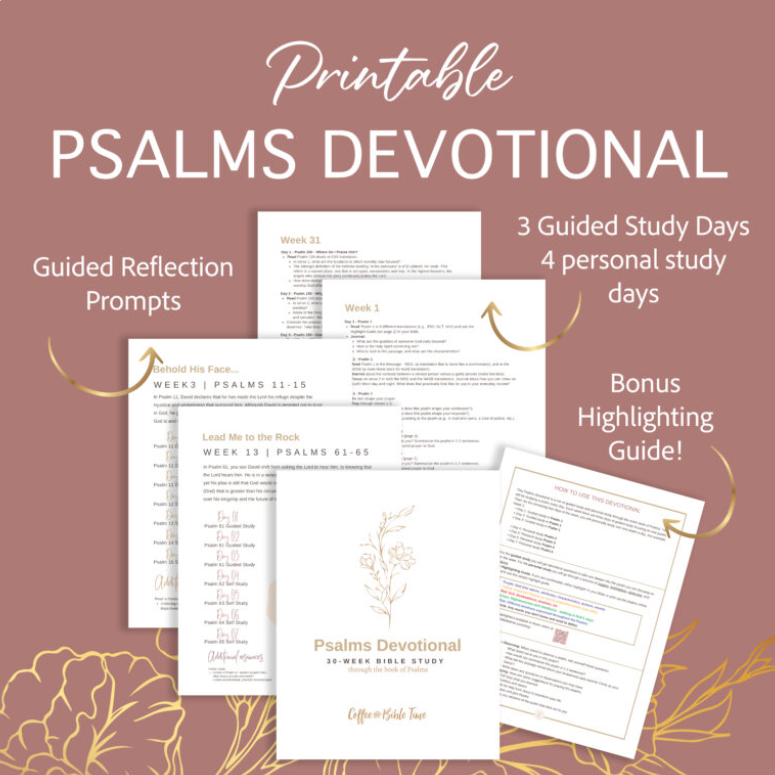
30 Week Psalms Devotional PDF
Grow deeper in your faith with this 30 week Psalms devotional PDF for women, designed to help you build a consistent, meaningful quiet time with God.
Part of the Coffee and Bible Time devotional series, this is the condensed digital download version of the full physical notebook—perfect for flexible, everyday use.
Leave a Reply