
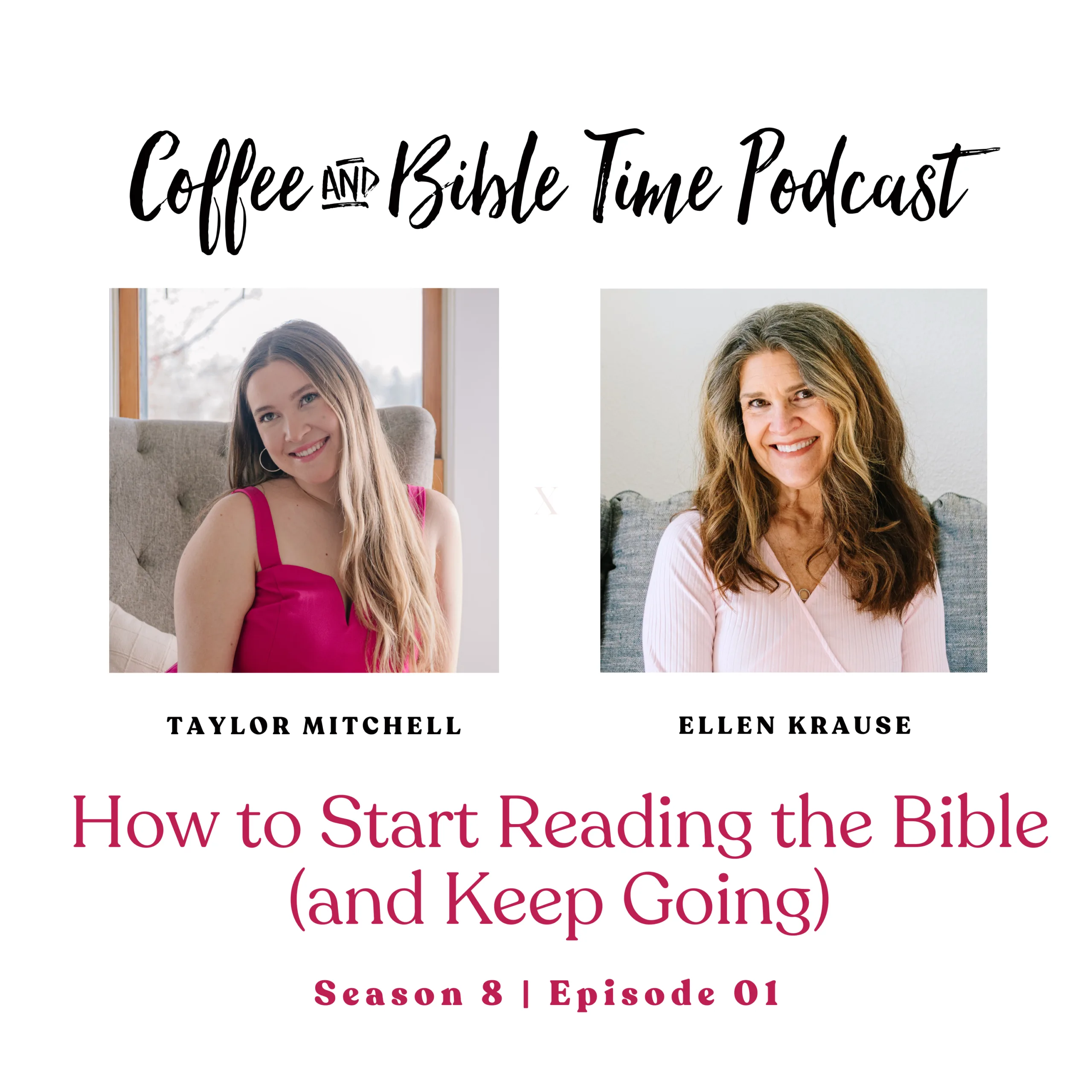

About this episode:
Have you ever started reading the Bible with good intentions of consistency, only to fall behind, feel discouraged, and give up? You’re not alone. Ellen and Taylor are sharing the simple, realistic, and grace-filled tips that helped them learn how to start reading the Bible—and actually keep going.
Subscribe & Listen on:
 Apple Podcasts
 Spotify
TIMESTAMPS:

00:00 New Year, New Beginnings: Starting Bible Reading
04:56 Choosing the Right Starting Point
09:53 Overcoming Guilt: Picking Up Where You Left Off
14:46 Finding Your Rhythm: Realistic Quiet Times
19:45 Small Steps, Big Changes: Starting Small
21:04 Understanding Scripture: The EASY Bible Study Method
Introduction [Taylor Mitchell]:
Life has seasons and ebbs and flows, right? And I think one of the beautiful things about a yearly rhythm is that you get this time to reset. This time of year, you give yourself permission to reset your goals and chase after the things you know are meaningful to you.
So my encouragement to you guys would be to embrace that—especially in terms of your relationship with God—and think about the things you want to do that will matter, that will have everlasting impact. Think about all the people who will witness your walk with God when they see you investing in your life. They may want to change their own lives or be inspired to take their relationship with God more seriously just by seeing how you’ve changed, transformed, and taken your faith seriously.
Ellen Krause:
Hi everyone, happy new year. Welcome back to the Coffee and Bible Time podcast. I’m Ellen, your host, and joining me today is my daughter, Taylor. Very excited to have you, Tay.
Taylor Mitchell:
Thank you so much. I’m so glad to be here.
Ellen Krause:
Very good. As the new year starts, I think we need to talk about tips for starting to read the Bible in this new year. I know a lot of people are frustrated because they’ve done this before, and by February things have fizzled out—or Leviticus, whichever came first. Can you relate?
Taylor Mitchell:
Absolutely, I can relate. I’ve fallen off in Genesis, okay? I’ve fallen off very quickly after starting. And for those of you listening, maybe you don’t know where to start, or maybe you’ve fallen behind in years past because life just gets loud and busy and crazy. Maybe the Bible has even felt overwhelming at times instead of life-giving.
Ellen Krause:
Absolutely. So today we want to take that pressure off. We’re going to share some simple, very realistic, helpful tips so that you can actually start reading the Bible this new year—and do it with joy, not guilt.
Our first tip is to join a Read the Bible in a Year plan. I know some of you might be thinking, “Ooh, that’s really daunting.” But what it actually does is take daily decision fatigue out of the equation. Taylor, you and I were just at YouVersion, which has now surpassed a billion downloads of the Bible app, and they shared that their most completed plans are the Read the Bible in a Year plans. You know why? Because you already know what you’re going to read—it’s just there for you.
Taylor Mitchell:
That’s so true. I love that you said that because one thing that’s kept me from reading my Bible daily in the past is decision fatigue—and putting too much emotional weight into the decision. Like, “What will make me feel this way today?” or “What passage will speak to how I’m feeling?”
Some days you’re just like, “I don’t even know what to do.” It’s one more decision on your plate. But if you remember that God is going to meet you where you’re at, and that we go to the Bible primarily to learn about God—not to address every single emotion we’re feeling—it actually makes it easier to commit to reading. Especially when you’re using a Bible-in-a-year plan that lays it all out for you.
Ellen Krause:
Absolutely. We’re actually providing a free Read the Bible in a Year plan. You can find it on our website at coffeeandbibletime.com.
The bonus is that you can do it within our community, which gives you accountability and a place to engage with others doing the plan. I think doing it together makes a huge difference. Don’t you, Tay?
Taylor Mitchell:
I do. Accountability really matters for a lot of us. Whether you have a small group or church to dig into Scripture with—or you’re someone who doesn’t have access to that—you want a place where other women are challenging themselves to do the same thing.
So yes, I’d totally recommend finding accountability this year. In the show notes, we’ll link both our community and the Read the Bible in a Year Plan.
Ellen Krause:
Absolutely. Tip number two is to start with one of the Gospels. If a Bible-in-a-year plan feels like too much, start with a Gospel—like the book of John.
Taylor Mitchell:
This is such an amazing place to start, especially if you’re digging into your faith for the first time or you’re newer to reading the Bible. If you want to learn about Jesus and understand why He’s so central to our faith, the Gospels are perfect.
The book of John, in particular, is great for those wrestling with faith or belief. It’s really written to help people understand why faith in Jesus matters and why believing in Him is so important.
Ellen Krause:
Yes, and the book of John has a special place in our hearts because we’ve spent a lot of time creating a brand-new Bible study with Moody Publishing called The Gospel of John, using the Easy Bible Study Method.
We walk through seven stories from the book of John and teach you how to study Scripture with the goal John himself states—that you may believe and truly know who Jesus is.
Taylor Mitchell:
Exactly. So if you’re thinking a Bible-in-a-year plan is too much right now, we’d recommend starting with one of the Gospels—Matthew, Mark, Luke, or John.
If you want extra help diving deeper into John, check out our EASY John Bible Study. We’ll link it in the show notes. This is brand new, and we’ll be going through it live weekly on our community platform, where Ashley, Ellen, and I will teach and interact directly with everyone. We’re really excited about this launch.
Anything else you want to add, Ellen?
Ellen Krause:
Just that I’m very excited. I love the book of John, and this is going to be an amazing time together.
Tip number three—this one’s close to Ashley’s heart—is to just pick up where you left off. If you started a reading plan last year and dropped it, don’t go back to the beginning. Just pick up where you left off.
Taylor Mitchell:
Yes. At the core of this is asking, “Why am I putting pressure here?” Where is this pressure coming from to have a perfect quiet time every day?
Something that’s transformed my approach is remembering that God knows we are dust. He knows we’re frail and complex and sinful—that’s why He sent Jesus. So why do we expect perfection from ourselves? Jesus’ blood covers us.
When you enter your quiet time clothed in that grace, it changes everything. God sees you as you are, and that’s comforting. Read what you can today. Soak in your time with Him. Don’t make it bigger than it needs to be.
Ellen Krause:
Absolutely. That reminds me of my ADHD and how hard focusing can be. There’s a lot of guilt and shame around that. We actually made a whole video on this recently, and we’ll link that ADHD video below.
What really matters is the heart behind why we’re reading—to know Him more and make Him known. He will transform your life if you let Him.
Taylor Mitchell:
Tip number four is to choose a quiet time that fits your real life. A lot of people quit because they choose a time that isn’t realistic.
How many of us have said, “I’m going to wake up at 5 a.m. every single day,” only to crash a few days later? Then the guilt and shame roll in. Instead, ask what’s actually realistic for your life right now. That may ebb and flow by season—especially if you have kids or changing schedules.
Ellen Krause:
Absolutely. Life changes in every season. There have been times when I’ve done quiet time first thing in the morning—and other seasons when I haven’t. I’m just not a morning person. Remember that DNA test we took?
Taylor Mitchell:
Yes, that test showed your natural body clock.
Ellen Krause:
Exactly. You have to be realistic. Maybe it’s during a nap time, or before bed. And if you can do it first thing in the morning—God bless you—you’re starting your day strong.
Taylor Mitchell:
Just remember, consistency grows when your plan fits your life, not when your life has to bend around unrealistic expectations. If waking up at 4 a.m. doesn’t fit you, don’t feel bad about it. Find a rhythm that works with your real life.
Ellen Krause:
Absolutely. The next tip is to start small—even five minutes. It’s like exercise: once you start, you often keep going.
Don’t tell yourself your quiet time only “counts” if it’s an hour long. God sees your heart. Whatever He wants to show you in His Word that day will be sufficient.
Taylor Mitchell:
Yes. For me, starting small might mean reading just a few verses. That helps me actually soak in what I’m reading instead of rushing through it.
Maybe your goal this year is two verses a day, or a short passage, or one chapter. That’s doable—and consistency builds from there.
Ellen Krause:
Absolutely.
Taylor Mitchell:
And I know there are a lot of people—I was actually encouraged again at the YouVersion Bible Conference. If you’re confused about what YouVersion is, it’s a Bible app. It’s the most popular Bible app across all devices.
Someone at that conference shared that they’ve read the Bible multiple times just by listening to it in the car during their commute to and from work. So if your commute—whether it’s to church, dropping your kids off at school, or going to school yourself—is five, ten, or fifteen minutes, that’s a built-in way to read the Bible. It fits right into your schedule, just like we were talking about earlier, and it’s a great way to start small.
Ellen Krause:
Yes, and I love that some of those readings are actually dramatized. It almost makes you feel like you’re there. Definitely check those out. And small, faithful steps can build sustainable habits.
Taylor Mitchell:
All righty, and I’ll go ahead and share our last tip—tip number six—which is to use a simple method to help you understand what you’re reading.
One reason people stop reading the Bible is simply because they don’t understand it. You might go into Bible reading without a system to help you navigate things like historical context. And we need to be honest—there are things in the Bible that we don’t understand at first. Many of those things are meant to be learned over time.
That’s why having a plan or system is so helpful. Here at Coffee and Bible Time, we’ve shared the EASY Bible Study Method for years, and we just came out with a book on it. It’s an acronym:
E – Enter the story
A – Assess the main idea
S – Seek God in His character
Y – Yearn for a heart change
This framework helps you understand Scripture and gives you a clear goal each day as you read—including something really important: context.
Ellen Krause:
Absolutely. From the feedback we’ve received on the EASY Bible Study Method, the “E—Enter the story” step has been a little elusive for some people. What’s crazy is that I’ve been reading my Bible for decades, but probably for the first whole decade, I never read the opening comments or introductions to the books of the Bible. I would just flip right past them, thinking, “That’s too academic. I don’t need that.”
But now I see how rich and important those introductions are. They ground us in when the book was written, who wrote it, who it was written to, and so much more. That context enriches your entire experience of reading the book.
Taylor Mitchell:
Studying—yes. And that’s just one part of the EASY Bible Study Method. It’s such a tremendous resource.
Another thing we just released is the coordinating EASY Bible Study Journal. If you’ve already learned the method, this journal is set up so you can pick a passage and study it for yourself using the EASY framework.
We really hope these tips encourage you to start reading your Bible. Don’t wait another day. Do you feel encouraged, Taylor?
Taylor Mitchell:
Yeah, I feel encouraged. I’m even thinking about my own life—life has seasons and ebbs and flows, right? And one of the beautiful things about a yearly rhythm is that you get this opportunity to reset.
This time of year, you give yourself permission to reset your goals and chase after the things you know are meaningful. So my encouragement to you guys is to embrace that, especially in your relationship with God. Think about the things you want to do that will truly matter and have everlasting impact.
This time of year, so many people focus on body image, diets, or making more money. And while not all of those things are bad, think about the things that have internal, eternal impact—the spiritual things you’ll take with you into heaven.
Think about all the people who will witness your walk with God when they see you investing in your life. They may be inspired to change their lives or take their relationship with God more seriously just by seeing how you’ve changed, transformed, and taken your faith seriously.
Ellen Krause:
That’s so beautiful. I love that, Tay. Thank you so much for sharing that.
Everyone, we want to invite you to take the pressure off and let this new year be less about checking a box and more about growing closer to Him. Thank you so much for joining us, and we’ll see you next time on the Coffee and Bible Time podcast.
Taylor Mitchell:
Bye!
For some of us, it’s a yearly (or monthly) tradition: you’ve fallen off your Bible reading plan, but you’re starting again—and this time, it’s going to stick! Your intentions are good, you got a new journal, and you’re starting fresh…and then you hit Leviticus.
If you’ve ever wondered how to start reading the Bible but felt overwhelmed, discouraged, or unsure where to begin, you are not alone.
In this episode of the Coffee and Bible Time podcast, Ellen and Taylor share realistic, grace-filled wisdom for anyone asking how to start reading the Bible in a way that actually fits real life.
Grace Motivates More Than Guilt
One of the biggest obstacles to learning how to start reading the Bible is guilt. It can be easy to get an idea in our mind of what an ideal Bible reading routine should look like—but when we get a few weeks behind or feel like our progress is too slow, the discouragement can be so overwhelming we give up.
But the truth is that God isn’t mad at us or distant when we struggle. He’s not looking for our perfection. He works in us even when we fall short.
“God knows that we are dust. He knows that we’re frail. He knows that we have all sorts of complexities in our life because of the fall and that we’re sinful human beings. That’s why he sent Jesus. Because he knows that we can’t be perfect.”
Taylor Mitchell
When thinking about how to start reading the Bible, it’s important to remember that your relationship with God is built on grace, not performance.
Helpful reminders as you begin:
- It’s okay to just pick up where you left off
- Falling behind doesn’t mean you’ve failed
- God cares more about your heart than your streak
Starting the Bible with grace allows you to return again and again—without shame.
Build a Bible Reading Plan That Fits Your Real Life
Another key part of learning how to start reading the Bible is building a routine that works with your actual schedule. Many people quit because they aim for unrealistic goals that don’t match their season of life.
Reading the Bible doesn’t always mean sitting down with an open book. Listening to Scripture counts. 5-minute study sessions count. Consistency grows when your plan fits your life.
Simple ways to build a sustainable habit:
- Listen to Scripture on your commute (try apps like YouVersion or her.Bible)
- Read a few verses instead of whole chapters
- Choose a realistic time of day
- Start with a Gospel, like the book of John
- Use a Bible-in-a-year plan to reduce decision fatigue
Ellen summarizes it well:
“Small faithful steps can build sustainable habits.”
Ellen Krause
If you’re learning how to start reading the Bible, small steps are often the most powerful ones.
Keep it Simple (and EASY)
A major reason people struggle with how to start reading the Bible is confusion. The Bible was written in a different time and culture, and without context, it can feel intimidating.
Taylor explains:
“One reason that people stop reading the Bible… is just you don’t understand it. You go into Bible reading and you don’t have a system that helps you navigate through some of those waters.”
That’s why using a simple study method can make all the difference when learning how to start reading the Bible. The Easy Bible Study Method gives readers a clear framework:
- E – Enter the story
- A – Assess the main idea
- S – Seek God in His character
- Y – Yearn for a heart change
Understanding context helps Scripture come alive—and makes Bible reading something you look forward to.
Encouragement As You Start Reading the Bible
If you’re still needing help learning how to start reading the Bible, remember this: God is not in a hurry, and He is not disappointed in you. He simply wants to meet you in His Word.
Taylor leaves us with this encouragement:
“Think about the things that will have an internal impact… including all the people that will be a witness to your walk with God when they see you investing in your life.”
Taylor Mitchell
You don’t need to do everything at once. Start small. Start today. And trust that as you learn how to start reading the Bible, God will meet you there—faithfully, gently, and full of grace.

The Gospel of John: A 7-Week Study
Using The Easy Bible Study Method, the Coffee and Bible Time team walk us through one of the most beloved books of the Bible—the gospel of John.
In this seven-week Bible study, readers dwell in John’s gospel, learning how to Enter into stories, Assess the main ideas, Seek God and His character, and Yearn for heart change and deeper intimacy with Jesus.
Leave a Reply