
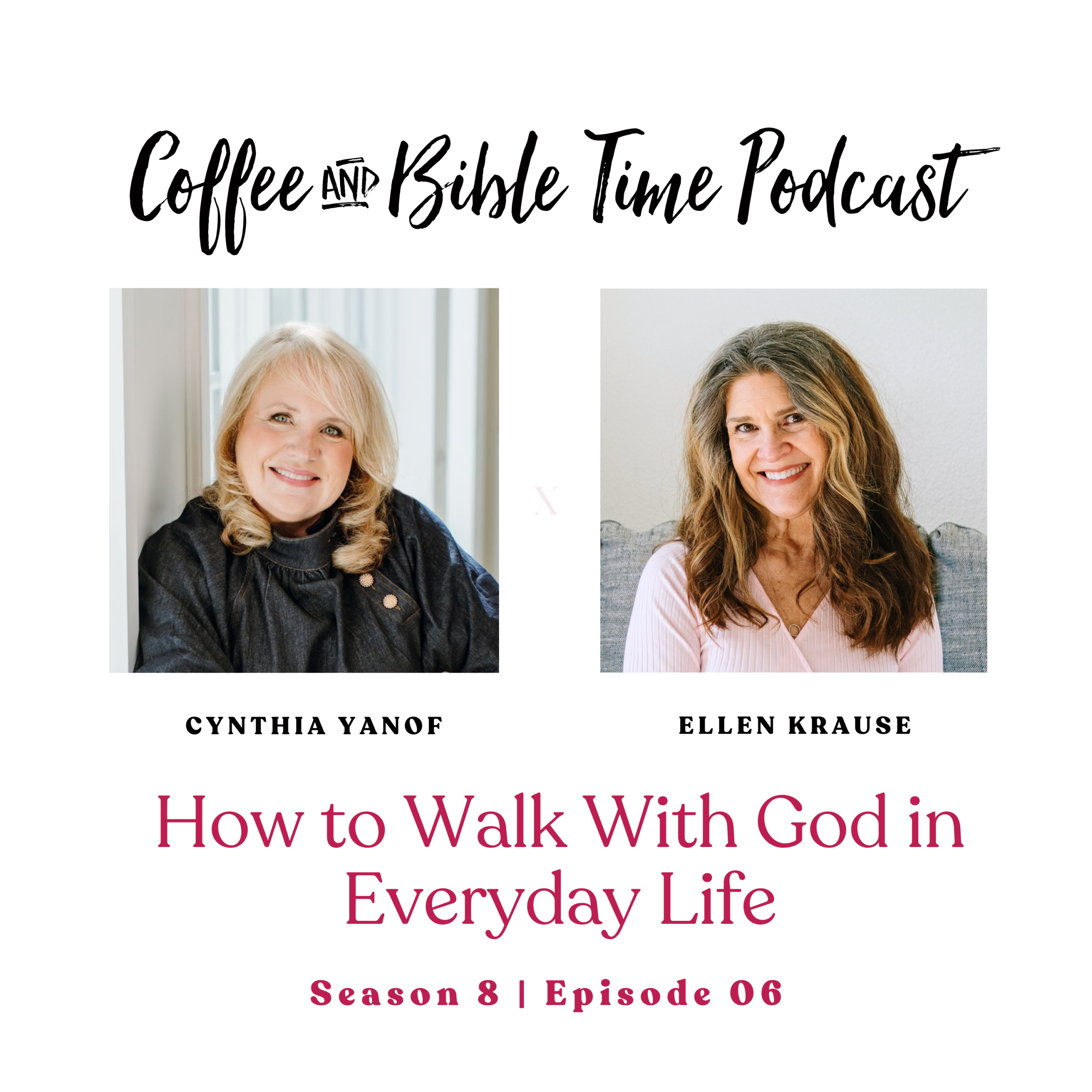

About this episode:
Our faith is shaped by small, sometimes inconvenient choices that shape our walk with God over time.
In this episode, Ellen and Cynthia explore how a steady, ordinary walk with God forms our obedience, emotions, and love for others—even when no one is watching. Cynthia shares powerful analogies, relatable stories, and biblical encouragement to help you see how God is actively at work in your everyday life.
 Apple Podcasts
 Spotify
TIMESTAMPS:
02:29 Walking with God in Everyday Moments
07:18 The Importance of Love in Faith
11:50 The Power of Friendship and Reconciliation
19:02 Understanding Identity Through Adoption
23:50 God’s Renovation: Building a New Life
31:22 Guest Information & Bible Study Tools
Ellen Krause: Welcome back to the Coffee and Bible Time podcast. I’m Ellen, your host, and I’m so glad that you have joined us.
Today we’re talking about what happens when we start noticing God in the small, ordinary, and sometimes ridiculous moments of life. You know, like the time you drove out of the gas station with the hose still attached. Yes, I’ve done that, and so has our guest.
And you know, the embarrassing parenting fails in all the places where we’re usually just trying to survive.
My guest today, Cynthia Yanof, a wife, mom, author, and host of the podcasts Mesmerized and Side Tracked. Cynthia combines wisdom and humor with a deep love for Jesus, and she’s here to help us learn what it looks like to be faithful in the small things.
When we live each day marked by compassion, generosity, availability, and a willingness to serve others, even when it’s inconvenient. In other words, how to stop building for applause and start building for eternal significance, one ordinary day at a time.
Please welcome Cynthia.
Cynthia Yanof: Aw, thank you for having me. I’m so glad to be here to chat today.
Ellen Krause: Yes, what a joy to have you on. I am so excited just because I know you have a tremendous sense of humor, and just the way—the lens in which you look through life—I think is so inspiring and light.
One thing I love about you is how quickly you notice what Jesus might be teaching you through everyday, sometimes totally ridiculous moments. Can you share a favorite story, or maybe one of those gas pump or drive-through moments that started out awkward or funny but ended up teaching you something deeper about faith?
Cynthia Yanof: Yeah, well, I’m very fortunate because I grew up in a Christian home, and my mom and dad valued laughter. Like, that was kind of a currency growing up. And so they kind of taught us to laugh at things, but they also were deep people of faith, and they would point to the spiritual within it.
And so I’m just thankful for that kind of juxtaposition of being able to laugh but also find God in it, because we spend so much time believing that all the faith things are the serious things, and faith is serious.
But if the Lord is only gonna be in the serious things that are on script, then two-thirds of my life is not in the faith category.
Because it is so off script all of the time and messing things up. And so my hope is that we can look at the things in life, the messy parts—that’s actually the title of my first book, Life Is Messy, God Is Good—we can look at these funny, messy moments and say, okay, like the Lord is still in that. He’s still using these moments.
And so to answer your question, I could tell you a thousand silly, funny, crazy things where I’m like, yes. But the title of this book, How’d I Miss That?, which is kind of my life story of “How did I miss that? I knew better,” has the subline Gas Pump Confessions.
And I’m so glad that we are sisters in Christ and pulling out the hose from the pump. How horrifying is that?
But yes, my experience was I was headed to Houston. I live in Dallas, and I was headed to Houston to a big speaking event, one of the larger ones at that time that I’d done. And so I was so focused on this moment, being this platform speaker.
And I get to Buc-ee’s. Do y’all have Buc-ee’s where you are? Let’s talk about that for a second.
Ellen Krause: No, no we don’t.
Cynthia Yanof: Okay, do you know what I’m talking about? But you know what a Buc-ee’s is?
Ellen Krause: Yes! Yes I do.
Cynthia Yanof: Okay, well, let’s not commit heresy, anyone, and just call it a gas station, okay? Like, Buc-ee’s is everything you want in life all wrapped up, and they happen to sell gas.
But nonetheless, I stopped at the Buc-ee’s, and this woman and her daughter came up to me and asked for food. And I was like, I don’t have any money. And legit, I never have cash.
And so they’re like, no, no, we don’t need money. Could you go into the Buc-ee’s and buy us food?
And so I’m like, okay. So I’m going in, and I’m thinking all the thoughts. I’m just being honest with you guys. I’m like, well, they’re either gonna rob my car while I’m gone, or they want my kidney. Like, I’m going through every scam that could possibly happen.
And so I go in, and I’m getting them food, and I’m like, I gotta get out of here. I’m gonna be late to my thing.
And so I give them the food, and they were very gracious, and they thanked me.
And then, in the rush of needing to get to my big speaking event and trying to safeguard my kidney and my car, I just pull off.
And I don’t mean like I inch forward. Like, you guys, I pull up like three or four lanes up, and I hear the crash. And I then realize, yeah, I didn’t take the hose out of my car.
Now thankfully—and you probably know this—gas doesn’t go flying everywhere. They have like safety release valves, or at least at Buc-ee’s, and it just kind of pops off. But it’s still horrifying that you have to get out of your car. I like to refer to it as my Christian walk of shame. And I had to grab that little nozzle thing and walk all the way back with it and put it back in the pump, dying, you guys.
But I think what I’ve learned from that, and being able to, one, laugh at that and be like, my goodness.
The other thing is, I feel like the Lord was saying, listen, there are so many times in your life when you are focused on the platform—
Ellen Krause: Yes.
Cynthia Yanof: And I just want you to know that I’m focused on the pump. And that doesn’t mean that the Lord isn’t gonna honor the platform moments, but He cares about our pump moments.
And my heart toward people who were in need—whether or not it was legit or not—was not my judgment call to make in that moment. The Lord put these people in front of me and asked me to do something.
And I did it, but I did it with the wrong heart.
Like, I did it because I felt obligated, and I was a little embarrassed, and I questioned everything.
And I just feel like there’s these moments—like maybe you as a listener, you’re not on stages or whatever—we all have these platform moments, the big moments, the significant ones. These are the ones that matter.
And I think the Lord’s saying, yeah, but you know what really matters is those moments of the pump, when you’re changing a diaper, or you are carpooling, you have someone else’s kid in the back seat, and you have an opportunity to pour into them.
Or how you’re treating the PTA president, or the coach who benched your kid at the most important moment.
Like, these are pump moments every day that matter, and they’re significant. And the Lord cares about the big moments, but I think He cares about the small ones too.
Ellen Krause: He most certainly, certainly does, especially when we are the hands and feet of Jesus here.
And you write about Jesus saying, “They’ll know you’re my disciples by your love.” But yet, when you look at the church today, something goes adrift.
Cynthia Yanof: Well, yeah, I mean, that’s the greatest commandment, right? And again, this is nothing you don’t know. If you’ve been in a church any amount of time, you know the greatest commandment is love.
And so when Jesus is kind of getting tripped up by the lawyer—leave it to the lawyers, I’ll get back to that—and it’s like, what’s the greatest commandment? There’s so many. And He’s like, love the Lord your God with all your heart, soul, mind, strength; love your neighbor as yourself.
You can’t separate your love for God from your love for His people. And our brand as Christians is love. Like Nike is “Just Do It,” then as Christians, it’s love.
And I think about it this way. Back years ago, when I went to law school—I don’t practice law anymore. I was really actually a terrible lawyer, everyone. So let’s just start with that.
But I remember one of the first classes I took was contracts. And it was the only class I’d ever taken where the entire class came down to one grade, one exam at the end. So that’s it. One shot.
So I did what I was supposed to do. I went to class, I joined the study group, and I participated.
And so test time comes around at the end of the semester, and I get the exam. I read it—it’s a long statement of facts kind of thing—and I read the two essay questions.
I’m like, ooh, I know this. I know this. I’m gonna nail it.
So back when I used paper and pencil, everybody, I scribbled out my answers front and back. I was like, okay, got it, turned it in.
The grades came out. They’re up on the front doors of the law school by your number, your student ID, and they were graded anonymously by the professor.
I go look at my grade, and I see an F. And I laugh out loud because I’m like, somebody got an F. Surely not me, because I’m a good student. I look again. It’s still an F, friends.
So I go to the professor, and I’m like, my gosh, what in the world?
And he’s shocked it’s me. He’s like, Cynthia, you know we grade anonymously. I had no idea.
And he’s like, you went to class, you participated in the lectures, you did all the things. But when you answered the question, you must have gone too fast. You read it wrong. You actually answered a question we weren’t asking. Now, if it makes you feel better, you would have gotten an A if that was the question. But it wasn’t.
And I was like, no, I don’t feel better. Thank you.
But I would just say this—let’s liken this back to love.
Every single day, you guys, we have people around us asking questions about our faith. They’re asking about our God. They’re asking if they are enough. They’re asking questions about their identity.
If we are answering that with anything but love, we have answered the wrong question.
And I think that we have these one-chance encounters, these one-chance moments. I had one chance to show what I knew on that exam. And every day we have one-chance encounters with people at the pump, or people in the office, or maybe the mean boss, or the jerky girl at the girls’ night out.
But you have one-chance encounters to show them what our brand is and to be about love. And it’s usually inconvenient delays and untimely moments and annoying people.
But if our brand is love, it doesn’t go unnoticed when we act unloving.
And we can go to the Bible studies, read through the Bible, do all the things. I was prepped for that exam. I just answered the wrong question.
And every day we have an opportunity to answer the question being asked, and we have to do it in love.
Ellen Krause: I love that you call that the brand because that really does sum it up in one word. God is love. I think that’s something I’m going to take home.
And I hope if you’re listening, that’s something so simple, yet so profound that if we wore it like a logo, that maybe would help remind ourselves in some of these small moments.
Well, you say that you become like the people that you walk with and that can hit a nerve for some people. What are some practical steps and why do you believe that in forming friendships?
Cynthia Yanof: Yeah, well you remember one of my favorite stories. I grew up in church, so we had like the felt boards back in the day. Do you know what I’m talking about? Where they would teach you in like the Vacation Bible School or Sunday School.
One of my favorite felt board stories was the paralytic whose four friends picked him up and carried him to Jesus, but they couldn’t get in the door. So they went up to the roof and they cut a hole and they lowered him. Jesus says, I’m going to heal you first spiritually and second physically.
Now that’s a sermon in and of itself everyone, but it goes on and he says, I’m healing you because of the faith of your friends. And if Jesus is healing someone because of the faith of their friends, then you have to believe your circle matters. It’s important.
I get asked to speak all over the country a lot on friendship. I used to kind of give a how-to on friendship. And I’ve decided we don’t need a how-to, we need a why-to. Why does deep community matter? Why do the people that surround us matter?
And I’m going to tell you, one is because we live in a culture with people that are on the mat. We need to be carrying mats of people that are not well. And I don’t mean necessarily physically, but I mean not well. And they are not going to get healing if we don’t get them before Jesus.
Even more than that, you guys, we’re on the mat. You may not be physically paralyzed, but you’re spiritually paralyzed. And I am too, every single day when I want comfort over calling. When I am unkind and I am bitter and I can’t forgive people.
Like, I have spiritual paralysis and I need people, those four crazy friends, that are gonna pick my mat up and carry my chubby behind to the second floor and lower me in front of Jesus because they know absent that, I cannot have healing.
So I would just say your community, the people around you, it matters. And I’m not saying we’re not gonna love people well. Like we just talked about that. Yes, we encounter people every single day we need to love well.
But we need to know that that inner circle of people, like the people that sit on our couch, not the front door people, not the mailbox people, the people on your couch, like you’ve got to be surrounded by people that are gonna point you back to Jesus. And likewise, we got to be doing that for other people.
Ellen Krause: Absolutely. And as hard as it might be, we need their sharpening. We truly, like, I think that’s when I’ve grown the most is when someone has called me out. Because then I take that accountability, but without that, it’s kind of maybe not being quite so forthcoming in my own.
Cynthia Yanof: Yes. Well, and the same thing is, we have this tendency to surround ourselves by people who think like we do, act like we do, say what we wanna hear. And I just don’t know, I mean, we need people around us that, to your point, are gonna sharpen us.
This is a little tangential, but if I can just mention one other thing. We’ve got to learn as Christian women, we’ve gotta learn to reconcile well. Like I just think that is the first level killer of friendship is that we so often, we get our feelings hurt. We are offended, all the things, and we don’t actually address it.
Remember in the Bible when Jesus says, if you’re at the altar giving a gift and you realize your brother has something against you, now stop right there. He’s talking to religious people that are at the altar giving their gift, right? Not like the pagans, like religious people. And he’s saying if someone has something against you, set down your gift at the altar and go fix it.
And I think that’s a word for us because we get busy doing all the religious activities, we’re going to Bible studies, we’re doing all these things, yet we have conflict in our lives. And we’ve got to figure out how to resolve that.
We tell the story in our family about my grandfather who just hated old man Hinesman. I don’t know why, but he always hated old man Hinesman, a neighbor. Finally, one day my dad drove up to my grandparents’ house and my grandfather was constructing a chain link fence around his residential house. My dad goes in, he’s like, what are we doing here? He’s like, I gotta keep old man Hinesman out. Man, that guy’s bad news.
So my dad’s like, you know what? We’re solving this right now. So he goes over to old man Hinesman’s house and speaks to his widow—he didn’t know she was a widow—and says, hey, can we get these two together? They need to work it out. And she said, old man Hinesman’s been dead for a decade. We kind of laugh about that, but isn’t that what’s happening in our own lives, you guys? We are building fences around ourselves to keep other people out. But we’re actually just imprisoning ourselves.
I think Louis Smedes says it maybe the best: “To forgive is to set a prisoner free and realize that the prisoner was you.”
And I just want to say, maybe that’s a word for someone today. We want connection, we want friendship, but it does not happen if we can’t reconcile well.
We need to accept some apologies, offer some apologies, assume the best with some people, let some things go. Get over it, stop being so offendable. I think there’s a word in there for myself for sure, but maybe for lots of us. We’ve got to have people around us that are gonna sharpen us. We also have to realize people will fail us, and we’ve got to be able to reconcile.
Ellen Krause: Absolutely. I love that tangent. And that’s one that we all definitely needed to hear.
You know, it’s interesting this morning when I was doing my quiet time, I was reading a John Piper book, and he was talking about forgiveness. He said forgiveness has the word give in it, and you’re giving away the opportunity or need to make retribution for whatever, however someone has faulted you.
So that’s what forgiveness is, right? It’s letting go. And I completely agree that those actually are when relationships are often strengthened the most as well, is that when we’ve come to this point of reconciliation.
Well, let’s talk about… our identity and grace. You share a story about your son’s gotcha day that completely reframed how you understand salvation. Can you share that?
Cynthia Yanof: Absolutely. You know, another example of why the book I wrote is titled How’d I Miss That? Because I feel like these obvious things like identity—I’ve heard my whole life that your identity is in Christ. I don’t really think I knew what that means. I’m still not sure I totally understand that.
If you understand your identity in Christ, though, it will change everything. It will change how you live your days. It will change how you love people, how you forgive people, who you surround yourself with.
We adopted a little one from foster care, which explains why I am probably the only mom you know in their 50s with a nine-year-old. We have older kids too. So I’m doing like math facts and menopause over here, guys. It’s not God’s best for anybody.
I remember the day we went to adopt him. We went to the courthouse, they took his old birth certificate and said, it’s no longer valid. They gave us a new one on his gotcha day. It had our last name.
Since then, since we adopted him when he was two—he’s now 10—there have been lots of moments where he hasn’t gotten it right, lots of moments where he’s done things that were like, man, that’s not the best for you, that’s not what we’d want for you.
But not one time have we gone back to the safe and pulled out the old birth certificate and said, well, you’re not living up to it. No, it is sealed. He is adopted. He is ours. He is Yanof through and through.
It has reframed how I look at identity and salvation because your identity is not dictated by your behavior. The Lord has adopted us.
If you know Jesus as your Lord and Savior, you are adopted into His family and it is signed and sealed. You’re going to get it wrong, we’re going to try to do better, and we’re going to ask for forgiveness—all crucial components of our faith.
But at the end of the day, you are not defined by the way you act because you already are adopted into His family. He’s not pulling out the old birth certificate.
I think of my friend who adopted, she’s just like me, has older kids and adopted a few little ones. And she was sitting down to tell them the story of their whole history. And it’s a tough one.
And she had these little paper dolls, and it had the CPS workers and the bio parents, the adoptive parents, and she wanted to tell them they have a half brother. And she’s sitting down to tell them the story. And she said, this is the story of us.
And you guys, for you and me, Genesis to Revelation is the story of us. And it is a story of a God that is pursuing you while you were still sinners. He is pursuing you.
Day in and day out, verse in and verse out, pursuing people that fall short.
And my friend Didi says, after she told her kids story, the little one wanted to tell the story again to them. He wanted to do it. And she’s like, okay, so he starts going through all the little paper dolls and who everybody is. And then when he got to the part where CPS called and said, will you adopt these kids? He said to his adoptive parents: when CPS called before they even asked the question, you said yes.
How it is for us, before you ask the question today, the Lord has already said yes. When you’re asking him, am I good enough? Do you know my past? Can you still use me? Can you still love me? All those questions, those identity questions before they’re even asked, God has said yes. And so my hope is, is that we can lean into that.
It’s one of those how did I miss that? moments. Like it’s reframed this adoption process and foster care for my family, reframed how I look at salvation because I know like it is signed, sealed, done.
Ellen Krause: You know, that really hits my heart deeply because I was adopted. I do have two birth certificates. And I remember thinking before I became a believer, I was adopted. I’m kind of a second-rate citizen… which is false. As I came to know God’s word and that we are adopted as His children, that changed everything.
Cynthia Yanof: Everything.
Ellen Krause: It made me realize that because of what Christ has done for me, I have been forgiven, and I can have salvation and be adopted by the best possible Father there could be.
Cynthia Yanof: Yeah, adoption changes things. It changes your view on things. I used to think, well, you know, we don’t have adoption in our family, so I wouldn’t adopt. But really, we all are. If we can lean into that, wow, game changer.
Ellen Krause: Mm. Yes, absolutely. You describe God as being in the business of renovation, not just redecorating, which we know the difference—tearing down things, rebuilding. When you look back at your own life, what’s something from your first house, quote-unquote, that you’re actually grateful He removed?
Cynthia Yanof: Yeah, I talk about in the book, I talk about how I feel like over the last 50 years, I’ve built two houses.
And the first house I built, I think, had some good attributes to it. Like, it looked pretty good from the outside. And, you know, I married my husband, and we’ve been married 25 years today. And so—
Ellen Krause: Congratulations!
Cynthia Yanof: Yes, thanks—and, you know, three kids, and a lot of good careers and some good friendships and all that. But it was also a house that was built on a lot of people-pleasing and defining success how the culture does, not so much how God does.
There was some bitterness. There was some jealousy. There was some identity based on achievement— a lot of things in that house. And I feel like there was a point in my life where the Lord said, we need to break some of this down.
And so it became a posture of building a second house.
And that second house—it’s interesting—the house I live in now looks quite similar to the first one on the outside, obviously, metaphorically speaking. It looks pretty similar. But the inside is completely different.
And here’s the thing: every day, every decision we make, we’re building the house we live in. Whether we’re willing to love people well and slow down at the gas pump, whether we are going to show up for our kids in the ways that they need us that maybe are inconvenient, how we treat our neighbors, how we act when we don’t get the promotion—all these things are building the house we live in.
And I’m just wondering, like, are we living in the houses that God designed for us, that He wants us to live in?
I love home decor. I think maybe I talked about this in my first book, but a little bit about how we had our foundation fixed on our house a few years ago and spent a really ungodly amount of money getting that done.
And not one person since has walked by and been like, “Hey, nice foundation,” or “Wow, man, y’all had a good year.” Nobody’s talking about our foundation. Nobody cares but me.
But I will say this: you can have pretty hardwood floors and nice window treatments, and you can have all the decorative stuff. But if your foundation is cracked, like, what do you have?
And I’ve lived in a house with a foundation that was cracked. It looked kind of pretty on the outside, but inside it wasn’t.
And today’s a day to start fresh. I mean, if your foundation is struggling, like, we don’t come from a place of condemnation, but from a place of hope.
The Lord is in the business of renovations. And so little piece by piece, He will help you rebuild, and you will actually be able to build a place that you want to live in—but more than that, the place that the Lord wants you to live in.
Ellen Krause: Hmm. Absolutely. Love that analogy. God’s mercies are new every day.
I love that we can—if we feel like we failed, we’ve said the wrong thing, we were disappointed in ourselves and someone else and all of these things—we can always start over.
And that was something that I always said with my kids when they were having a bad day or something. I’d be like, “Do you want to start our day over?”
And even as adults, a few times they’ve said, “Do you want to start our day over?” So I love that.
Cynthia Yanof: Yeah.
Ellen Krause: God doesn’t stop renovating, right? He keeps forgiving us and allowing us to traverse that sanctification process, as difficult as it can be.
Well, as we start to wrap things up here toward the end of the book, you encourage readers to create their own personal Mount Rushmore markers of God’s faithfulness.
Cynthia Yanof: Hmm.
Ellen Krause: So what does that look like, and how does remembering those moments help us stay faithful in these ordinary days of our lives?
Cynthia Yanof: Yeah, I think I first saw this from Mark Batterson. I love him. He’s an author, pastor—one of kind of my faith heroes.
When I interviewed him on my podcast, he had some pictures of people behind him. And I was like, what am I looking at here? And he’s like, “Oh, it’s my own personal Mount Rushmore. These are people that encouraged me to do life better, more godly.”
And I thought a lot about that. I started kind of looking at Mount Rushmore, like researching. I’ve never been, but I shall someday soon, hopefully.
But I was doing a little research, and, you know, it’s 14 years and a million dollars in order to get Washington, Jefferson, Roosevelt, Lincoln up there. And they wanted something that depicted America.
And I thought, who depicts faith for us—like, for me individually? It’s not influencers. It’s not famous people.
The people who would be on my Mount Rushmore are people like my mom. There are several—I could tell you all about them, but we don’t have time for that.
But I would just say this: with Mount Rushmore, you gotta believe people were walking by it while they were building it. And for 14 years, people were like, “What is this? This looks like nothing. What a mess,” right?
They actually dynamited out big portions of it—90 percent. And then after that, it was the fine-tuning and the carving, which was 10 percent.
And I just think every day, as we’re doing the small things—the small things that make a big difference—it may not look like much to anyone else.
It may look like, I got up earlier this morning to do my quiet time, or I took a casserole to somebody. It doesn’t look like much in the moment.
But we are really doing the fine-tuning of carving out a sculpture of Jesus.
And so I just encourage you that some things we need to do are the 90 percent dynamite. They’re the big things—restoring marriages, our own marriage, overcoming addictions, all those things.
But most of what we do is in the 10 percent. We’re just doing these small little shavings and carvings.
And in that, together, we are doing a portrait of the Savior. We are designing a portrait of Him.
And so I just encourage you to have a Mount Rushmore. I talk about it in my book, How’d I Miss That? The people that are on my Mount Rushmore—like a woman named Peggy Powell and some others—people you have never heard of, but people who have done life really well in small ways.
And it encourages me to do the small things that make a big difference.
I think this whole book was based on a quote from an unknown author that people are basically the same, but it’s the little difference that makes the big difference.
And I think those little differences every day, little kingdom pivots, are game changers.
And that’s what I hope to encourage you in. I hope my book would make you laugh, but also just remind you—get your Mount Rushmore.
Who are the people that encourage you, inspire you to live out a kingdom life?
Ellen Krause: Mm. Absolutely.
And you know, when Jesus left, He gave us the Holy Spirit to be inside each one of us. And that is the power that we need, even for these small acts of kindness, to stay faithful to God’s calling in our lives.
And so just call upon the Holy Spirit. Ask Him to help you in regards to feeling the nudging of the Holy Spirit—prompting you to help the people at the gas pump or whoever, whatever He might be leading you to.
And so I just want you to know that you’re not doing this alone. You have the power of the Holy Spirit within you.
Cynthia Yanof: Amen. Yes, amen and amen.
Ellen Krause: Well, Cynthia, where can people find out more information about you and your book?
Cynthia Yanof: Well, I am on social media under Cynthia Yanof—weird last name, but Y-A-N-O-F. So you can find most things there.
And I don’t know when this is releasing, but as of February 3rd, it’s out. You can get it on Amazon and Barnes & Noble and all the usual places. It’s called How’d I Miss That? And I’d love for you to follow me on social.
I would really love to pray for you. If there’s any way—DM me anytime. I’m here. I’d love to pray for you, encourage you, laugh with you, all the things.
Ellen Krause: Very good. Well, we will make sure we include those links in our show notes.
Before I let you go, I just want to ask you a couple of our favorite questions here.
What is your go-to Bible, and what translation is it?
Cynthia Yanof: Okay, I’m glad you asked. I do not have a go-to Bible per se.
But my translation has been ESV for years, but I switched back to NIV recently. It’s like the NIV Study Bible that I’ve had for years and years, and I flipped back to it recently, and I’ve really been enjoying it.
But I am a big fan of moving around between translations.
And also between Bible types. My college kids just started using the ones that have journaling space on the other side of the page. So half of it is Scripture, and the other half you can write notes.
I think that’s amazing. Yeah, lots of options out there.
Ellen Krause: I know—there are so many good ones.
All right, do you have any favorite journaling supplies, or do you like to journal?
Cynthia Yanof: Yeah, I’m a horrible journaler, everybody. The worst journaler that’s ever been.
I start journals. I never finish them. I go back and I’m like, that was nice 18 months ago when I wrote something.
However, I will say, one of the sponsors for my podcast a while back was Mr. Pen. I had never heard of Mr. Pen, but I actually love all their stuff.
They’re no longer sponsored—nobody’s making money on this—but they have Bible highlighters, Bible tabs that don’t rip your pages, all kinds of stickies.
So I enjoy using those just in my actual physical Bible. But I’m a terrible journaler, and maybe we need to start a support group for those of us who can’t get it done.
Ellen Krause: Appreciate your honesty.
Lastly, what is your favorite app or website for Bible study tools?
Cynthia Yanof: Yeah, well, right now it’s The Bible Recap.
I just went through the Bible in a year with my friends—you know, Terri Lee Cobble is the Bible Recap chick—and it’s amazing.
We did it through the app, through the Bible app, I believe, and then you can leave notes.
I love that because, one, it was accountability. My friends would be like, “I love this part,” and “I love this part,” and I didn’t want to be the one who didn’t read any of it.
But also, I love seeing how the Holy Spirit was speaking a passage over them versus what I was hearing.
So I would say I’m a big fan of The Bible Recap right now.
Ellen Krause: Yes, awesome. Okay, that can be found on the YouVersion Bible app. We will include a link to that as well.
Well, Cynthia, I’m so grateful for this conversation. Thank you for sharing your stories with us today and just your insights on helping us to be faithful in the ordinary things of life.
Cynthia Yanof: Well, thank you for having me. So nice to meet all of you guys.
And yeah, thanks for what you’re doing and the way you encourage us. So amazing.
Ellen Krause: Well, thank you.
And to our listeners, if any of you are waiting for the big moment, the big calling, the big breakthrough, I hope you’re reminded that God is often found in the small pivots, the quiet obedience in our everyday.
I hope this conversation encourages you to see where God might be speaking to you in your own stories and to follow Him with love, obedience, and hopefully laughter too.
Well, thank you for joining us today. We’ll see you next time on the Coffee and Bible Time podcast.
Many of us long to walk with God faithfully, but it’s easy to wonder…do our everyday lives really count?
It seems like the most celebrated spiritual growth happens in big breakthroughs, dramatic moments, or clearly defined callings. But what if a powerful walk with God is formed somewhere much less noticable?
In this episode of Coffee and Bible Time, Ellen Krause sits down with author and speaker Cynthia Yanof for an honest, hope-filled conversation about what it truly means to walk with God in everyday life.
Through relatable stories, thoughtful analogies, and biblical wisdom, Cynthia teaches us that our faith is built in ordinary decisions—moments that few will applaud, but God sees clearly.
Our Ordinary Moments Matters to God
A faithful walk with God is built by the everyday choices we make.
Jesus told His disciples: “By this everyone will know that you are my disciples, if you love one another.” (John 13:35)
If our walk with God doesn’t lead us to show love to every person, in every circumstance, we have missed the mark.
Cynthia points to moments we often overlook: how we treat people when we’re rushed, how we respond when plans fall through, how we show up for our kids when it’s inconvenient.
“Whether we’re willing to love people well and slow down at the gas pump… how we treat our neighbors, how we act when we don’t get the promotion, all these things are building the house we live in.”
Cynthia Yanof
This is where walking with God becomes deeply practical.
Walking With God Is Built One Decision at a Time
Cynthia shares a powerful metaphor that frames the entire episode: the idea of building a house. Not a physical or literal house, but one made out of our decisions and values.
“In the book, I talk about how I feel like over the last 50 years, I’ve built two houses.”
Cynthia Yanof
She explains that the first “house” of her life looked good on the outside—marriage, kids, career, friendships—but beneath the surface, it was built on people-pleasing, comparison, and defining success the way culture does instead of how God does.
Eventually, God invited her into a season of rebuilding—not externally, but internally.
“I feel like there was a point in my life where the Lord said, ‘we need to break some of this down.’”
Cynthia Yanof
Her second house “looked” similar, but the inside, metaphorically, was totally different. It was built on her identity in Christ, rather than what she felt she needed to look like.
Walking with God, Cynthia explains, is not about constructing a life that impresses others. It’s about allowing God to renovate the foundation.
Why the Foundation Matters More Than the Appearance
Cynthia shares a memorable story about repairing the foundation of her home—an expensive, unseen investment that no one compliments.
But she points out something crucial: without a solid foundation, everything else eventually cracks.
“You can have pretty hardwood floors and nice window treatments… But if your foundation is cracked, what do you have?”
Cynthia Yanof
To walk with God means to allow Him to do the unseen work—shaping our character, healing our motives, and forming Christlikeness deep within us.
A faithful walk with God is more concerned with obedience than applause. As Jesus said,
Therefore everyone who hears these words of mine and puts them into practice is like a wise man who built his house on the rock. The rain came down, the streams rose, and the winds blew and beat against that house; yet it did not fall, because it had its foundation on the rock.
Matthew 7:24-25
God Is a Patient Renovator, Not a Harsh Critic
This episode carries a tone of grace, especially for listeners who feel discouraged about their spiritual progress.
As Cynthia says,
The Lord is in the business of renovations. And so little piece by piece, He will help you rebuild, and you will actually be able to build a place that you want to live in—but more than that, the place that the Lord wants you to live in.
Cynthia Yanof
A faithful walk with God does not mean perfection. It means returning to Him again and again, trusting that He is committed to the slow, steady work of transformation. As it says in Philippians 1:6, “he who began a good work in you will carry it on to completion until the day of Christ Jesus.”
“Piece by piece, he will help you rebuild.”
Cynthia Yanof
Walking With God Means Valuing the Small Things
Cynthia reflects on the idea of a personal “Mount Rushmore”—people whose quiet faithfulness shaped her walk with God.
“The people who would be on my Mount Rushmore… you have never heard of them, but people who have done life really well in small ways.”
Cynthia Yanof
She explains that when Mount Rushmore was constructed, 90% of it was knocked out by dynamite, and the final parts, the carving and fine-tuning, was only 10%.
In our walk with God, that “10 percent”—the small changes, the refinement, the final touches—are made up of our daily, unglamorous acts of obedience. Our walk with God is rarely flashy, but it is deeply formative.
I just think every day, as we’re doing the small things—the small things that make a big difference—it may not look like much to anyone else.
It may look like, I got up earlier this morning to do my quiet time, or I took a casserole to somebody. It doesn’t look like much in the moment.
But we are really doing the fine-tuning of carving out a sculpture of Jesus.
Cynthia Yanof
A Gentle Invitation
If you’ve been wondering whether your ordinary life really matters—or if your walk with God feels regular, slow, or unseen—this conversation is a reminder that God is present in the small steps.
Today, consider asking:
- Where is God inviting me to walk with Him more intentionally?
- What small act of obedience can I say yes to today?
Your walk with God is not about doing more—it’s about trusting Him one step at a time.
If this encouraged you, take a moment to reflect, pray, or share this episode with someone who may need the same reminder. God is at work, even here.
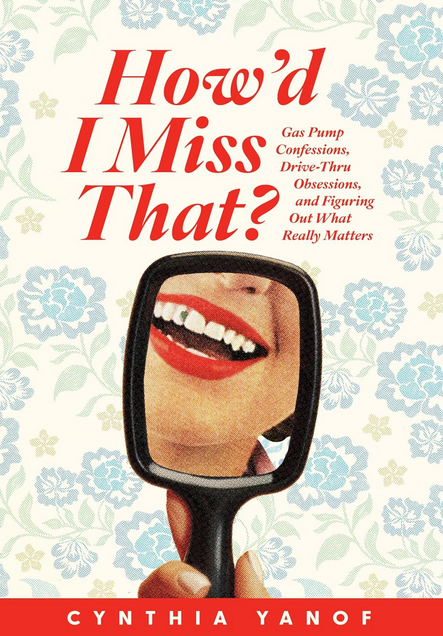
How’d I Miss That?: Gas Pump Confessions, Drive-Thru Obsessions, and Figuring Out What Really Matters
In How’d I Miss That? popular podcaster Cynthia Yanof shares the lighthearted, awkward, and occasional should-she-be-telling-us-this? moments that prove life is more than professional ladders, night sweats, and frantically searching for your phone. (Hint: It’s in your hand.) Turns out, the seemingly small things―like availability and generosity, friendship and forgiveness―aren’t so small after all.
Leave a Reply