
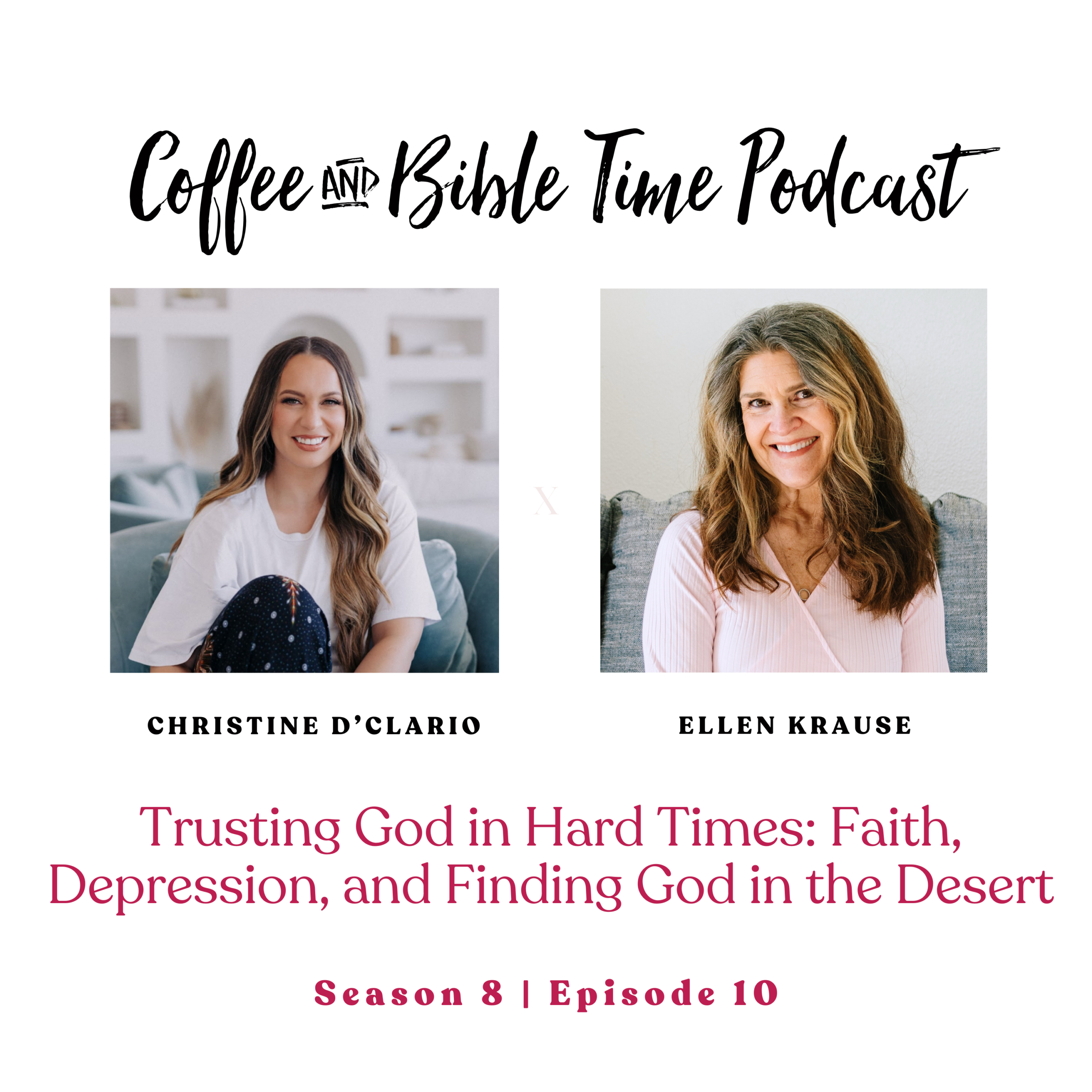

About this episode:
What does it look like to follow Jesus — and keep trusting God in hard times—while walking through depression?
In this honest and hope-filled conversation, Christine D’Clario shares her journey through a dark season of mental and emotional crisis after she gave birth to her second baby—and how God met her there. We talk about Christian mental health, breaking the shame around asking for help, and why vulnerability is not weakness but a step toward healing.

 Apple Podcasts
 Spotify
TIMESTAMPS:
00:00 God Stays With Us
02:49 Infertility, Surrender, and a Miracle
06:46 Miraculous Healing and Answered Prayers
08:56 Descent Into Postpartum Depression
12:07 The Breaking Point
14:23 Trauma, Shame, and Not Asking for Help
17:04 The Angel Who Saved Her Life
21:10 What the Desert Taught Me
31:45 Christine’s Favorite Bible Study Tools
Ellen Krause:
Welcome back to the Coffee and Bible Time podcast. I’m Ellen, your host, and I’m so glad that you have joined us today. If you’ve been struggling with anxiety, depression, burnout, or emotional exhaustion, wondering where that fits in with your faith, then this conversation is for you. Today, we’re talking about dealing with mental health issues and following Jesus at the same time.
Our guest is Christine DiClario, a bilingual worship leader and songwriter whose music has reached millions around the world. She’s led worship across the US, Latin America, and beyond, and her songs have ministered to people in some of their deepest moments with God. But behind the platform, Christine has also walked through her own season of postpartum depression and emotional healing.
Today she’s sharing what she’s learned about vulnerability, faith, and finding God’s presence in the middle of a desert season. Christine, welcome to the podcast.
Christine D’Clario:
Thank you so much. It’s so wonderful to be here, especially because just the name of your podcast is two of my favorite things in the world. Give me coffee and the Bible and I’m good.
Ellen Krause:
Yay. I love to hear that. That’s so awesome. Well, Christine, some of our listeners, especially those who are Spanish speakers, probably know you best from your music. But what led you to share such a personal story in your book that’s called Healing in the Desert?
Christine D’Clario:
Well, Healing in the Desert is my second book, and I had already been through an extensive journey of restoration with the Lord spiritually. And I put that in my first book, Prodigal Hearts, my story of redemption and being rescued from a double life as a Christian, and how I had my encounter with God and the love of the Father and identity as His child.
So when I handed in the manuscript to that book, the very last thing that I wrote on that manuscript was the dedication. The last line I wrote was, “To my unborn children, I hope this book will serve as a guide in the future.” I’m paraphrasing, but that’s kind of what I wrote. There was an emphasis on me closing it with the prophecy of “to my unborn children.”
So one month after I hand in that manuscript, I get diagnosed with infertility. And it was such a blow to my heart.
Though I had already been transparent and known in ministry for being transparent and testifying what the Lord had done, I thought that God had done His thing, you know? That that would be like my story to tell. And then I get this diagnosis that pretty much shattered so much of my hope in my future.
Now two years went by of my husband and I trying in futile efforts to get pregnant, having to schedule a surgery because my condition was endometriosis. It was very severe and chronic, extremely painful. And so the doctor said, “Well, you’re probably never going to have children because what this condition does is, if it’s been there long enough, it can render your womb dead. Like, dead womb syndrome. And that’s where everything points with you. But we can still go in, have a surgery just to clean out all that dead scar tissue so that you could have relief from the pain.”
I scheduled the surgery. Prayed, wailed, bargained, pled with the Lord. Didn’t get pregnant.
As I’m waiting for the surgery, which was months in advance, there was a prayer service at church. And a few days before that prayer service, I had a moment of surrender where I was like, “You know what? You want to heal me, that’s fine. If You don’t, I understand it’s not for me right now. If You want to give me children, I will receive them with open arms. But if it’s not in Your will for me, then I’ll be content with Your grace. I’ll be content knowing that You are mine and I am Yours. And if I’m not going to be a physical mom, maybe I’ll adopt a kid.”
You know, I’m making all these plans, but I really said to the Lord, and lo and behold, just a short time later, there was a prayer service at church and I received prayer for healing in a moment where the pastor felt led to call out women who were suffering from infertility. And I decided to be brave and get prayed for.
And the Lord touched my womb, and it was very supernatural. There was this hot water feeling inside of my entire torso that kind of moved and oscillated for about 30 minutes, and I felt burning inside of me, cauterizing, burning-type feeling.
So I go in for the surgery, and the doctor came out confused because he was sure he was going to spend between four and six hours just cleaning out all the stuff that was in there. And there was nothing to clean out. My organs were completely clean and beautiful. And in his words, “You have the womb of a pubescent girl ready to conceive.”
Wonderful. And you all are people of faith, and the only thing that explains this is a miracle.
So that’s how this whole story started.
Now I must say, I received healing from the Lord not because of anything I did, but because of everything He already did, because He’s good no matter what. And in His goodness and perfect timing, He healed me.
So four months after that surgery, where it was just to confirm the miracle, I got pregnant with my firstborn, miraculously. The Lord breathed life into my womb, and little Ian came along, and he is amazing. He is just like his mama — very artistic, musician, ADD, head in the clouds, creative type. Amazing child.
And you know, we thought, my husband and I, okay, this is the child of the promise. This is what the Lord has given us. And when he was six months old, I got pregnant again with Kenzie. And they are exactly 16 months apart.
And it was a roller coaster adventure where I was like, “Dear God, I better hold on because I’m still trying to figure out how to mom one. I don’t know how I’m gonna mom two. You need to help me.” And then He did.
So when I birthed Ian, it was a very traumatic birth. He really, really hurt me on the way out because he came out very, very fast. But it was totally the Holy Spirit because he was en route to be stillborn. His lungs were filled with amniotic fluid and he was drowning. And the Lord pretty much blew him out of me so that had I spent the three, four hours pushing like is normal for a first-time mom, he would have been stillborn. That’s what the doctor said.
But he came out in three pushes, and I know that was the Holy Spirit to save us both. Both our lives were in danger those first few days.
So that trauma kind of carried over to when I found out I was pregnant the second time. And I was like, “I don’t know if I can do this trauma again.”
But then the Lord immediately settled upon my heart those first few days: “Redemptive birth.” He told me clearly, “This will be a redemptive birth. You’re gonna be okay.”
And that’s exactly what the Lord gave me. Everything repeated pretty much exactly the same except all of the fear and the brokenness within the birth process of my son was redeemed in the birth process of my daughter. Like to the point where the birth room was the same, where I got my contraction that broke my water was in the same spot. It was just this beautiful redemption of the Lord.
So she’s born. I have my one-and-a-half-year-old. I’m celebrating this wonderful miracle. Like, wow, God is so kind that He gave me not one, but He gave me two. And they’re everything I ever dreamed of and I ever desired. And you know, there’s just so much fulfillment.
And then very shortly after, I start feeling strange. And by strange, I mean very, very sad. But it was a depth of sadness that penetrated not just my emotions, but it kind of seeped deep into my body and my mind.
You know, us women, we have coping mechanisms when we feel sad. I like to do the micro cry. Go into a room and give yourself 20 minutes and wail in the shower and it’s just you and the Lord. And then you come out and you’re refreshed. Or you’re screaming into a pillow or something, and it’s like, okay. And then you come out and like, okay, what’s for dinner, everybody? And it works. It’s worked for me.
But it didn’t work then.
And I was like, there’s something that’s not right. But I’m supposed to be the mom now. I’m supposed to be the one that, according to Instagram and according to church and according to my family, I need to have it all together. I need to have a flat belly quickly, so let me tie myself up with this ridiculous, torturous device. I get my belly flat, walk in high heels again, breastfeed with a smile, pose for the gram, be fully made up, be on a stage and on a platform jumping up and down and leading worship somewhere, and everything is like hoo-ha-yay, everything is wonderful.
But I did not feel that way inside at all.
And so the more I cried in secret, the sadder I became. And then the sadder I became, the more self-condemnation made its way in.
Because now I’m thinking, goodness, these are the children that God promised to me and He gave me. I should be joyful. Why am I such an ingrate?
And so then that self-condemnation quickly turned into hopelessness. And you know, the deception that comes with postpartum depression for a lot of moms is, “You’re always going to be this way. Motherhood broke you.” Which is one of the greatest lies ever invented by the enemy.
It’s a becoming. It’s not a shattering. That’s what motherhood is. Things do need to kind of break in a sense, but it’s only like the breaking of a seed that makes way for a tree that bears fruit. It always is to bring forth new life when it comes to motherhood.
And so that thought of, “You are always going to be this way. Motherhood broke you. Why did you have to go on and pray for a miracle? God made you infertile for a reason. You’re not cut out for this. Yes, they are children of purpose. Yes, they are children of promise. But you’re the least qualified to give them what it is that God wants for them.”
That was the deception of the enemy within the crisis.
And then the idea came, well, if I’m not getting better, I’m just getting worse. Might be some truth to it. There is an unspoken history of mental illness with some of my ancestors, a proneness to depression. Like, is this hereditary? Am I always gonna be this way? Am I ever going to recover? I don’t think so because I’ve never been in this position before.
Well, maybe I should think about doing a service to my children by removing myself from their lives so that they don’t have to suffer through the burden that I can cast upon them.
And so then suicide ideation came in. And I believe that that part was very spiritual. You know how the enemy likes to steal, kill, and destroy? That’s his motto.
So in the stealing, killing, and destroying against me in that situation, as he does with everybody, he likes to kick them when they’re down. And that’s when he likes to come and just bombard us with all the things that would mean death or robbery of blessing or destruction of purpose.
And for me in that moment it was, well, it makes sense that you just take your life and it’ll be in a peaceful way and nobody has to suffer, no drama. Just you need to get out of these kids’ lives.
And so that became a regurgitating thought that I was locked in this loop of poison thinking and I couldn’t get out of it. And I tried and I tried and I tried, and I couldn’t get out of it.
I know now that it was a spiral of literal neuropathways in my brain that were dying off. Like the good was dying off with all the bad thoughts that were just lingering.
Add onto that there was a lot of malnutrition, which happens a lot in mamas that are breastfeeding. There was no sleep. There was barely any water drinking. You know, all the basics kind of went out the window because there were these babies to take care of and all these things.
I should add to that that I survived childhood sexual abuse when I was five. And I also survived my father to addiction. He passed away when I was six. And there was a snowball effect of trauma that came from those really big ones.
So I wasn’t aware that there was still sexual trauma in my body, so I never thought about healing it. I’m like, okay, I’ll just forgive people and move on.
Well, I didn’t know that the nervous system sucks in trauma sometimes and you have to work to release it. No clue. I just did prayer and fasting, what I knew. And my spirit was strong. That’s why I believe I’m still alive today, because my spirit was strong. The Word of God in me was alive, and that’s why I believe I didn’t perish to this mental illness.
But my body was broken. My emotions were wounded. And my mind was poisoned.
And so in that dilemma, which is a very big understatement for where I was, but I’ll just say it lightly, I had to come face to face with the truth that I was going to die if something didn’t happen.
Now there was a layer to that, and it’s that I was too ashamed and too afraid to ask for help.
It’s kind of a very big thing, especially amongst us within the church, or even more so within leaders within the church. I’m gonna speak for myself, I’m not gonna speak for everybody else, but for myself, I had not understood mental health enough to surround myself with healthy people that, if and when a crisis came, they were anointed enough to pull me out of it.
I didn’t have that experience in that context. And so I didn’t know who to reach out to. I was so afraid because my experience had been, you know, so-and-so fell, so-and-so went into crisis and they lost their church. So-and-so needed help and asked for it and they had to step down from ministry. So-and-so had to stop singing.
And I was terrified of that because now I had two babies that I needed to give milk and diapers and all these things. I’m like, well, if I stop singing, where’s my livelihood going to come from? I don’t do anything else. I don’t know how to do anything else.
And so I was very afraid to confess. I didn’t have anybody that I allocated within my life that I would trust enough to.
So it was later, my last appointment with my midwife. I was being discharged because my body was healing phenomenally after pushing out a nine-pound, two-ounce baby, which that was my little girl’s weight.
And my midwife, she’s filling out her discharge records, and she’s like, “Let me just finish out your discharge papers and you can go home and be with your family. And don’t leave yet. I just have one more question to ask you and then you’re good to go.”
I’m like, well, okay.
I sat down and she sat in front of me when she was done with the paperwork, and she got really, really, almost uncomfortably close. And she was like, “How’s your heart? What’s going on inside of you?”
And she just stayed there. No blink. Still like a statue.
I was confronted with the question.
And I was tempted to lie, but I couldn’t.
I realized later that my heart just needed permission to confess. I needed that help. I needed somebody to open the door, give the little prick on this water balloon that had been filling up, and just let it out.
And I started to tell her everything. I feel so sad. I can’t stop feeling sad. And then I feel like an ingrate. I feel like the worst possible child of God or mother for these children. I don’t think I know what I’m doing with being a mom. And I think I’m broken. Like I can’t rely on my brain. Like there’s things that are not making sense in my brain. And I think that I’m going crazy. I think motherhood broke me and I’m going to damage these precious children that God gave me and I can’t afford to do that. And so I’m struggling with the thought of being alive tomorrow. And I already have a plan to deal with that.
And then I just bawled.
What she didn’t know is that that would have been very likely the eve of my suicide. Because my plan was drawn. I had it out on paper. I was ready to do this quote-unquote very deceiving term, but service to my children.
And when I told her about that, she started crying right there with me, like plopping tears alongside mine.
And I asked her, “Why are you crying? I know I am crying, but why are you crying? I don’t get it.”
And she’s like, “Well, I don’t have to be an expert to know that you have severe postpartum depression. And I know it because I went through the exact same thing you’re describing with my children.”
And it was like I just sat back and I was like, whoa. You?
Mind you, this woman is a warrior of faith. She prays heaven-moves type of lady. She has high discernment. She’s prophetic. She’ll give you a word in due season right when you need it on behalf of the Lord. She to me was like this gladiator of a woman.
And I’m like, wait, you went through this? It’s not possible.
And she’s like, yeah, it’s possible. And you’re not the only one. And you won’t be. It’s many of us that go through these struggles. You’re not alone. And there is a way out because I’m well now and I healed. And you will heal too.
So she gave me a card. She said, “This is a therapist. She is spirit-filled. She invites the Holy Spirit into the session and she’s an expert in postpartum trauma. And I want you to call her today when you leave. Before you take off in your car, I want you to call her and make an appointment. And I am going to text you in an hour to see if you have.”
And I’m like, okay.
And so I tried to call. Nobody answered. So I just kind of gave up.
And then an hour later, “Hey, did you call yet?”
I’m like, yeah, but nobody answered.
“Try again. I’m gonna text you in an hour.”
So I tried again. Nothing.
“Okay, I’m gonna text you in an hour. Did you call yet? Did you get an appointment yet?”
She did that for 48 hours. Every waking hour of 48 hours. Every hour she asked until I told her, yes, I got a hold of somebody. They gave me an appointment.
And then I said, it’s within a month. I don’t know. Like my brain is not all functioning. I can’t really be too responsible for my thoughts. So I don’t know if I’m gonna make it to a month.
And she said, “It’s okay. Just make it to tomorrow. If you make it to tomorrow, it’s a victory. I will call you tomorrow. We’ll deal with tomorrow tomorrow.”
And she did.
For an entire month, every day she reached out to me. And she became my lifeline.
I can say without a shadow of a doubt, I am alive today because of Angela. Which, what an appropriate name the Lord gave her because she was an angelic force of life in my life. She kept me earth-side as long as she could until I was able to go in and mitigate my crisis, which I did.
And so I’m eternally grateful because that whole situation, it was longer than it needed to be, but it was just right for me.
Because it put me smack in the middle of this tornado that, though I kind of saw coming, I thought it’s never going to touch me.
And if you ask anybody who knows me, they would have told you the same thing. Postpartum depression? That woman right there will never be the one to get it. Mental illness? That woman right there? She’s so anchored on the Word. She knows her Bible. She knows life. She’s positive. I’m naturally joyful and encouraging.
I would have been the least likely, personality-wise, to be where I was.
But I fell there.
And it was necessary.
And now I’m grateful for it because seven years have passed since I got that diagnosis. And the best and hardest journey of my life happened recovering from that illness.
That’s when I got to learn two very important things that I would not have learned otherwise.
And those are:
Number one, God stays. He does not bail on us. He stays. He sits in the mud. He gets filthy with you. And if you don’t have the strength to get up, He will never pressure you or push you to hurry up and get healed. He will be patient and kind and silent when you need it. And He will speak when you need it. And He’ll hold you when you need it. And He’ll leave you alone when you need it. And He will be there every step of the way until you have the strength enough to stand up and say, I want to heal.
That’s one.
And the second, I am called to love the Lord not just with my spirit. I’m called to love Him with my emotions, my heart, my thoughts, my mind, and my body, my strengths.
And if I don’t have all four elements of myself with which I need to love the Lord in check, something is going to get off kilter, off balance, and something will ultimately collapse, which is where I was.
So now I’m at a point where the Lord has been pushing me forward into imparting what I’ve learned on the journey.
Because who came out of the desert was a woman that at first I couldn’t recognize, but now I have learned to love her because I have a whole perspective of my faith. It’s not just what I consumed in church or during ministry time spiritually. There’s so much more.
I can see the wonders of how God created our bodies to function. I can see how beautiful He is to allow us to create actual, literal little bridges in our brain with these thoughts that He places within us. I can see what healthy emotion is and holding space for others to have their emotions and helping even my family and my children to regulate their emotions.
There’s just so much beauty in all the different ramifications of who we are in the human experience that I could not have seen had I not been through what I’ve been through. And so now it’s time to share that.
I did confess online, kind of by accident, on a national radio show where somebody asked me a very direct question that I couldn’t wiggle myself out of. And I did confess soon after my diagnosis that I was going through a very dark season and I didn’t really know how I was going to get through it, but I had faith that I would. And if there was anybody else out there that was going through challenges, well, let’s heal together, was kind of the whole thing.
And I was very surprised to see how many hundreds of thousands of people reaching out that they were going through some way or form of a mental or emotional challenge. And they finally saw in someone else that they weren’t alone and they could get through it.
And so that’s kind of turned into a movement that’s ended in me publishing this book, telling the whole story, everything I’ve learned, from identifying when you’re in a crisis to walking through it and allowing the Lord to prepare you for transformation, which is the ultimate cause and effect of the desert.
We come out transformed and we come out ready to help see others that are going through it and pull them out of the darkness and into the light. And that’s what I believe all of this is for.
My benefit, I got healed. My purpose, help others heal.
Ellen Krause:
Yes. And you truly are.
Christine, for our listeners, I just want you to know what really struck me, too, about your book is that it’s so theologically rich. You’re an incredible writer. The research that you’ve done to pull in, for example, the Shema that points to Moses and giving the instructions to the Israelites regarding loving the Lord your God with all your soul, body, and mind. And so you’ve so beautifully captured the way that we can incorporate our faith and healing.
The one thing I just want to ask you on behalf of our listeners is just that if someone, let’s say, is struggling right now — and you mentioned it in the book — like that it’s so hard to take that step to be vulnerable enough to say, I need help. I want healing.
What would your advice be today if someone is resonating with what your story is and maybe how it’s impacting them?
Christine D’Clario:
Yeah.
Well, I would say very clearly that society and also many church families have lied to us in making us believe that vulnerability is a weakness, that you have to hide behind shame. That gives shame a glory that it doesn’t deserve, which is to be our protector. Shame doesn’t protect us. Shame destroys us.
We don’t hide behind shame. We face it.
Vulnerability is not a weakness. On the contrary, it’s a superpower. Because what we do with vulnerability is basically giving life to that scripture that says that God’s power is perfected in our weakness.
So when we confess, hey, I’m weak. I have a challenge in this area of my life. So then I need God to be strong. What we’re literally doing is we are borrowing His weapon, and we’re wielding this vulnerability as this superpower.
And what we’re doing is we’re chopping off stakes that the enemy has made in our life called condemnation, shame, self-loathing, and even mental illness. Because a lot of mental illness happens because we’ve bottled stuff inside so much that our nervous system doesn’t know what to do with it, and then it starts attacking our brain. That’s textbook what a lot of the definitions of illness are.
And so what we have to do is learn to unmask the enemy. How do we do that? We open up the doors and the windows and we let the light in, because that way he can’t use what’s been creeping in the dark to condemn us anymore.
Newsflash: we’re weak. We need Jesus. We need one another. That is not new. That is something that’s a common denominator in everybody’s life.
When we speak it, we take that power away from the enemy. And by taking the power of condemnation away from him, we say, Holy Spirit, here is the entirety of who I am — the good, the bad, and the in-betweens, the black, the white, and all the grays. This is Yours for You to bring in Your power and perfect in my weakness.
I’m giving You the authority. I’m giving You the dominion. Yours is the majesty. You are the King and Lord of my life. You’re the only one who could fix this, and I admit it. And I will say it to whoever stands in front of me. I am weak, but He is strong. I am broken, but He’s the restorer. There are things in me that might seem dead, but He’s the resurrector. And I choose to believe that He is walking me through this desert.
So if people are going through hard times, don’t believe the lie that to be vulnerable is to be weak. Because we all are weak, and we need Him, and we need one another.
Reach out to someone you trust. Reach out to somebody who’s borne really good fruit that you know God is with them. I’m sure you won’t bother them by asking for help. Because those of us that have been through the desert, we’re waiting around for people to say, hey, I need help. You know why? Because we have the map. We know exactly where to tell you to go.
And if we don’t, we will find you help.
Like Angela did with me. She wasn’t a therapist, but she knew who could help me. And she walked with me until I got the help.
So if you’re needing it, just ask. Don’t be shy. Don’t be ashamed.
And also, I’m aware that there are people that are going through challenges that might be saying, well, I don’t have anybody in my life. I don’t really know who I can reach out to. Or maybe they live in a situation where their family nucleus is toxic. Their church is maybe not the healthiest spiritually. Or they simply don’t have mentors in their life.
That is the case with many people.
The Lord has given me, as a fruit of this whole process, a ministry called Soul Share Health. And we are an online community of believers who have either been through crisis and know how to help and walk with people like Angela did with me.
We also have clinical personnel. We have therapists, psychologists, psychiatrists, professional counselors who are faith-centered and Spirit-filled. And we train them with an additional 300 hours so that they can minister in session and bring the Holy Spirit into session.
And we also have, of course, the people that are going through crisis and going through their journeys. And we have this conglomerate of desert dwellers who are helping one another to heal.
We’re bringing in the Holy Spirit. We have weekly prayer meetings. We have support groups that are led by our clinical staff. We are here to help you through your desert.
So if you feel like you don’t have anybody in your life that you can really reach out to, or you still have to find who that is, just come on and log into soulsharehealth.com. We share the soul and we share health.
You can be a part of our community. No strings attached. We’re here to help and we’re here to serve. We understand, and we want you to have a successful journey through your desert.
Ellen Krause:
Absolutely. What a tremendous resource that you’re offering there, Christine. Is there a different website, or where would they go to find out more information about you?
Christine D’Clario:
About me, well, ChristineDClario.com, or you can do a quick Google search of Healing in the Desert or Christine D’Clario. You’ll get all the links automatically there.
And it’s also available online for you to get before March 3rd. It’s available for pre-order on Amazon. So if you’re listening to this before March 3rd, go onto Amazon, reserve your copy. They’re going quite fast, which is a great thing. And if it’s after March 3rd, it’s available wherever you buy books.
Ellen Krause:
Yes, you have to get it. It’s awesome.
Before I let you go, Christine, though, I need to ask you our favorite questions here that Coffee and Bible Time listeners want to know. What is your go-to Bible, and what translation is it?
Christine D’Clario:
Right now I am having the best time reading The Message. I like a good bring-it-down-to-the-simples, and I like conversational Bible study. And so it’s really touching a fiber of my heart because it feels like I’m talking to a friend or like a friend is explaining the Bible to me.
Ellen Krause:
All right, next one is, do you have any favorite Bible journaling supplies, or do you like to journal as a writer?
Christine D’Clario:
I just bought — literally just bought — some new highlighters that are non-transfer. I love the non-transfer highlighters because I really hate it when you turn the page and it’s like, which page did I highlight? I don’t know.
And I’m the color coder. I have like a blue for worship, and I got like pink for women, and I like to categorize that way. So I’ve got these highlighters that have the categories already on the marker so you don’t forget what color you put on what things.
And so I’m excited about using those. I just got them, so I haven’t had a chance to use them yet. And of course, a really good, easy-gliding pen to circle and date and write things in the margins.
Ellen Krause:
Awesome. Last one. What’s your favorite app or website for Bible study tools?
Christine D’Clario:
I really like YouVersion. YouVersion is just very easy, and I love what they’re doing.
But when I’m searching for sermons and teaching, I use Bible Gateway because of the parallels. We’ve got all these versions. It’s like you can have five or six different versions open at the same time.
And Bible Hub, of course, because if I need to go to a concordance or an original Greek or Hebrew, it’s all in one place.
Those are my normal tools, but I’m always discovering new things with the Bible.
Ellen Krause:
Okay. I know. Aren’t we all? That’s so awesome.
Well, we will make sure we include links to all those things in our show notes.
Christine, thank you so much just for your honesty, the courage that you’ve had to face this, and the willingness to share it with people to help others.
Christine D’Clario:
Thank you very much for having me in. Thanks to the audience for listening this far.
Remember, we’re all in some point of the desert, whether it be entering or exiting or cycling back in. And God heals us through all of it.
Ellen Krause:
Yes, He sure does.
If this episode encouraged you, I just invite you to share it with a friend who might need to hear this message because they’re out there, and this can truly be an avenue to open the door to start the healing process with someone else.
Until next time, delight in God’s Word and trust that even in the desert, He is near.
We’ll see you next time on the Coffee and Bible Time podcast.
Trusting God in hard times sounds beautiful…in theory.
But sometimes the hard times last longer and look different than you ever could have expected.
What do you do when your answered prayer turns to postpartum depression, the trauma you thought you healed resurfaces, or your anxiety lasts for weeks? What does faith look like then?
In a powerful conversation on the Coffee and Bible Time Podcast, worship leader and author Christine D’Clario shares her deeply personal journey through a miraculous pregnancy that led to a bout of postpartum depression that almost took her life—and ultimately taught her what trusting God in hard times truly means.
First, A Miracle
Christine’s story begins with a medical diagnosis of severe endometriosis—a sure sign of infertility. Doctors warned she would never conceive. After prayer and what she describes as a supernatural healing, she became pregnant—not once, but twice.
But the miracle didn’t shield her from suffering.
Shortly after the birth of her second child, she began experiencing what she later learned was severe postpartum depression. The sadness wasn’t temporary or situational—it was deep, physical, and suffocating.
“I start feeling strange. And by strange, I mean very, very sad. But it was a depth of sadness that penetrated not just my emotions, but it kind of seeped deep into my body and my mind.”
Christine described spiraling thoughts of shame and self-condemnation that got worse until, eventually, suicidal ideation entered the picture.
She had a plan. She was convinced removing herself would be “a service” to her children.
This is where trusting God in hard times becomes more than a devotional phrase. It becomes survival.
The Lie of Shame in Christian Spaces
“I was too ashamed and too afraid to ask for help.”
Christine D’Clario
Christine feared that if she admitted her struggle, she might lose her ministry, her platform, and her livelihood. Rather than admit what was happening, she stayed silent.
Her story isn’t unique. For many believers, the idea of trusting God in hard times gets confused with pretending everything is fine.
But Scripture tells a different story.
In 2 Corinthians 12:9, Paul writes:
“My grace is sufficient for you, for my power is made perfect in weakness.”
The Power of Vulnerability
Christine’s struggle finally came to light when, at her final appointment, her midwife asked her—directly, unavoidably—“How is your heart?”
Confronted with this question, Christine made the courageous choice to tell the truth.
And the truth was, her heart was not well. She was in a pit of sadness so deep that it seemed like she would never get out.
That moment of courageous vulnerability was the beginning of Christine’s journey out from the pit.
Looking back now, Christine no longer sees vulnerability as weakness—but as spiritual warfare.
“Vulnerability is not a weakness. On the contrary, it’s a superpower.”
Christine D’Clario
Trusting God in hard times doesn’t mean putting on a happy face or praying away the pain. It means being honest: about what you’re going through and who God is.
God Stays in the Desert
Christine’s time in the desert taught her something invaluable about God:
“God stays. He does not bail on us. He stays. He sits in the mud. He gets filthy with you. And if you don’t have the strength to get up, He will never pressure you or push you to hurry up and get healed. He will be patient and kind.”
Christine D’Clario
That statement echoes the heart of Scripture. Psalm 34:18 reminds us:
“The Lord is close to the brokenhearted and saves those who are crushed in spirit.”
Trusting God in hard times does not mean He instantly removes the pain. It means He remains with us in it.
Christine described how her midwife became the lifeline that kept her alive—texting her hourly for 48 hours until she secured therapy. Through that woman’s persistence, she saw God’s faithfulness.
“I am alive today because of Angela.”
We see God’s faithful, staying presence through the people He puts in our lives.
Loving God With Your Whole Self
A key theological thread in Christine’s book Healing in the Desert is the Shema from Deuteronomy 6:5:
“Love the Lord your God with all your heart and with all your soul and with all your strength.”
(Jesus later adds “mind” in Mark 12:30.)
Christine realized she had focused primarily on spiritual strength, but neglected her emotional and physical health.
“I am called to love the Lord not just with my spirit. I’m called to love Him with my emotions, my thoughts, and my body.”
Christine D’Clario
Trusting God in hard times includes caring for your nervous system. Seeking therapy. Addressing trauma. Drinking water. Sleeping. It’s not unspiritual—it’s obedience to a God who made our bodies as well as our souls.
Experiencing mental illness does not mean you lack faith. It means you’re human.

4 Ways to Practice Trusting God in Hard Times
If you are currently walking through a difficult season, here are practical takeaways from Christine’s story:
1. Tell Someone
This is the step that no one wants to do…but is absolutely necessary.
Silence strengthens shame. Shame makes you spiral. Spiraling keeps you down.
So open a door. Tell someone safe. Ask for help—and be direct.
2. Separate Feelings from Truth
- “You’ll always be this way.”
- “You’re broken.”
- “God made a mistake.”
But Scripture says:
- “He who began a good work in you will carry it on to completion until the day of Christ Jesus.” (Philippians 1:6)
- “Those who hope in the Lord will renew their strength.” (Isaiah 40:31)
- “There is now no condemnation for those who are in Christ Jesus.” (Romans 8:1)
- “Even though I walk through the darkest valley, I will fear no evil, for you are with me, your rod and your staff, they comfort me.” (Psalm 23:4)
Trusting God in hard times means anchoring your mind to truth—even when your emotions disagree.
3. Invite Professional Help
Christine sought a therapist who integrated faith and clinical expertise. That decision saved her life.
Seeking therapy does not replace trusting God in hard times—it complements it.
God works through doctors, therapists, midwives, and community.
4. Redefine the Desert
Christine described the desert not as punishment—but transformation.
“We come out transformed and we come out ready to help see others that are going through it.”
Throughout Scripture, deserts are preparation grounds:
- Moses in Midian.
- Elijah under the broom tree.
- Jesus in the wilderness.
The desert is not abandonment. It’s formation.
Trusting God in Hard Times Doesn’t Mean You Won’t Struggle
But it does mean you won’t struggle alone.
Christine’s story dismantles the myth that strong believers are immune to depression. She was a worship leader, biblically grounded, joyful by personality—and still fell into severe postpartum depression.
And yet:
“God stays.”
Christine D’Clario
Seven years later, she describes the journey as something that God used for her good.
Not because the depression was good; but because God was faithful.
If You Are in a Hard Season Right Now
If you are struggling with depression, trauma, or suicidal thoughts, you are not weak. You are not alone. And trusting God in hard times does not mean suppressing your pain.
It means bringing your whole self—heart, soul, mind, and strength—to Him. And sometimes it means picking up the phone.
The desert is not your final destination.
Healing is possible.
God stays.
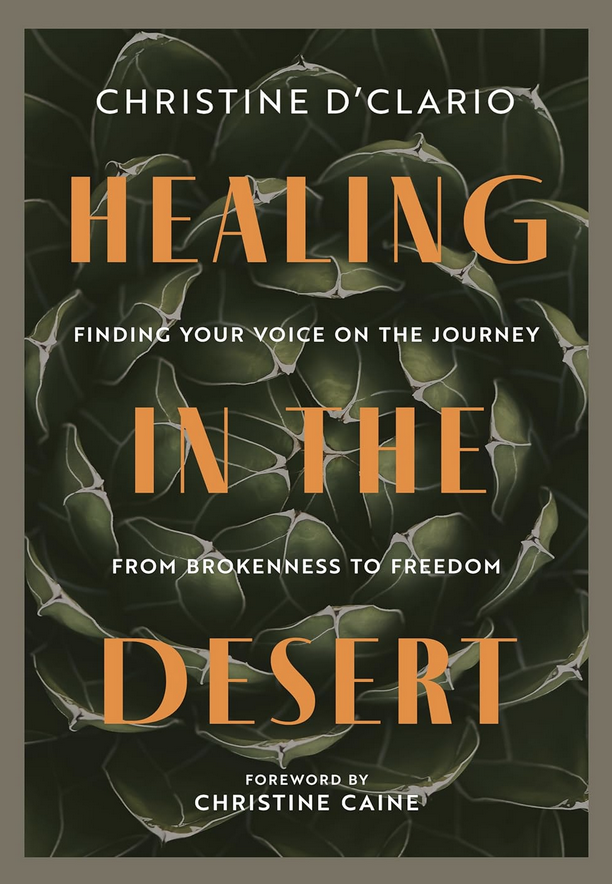
Healing in the Desert
Worship artist Christine D’Clario knows firsthand what it means to break down―and how God puts us back together. She knows that many of us in faith communities struggle silently with anxiety, depression, and burnout but are hesitant to show any sign of weakness. She knows that well-meaning churches and friends often emphasize spiritual answers while leaving emotional and mental-health concerns underdeveloped or stigmatized.
With practical takeaways for whole-person well-being, Healing in the Desert breaks down walls of isolation to offer a compassionate path to communion with God that honors every part of how He made us.
Leave a Reply