
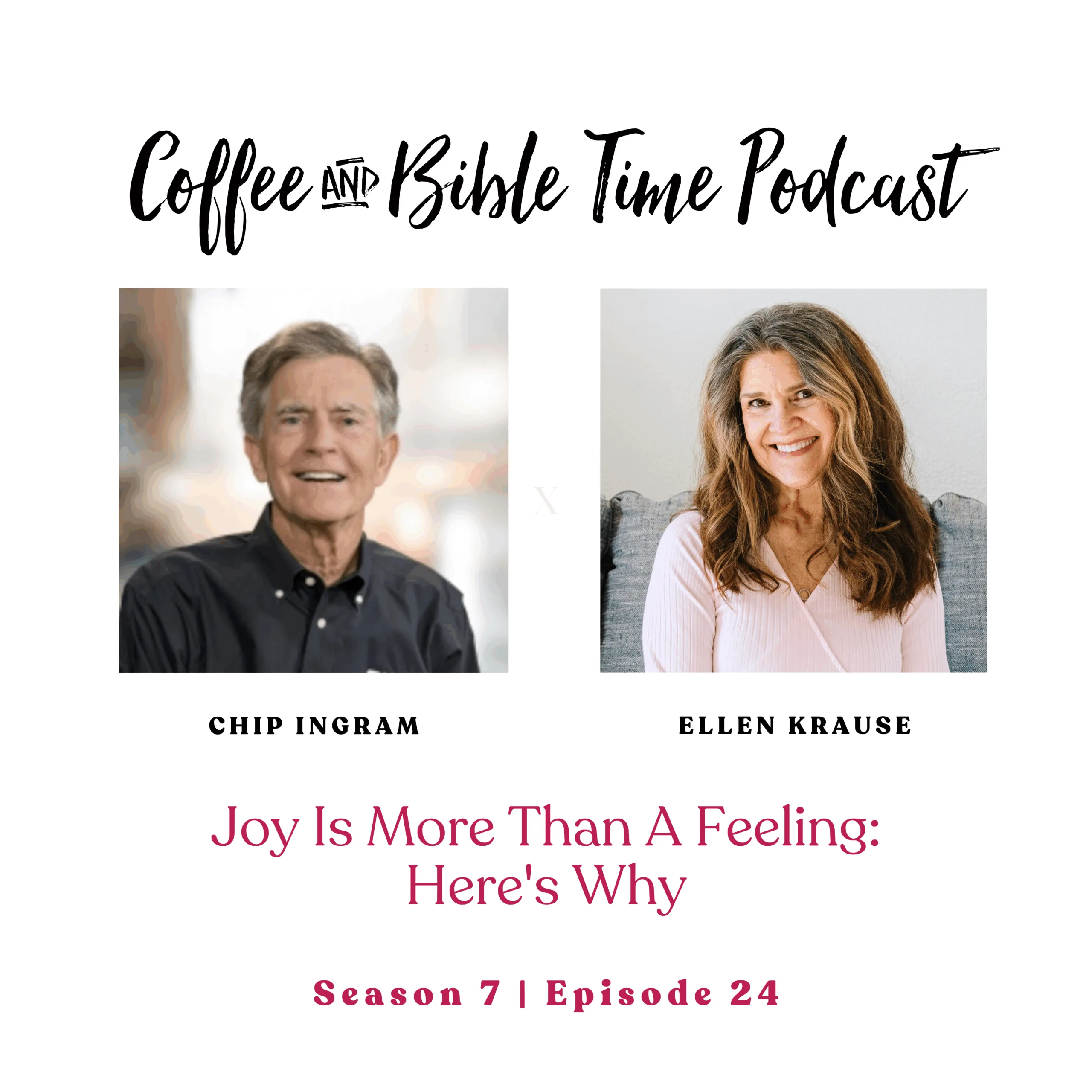

Hosted by Ellen Krause
It sounds impossible, right? Joy and suffering in the same sentence. But in this powerful conversation with pastor and author Chip Ingram, we dive into Paul’s letter to the Philippians and learn how joy can actually grow because of hardship—not in spite of it. If you’re walking through something heavy, this episode is for you.
Subscribe & Listen on:
 Apple Podcasts
 Spotify
TIMESTAMPS:
0:00 — Introduction to Joy Beyond Circumstances
11:30 — Joy vs. Happiness: The Critical Difference
19:15 — Paul’s Prison Perspective: The Joy Formula
26:28 — The Power of Perspective Over Circumstances
30:07 — Practical Steps to Choose Joy Daily
33:15 — From Depression to Worldwide Ministry
37:32 — Final Thoughts: Living Like Christians
Full Transcript
At the Coffee and Bible Time podcast. Our goal is to help you delight in God’s Word and thrive in Christian living. Each week we talk to subject matter experts who broaden your biblical understanding, encourage you in hard times and provide life-building tips to enhance your Christian walk. We are so glad you have joined us. Welcome back to the Coffee and Bible Time podcast. I’m Ellen, your host, and I’m so glad that you have joined us today.
If joy feels a little out of reach lately, you’re not alone. In a world that feels increasingly chaotic, discouraging or just plain exhausting, joy might feel more like a luxury than a hallmark of the Holy Spirit. But what if joy isn’t just a feeling? What if it’s something deeper, something stronger than our circumstances? Well, today we are joined by Chip Ingram, the teaching pastor and CEO of Living on the Edge, an international teaching and discipleship ministry. Chip is a longtime pastor, the author of several books, including Holy Ambition and the Invisible War, and a passionate Bible teacher who spent decades helping people follow Jesus authentically. He and his wife Teresa live in California and have four grown children and 12 grandchildren, and in this conversation we’re going to discuss how Philippians 1 and the life of the Apostle Paul teach us how to experience authentic joy even when our circumstances make it feel impossible. So if you’ve ever wondered how to hold on when life gets hard, you’re going to be encouraged by what Chip has to teach us. So, without further ado, welcome Chip.
Thank you, Ellen. Great to be with you and your daughter.
I just love hearing the sound of your voice and now getting to see you in person. It’s so exciting for me because I’ve listened to you on Moody Radio for years, so thank you for your ministry there.
We’re thrilled to get to do it. Moody’s been a really great partner. We have deep and long ties to the school and many of the presidents and just how it’s been a beacon of light in the midst of a crazy world for well over a century.
Absolutely Well. Why don’t you start out by telling us a little bit about why you decided to approach this topic of joy now? Was there a specific life experience that prompted you?
Yes, you know, it’s one of those where sometimes you get a great idea and you think, oh Lord’s given you something, so please show me what to do. And then other times you find yourself writing out of your own personal need, and this is one of those. About seven years ago maybe almost eight now I had a really difficult pain in terms of my back. I had discs that were bad, my back was bent, stenosis, all kind of different things. So two years of every treatment under the sun, followed by a major surgery, infusion, followed by a couple hard years, yet another surgery, when all that broke loose. And you know it was just. You know I continued to work and but I was on ice packs and every treatment under the world and couldn’t sit, couldn’t stand. Every surgery was a long, major rehab and taking little steps in the backyard and praying.
And I came in one day after doing that and of course, you know my wife bore a lot of that burden for a long time and I remember sitting down on the hearth and she looked at me and she said, chip, I don’t want to hurt your feelings, but I feel like I need to share something with you. And I said, well, what’s that she goes well. You know I really appreciate your persevering and all the rest, but I married a really positive, upbeat, future-oriented person and you’ve really lost your joy. Do you realize how it’s very subtle, how negative you become, and I thought my initial godly reaction was no way, that’s not me. I didn’t say anything, though After 46 years of marriage, you learn not to say the first thing, and you know I had a little time to think about it and I realized, yeah, because of pain, those people that had chronic pain, your patients, get smaller.
The glass is more half full, and little by little, I realized I did, and so I was to speak at the Billy Graham Conference Center in about two months, and the topic was Philippians, chapter one, and so I studied it in depth and it was like God just ringing and saying Chip, look look at Paul’s circumstances. He’s in prison. He’s writing a thank you note because they sent some food and some financial resources through one of the church members, epaphroditus, and he wants to thank them. And look, his opening is he prays for them with joy and his focus is upward, and then he’s chained between these two guards and you know, I’ve seen a picture of the prison. They would drop you down in a hole and it was dark and I mean just horrendous. If you didn’t have a friend to bring you food you didn’t eat. I mean just horrendous. And if you didn’t have a friend to bring you food you didn’t eat. I mean it wasn’t like they serve meals.
When we read prison we think a little bit of how we see it.
And I thought he said I thank God that my circumstances have turned out for the greater progress of the gospel. And so as I went through the chapter and I taught it and then I pulled out some very practical things that I wrote on little cards and Ellen, this isn’t a silver bullet like hey, read the book, I choose joy and things will be great. But it will, I think, help people understand first that we don’t have to wait for joy to come our way, but also you can go into training and we really can allow ourselves to look at life through God’s perspective and in the midst of our hardest, deepest times, my testimony is that I’ve been able to choose joy and the response to that weekend and the response to it airing on the broadcast, it was like people with anxiety and depression and struggles and young people and suicide. It just seemed like you know, lord, I better, I better get this in a format that more people can get. So it grew out of my own lack of joy.
If you will, and God speaking to me, and it’s incredible that you know God allowed you to have that experience and so that now he is using it for the good of so many others. And you know you touched on there that there are people listening who are going through some horrific circumstances now, and I’m just thinking of like the flooding in Texas. Tell us about how. Do you think joy is just still something that is important, even when it seems impossible?
or someone’s sick and you pray and they get better, or you have a wonderful dinner with your family. I mean, there’s lots of things, events that make us happy, but the word happy comes from happenings. Happiness is tied mostly to events and joy is a sustaining byproduct of your connection with Jesus that, supernaturally inside of you, allows you, in the midst of darkness, difficulty, pain, disappointment, betrayal, to be buoyed up inside in a way that no one can rob it from you, and it’s a fruit of the Spirit. It’s something the Spirit of God produces. You know, this fruit of the Spirit is love, joy, peace, patience, kindness, etc. And I love CS Lewis. You know such an influential writer. One of his quotes he says joy is the serious business of heaven, and that’s what I would want believers to hear. This isn’t like oh, this is okay.
In Nehemiah, you know, god’s agenda was pretty much completely dissipated. He went back to rebuild a wall. Other leaders had gone back 80 years before. Finally they build the actual wall. But then he has to rebuild the focus on God and the people walking with God again. I mean, it was a complete turnaround and as they read the scriptures, the people just wept because they saw how far away from God. They drifted and it happened to be a day of festival. And so he says no, we’re going to repent, we’re going to go through the process. But here’s what we need. We need strength to make it through.
The joy of the Lord is your strength, and he had them. Rejoice in who God was and rejoice that his forgiveness is available. And I think that has been a big lesson for me is that joy isn’t like it would be nice. Joy is always available and there is a way to think and process and pray where, in the worst of circumstances, god promises If you get a command right, rejoice always. That’s not a suggestion. And again I say rejoice. Let your gentleness or forbearance be evident to everyone. The Lord is near Someone. One theologian said that if love was the community of the early church, joy was their business card. It was. You just saw this joy in the midst and I think we have a great opportunity. And it doesn’t mean we’re up all the time. This isn’t glad handing. This is not self-help. Positive thinking, this is the spirit of God in the context of community and God’s word, allowing us to see through a perspective, allows us to have great joy.
Absolutely, and I know that I’ve seen that joy in others and it really is, I think, contagious to the standpoint that you want to experience that yourself. And I think when you see people going through these tremendous difficulties and having that, you know that
it has to be supernatural. Would you say that joy is more of a discipline or a gift, and where do our emotions fit in with the experience of joy?
Well, that is a really great question because I think those things you know, they so overlap in so many ways. It does require some discipline and our emotions are definitely involved, but I can’t. I can’t wait for my emotions to get to a place before I do what I know God wants me to do. And one of the things you know. There’s four key paragraphs in chapter one and as I studied that, I’m going to answer your question like this, because as I studied it, as Paul prayed, I saw, wow, his focus was upward, praising and thanking God, and his focus was outward, in his terrible situation. He’s praying that their love would grow and increase.
Second, what I noticed was in his own circumstances. He looked through the lens of purpose and it was like what’s God’s purpose in this? So he found joy, not that he was chained between two guards and it was terrible. I mean, he was real. He’s getting up and going. Here’s another day. This is going to be really rough. I’m chained to guys. I wonder if I’m going to get anything to eat. It’s dark, it’s damp, there’s rats. Nevertheless, that’s that. And he looked at it through that lens and then, a little bit later, he’s not sure whether he’s going to live or die. And he looks at life through the lens of hope. And if he looked at his current situation, hope was pretty dim, possibly executed. But he looked at it through eternal perspective. And so that perspective was for me to live as Christ, to die as gain.
And then maybe one of the most powerful parts of the book for me was at the very end, and he’s encouraging this church. It’s a young church and they got the same kind of external persecution and it’s a little disunity going on between a couple of ladies and factions. And he tells them it’s been granted to you not only to believe in him but also to suffer for his sake, experiencing the same conflict which you’ve heard to be and seen to be in me. And I think he looked at it through a perspective of God’s expectations. God does miracles, he’s powerful, and he also says in the world you’ll have tribulation. And so those four things, I came up with a question for each one. And then, if you don’t mind, my dad was a math teacher, I loved algebra, and so when I looked at the entire chapter, an algebraic formula came up. A algebraic formula came up and it’s the letter C for circumstances plus the letter P for perspective equals sign your experience.
And so what I find is our circumstances. We have very little control of. I mean, whether it rains, whether it doesn’t rain, the stock market up down, tariffs who’s president, who’s not? We’re bombarded by circumstances. We can’t control tariffs. Who’s president, who’s not? We’re bombarded by circumstances we can’t control. If our focus, our perspective, is through those, we will have a life of ups and downs and dips and valleys.
But our circumstances plus our perspective, if we can, in the midst of our challenges, say where’s my focus right now? Is it upward and outward or is it inward? And what’s my purpose, what’s God’s agenda in this versus what I really want. And so I ended up writing on four little cards what’s my focus, what’s my purpose, where’s my hope and what are my expectations. And then I begin to read those things over out of Philippians 1. And I put those in the book in a way where, just for me, it’s just us ordinary Christians going into training where we, you, can actually train your mind. It takes a few weeks and you practice for a few months.
I’ve been doing this, for you know, years and years and years, to where, yes, your initial is oh, why did that happen. And the Spirit of God, chip, where’s your focus? Okay, lord, I don’t like this. It’s painful right now. I thank you that you’re in control. I thank you’re going to use it and then shift your focus and begin to say other people are going through some worse things. How do I help them? It’s an amazing thing to me.
I don’t feel like it and I can feel really low and down and I can choose. I choose to pray when I don’t feel like praying, when I get really discouraged or even depressed. I have sort of a three-part practical strategy. Number one I go and get as hard a workout as I can so I get sweaty, because God gives us biology. Those endorphins are antidepressants. Number two I find a place where no one is, because I’m discouraged, I don’t want to pray, and I sing as loud as I can Praises to God. Lord, I don’t really want to do this right now, but you are the King of Kings and the Lord of Lords. Blessed be the name of the Lord. And my son’s a songwriter, so I sing a lot of his songs and I just worship the Lord and in this process, first my body is kind of like I don’t want to wear out, I don’t feel like it. Why is this happening to me? I’m moaning and whining in my mind all that, and then step three is okay, lord, I need an action, step Someone or something that’s hurting more than me right now. Today, I’m going to help them.
It is amazing how your emotions change because your perspective changes and you feel this energy well up inside of you and this hope that gets to be birthed, and there’s this joy. And is it a battle? Yes, does it require discipline? Yes, do I do it 100% of the time? No, you know. Paul says walk in a manner worthy. Well, a walk is baby steps, and if you see a baby, they walk three or four steps and when they’re learning, they fall. Well, parents don’t get up right now, they’re thrilled with the three steps, and our Heavenly Father is so patient with us. So, as you learn consistently to get the right perspective, you experience great joy.
I love in the book how you recommended writing that down on the card because I made a note for myself the C plus P plus E, and just I want to remember that living above my circumstances, you said, occurs when my perspective interprets my circumstances rather than my circumstances determining my perspective, and that’s really powerful. I think one of the things that I found so interesting with this passage in Paul is that during those most difficult times that he was having there, like you just described, that the letters that he went on to write have now encouraged and convicted thousands or millions of millions of people across the generations. You kind of wish Paul knew that he would have such an impact. But what would you say overall? What do you think we can learn from Paul’s perseverance and faithfulness in the worst of circumstances?
I would say both from scripture and even history, let alone church history. Probably the greatest people that are the most loving and the greatest impact are people that have been through extraordinary suffering and some people run from God during that and blame him and others lean in and he’s able to do something in us through that and confession. I hope it’s okay.
The COVID it was early on and in California it was a level of shutdown like no other place. They were like if you walk outside you have to have a mask on by yourself. I mean, it was crazy. I couldn’t see my kids, my grandkids, and so I got discouraged and then I had about two or three days. I get depressed and I’m kind of up person in general, and when I get depressed I don’t have a mild one. I was really dark and it was just. I knew I was in a spiritual battle and so I went out and, you know, got on the treadmill and I got real sweaty and I took a long walk and, you know, praise God and I feel a little better. And then I walked in the house and on the television was the news was depicting what was happening in Egypt during COVID. The early. This was like June, july, when it first started, and you know body bags and desperate, and the head of all the Protestant churches has become a good friend. We’ve trained the Protestant pastors throughout all of Egypt and so I said, okay, I was. Who’s hurting more than me? Dr Zaki and all the pastors there. So I had a Zoom call the next day. We have a conversation. He goes, I and my family are OK, but we’re barely surviving a chance. I mean completely unplanned. He didn’t know. The only reason I reached out to you is because you’re hurting worse than me and I’m stuck and can’t get out of it. So everything that’s going to happen from this point on is not great leadership, some big strategy. It’s a hurting person just trying to obey and in my weakness, god, would you help this person? So he says, oh, send me that series. I said no, dr Zaki, I’m thinking about a series, because as I saw COVID, I thought what would the Lord say to the world right now If someone said, chip, you’ve got three weeks or five weeks or two, whatever.
What is God’s word to the early months of COVID? And I thought to myself you know, not a lot different from the very first book of the early church Jews are running for their lives, persecution has come. And James, the half-brother of Jesus it’s the very first book in the New Testament to these Jewish Christians that are spread and he gives them a three-part the art of survival. The A is there’s an attitude Consider it all. Joy. In the midst of this, god’s going to work in you, then through you, and then there’s a resource wisdom, there’s supernatural wisdom, which is what to do, when to do it, how to do it, if you’re willing to do whatever God says, which is a challenge. And then the last part of that, in the first 12 verses, is there’s a theology about life and perspective that allows you to overcome discouragement and see yourself from God’s perspective.
And that was on a Thursday and I went from being depressed to making a couple of phone calls. By Monday I had a guy with two cameras. I took a PVC pipe and put a sheet that looked like bricks on it as a background and I studied all weekend. I taught it, but never like this Did three messages sent them. By Friday they were in Egypt. By the next Friday they were dubbed the following I think Tuesday or so every pastor in Egypt it was. You know these Zooms. I mean I had pages and pages and pages. And Dr Zaki says look, we’re hurting, share it all Hour and a half. Then I did an hour and a half of Q&A and I heard, I mean people ask me, chip, why did God let my wife die? And it was just crushing. And our head of international was with me and we got off of it and he said, chip, I don’t think that series that you developed was just for Egypt, and he had worked with Billy Graham for 10 years and he worked with Luis Palau for 13. So he was connected all over the world.
And the next week I found myself with 700 pastors from 300 cities in India, and I won’t go into it all, but it was for the next 25 months, morning and evening. Everyone offered it Right now media, every organization, worship pastors, morning and night. We would just encourage tens of thousands of pastors. And then that little booklet went into about 32 different languages. And then, near the end of COVID, we went to them and we spent a day and we do session one, and then let them get in groups of maybe four and they cried and they wept as pastors India, africa, latin America, southeast Asia.
And I look back and I think I was down and discouraged because my circumstances were bad. I was angry, I was frustrated and God used my weakness, my struggle and a small baby step in all the ministry I’ve ever been in. I think. One of our international team members told me we’ve trained 339,000 or 400,000 pastors in live events in the last three and a half years. That all grew out of that moment in COVID, and so I would just want to say to people ask God, lord, okay, I don’t like what I’m going through with my mate. I’m so worried about one of my children. I’m depressed. I’ve got a health issue’m going through with my mate. I’m so worried about one of my children. I’m depressed. I’ve got a health issue that doesn’t seem to change. We’ve had a split in our church. I’m so mad at so-and-so.
Ask the question where’s my focus? And then God, what’s your purpose? How could you use these circumstances? That perspective changed my life and it changed the trajectory of everything I did up to the first 40 some years of ministry. Joy is the serious business of heaven, as I’ve seen this happen. I mean now we’ve got nationals in India and Dubai and Egypt and Latin America. None of these people I even knew. Now they’re all on our team and I track and I hear what God is doing in these rural villages in Nepal and think, humanly speaking, that happened because a pretty immature pastor named Chip got discouraged. Then he lost perspective and got really depressed and then he chose to take a baby step toward the light. And God said I wanted you to be positioned and, as we’ve all celebrated these last five, six years, there is zero credit to be taken by anyone. I mean, it’s not like well, what was your strategy? Didn’t have one, how did you think it was work? Had no idea. What did you do? We followed the light. We just kept taking the next baby steps.
I just really want to encourage those listening. God has great and wonderful and supernatural purposes and you can choose to enter in and wonderful and supernatural purposes and you can choose to enter in and some of the things that you all talk about. Why our hearts connect is but you have to be in God’s word so you can hear his voice and you have to be in community and sharing. I was able to say I made a phone call when it was dark. I still remember we were dropping the dog off or something and my
wife went in to the vet and I called a mentor. He’s 90. He has been with me since I was 28.
And I said I said, ac, I’m in a dark spot and thoughts are going through my mind that I’m there. I mean I can’t believe I’m even thinking of them. I have to get them out, would you? Would you listen? And he’s known me since he knows all my kids. And I said, gosh, I mean like, don’t be a pastor anymore, your life is away.
I mean there were lies, but they kept going around and around in my head and I couldn’t get rid of them and I prayed and I fasted and I just laid that out for him and he listened, encouraged me. I just laid that out for him and he listened, encouraged me. He called me or texted me every single day, probably for the next 20 days. How are you doing today? Prayed for you. Today we need people and God restored my joy and God worked in my heart. But we go through some dark times that feel like that’s the key. They feel like they’ll never change. We don’t have to wait for circumstances to change. We can choose joy in the midst of them. So that’s my heart for this book.
That’s so powerful. I just made a little note because I want to put it on my board. God can use our baby steps and, like you said, when we’re in these low, low, seemingly in states where we feel like it’s hopeless, yes, if we can just allow ourselves that one baby step, I think of a couple at our church who they had ended up turning it like into a little skit that was done at the front of our church and about a relationship this couple had developed with this man and later you come to learn that it was the man who was the drunk driver that hit and killed their son. Wow, and you don’t know that until the very end, but you can see how. That’s the joy we’re talking about. They saw that God had a bigger purpose, a bigger plan, things that we can’t possibly understand, and has really impacted me as well.
And it’s exciting to hear the impact of this ministry of yours has just gone all around the world, because clearly everyone, all around the world, we’re all God’s people and they need to hear this message as well. Well, chip, as we start to wrap things up here, I know you’ve shared this message at various conferences and broadcasts, and could you share maybe one story that someone about how this truth has impacted their life?
Yes, I get a lot of letters and a lot of emails and I got a few just in the last few days, you know, a lady saying I was really discouraged and we’ve had ongoing marriage problems and in my mind I’ve blamed my husband because he’s not doing this, he’s not doing that and I just keep feeding off the negative. And I heard this series and I began to think about what are my choices and how am I thinking and what’s God’s purpose in it and where is my hope? Is my hope that I had this perfect marriage or is my hope that I can’t have any joy in my life until quote my husband changes? And you know what are my expectations. You know, and as she went through that, she said just thank you so much, for I knew what she
meant. It wasn’t me, but for saving my life and saving my marriage. She says it didn’t happen overnight, but it was me beginning to recognize where my thinking was and one of the things you know, I’m certain in this book, but especially in some other things, like the good friend Kyle Eidelman wrote a book called Taking Every Thought Captive.
He and I are good friends. He’s a pastor in Kentucky and one of the things I was just going to mention is, as you change your focus, you have to change your inputs, and so a steady diet of news, an addiction to our phone we all kind of talk about it as though, yeah, it’s really not good, we really shouldn’t do it. And then everyone keeps doing it and I really just tell people you are the product of your thought life. If you want to have joy, I would say, as one mentor told me, invest your mind on things that are timeless and then spend a little bit of time on things that are timely, because they always change. You don’t want to make big decisions or make big convictions about what’s timely. You want to base your life on what’s timeless. I’ve been in these conversations, ellen. It’s like well, chip, thanks, I really understand. I’m glad for you.
I don’t really read the Bible that much and you know I’m glad you know pastors and people like you, and this isn’t for people like me, this is for all of us, ordinary. I feel like I’m a very ordinary Christian who was discipled by a bricklayer with a high school education and his life propelled me to discover I had some gifts and become a pastor, and I’m glad for seminary and languages and theology, but to this day, if I could trade my time with a bricklayer. Over all the time, and all the studies and all the mentors he taught me to meet with God every day. He taught me how to study the Bible for myself. So I heard God speak to me. That has been the most important and the most sustaining thing of my whole life.
I think a lot of the challenges of our brothers and sisters is that basic aligning your life with scripture, meeting with Jesus to get to know him, not so we can get him to make our lives work out the way we want to. My dream in my life is to help Christians live like Christians, because when I grew up, I attended a church that didn’t believe the Bible and they said one thing and lived another way, and I rejected God, the Bible, everything. And when I met some Christians that lived like Christians, they weren’t perfect, but they were real, they were passionate, they were honest and it was like I saw Jesus. And so that’s my heart for those listening to us, that we have a kind, loving, just and holy God that longs for our lives to flourish, and he’s laid out. This is how it works, and I think, as G K Chesterton once said
it’s not that the Christian life has been tried and it’s not workable. It’s rarely even been tried among most Christians. So that’s our heart’s desire.
Thank you so much, Chip. Your insight has really impacted my heart and we’ve just scratched the surface of what’s in your book, which is even more incredible content. Where can people learn more about? I Choose Joy and your work.
Well, they certainly can go to, you know, livingontheedgeorg. They can go to Amazon or any bookstore. And then we have we do have a Chip Ingram app. We have fresh messages every day, but we’ll have the last six months and they’re all free. And then at the bottom we have a little click on discipleship, so that, much like what you all do. We have these eight-minute. They’re kind of mini teachings and I’ll walk through and teach people how to study the Bible, how to journal, how to pray. So those are a couple good ways to do it. And, of course, listen to Moody Radio. That’s always a good one.
Excellent. Well, we will make sure we include links to all of those in our show notes. Before we let you go, I have to ask you a couple of our favorite questions, and the first one is I know you probably have a whole library of Bibles, but which Bible is your go-to Bible and what translation is it?
I kind of have two. My go-to Bible is the New American Standard 1995. And you know they keep updating it just a little. But one of the things that Bricklayer helped me with and it was so was memorizing scripture. And so I memorized hundreds of scriptures in small books of the Bible. They’re in the New American Standard and so even when I read another passage sometimes I misquote it because part of it’s in my brain. And then, especially in narratives I really like. I like the NIV, I like the NIV 84. And again, they’re all excellent translations and ESV. But those are probably my go-to passages. And then, devotionally, you know where I’m studying. It’s always nice to you know. Check out Phillips translation. We have so many good tools. In fact, that’s one of your other questions, isn’t it?
Yes, Let me ask you this Do you have any favorite Bible journaling supplies? Is that something that you do?
Yes, In fact I kept saying on programs that I journaled, and so our Living on the Edge team, we have a prayer journal and I feel like everyone’s looking for how exactly do you do that? And so I write down in the very beginning a few tips, because I think journaling can either get to become a duty or a performance or like, oh, I didn’t do it today and you miss the point. And so I kind of line out what I think is the best way to do it and find your own way. And then it’s kind of nice to have, you know, a few quotes just here and there to give people some perspective, but mostly a lot of white space. And, as I tell people, sometimes I’ll journal five or six pages, sometimes I won’t journal for a couple of days.
I want to be explaining, I’m processing my heart out loud and this is so convicting. But I find I can think certain things, but when I write them out and I see them, it’s a lot harder to lie to myself and to lie to God. And so I hope my journals shortly after my death will be burned because they’re very raw. But I find is honest. You got to get honest with God and you got to get honest with yourself. So that’s been a very, very powerful tool. It may not be for everybody, but it’s been a powerful tool for me.
Fantastic. Ok, well, links, links to those as well. Last question what’s your favorite app or website for Bible study tools?
or website for Bible study tools. I obviously use YouVersion on a regular basis and we have a lot of reading plans in there, but my favorite app is Logos. It is after all those years of studying. You know we had to. You know three years of Greek, two years of Hebrew and have every commentary and I push a button and I put a cursor over it and it’ll it’ll parse the verb for me and
click word study. I thank God for the brilliant people who created and they have them at different levels. You know you don’t have to bend a Bible school. You know there’s. I don’t know they have a color coded ones, but it is. Yeah, that’s probably my favorite Bible ever.
Awesome. Yes, I think that’s our favorite as well. It is clearly just a phenomenal resource. Well, chip, thank you so much for joining us today and for sharing such practical, spirit-filled wisdom. Your insights from I Choose Joy are both timely and just deeply needed by people. So I appreciate your authenticity and just your willingness to share. So, thank you, guys are doing.
And, as we said before we came on, the thrill to get to do that with your grown children is really, really special. So God bless you guys and thanks.
Thank you so much and to our listeners. If this conversation encouraged you, make sure to check out Chip’s book I Choose Joy. You can also learn more about his teaching ministry Living on the Edge through the links in our show notes. As always, if this episode blessed you, would you take just a moment to leave a review or share this with a friend? It helps support our work and allows more women to discover these conversations. We love you all. Thank you for being here.
Philippians 1 and the Secret to Joy in Hard Seasons
Hosted by Ellen Krause
0:00 – Introduction: Choosing Joy in a Broken World
Chip Ingram shares how a deeply personal season of chronic pain, discouragement, and spiritual fatigue led him to rediscover true joy—not as a fleeting feeling, but as a Christ-centered choice. His wife’s honest feedback sparked reflection that later became the foundation for his message and book, I Choose Joy, rooted in Philippians 1.
“We don’t have to wait for joy to come our way… we really can allow ourselves to look at life through God’s perspective.”
11:30 – Joy vs. Happiness: Why Choosing Joy Changes Everything
Chip explores the key difference between joy and happiness. Happiness is tied to circumstances; biblical joy is supernatural and Spirit-empowered. Drawing from Philippians 4:4, Nehemiah 8:10, and the words of C.S. Lewis, he reveals how believers can experience lasting joy—especially in hard seasons.
- “Joy is the serious business of heaven.” – C.S. Lewis
- “The joy of the Lord is your strength.” – Nehemiah 8:10
- “Rejoice in the Lord always. I will say it again: Rejoice.” – Philippians 4:4
19:15 – Paul’s Prison Perspective: The Formula for Choosing Joy
Chip introduces a practical joy mindset drawn from Philippians 1:
C (Circumstances) + P (Perspective) = E (Experience).
By shifting perspective—focusing upward on God, outward toward others, and inward toward purpose—we learn how to choose joy no matter the circumstances.
Key takeaways:
- Paul didn’t deny suffering, but interpreted it through hope and mission.
- Chip’s depression during COVID led to a global ministry that reached over 300,000 pastors—all because he took a single faithful step in weakness.
26:28 – When Choosing Joy Feels Impossible: Start with Perspective
In a season of darkness, Chip took one vulnerable step—reaching out to a mentor—that helped him rediscover joy. He explains how Christian community, honest prayer, and Scripture can realign our minds and hearts with truth.
Simple but powerful disciplines:
- Name your mental spiral and talk to someone who will listen and pray.
- Rely on community support and develop a habit of perspective-shifting questions (focus, purpose, hope, expectation).
- Take baby steps toward light—even if it’s just one.
30:07 – From Depression to Global Impact
What began as deep discouragement during COVID turned into a global discipleship movement. Chip shares how God can use our lowest moments when we simply choose joy through faith and obedience.
“I didn’t have a strategy. We just kept taking the next baby step.”
Chip Ingram
37:32 – Final Thoughts: Living Like Christians
Chip closes with a challenge to all believers: live like Christians.
Joy doesn’t come from knowledge alone—it’s birthed in daily connection with God, community, and living out Scripture.
Final encouragement:
The most sustaining discipline in Chip’s life wasn’t seminary—it was being taught to meet with God daily by a bricklayer with a high school education.
Real joy grows when we saturate our minds with what is timeless rather than being consumed by what is timely.
Chip Ingram

I Choose Joy: Change Your Perspective, Change Your Life
C.S. Lewis said, “Joy is the serious business of Heaven.” Too often, however, joy is missing from our lives. When we look to Scripture, we see examples of early Christians thriving even amid hardship and persecution. How do we recapture that deep and stubborn joy?
Pastor and author Chip Ingram takes us to God’s Word, helping us shift away from self-centered happiness and toward lasting joy found in God’s goodness.
Resources
Want to learn more about Chip’s ministry, Living on the Edge? Visit their website here and download his app here.
Scripture referenced:
- Philippians 1
- Nehemiah 8:9-12
- Philippians 1:21
- Philippians 1:29
- John 16:33
- Ephesians 4:1
- 2 Corinthians 12:9-10
Chip’s Faves:
NASB 1995 | NIV | Living on the Edge Prayer Journal | YouVersion | Logos Bible Software
Been thinking about getting Logos? Use this link to get 60 days FREE! But don’t wait, this offer ends July 21st, 2025!

About Chip Ingram
Chip Ingram is the teaching pastor and CEO of Living on the Edge, an international teaching and discipleship
ministry. A pastor for more than thirty years, Chip is the author of many books, including Holy Ambition and The
Invisible War. Chip and his wife, Theresa, have four grown children and twelve grandchildren and live in California.
Leave a Reply