

About this episode:
If you’ve been too busy to spend time with Jesus, this conversation will help you slow down—without adding anything to your to-do list.
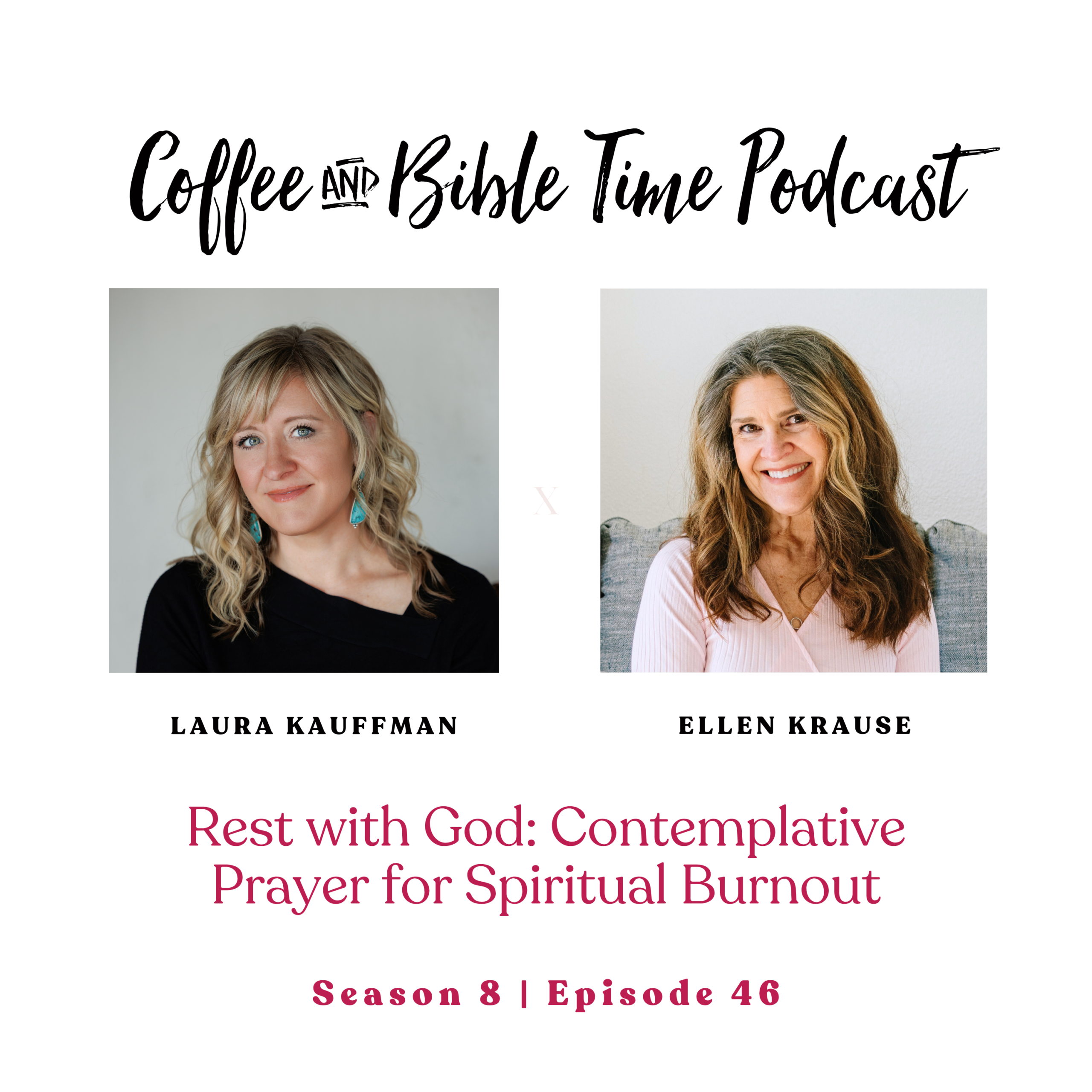
Ellen Krause talks with spiritual director and poet Laura Kauffman, about taking care of your soul and finding rest with God through contemplative prayer, even in seasons of spiritual burnout.

 Apple Podcasts
 Spotify
TIMESTAMPS:
00:00 Making Space for God in a Busy Life
02:17 Signs of Spiritual Burnout
03:53 Laura’s Grad School Burnout Story
05:48 This Brought Me Rest
07:46 What Is Contemplative Prayer?
09:10 Why Stillness Is So Hard (Attachment, Guilt, and ADHD)
14:46 What Is Spiritual Direction?
17:00 How to Discern God’s Voice in Prayer
18:51 Breath Prayer: A Practice to Try This Week
20:30 A Word for the Woman Feeling Burned Out
21:38 Where to Find Laura’s Book and Favorite Bible Tools
Laura Kauffman: I had three boys in four years. So, you know, didn’t sleep a lot, never drank a cup of coffee while it was hot.
A friend of mine recommended a class, and I didn’t even know what it was. I just knew it offered free childcare.
And I thought, “Yep, I’m in. I just want to be around grown-ups.”
It was a contemplative prayer and spiritual direction class, and I had never heard of those words. But when I got into that place, I found someone who would guard the door for me.
Often when I tried to slow down or be quiet or still, my mind didn’t stop. My body had a hard time stopping. There was always something I could be doing or should be doing.
I knew a lot of things to read and study and do and serve, but I hadn’t had a lot of experience of just dwelling with God and letting Him take care of me a bit.
Ellen Krause: Welcome back to the Coffee and Bible Time podcast. I’m Ellen, your host.
Have you ever had a season where you just felt spiritually exhausted? Your mind is constantly going, your phone is always buzzing, and even when you finally have a quiet moment, it can be hard to actually slow down and be present with God.
What you’re longing for isn’t another thing to add to your to-do list. You just want to feel close to Jesus and to become more aware of his presence in the middle of your very ordinary, busy life.
Well, today we are talking about how we can create that kind of space with God, even when life feels anything but peaceful.
I’m so excited to have Laura Kauffman with us today. Laura is a spiritual director and poet who has spent years helping people slow down, pay attention to what God is doing in their lives, and grow in deeper intimacy with Him.
Laura, welcome to the podcast!
Laura Kauffman: Thank you! Thank you so much for having me.
Ellen Krause: I’m so excited to talk about this topic, because I grew up Lutheran initially when I was a kid, and then kind of just in evangelical church, missionary church now.
And so spiritual direction and contemplative prayer, these types of things weren’t really on the top of my radar for my sort of spiritual education, if you will. So I’m excited to dive into that with you.
And something that I really love about you is your heart for people who are just exhausted in their Christian walk. That’s what you call spiritual burnout, right?
What are some of the signs if someone’s listening that they might be experiencing spiritual burnout?
Laura Kauffman: Mm, that’s a great question. I think the signs of spiritual burnout look a lot like the signs of normal burnout.
You start to get maybe anxious. The ‘shoulds’ in your mind get very loud. You’re very aware of all the things you have to get to, and you just feel like you don’t have the energy or capacity for any of that.
The hard part is it’s often caused by really good things.
You know, I’m a huge reader, so books I want to read are stacked to my ceiling in my bedroom.
The people I want to pray for—you know, you read the news and you’re wanting to pray for the world, and the people in my home and the people in my community, and the service projects I could be involved in.
It all can feel like a lot.
I can find myself anxious and overwhelmed, exhausted, feeling like I have nothing left to give, and then I’m not really doing much well.
And so that inner sense is how I start to notice the signs of spiritual burnout in me.
Ellen Krause: What was happening in your own life, Laura, when you realized that you were experiencing spiritual burnout?
Laura Kauffman: I’ve had several seasons of the spiritual burnout, but the first that I remember putting that language to happened in grad school.
I was in a master’s in counseling program, and I was a grad assistant. So this year was such a big deal.
I’m learning these skills, care of souls, and I’m training other counselors. I’m reviewing their work.
And every week I met with my supervisor in the program, and her name was Tammy.
I usually love those meetings, but I remember one week going into the meeting with her and I was just a wreck. I was jittery, I’d been pounding the coffee, and I just wanted it done so I could get to more things, you know, hadn’t slept, all that.
Tammy comes out around the corner at the time of our meeting, and she takes one look at me and just said, “Oh.”
And that was it. She could tell just by looking at me that something was really off in my spirit.
And she said, “Okay, come with me.”
And we went down the hallway away from her office into this little storage room at the very back of the hallway.
She opened the door and turned to me and said, “Give me your bags.” So I handed her my backpack and all my files, my cell phone.
And she said, “You’ve been working really hard, and I’m really proud of you. Today your work is to rest.”
She pointed to the couch and said, “Lay down. I’ll wake you when the hour is over.” And she flipped off the lights and created that space for me.
And I tell you, as much as I needed and craved that, it was awful.
Sitting there in the dark, in the silence, having everything finally calmed down, all the voices that I had ignored came up loud. All my fears and insecurities. Sitting in the silence took a little bit of time to adjust to.
And that’s when I knew something in my spirit needs this place, and it might be hard for a bit, but I think I’ve got to figure out how to be here.
Ellen Krause: Ah, Laura, thank you for sharing that intimate moment that you had, because I think to one degree or another, we’ve all been in a circumstance that has just kind of brought us to the end of ourselves where we feel like we have nothing left.
What helped you recover from that state?
Laura Kauffman: It was really the practice of spiritual direction, which I found a little bit later.
I also didn’t grow up in a tradition where we even knew about spiritual direction or any contemplative practices.
And when I stumbled into spiritual direction, I was in another season of burnout in my early 30s.
I had three boys in four years. So, you know, didn’t sleep a lot, never drank a cup of coffee while it was hot.
Ellen Krause: That explains a lot. Yes. [laughs]
Laura Kauffman: [laughs] And actually at that time, a friend of mine recommended a class and I didn’t even know what it was—at the local church, the class that I was taking. I just knew it offered free childcare.
And I thought, “Yep, I’m in. I just want to be around grown-ups.”
It was a contemplative prayer and spiritual direction class, and I had never heard of those words.
But when I got into that place, especially when I started meeting with my spiritual director, I found someone who would guard the door for me.
Often when I tried to slow down or be quiet or still, my mind didn’t stop. My body had a hard time stopping. There was always something I could be doing or should be doing.
But with Sherry, my director, she guarded the door. She created a place for me to come and have nothing I had to do except settle into the presence of God and rest with Jesus.
That really started tending to me in a way that I had never known before. I knew a lot of things to read and study and do and serve, but I hadn’t had a lot of experience of just dwelling with God and letting Him take care of me a bit.
Ellen Krause: That simple act—you know, we think we have to do something magnanimous, you know? And really it’s that slowing down and opening our hands and laying all of our burdens at Jesus’ feet.
Well, let’s talk a little bit about contemplative prayer.
When you use that phrase, for those who aren’t familiar with it, tell us about that and how it’s different from the way most people just normally pray.
Laura Kauffman: You know, it’s hard to say…how do we all pray? I think everyone does it a little differently based on how they’re wired, based on their life. And I think that’s great.
So the contemplative element of that is probably that settling in. That’s what’s felt really distinctive for me.
There is an anchoring, a centering in God’s presence that happens first, where you let your mind and body grow still, you become aware of him with you, and then you proceed into the thing that you’re going to do.
Have you ever seen a skateboarder and how they’ll be on their skateboard and they’re pedaling real fast, like going, going, going, picking up speed?
When you put that second foot up on top of the board, the wheels are still turning. You may not be pushing anymore, but it takes a while for that skateboard to settle and come to rest.
And that’s kind of the heart of contemplative prayer, that as we settle in and let ourselves grow still, our attention shifts from the constant whirring and movement and is able to turn upward and see God with us in the moment.
Ellen Krause: What a beautiful analogy that really helps bring it home—and reminds me of Psalm 46:10, where it says, “Be still and know that I am God.”
And I think most people are very familiar with that verse, but in reality they just don’t know how to do it. Why do you think we struggle so much with stillness?
Laura Kauffman: That’s such a great question. I think we struggle with stillness for external reasons and for internal reasons.
I think externally there’s always something tapping me on the shoulder, whether it’s an actual child who needs something from me, or my phone that’s going off, or a very full calendar.
Often when I’m burned out, I don’t want to go to a silent place. I want to watch a BBC murder mystery show because that feels easier in the moment.
You know, there’s always something to fill those quiet places with. So there’s a lot of external distractions.
And then I think there’s a lot of internal distractions.
It’s hard to get your spirit and your mind to settle. And I think if we go into stillness thinking it’s a test we either fail or pass, we’re setting ourselves up for a lot of frustration.
And so stillness, I think, is something given to us rather than something we earn.
Now we can practice, we can play, we can enter into God’s presence, but it’s a gift, it’s a grace that’s given by God. And so we just learn to open ourselves up to it, to notice it and be aware.
Ellen Krause: Hmm. You know, one of the things that came to mind when I was thinking about this was the fact that we each have sort of different attachment styles.
And I don’t want to get too, you know, clinical here, but I only know this because I was given up for adoption.
And so I have a detached emotional style, which is kind of like where I just want to keep everybody at an arm’s length distance.
Do you see that as one of those inhibitors perhaps, that, you know, afraid to get too close, if you will?
Laura Kauffman: Thank you for sharing that. I mean, I relate to that in a lot of ways. I’ve had a really tough summer.
We had some hard medical diagnosis for one of our sons. And I have been angry with God in a way that I think is new for me.
This summer, as I’ve sat with my spiritual director, I have felt that push where I’m like, “I want to be in the room with God, but I want him in that far corner. I’m not ready to let him any closer right now because I’ve got some work to do and I’m hurt and I’m upset.”
And she has said, “Absolutely. He won’t push, he won’t force. He will sit there trusting that his spirit’s in you. It’s working you towards the healing and resolution you need.”
And I can remember telling her one week, “Okay, I think I’m ready for him to scooch his chair a little closer.” And that’s just what our connection looked like.
So I think you’re so wise to notice where your attachment styles are and then to say this practice isn’t one where God is gonna come in and force himself upon you. God partners with you in that space and lets you set some of the tone.
Ellen Krause: Yeah, and I love that Jesus knows everything about us. So He knows I have that, and probably thousands of other people have that, and that’s okay.
Laura Kauffman: Yes. Yes.
Ellen Krause: And that we can come to him with what we do have.
You mentioned earlier, productivity, you know, goals in our life. I wonder if part of the problem is that stillness feels unproductive.
You know, we’re so used to asking, “What did I accomplish today?” And just, that’s, you know, simply sitting at God’s feet feels like we’re wasting time.
What would you say to someone who’s kind of feeling guilty for thinking along those terms?
Laura Kauffman: I think that’s absolutely a very common experience.
And if someone was feeling guilty about that…man, I think I just want to ask a lot of questions. Because often I think we see that guilt and we either respond to it or ignore it.
But in spiritual direction, we let it breathe a bit. Be like, “That’s a great noticing. Tell me more!”
Tell me more about what it feels like to feel guilty about your productivity. Tell me about how productivity gets tied into how you see yourself and how you think God sees you. Tell me how you discern what are good yeses and good no’s. Tell me what rest is like for you.
I mean, we could just unpack that for ages.
So I think that if someone were saying, you know, “I feel guilty about this,” I would invite them to explore that more, because that’s some rich ground.
Ellen Krause: Yes, I completely agree. And I think there’s a lot to be discovered in doing that for sure.
You know, another issue that runs in our family, and specifically I can speak to it, is just having an ADHD brain that’s hard to focus.
What would your advice be to someone whose mind, you know, is constantly going in a hundred different directions? It doesn’t just sit. What do we do?
Laura Kauffman: So, I think there’s this idea that contemplative prayer or stillness has to be this very quiet, relaxed, emptying of yourself.
And yeah, there are moments where I come into prayer like that. But often it’s vibrant, it’s lively, it’s moving.
So I think that knowing how you’re wired, that God will meet you in those places too in contemplative prayer.
And that often it’s not so much getting ourself into a different place, but recognizing God with us where we are.
That’s been the real gift of contemplative prayer for me as I’ve exercised these muscles of awareness of his presence.
I find him while I’m washing dishes. I find him while I’m stopped at a stoplight. It doesn’t have to be this little magic room of quiet contemplation. He just starts invading my awareness in everyday moments.
Ellen Krause: Yes, and I love that so much. I feel like that is kind of the way I work. [laughs] I love the glimpses that I feel in just those various moments throughout the day.
Well, I want to talk about spiritual direction now, because you’ve started to, you know, give some examples here.
For those of us who aren’t as familiar with it, what is it? What’s it used for? And how do you know if this is something you want to explore?
Laura Kauffman: Yeah, spiritual direction is a shared contemplative prayer practice, and it’s been around since the days of the early church.
There’s actually a great example, a sort of spiritual direction moment, in the Bible, which is when Samuel and Eli are together.
And, you know, a very young Samuel hears the voice of God but doesn’t quite know what it is. So he goes to the priest and says, “You know, did you call me? What are we here to talk about?” Eli says, “No, no, no, it wasn’t me, go back to bed.”
And this repeats. And at some point, Eli becomes aware this isn’t just a kid with a nightmare or some kind of dream. This is the movement of God.
And so he helps to position Samuel so that Samuel can hear directly from God. And really, that’s a beautiful little microcosm of what spiritual direction is.
The director isn’t very directive, even though you’d think with a name like that they would be.
The director is actually just a compassionate listener who listens to the story of the person and the movement of God, then creates space for the two of them to interact.
So it becomes this kind of three-way conversation in which God takes the lead and the director listens compassionately. We do a lot of listening, we do a lot of quiet, and then we see what God has for our hour ahead.
I can tell you, I’ve had sessions where that’s been pretty much my whole session, where I get still and I just feel hungry. Like I need more of that quiet. And I just rest in it.
Other times I’ll come in and I’ve needed to talk to God about something I’ve been wrestling with. And then that kind of starts the catalyst of the conversation with my director.
But often, even this last week when I met with her, she’ll hear something that I’m rattling off as I’m processing stuff and she’ll say, “I want to pause there. That was significant. Let’s hold that before Jesus and see if he has anything for you right there.”
And we just stop and we sit and we let him weigh in.
That kind of dynamic was new for me. I hadn’t really done much of that before spiritual direction. And that’s been really tender for me, to get to sit with him with something that I’ve just named and said out loud.
Ellen Krause: For those of us, Laura, that have accepted Christ as our personal savior and we’re sitting in that room, you know, waiting for Jesus to take part, would you say what comes to our mind generally is coming from the Lord?
Laura Kauffman: Mm, that’s such a good question.
The question of discernment in general is really important and deserves to take a lot of space.
As we read the word, we know the character of God. As we’re engaged in community, we see the way He shapes and grows us.
So when I’m sitting in direction and I’m wondering if the voice in my head is my imagination or the voice of God or the enemy, I hold all those pieces together.
I think of the God I know in the Bible and who he’s revealed himself to be. I know of the God I see in my community, how he interacts with us as a people. And so if I’m holding something in my prayer life that feels counter to any of that, then I know I can just set that aside. That’s not an encouragement of the spirit or the voice of God.
But if I hear things that I know to be true of God, if I feel the fruits of the spirit being stirred, you know, the enemy can’t manufacture the fruits of the spirit. He only has bad counterfeits.
And so if I see peace that’s welling up deeply, I can know that the spirit’s moving. And if I see joy or patience, then I know that those are safe attributes to lean into and to continue listening to.
That’s also why the role of the director is especially helpful, because I can think of times where I’ve maybe gone down some funny rabbit trails. And when she names that, she helps me to push that away and to keep my view of God in a healthier place.
Ellen Krause: Thank you just for explaining that, because I think that’s one of the things that people kind of wonder in prayer in general.
It’s so important to weigh what we learn, which is why it’s so important that you know scriptural truths.
You know, Laura, you have written the most incredible book. I absolutely love it. It’s called The Meeting Place.
You talk about finding a space of unhurried encounter with God. And I love the way that you write these relatable stories, and then you also provide practical exercises that people can use in their own lives at the end of each chapter.
What would be an example of one of those that someone could try this week?
Laura Kauffman: That’s a great question. I’ve kind of hinted at this one a little bit already, but I’ll camp on breath prayer, because that’s a really accessible one.
Breath prayer is a practice that lets you pray in rhythm with the breath. The most famous breath prayer is the passage that says, “Lord Jesus Christ, have mercy on me.” And you just over and over again repeat the words from the New Testament.
But the great thing about that practice is it can be done with really anything. I have prayed so many different scripture passages.
There’s a season where I was struggling with some insomnia, and I would wake up in the middle of the night laying there, and with my breath I would just pray the psalm of the Lord coming close in the night: “In peace I will lay down and sleep. For you, O Lord, have been my safety.” Just over and over until I could drift back to sleep.
So those little gifts of contemplative prayer, where it’s not more language, more words, more insight, but just simply a sinking deeper into what is. That breath prayer has been especially meaningful to me.
Ellen Krause: Yes, I love to do that as well. And I love that it’s something that you can do anywhere, like you said, in the middle of the night or wherever you are throughout your day. It’s something that you can bring to God because He’s there with you every moment of every day.
Well, Laura, if you could speak directly to the woman listening right now who loves Jesus and longs to feel closer to him, perhaps is experiencing spiritual burnout, what would you want her to know?
Laura Kauffman: Mmm. I would want her to know that God sees her hard work and is really proud of her.
And that he also invites her to come on the couch like Tammy, my professor, did so long ago, and to tuck me and to say, “You can rest too.”
I think of, you know, Elijah, right? After he’d had all that big spiritual battle where he’d worked so hard and then was so burned out and so exhausted that he wanted to die.
God didn’t talk to him about his motives. God didn’t give him a “Go ahead, boy, you can do this.” He made him sleep. And then he made him eat. And then he made him sleep. And then when he was restored, they chatted.
So I would invite any woman who’s feeling that burnout to be gentle with herself, to not be afraid to lean into those rhythms of rest.
Let God tuck her in, give her some good food, and then he’ll be there patiently waiting when the moment is right to have some conversation.
Ellen Krause: Thank you for that. Well, I know our listeners are gonna wanna learn more about you and your new book called The Meeting Place. Where would they find that at?
Laura Kauffman: Best place is my website, LauraKauffman.com. If you go on there, you’ve got links to all my books, and you’ve got a practice library that’s growing.
So if anyone wanted to dabble in some of these things, they could find those there.
Any more information about spiritual direction, if someone’s curious about it, I have a link provided where you can search your area and see what directors are operating in your area. So you can chat with someone, see if it’s something you wanted to try.
Ellen Krause: Amazing. Well, we will make sure we include those links in our show notes.
Laura Kauffman: Thank you.
Ellen Krause: Yes, before I let you go though, I need to run by you some of our favorite questions here. Laura, what is your go-to Bible and what translation is it?
Laura Kauffman: I just unpacked a box from my basement with a bunch of old family Bibles. So my grandma’s old school King James Bible is especially sweet to me right now.
Ellen Krause: Oh, I love that. Have you found any, like, special things, like underlined or notes?
Laura Kauffman: Notes, prayer requests. They ran a little seniors Bible study towards the end of their lives. And so I found their, like, attendance rosters and obituaries, and it’s beautiful seeing the faith of my grandparents on the page with the word.
Ellen Krause: Oh, I love that. You know what? I found one—actually my cousin gave it to me because she’s like, “I think you might like this.” And it was from our mutual grandmother.
And I went to look at it and it was so uplifting. Just knowing that you have that heritage of someone who loved the Lord, and you can see parts of their journey in the notes that they wrote and the prayers they prayed.
And oh, it was beautiful, beautiful.
Okay, do you have any favorite Bible journaling supplies that you like to use?
Laura Kauffman: So many. I have a whole closet over here that you can’t see that it’s exploding.
My one I’m loving right now, I actually have it right here. It’s this little Sprocket picture printer, and it links up to your phone. You can print anything off your phone and it’s, like, an adhesive sticker.
In most of my journaling I really like this practice called an examen practice, which is essentially looking back over a certain amount of time with God.
So I might be reflecting on the week that I just had, and I’ll go through my phone. I’ll look at the pictures to spur memories and have conversations with God. And the ones that are really meaningful, I print them out and I put them in my journal.
And then as I’m flipping back through over time, you almost get this visual reflection of how God has been moving in your life. And I love it. So I’m currently nerding out on the HP Sprocket picture printer.
Ellen Krause: Wow, that’s a first. And that is super cool. Super cool. I love it. Okay.
Well, lastly, what’s your favorite app or website for Bible study tools?
Laura Kauffman: Pray as You Go. It has a daily Bible podcast that is short, but it leads you in contemplative engagement of the word.
So in the beginning, there’s a moment to settle in with some music. They read a short passage of scripture, and then they ask questions and give space for you to dive deeper in and to meditate, to see where the word is rattling around inside of you, where God is speaking.
So it’s a great way to dive into contemplative prayer with the Word.
And there are a lot of other practices I talk about in my book that they actually have guided examples of there.
So if one of them strikes your interest and you’re like, “I kind of want to do that today,” put it on while you’re in the car. Let it rattle around with you while you’re driving.
And you can practice a lot of these and see which ones really resonate. So…Pray as You Go. Love it.
Ellen Krause: Amazing. All right. Well, we will include links to all these things in our show notes, except for her grandma’s Bible. We can’t do that. [laughs]
Laura Kauffman: [laughs] Yeah.
Ellen Krause: But Laura, thank you so much for joining us today. This conversation has just been so encouraging.
Laura Kauffman: Mm, such a pleasure. Thank you, Ellen.
Ellen Krause: You’re welcome.
And for those of you listening, I hope this conversation has reminded you that you don’t need hours of uninterrupted time to meet with God. Even a few quiet moments of turning your heart to him matter.
So, thank you so much for joining us today. We’ll see you next time on the Coffee and Bible Time podcast. Have a blessed day.
Contemplative Prayer: How to Rest in God’s Presence When You’re Spiritually Exhausted
Your phone is buzzing, your calendar is full, and even if there’s a rare time when you get a quiet moment with God, your mind won’t stop racing.
If you love Jesus but feel worn out in your faith, you’re not alone…and you probably don’t need another thing to add to your spiritual to-do list.
But, you may need to learn contemplative prayer.
On a recent episode of the Coffee and Bible Time Podcast, host Ellen Krause talked with spiritual director and poet Laura Kauffman about spiritual burnout and the simple, ancient practice of resting with God.
Here’s what they shared, and how you can start practicing contemplative prayer this week.
What Is Contemplative Prayer?
Contemplative prayer is a way of praying that begins with settling into silence.
Instead of bringing up prayer requests or topics, you take time to breathe deeply and become aware that God is with you.
Laura describes it this way:
“You let your mind and body grow still, you become aware of him with you, and then you proceed into the thing that you’re going to do.”
Laura Kauffman
When a bike or a skateboard picks up speed, it takes a while for it to come to a complete stop, even when the rider stops pedaling.
Contemplative prayer is like stopping pedaling your bike and letting your mind come to rest. As we grow still, Laura says:
“…our attention shifts from the constant whirring and movement, and is able to turn upward to see God with us in the moment.”
Signs of Spiritual Burnout
Spiritual burnout often looks like regular burnout.
You might get more anxious than usual. Maybe your mind fills up with lists of things you “should” be doing. And, most likely, it will be caused by good things—that you no longer have the energy or capacity for.
Laura knows this firsthand. She was a grad assistant running on coffee, stress, and no sleep, when her supervisor, Tammy, walked her to a dark storage room.
Tammy took her bags and said, “Today your work is to rest.”
And at first, it was awful. “All the voices that I had ignored came up loud.” But it showed Laura that her spirit needed a place to be still.
More signs of spiritual burnout include:
Why Contemplative Prayer Feels So Hard
Most of us know the words of Psalm 46:10:
He says, “Be still, and know that I am God;
Psalm 46:10
I will be exalted among the nations,
I will be exalted in the earth.”
But actually doing it? That’s another story.
There are both external and internal things that keep us from stillness: a child who needs something, a buzzing phone, a full calendar, and a mind that won’t settle.
“Stillness, I think, is something given to us rather than something we earn.”
You can’t fail at it. You simply “open [yourself] up to it, to notice it and be aware.”
This also applies if you have a busy brain or an ADHD mind. Laura says contemplative prayer isn’t always quiet and relaxed: “Often it’s vibrant, it’s lively, it’s moving.”
You don’t have to get yourself into a different place. You just recognize God with you where you are.
Laura says,
“I find him while I’m washing dishes. I find him while I’m stopped at a stoplight. It doesn’t have to be this little magic room of quiet contemplation.”
Ellen’s encouragement at the end of the episode says it well:
“You don’t need hours of uninterrupted time to meet with God. Even a few quiet moments of turning your heart to Him matter.”
Ellen Krause
A Simple Contemplative Prayer to Try: Breath Prayer
Breath prayer is an accessible, simple way to try contemplative prayer.
Take a short phrase—usually taken from Scripture—and pray it in rhythm with your breath.
A common breath prayer is, as you breathe in, “Lord Jesus Christ,” then on the breath out, “have mercy on me.”
You can use phrases from Scripture, or even words from worship songs or your own prayer life to repeat over and over again. During a season of insomnia, Laura prayed “In peace I will lay down and sleep” (Psalm 4:8), over and over until she drifted back to sleep.
This kind of contemplative prayer doesn’t require you to come up with more words, or pray over a variety of topics…but to go deep into one truth, over and over again.
God Invites You to Rest
Laura reminds us of Elijah in 1 Kings 19. After his exhausting spiritual battle, God didn’t give him a pep talk.
“He made him sleep. And then he made him eat. And then he made him sleep. And then when he was restored, they chatted.”
Laura’s invitation to you: “Be gentle with yourself, to not be afraid to lean into those rhythms of rest.”
Practical Takeaways: Start Contemplative Prayer This Week
Frequently Asked Questions
Is contemplative prayer biblical?
Contemplative prayer draws on Scripture like Psalm 46:10 and passages such as 1 Samuel 3 and 1 Kings 19, and its focus is resting in God’s presence.
How is contemplative prayer different from other prayer?
It begins with settling and becoming aware of God before you move on to requests or other things you plan to pray about.
Can I practice contemplative prayer if I can’t sit still?
Yes. Laura says God meets you where you are, even in a lively, moving mind or in everyday tasks.
Want to hear the full conversation? Listen to the Coffee and Bible Time episode with Laura Kauffman, and find her book, The Meeting Place, in the show notes.
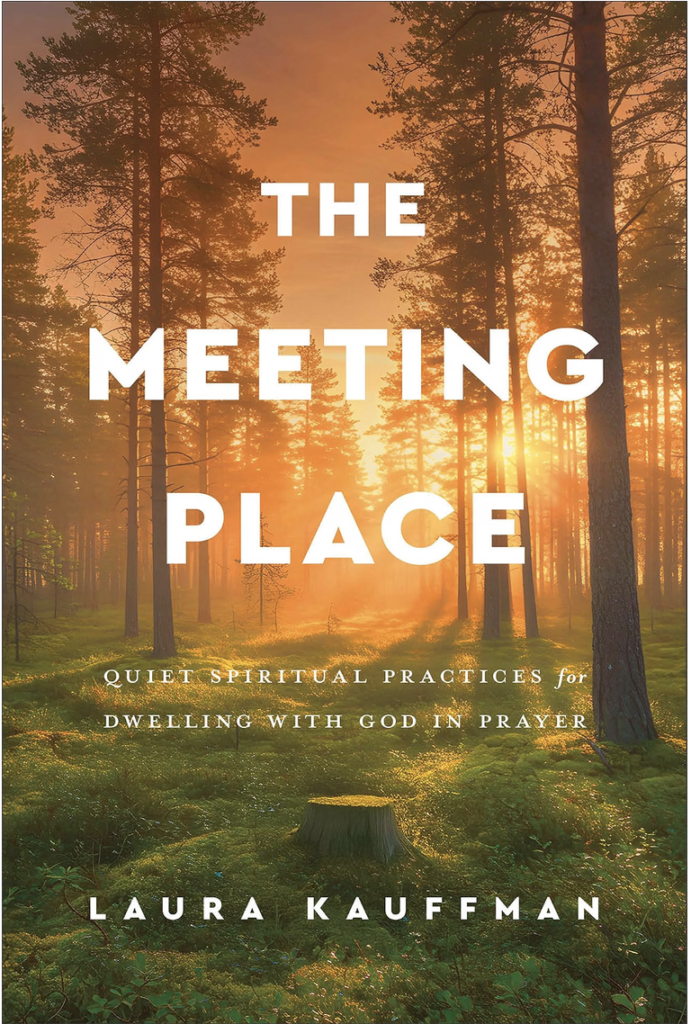
The Meeting Place: Quiet Spiritual Practices for Dwelling with God in Prayer
We long to tangibly experience the presence of God—to come and see what the Lord has done, to be still and know our God.
Far too often, that longing is swallowed up in the dings of technology, the demands of our schedules, and the duties of our faith.
The Meeting Place is a guide to two ancient, proven practices for drawing near to God in a loud and distracting world: spiritual direction—the art of attending to God’s movements in your life with the help of a trained companion—and contemplative prayer—the practice of quieting the mind and opening the heart to receive rather than speak.
Together, these practices create a meeting place: a space of unhurried encounter between your soul and a God who is closer than you think.
Leave a Reply