
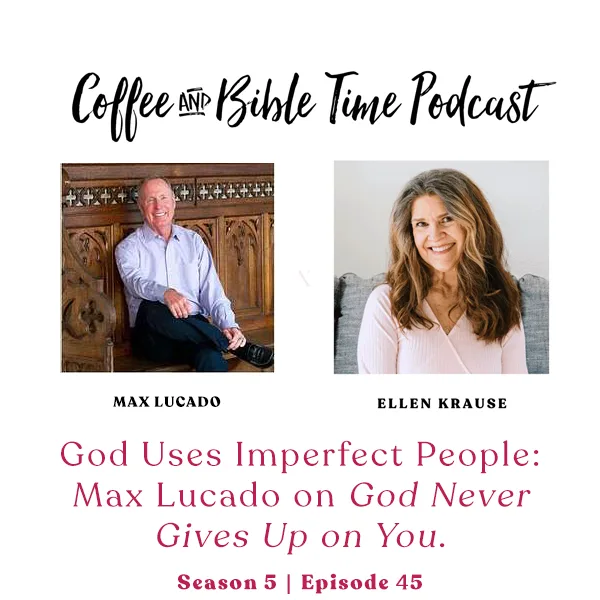

Hosted by Ellen Krause (Mentor Mama)
God Uses Imperfect People:
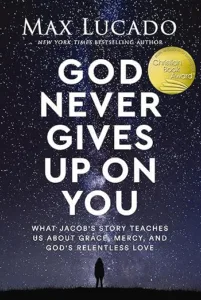
Ever feel disqualified by your past or today’s struggles? In this conversation, Max Lucado shares hope from his new book, God Never Gives Up on You—a fresh look at Jacob that proves God writes straight with crooked lines. If your breakdowns outnumber your breakthroughs, you’re right where grace can meet you. We talk about God’s covenant love, the danger of shrinking God down to “manageable terms,” facing the past with humility, and why the gospel frees us from guilt and fear.
Chapters:

00:00 Intro — God uses imperfect people; episode setup
02:20 Meet Max Lucado
03:40 “Tilted halos”: who this book is for (and Max’s club)
06:20 Quick tour of Jacob’s life (birthright, exile, Jabbok)
10:20 The real hero: God’s covenant faithfulness
12:05 Transactional prayer & the ladder vision (letting God be big)
15:30 Tozer’s warning: shrinking God to “manageable terms”
17:45 Laban’s switcheroo & living with consequences
20:40 Facing Esau: humility, confession, reconciliation
23:55 The toxic detour at Shechem — why to leave unsafe cultures
27:30 Second (and third) chances: grace that won’t quit
30:05 Say “yes” to grace — Plan A vs. Plan B
32:20 The gospel: cross, resurrection, freedom from guilt & fear
35:15 Resources & free Jacob study (maxlucado.com)
36:10 Lightning round: Bible version, journaling, study tools
38:05 Final encouragement
39:10 Close

Full Transcript
Mentor Mama:
I’m Mentor Mama and today we are going to be talking about how God uses imperfect people to do great things. You know, do you ever feel like you’re disqualified from God’s love because you’ve messed up again? Or because your past just feels so tainted that God couldn’t possibly love you or use you in his perfect salvation story? Well, lucky for us, He is the God of second chances and new beginnings. His grace does not quit because we feel unworthy to accept it. And here today to delve deeper into this truth is Max Lucado, whose newly released book, God Never Gives Up on You, encourages believers that if your breakdowns outnumber your breakthroughs, you are in the right place for an encounter with God. Max highlights the Old Testament story of Jacob to reveal a redeeming God that is still the same today.
Max Lucado is America’s best-selling inspirational author with more than 145 million products in print. His message, whether in print, audio, or video formats, is relentlessly focused on God’s grace and love around the globe. The Max Lucado Encouraging Word podcast has garnered more than 6 million downloads in just over two years. And Max has been featured in prominent national media outlets including Good Morning America, Fox & Friends, CNN, The Today Show, and USA Today. Nearly 5 million people follow him across social media platforms. Max and his wife reside in Texas. Please welcome Max.
Max Lucado:
Thank you so much. Really a treat to be with you and thank you for that kind introduction. I didn’t know I was such a good person till you said all that.
Mentor Mama:
Well, you’re amazing, and Max, you know, I just, I love your writing style because your sense of humor and just your ability to help us understand the Bible of the old days and kind of what that might look like today. I just find so, so helpful and just so exhilarating in examining God’s words. From the beginning of God Never Gives Up on You, your new book, you clarify who the audience is of this book by saying that it isn’t for the super saint, but for those with a tilted halo. So, tell us, why was it important for you to start with this disclaimer? And which group do you belong to, Max?
Max Lucado:
Yeah, I’m the charter member of the Tilted Halo Society.
I began thinking about this book many years ago when I read the story of Jacob just reading through the Bible on my own and kept thinking, at some point, Jacob’s going to get his act together. At some point, he’s going to have an awakening, a spiritual awakening. And yet it just doesn’t seem to happen. It doesn’t seem to happen. It seems like Jacob does, you know, he has two steps forward but then he’ll take three steps back. He can’t quite break out. And I didn’t know what to do with him, Ellen. I thought, well, this would be a great… story, but you know what to do with Moses, you know what to do with Esther, you know what to do with Daniel, these kind of sterling silver characters of the Bible, and it’s inspiring. It’s inspiring to put them up on the pedestal and say, I want to be a Daniel, I’m going to be a Joseph of my day, I want to be Esther in my generation, I want to be the apostle Paul of our culture. But Jacob… And I laughed because his story still makes me chuckle. I look for that one redeeming moment, that one story of Jacob that says, you know what, I want to be just like that. And then it dawned on me that really the hero of the Jacob story is not Jacob, but God, that God had made a covenant to use Abraham and his descendants and his grandson. Jacob would be on that list. To use them to bless the world. In spite of Jacob, God did it. And I’d like to say that I’m not, I would prefer to say that I’m not a Jacob, but I have so many seasons of Jacob-like behavior that I found a real kinship with him. So anyway, that’s a very long answer to a very good question. That’s what got me thinking because I think he just represents and symbolizes a life that many of us live.
Mentor Mama:
Absolutely. And I’m just so glad that God faithfully not only pursues us tilted halos, but actually invites us to be an instrumental part of his work. And that’s just so encouraging. Well, if you are listening to this and thinking, I’m one of those tilted halos that fumbles and struggles and doubts. Then Max, what is the upside of this gloomy news?
Max Lucado:
Well, the gloomy news is that it’s not so much our hold on God, but God’s hold on us that matters. Can I take just a minute and do a maybe three-minute summary of Jacob’s life?
Mentor Mama:
Absolutely.
Max Lucado:
Because I’m surprised. I guess I shouldn’t be surprised, but many people don’t quite know where we place him, where he fits in the Bible narrative. So, God makes a promise to Abraham to bless the world through the seed of Abraham. And boy has he ever. One of his descendants is our savior, Jesus Christ. Through the Hebrew people, we have the church, we have Scripture. So, God has blessed the world through the Jewish nation. His grandson, Jacob, was obviously the son of his son, Isaac. Jacob was really the second born of a set of twins. And in the ancient clan, the first born was the one to inherit the… clan. Jacob really wanted that job. In fact, when he was born, he came out of the womb holding onto the heel of his brother. And there’s a triumph of irony there because he’s always pulling people back in order to get ahead. Jacob’s mother, Rebecca, had sensed in a dream, in a vision that the elder Esau would serve the younger Jacob. But rather than wait for God to make that happen, they took matters into their own hands. And boy, the stories began. Jacob convinces Esau to sell the birthright for just a bowl of stew. Jacob dresses up like Esau and convinces his nearly blind father that he is Esau and that he deserves the blessing. I know these are cultural things that are odd, but I do unpack them in the book. And then Esau finds out that Jacob has received the blessing and Jacob deserves to die, according to Esau. And so, Jacob high tales it out and the stories begin. They just continue. He marries, thinks he’s marrying one woman when he’s really marrying another. He has to serve as essentially an indentured servant to his father-in-law in order to be married. And that leads to a whole bunch of stuff, just a hornet’s nest of mess. Finally, he comes back after 20 years to the land of Canaan. And that’s when he wrestles with God in the mud of Jabbok. That’s when he has come to grips with his past and he reconciles with Esau. But then his sons outside of a village go Rambo on a village and kill everyone in the town. I’m not making this up. It’s just bizarre stuff.
Mentor Mama:
Yeah.
Max Lucado:
One thing after another. Finally, he comes back, Genesis chapter 35. And after all this circular, all this prodigal living, God’s still there. God still blesses him, God still uses him. So, it’s a 20-year period in the life of Jacob that is full of more downs than ups, but God’s faithful to Jacob. So, I love the story because of that very reason. It’s one of the stories in the Bible that tells us that truly what matters is the fact that God has made a covenant with us, and even when we forget him, he will never forget us.
Mentor Mama:
Yes. That really reminds me of something else that you said in that portion of the book, that it’s just so comforting to know that by God’s grace, he declared himself to be the God of Abraham, Isaac, and Jacob, right?
Max Lucado:
Yeah, I might have taken that third one off. I would have removed his face from the Mount Rushmore of Hebrew he wrote.
Mentor Mama:
Yeah, so God does include him. Well, you know, God Never Gives Up on You, highlights the story of Jacob, who was considered, like you said, one of the Old Testament patriarchs. And tell us why, you know, just in your opinion that Jacob’s story was included in all of the other patriarchs.
Max Lucado:
Well, there’s so many takeaway lessons from the life of Jacob. Let me pick a couple of my favorites. One of my favorites is the way that he had a tendency to pray. There was an occasion that when Jacob was dead broke, running as a fugitive away from his brother, he spent the night in the desert so poor that he had to use a rock for a pillow. But God came to him in the middle of the night in the form of a vision or a dream. And Jacob saw a ladder from heaven. Remember that famous, the ladder from heaven? That’s Jacob, that’s Jacob. And angels were ascending and descending that ladder. And God was at the top of the ladder and God affirmed the covenant. He affirmed the covenant, even though Jacob had nothing to give. By the way, Jacob’s done nothing, nothing thus far that’s spiritual. Not one thing. He’s never, as far as we know, bent his knees, folded his hands, bowed his head, never preached, never written. There’s nothing. All he’s done is cheat his brother, cheat his father, and run away. So that’s it. And yet even so, God appears to him. And so, Jacob rightly responds with worship. He says, surely God was in this place and I didn’t know it. He calls that area the House of God. And then he prays. Now here’s what I was thinking. When he prays, he prays the prayer, “God if you will watch over me take care of me and lead me back home then I will call you my God and I will give you a tenth of everything that I own.” It’s a transactional prayer if you do this I will do that if you take care of me I will call you my God and when you stop and think about it, Ellen here’s a guy who’s dead broke he doesn’t have any family doesn’t have any servants don’t Donkey that we know of he’s dead broke and yet he has the audacity to try to strike a deal with God to negotiate with God. But we do that! I’ve done that Lord if you’ll do this then I will do that If you’ll take care of us, I’ll take care of that and this is a story that strikes at the heart of these small deities that we created tiny view of God, which we think we can reduce him down to someone who needs something that I have. What pompous behavior that is. And yet Jacob’s story reminds us, no, you got to let God be God. You got to let God be big. You got to let God be holy. Let him be the other God, the otherness of God. The holy separateness of God is what we need. So, stories like that. in the story of Jacob served to remind us that even though Jacob didn’t quite get God, we don’t either. And even though God had every reason to cut Jacob off, He never does. And He doesn’t cut us off either.
Mentor Mama:
Yeah. You know, you included a quote from A.W. Tozer in that portion of the book that really, I think, helped make the point in my mind. He said, left to ourselves, we tend immediately to reduce God to manageable terms. We want a God we can in some measure control. And that just really making me realize like how much I do tend to kind of want to put God into a box, something that I can more fully understand.
Max Lucado:
Yeah, isn’t that a great quote? It is, it is. Left to our own terms, we create a small God. We do, we do. You think about the many times in Scripture that the people are criticized by prophets for creating gods with their own hands and then worshiping them. We read about people carving a god out of a piece of wood and worshiping and saying, now how would they do that? But we do the same thing.
Mentor Mama:
Hmm.
Max Lucado:
We just worship. I don’t know, careers, or we worship an athletic endeavor, or we worship our retirement account. We worship something small when in reality the only one worthy of our worship is so great that the earth is like a footstool to him, and he could hold all the universe in the palm of his hand. That’s how big our God is. So, the tragedy of transactional theology or trying to negotiate a deal with God or that say if you do this, I’ll do that is that we end up with a very small view of God when what we really need is a big God. A God who’s strong and shows us his power and strength we need a big God because well we have big problems.
Mentor Mama:
Yes, we sure do. Well, another sort of tilted Halo character in the Jacob story is his father-in-law, Laban, or maybe his Halo is falling off. I’m not sure, but tell us about the misdeeds of Laban and how God used those for good in Jacob’s story.
Max Lucado:
Okay, well it’s interesting because Jacob is a trickster. He’s a huckster. He’s one who seems to thrive in the opportunity for shortcuts and in working the system. But then he meets his match when he meets his future father-in-law, with two daughters, one is named Rachel and one is named Leah. Rachel, oh my goodness, Jacob falls for her. He falls for her the minute he sees her. And he wants to marry her. He tells Laban, I’ll work for her hand in marriage. And Laban agrees, but Jacob has to work seven years. Seven years. But the Scripture has that beautiful phrase, it seemed like nothing to Jacob because he was so in love with her. Beautiful little phrase. But on the night of the wedding, rather than consummate the marriage with Rachel, he wakes up the next morning, Jacob does, and realizes that he has spent the night with Leah. Now let your imagination try to figure that one out. I mean. The best explanation I can get is that Laban pulled a switcheroo, and Jacob was so drunk that Laban got by with it. But by the time Jacob wakes up and realizes what he’s done, Laban says, well, now you’ve got to take the older sister. She apparently was not quite, at least Jacob didn’t think she was quite as attracted as Rachel. And so the trickster got tricked. He got tricked and he ends up working seven years for the hand of Rachel, even though he’s already worked seven years, so 14 years in all. I think there’s a lot of, there are many lessons in that story, and one of them is even though God promises that he’ll never give up on us, he never promises that we won’t feel the consequences of our poor choices. And sometimes, we come face to face with our own poor choices when we encounter other people. And Jacob did. Jacob tricked his family and he got tricked. Jacob tricked his sibling and he got tricked. Jacob pulled a switcheroo on his father and he got a switcheroo pulled on him.
Mentor Mama:
Yeah.
Max Lucado:
We reap what we sow. We parents tell that to our kids all the time, but we grownups need to hear it from God. Don’t think for a second that you can disobey without consequence. It just happens, it comes with consequence. I’m very confident God will save my soul. Absolutely, no doubt, I’m in the hands of God. I’m equally confident that if I go out and do something intentionally, deliberately, to defy what God has said, then I’ll pay the price for it. And it could impact my integrity, it could impact the way people trust me, but I will pay the price for it. God’s grace is great, he forgives, but he does let us feel the consequences of our rebellion.
Mentor Mama:
Mm-hmm. Yeah, he sure does. I know frequently when I think of that God sees me, that makes me feel so good and so secure, but at the same time, he sees everything, and he knows exactly what’s going on. Well, you had just mentioned some of these stains in Jacob’s past, and God instructed him to confront one of these, tell us how Jacob came face to face with his past so that he could move into his future.
Max Lucado:
Yeah, there was no way that Jacob could go back into Canaan without passing through the territory of Esau, his brother. And there’s a real principle there. To get to the Promised Land, you have to deal with your past. He hadn’t seen Esau since he swindled Esau 20 years earlier. So, he didn’t know if Esau was going to strangle him or hug him. Yet the pathway God had for Jacob took him through an encounter with his past in order to face his future. All of us have Esau events in our past, things we did that we know we should not have done. And until we deal with those, until we come face to face with those, we never fully move into the promise that God has for us. Now here’s a time that Jacob did well. He did well. He saw Esau on the horizon. Of course, the fact that Esau had 400 soldiers with him probably caused Jacob to humble himself as well. But Jacob did, he humbled himself. He took the form of a sincere servant, and he bowed before Esau seven times as an act of contrition, act of apology. Way to go, Jacob. And God had already been working on Esau’s heart. So, Esau’s heart was soft toward his twin brother and the two embraced and there was healing there. And there’s a principle. If we can go face our past with humility, acknowledging that we mis stepped or misspoke or misspent or misbehaved, whatever we did, we’ll just acknowledge it. It’s the confessional spirit that is blessed by our heavenly Father. And you never know, God might have gone ahead of you. He probably has, and he has softened the Esau, softened that situation. And let God pour grace over that moment. If you don’t, you’ll spend your life hiding, suppressing, denying. You’ll do all the things we do with our past, the most important thing to do with our past, is just deal with it. Let God’s grace speak over it and move forward.
Mentor Mama:
Absolutely. I think one of the things you mentioned in that chapter was just that if we allow ourselves through Jesus to do this, every chain and shackle you said can fall to the ground. And so, I hope if you’re listening to this today, I just encourage you to tackle that, right? So, we can break free from the past and start moving towards the future. Well, Jacob spent a season in a toxic wasteland. Tell us what happened there and how did he get out and how can we do the same?
Max Lucado:
Well, I hope you readers and listeners will read Genesis 34 because it’s such an extraordinary story. You’ll think I’m making it up.
Mentor Mama:
Yeah.
Max Lucado:
It’s such a tragedy. I do call it a toxic wasteland. The short version, I mean super short, Jacob leads his caravan or his family toward Bethel, but rather than continue the direction, I mean, go all the way to Bethel, he stops 20 miles shy. He’s within a zip code of being home, but he stops in Shechem and he pitches his tent outside the village of Shechem. Who knows why? Maybe they had some good food or something, but heand his group became friends with that group. Now the Shechemites were not God followers and the Shechemites were barbaric people. And One of the Shechemites, the son of the king, raped the only daughter of Jacob. Jacob, rather than defend his daughter, was passive. But when the brothers of Jacob found out about it, they slaughtered the people of Shechem. See, I told you wouldn’t believe me. It’s in Genesis 34. It’s just terrible. It’s a terrible moment. And these are the 12 tribes of Israel. These are God’s people. It’s not one of the finer moments. It’s a toxic culture, a toxic situation. The takeaway, several takeaways from this. One, never underestimate the sinful heart of the human being. Just never underestimate it. The right situation will bring out the wrong behavior. And apart from God’s grace, we’re just barbaric people. If you ever find yourself in a toxic culture, by toxic culture, I mean, one that elevates strength over kindness, that elevates power over the marginalized, that takes advantage of the weak, that doesn’t exercise justice over those who hurt the weak. That’s toxicity, that’s poison. If you find yourself in that situation, it’s probably good to get out. Probably good in a workplace, and even in a church, someplace where it’s a top-down oppression of the weak. The weakest person in the story is Dinah, the daughter of Jacob, and she goes unprotected, undefended, and if you find yourself in that kind of situation, it’s a dangerous situation. Jacob finally repented. Way to go, Jacob. You were slow to do it, but he finally repented, and he got out. God is not mentioned in Genesis 34. but he’s mentioned at least by my count 11 times in the first 15 verses of chapter 35. God never gave up on him, never did. He was waiting on Jacob when Jacob got to Bethel. It just took Jacob a long time to get there.
Mentor Mama:
Yeah, yeah, and that really is the message of God, right, and his promise of grace. And he did not give up on Jacob. Well, why do you think God did give Jacob a second chance, and how can we know ourselves that he will do the same for us?
Max Lucado:
Well, God didn’t give Jacob a second. He gave him a third and a fourth and a 10th and a 30th. Yeah, but doesn’t he do the same for us? I mean, you know, even today, I’ve not been as grateful as I should be. I’m a blessed man. I should be living my life, kicking my heels, and scratching my head with disbelief at all the blessings. But instead, I forget. I get grumpy. I get insensitive, you know. Who among us, who among us is not, let me say that one more time, I’m going to get this right. Who among us is spared a large dose of Jacob in their life?
Mentor Mama:
Mm.
Max Lucado:
All of us behave like Jacob. So we might aspire to be a Moses, we might aspire to be an Esther, we might aspire to be a Daniel, but the fact is all of us are Jacob. So, Jacob’s story is in the Bible to show us, hey, here’s a classic case of poster child of a guy who never quite got his cheese on his cracker, but God still used him right up until the very end.
Mentor Mama:
Oh, I love that. And you know, Max, as we start to wrap things up here, if there’s someone listening right now that is holding back from accepting God’s grace, what would you say to them?
Max Lucado:
I would say I’ve tried plan B and that doesn’t work. Plan B says I’m not good enough for grace or I’m too good for grace. Neither one of those work. Plan A says I’ve got to have the grace of God. There’s no greater place to be than in that space of grace, in that place where we’re living receiving the grace of God. So just say yes. Just say yes. Let God love you. Let God forgive you. Let God use you. Let God do with you what he so desires to do. There is a place that God has reserved for you in the great kingdom of God in which he takes away the power of guilt and the fear of death. Wouldn’t you love to lead a life in which guilt has no power and death has no fear? Man, that’s the place to be. And that’s where God wants you to be. And all you have to do is just say yes to him. and he’ll begin to move you daily, daily into that place of grace.
Mentor Mama:
Hmm, absolutely. As one final question here, Max, because I know, like, we may have people listening here that come from a range of their Christian walk, help them understand the truth of Jesus’s death and burial and resurrection and how all of that folds into helping us understand that it can repair a brokenness.
Max Lucado:
Yeah, well it comes down to this. God’s plan is for perfect people to live with him in a perfect paradise forever. But the problem is we’re anything but perfect. So, the only perfect person who ever lived, Jesus Christ, lived without sin, never rebelled, never turned against, always followed his father’s will. When he died on the cross, he took Max’s place. Max deserved to die. because the wages of sin is death. The wages of sin is separation from God. So, for a time on the cross, Jesus endured. He paid the price that I deserved to pay. And he became sin so I could become perfect. Consequently, when I enter into the perfect paradise that awaits me and all of us after we die, and God says, Max, why should I let you into my perfect place? I’ll say because Jesus died for me. Not because Max was good, because he wasn’t, but I’ll say because Jesus died for me. He took my place. He paid the price so that I could be with you in this eternal place. And really what it comes down to, all of this life exists, we’ll make a decision about where we’ll spend our eternal life. And the fact that Jesus died on the cross is enough to convince me that God wants me to be in that eternal life with him. And the fact that he rose from the dead authenticates the authority that Jesus has to issue that invitation and fulfill it.
Mentor Mama:
Well, and listeners, that includes you as well. We want you to be there as well. If anyone has any further questions or they’d like to reach out to you and get more information about your book, Max, where should they go?
Max Lucado:
MaxLucado.com has everything a person would need.
Mentor Mama:
Perfect. Okay, we will include a link to that site.
Max Lucado:
Also, there’s a free Bible study about Jacob too. Free, absolutely free. People can sign up for at maxlucado.com.
Mentor Mama:
Oh, excellent. Okay, we will include a link to that in the show notes. Before we go, just a couple quick questions for you. What Bible is your go to Bible and what translation is it?
Max Lucado:
It’s a New King James Version. When I’m writing sermons, I’ll use all kinds of versions, but I read from the New King James Version.
Mentor Mama:
Okay, excellent. Okay, do you have any favorite journaling supplies or anything that you like to use to enhance your Bible study experience?
Max Lucado:
Yeah, I used a Moleskin journal, little prayer journal. I’ve got probably 30 of those. And I just write my prayers in those. And I don’t know what to do with them. I don’t want my kids to have to read my terrible prayers after I’m gone. So, I don’t know what I’m going to do with them. We need to decide that between now and when I leave this earth.
Mentor Mama:
What a blessing that you’ve been praying all those prayers. Lastly, what’s your favorite app or website for Bible study tools?
Max Lucado:
Faith Gateway, Faith Gateway. I like the way they cluster all the different translations together so you can pick the one that works best or feels right.
Mentor Mama:
Oh, okay. We will include a link to that as well. Max, congratulations on your new book. Thank you so much for being here today to share it with us. I know this is a topic that can never be talked about enough, and there’s just so many Christians allow their past and their current struggles and flaws to keep them from stepping into this life of grace and forgiveness. God wants to extend to each one of us, and I thank you for sharing that message.
Max Lucado:
Well, thank you, Ellen. Great to be with you.
Mentor Mama:
Thank you. And for our listeners, be sure and get a copy of Max’s book, God Never Gives Up on You. We will provide a link in our show notes. We love you all. Have a blessed day.
God Uses Imperfect People—and that’s the hope at the heart of this episode with best-selling author Max Lucado. If your past feels messy or your “tilted halo” keeps slipping, you’re exactly the kind of person God loves to restore and use. Drawing from Jacob’s story and Max’s new book, God Never Gives Up on You, we explore how a big, holy God pursues broken people, keeps His covenant, and turns breakdowns into breakthroughs. You’ll hear why bargaining with God shrinks our view of Him, how to face your “Esau” with humility and find real reconciliation, and why grace forgives fully while still teaching us through consequences. Packed with gospel-centered encouragement and practical next steps, this conversation shows—plainly and tenderly—how God uses imperfect people to accomplish His good purposes, and how you can say “yes” to that grace today.
For the not-so-super saints
Max introduces his book to anyone with a “tilted halo.” Jacob’s story is messy—more stumbles than triumphs—yet the hero is God, who keeps His promise and pursues a changed heart. If you’ve failed, you’re not disqualified; you’re the kind of person God loves to redeem and use.
A quick tour of Jacob (and why it matters)
From birthright drama and family deceit to the long exile, Laban’s trickery, and the night wrestling at Jabbok, Jacob’s life is a tangle of schemes and grace. Max highlights the “ladder” vision—God initiating when Jacob had nothing to offer—and the eventual reconciliation with Esau, where humility opened the door to healing.
Don’t bargain with a big God
Left alone, we try to reduce God to something we can manage—“If You do this, I’ll do that.” Max urges us to let God be God: holy, other, and immeasurably kind. Transactional faith shrinks our worship; grace-first faith enlarges it.
Consequences are real; covenant love is steadier still
Jacob deceived and was deceived. Grace doesn’t erase every earthly ripple—but it stays with us in the fallout, forming character and dependence on God. Expect mercy and wise discipline from a Father who won’t let go.
“Face your Esau with humility; God often gets there first.”
-Max Lucado
Face your Esau
To enter the future God prepared, Jacob had to pass through Esau’s territory. We, too, must face the people and moments we’ve wounded. Max shows how humility, confession, and courage invite God’s healing—and how God often goes ahead to soften hearts.
When you’re in a toxic place
Jacob stopped short of Bethel and settled near Shechem—a tragic detour. Max names toxic cultures (power over kindness, injustice over care for the weak) and says: leave. God wasn’t named in that chapter, but He reappears as Jacob repents and returns. Grace waits at Bethel.
“Grace means God won’t give up—even when we do.”
-Max Lucado
Say “yes” to grace
Max closes with the gospel: Jesus took our place so we could enter God’s presence without fear. Plan A is grace—freely received, daily lived. Say “yes,” and let God lead you into a life where guilt loses power and death loses its sting.
Key Moments
“The hero of Jacob’s story isn’t Jacob—it’s God.”
-Max Lucado
Resources & Links
FAQs
Does God really use imperfect people?
Yes—Jacob’s life shows that God’s covenant love outlasts our failures. He refines us and still works through us.
What if I’m carrying guilt from my past?
Bring it into the light. Confess, make amends where possible, and receive grace. In Christ, guilt loses its power.
Can I out-sin God’s grace?
No. Grace isn’t license, but it is larger than your worst day. God disciplines, restores, and doesn’t give up.
How do I start again with God today?
Pray simply: “Jesus, I say yes to Your grace. Forgive me, lead me, and make me new.” Then take one obedient step.
Final Encouragement
If you feel like Jacob—complex, inconsistent, a little bit of a mess—you’re not beyond God’s reach. Turn toward Him today. Let grace untangle the knots, one humble step at a time.
Leave a Reply