
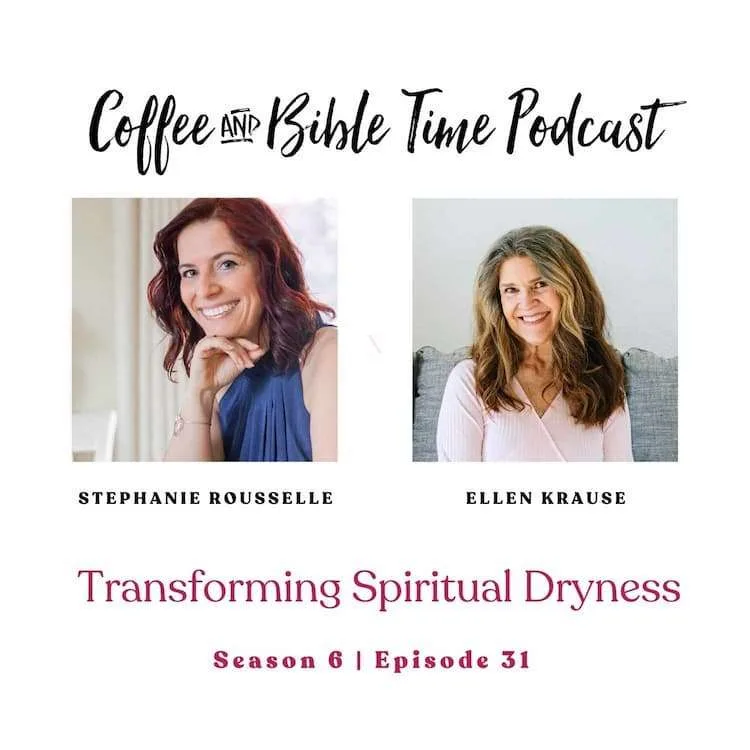

Hosted by Ellen Krause
Transforming Spiritual Dryness w/ Stephanie Rousselle
From intellectual atheism in France to discovering a vibrant faith in the US, Stephanie Rousselle of Gospel Spice Ministries shares her remarkable spiritual journey.
Subscribe & Listen on:
 Apple Podcasts
 Spotify
Coffee and Bible Time | 8/8/2024

Get Your FREE Guide “How to Study the Bible” at www.coffeeandbibletime.com!
Full Transcript
Ellen Krause: 0:04
At the Coffee and Bible Time podcast, Our goal is to help you delight in God’s Word and thrive in Christian living. Each week, we talk to subject matter experts who broaden your biblical understanding, encourage you in hard times and provide life-building tips to enhance your Christian walk. We are so glad you have joined us. Welcome back to the Coffee and Bible Time podcast. This is Ellen, your host.Ellen Krause: 0:33
You know many of us struggle to find true delight and satisfaction in our daily lives, and we often feel disconnected from the deeper joy that comes from a close relationship with God, and this leaves us yearning for something more, something that truly fulfills. And in this episode, I introduce to you Stephanie Roussell from Gospel Spice Ministries, and she invites us to nurture a life filled with delight in God. She has a passion for growing closer to our Savior, as he offers us just a refreshing perspective that can transform our spiritual journey, and so, without addressing that, we could miss out on the profound joy and peace that comes from a close relationship with our Creator. So stick with us today and be inspired to deepen your love for the one who loves you most.Ellen Krause: 1:39
Stephanie is the founder of Gospel Spice Ministries and the host of the Gospel Spice podcast. Her personal motto is God’s glory, our delight. Born and raised in France, she has lived for her one Lord over the last two decades on three continents, four countries and five cities, through six professional roles. This 100% native French woman is a wife, mom, podcaster, public speaker, bible teacher, former women’s ministry director and strategy consultant. Please welcome Stephanie.Stephanie Rousselle: 2:20
Oh, it’s so good to be here with you, Ellen. We’ve been looking forward to chatting with you and hearing what the Lord has put on your heart too.Ellen Krause: 2:27
Oh, you know, I’m so excited to have you on this podcast and I wish, for our listeners’ sake, we had hit the record button sooner, because we just got chatting away here and had so much to say and I was like, oh, we got to hit that record button. So I’m excited to get this conversation started. You know, I have a friend who was a missionary in France, actually for many years, and I know that that can be a tough place to share the gospel. Tell us what the Christian culture is like in France.Stephanie Rousselle: 3:03
That’s such a good question, you know. So. I left France almost 20 years ago, so I can’t say I’m on top of it as much as I used to. What I do know is that the French are considered among one of the most unreached people groups, and that being a missionary there really is not an easy thing, because most people are deeply atheist or, if they are spiritually minded, they are looking to definitely Eastern religions. And so, for the French, the fastest growing religions are, you know, Buddhism, for example, but also it’s interesting that, especially through immigration, the single fastest growing faith in France is Islam right now, and it’s actually anticipated that in the next 20 to 30 years, Islam might actually be one of the dominant religions in Europe, and that’s something that well, is something to think about, and that is largely because the French in particular, and a lot of Europe, have rejected our Judeo-Christian roots, even, you know, more than the Americans have, but not as fast. Fast.Stephanie Rousselle: 4:04
It took us 200 years after the French revolution to get to a place of radical secularism, which is something that I see America going towards in less than one generation, and that saddens me, but that’s probably a conversation for another day. Yeah, so take, take a warning from how Europe is operating, because I’m not sure that’s the model you really want to follow, but but spiritually speaking at least France is. Is a dark place, but it’s so fascinating. A few weeks ago there was a large gathering of Christians in Paris and over 20,000 Christians gathered and I wept tears of joy and I don’t want to say unbelief because I wanted to believe it, but it was so overwhelming to me to see so many French Christians. God is doing a new thing in France too.Ellen Krause: 4:53
And clearly through you as well. How did you personally come to faith in Christ? Was i t while you were in France or after.Stephanie Rousselle: 5:02
You know, Ellen, God has a sense of humor, right. I’m sure you know that already. And so, for me, he took me out of France, and I’ve heard several stories of French people who have come to faith outside of France. And I think 30 years ago, when I became a Christian, france was so dark spiritually that the Lord was literally taking people, handpicking people among us, out of France and exposing us to the gospel outside of France. And now he’s bringing a lot of us back towards France.Stephanie Rousselle: 5:27
But for me, when I was 17 years old, I became a foreign exchange student to the US. I did my senior year of high school in the States, and I did this because I wanted to learn English, and that was not really happening in the French public school system. And so I went and lived with a family for one year, and I wasn’t an au pair, I was going to school, I was just, you know, part of their family. They welcomed me for an entire year and, as you may already have guessed at this point, Ellen, this family were very strong Christians, and so that was my first exposure to the gospel. But you know, God again is so thoughtful and he leads us to him in such a personalized manner for me, because I came from a very deep intellectual atheism. It was really well thought out. It’s something I had not just embraced from my own upbringing but something I had truly accepted as my own worldview. And so, because it was very intellectual, god in his kindness revealed himself to me through the intellect, but also through experiences, through relationships, because he caters to our head and to our hearts, and I desperately needed both. And so he allowed me to discover him through my people. I call to this day my American mom and dad. And, long story short, at the end of my year in the States I gave my life to Christ.Stephanie Rousselle: 6:50
And it was a complicated story because it happened through my exposure to the gospel accounts of the resurrection and again, intellectually speaking, it’s very difficult for an atheist to wrap your head around how could the resurrection have happened? And so I was one of those who tried you know, case for Christ style, least trouble style, tried to dismantle the resurrection. And of course you can’t do it. But I love when the Lord kind of challenges you that way. And I became rather quite quickly in my spiritual journey, quite quickly aware of the historical fact of the resurrection.Stephanie Rousselle: 7:25
But it was first very uncomfortable. I mean, you need to imagine that it’s really not easy for an atheist to believe that the resurrection happened. Right, it’s like sleeping on a bed of nails because it shatters all sorts of beliefs you thought you had. And then after that, it’s one thing to believe in the historical truth of the resurrection, but that does not make you a believer. It takes more than that. It takes a relational experience of Christ.Stephanie Rousselle: 7:49
And so God led me to choose to believe in him, even though that was something that made no sense and I could go into more details of what happened there, but that’s kind of the gist of what happened. And I got baptized and went back to France, you know, still basically getting off the plane dripping wet from baptism because it was so recent and CS Lewis style, you know, as he says he was the most reluctant convert in all of the UK, and for me it would have been in all of France. And I went back to France pretty much convinced I was the very first French Christian ever, right, because I had never heard of one, I had never met one. And then, you know, I’ve spent the last 30 years discovering the rich heritage of French Christians. So there you go.Ellen Krause: 9:22
I love how God just works in so many incredible ways and it reminds me and if there’s anyone listening to this, I know we had au pairs for four years before I stayed home with our kids and it is a great opportunity to love on those people to share the love of Christ, and I think that’s so amazing how that family really helped you.Stephanie Rousselle: 9:57
I thank you for having these au pairs, thank you for sharing your lives with them and I would say, for anyone listening, indeed, consider having a foreign exchange student, maybe not for a whole year, the way my American mom and dad did it, but for a summer. And there’s entire ministries that are actually built. I know of a podcast, even that exists, that is specifically targeting Christians who want to host foreign exchange students and how to share the gospel with them. So it really is such an incredible way to be a reverse missionary. Right, you were talking about your friend who’s a missionary in France. Well, you can be a missionary in your own home by welcoming people from all over the world into your home. It doesn’t get better than that.Ellen Krause: 10:36
Yeah, yeah, oh, that’s so neat, okay. So today we want to help our listeners overcome any stumbling blocks that they may have in developing a closer relationship with the Lord. So what are some of those stumbling blocks, do you think, and what’s the remedy for that?Stephanie Rousselle: 10:58
Yeah, well, I wouldn’t know about all of the stumbling block. I can speak from personal experience, right, and I’d love to ask your own personal experience with that I can relate to, even though I’m absolutely passionate about scripture and about God. I think we by and large are as Christians, but it’s easy to forget, and so I think it has to do with remembering that, even our hard times, when it feels dry and we’re kind of a bit lost and we don’t desire God anymore, what if, instead of beating ourselves up and feeling guilty about it and thinking, oh, because my default would be to think, oh, I should pray more, I should read my Bible more? I should? You know, I’m not spiritual enough. No, no, no, no, no. What if, instead, this was an invitation into deeper intimacy with God, because he’s actually trusting you with a season of dryness? What if that season of dryness, you know, was actually a blessing? Instead of looking at it, oh, I must have done something wrong. Right, again, I should pray more, I should start fasting, maybe I should get up, you know, earlier in the morning, or maybe I should go to bed later at night. Oh, I should do one more Bible study. No, no, no.Stephanie Rousselle: 12:10
What if, again, this was actually an invitation. So, unless you are in, you know open rebellion and you’re openly sinning and you’re openly rejecting God, and if you were, you wouldn’t sense that dryness and you wouldn’t sense that desire to grow closer to him. The very fact that you miss God, you miss his presence in your life, you miss maybe the deeper intimacy you feel you used to have. And again we all go through that. Again, I think it’s actually an invitation. It’s God saying hey, okay, let’s go deeper together. So I am allowing you to experience discontent so that together we will find the solution for it.Stephanie Rousselle: 12:51
And if you again speaking only from personal experience, I don’t have anything else I have found that in my overachiever, perfectionist band I will try to like find something I’m supposed to do. But what if, again, it’s not something I’m supposed to do? What if I’m just supposed to wait and trust him to lead me? Because, at the end of the day, I’m trying to get rid of my self-sufficiency, because that’s actually probably what’s standing in the way, the fact that I’m even thinking, oh, I should fix this, I should do something about this, no, no, no. What if he is supposed to fix this? What if he is supposed to do something about it and he’s just telling you to take your hands off the wheel, just relax and actually embrace the season of dryness, not with guilt, but with holy expectancy of what he is about to do. Right, what about that? That would be a good place to start.Ellen Krause: 13:49
Yes, I think that’s an excellent, excellent place to start. Actually, and I feel, like you know, even within my own life I have different layers of how my relationship maybe feels or is with God, Like in some, you know, things I feel close and then maybe on some specific things, I’m really struggling from waiting to see and, like you said, holy expectation that God is going to do something, but it can be scary in the waiting.Stephanie Rousselle: 14:29
Oh and so uncomfortable. I don’t like waiting. None of us like waiting, and yet we spend so much of our time in the waiting rooms of life. We really, really, really do. Actually, it’s interesting, and that’s not in the French, but that’s in Spanish In a waiting room, in Spanish is sala de espero. It’s a hoping room, a place where you hope the word. It’s not a waiting room, it’s a place of hope, a place where you hope the word. It’s not a waiting room, it’s a place of hope, a place where you hope.Stephanie Rousselle: 14:54
So what if, instead of waiting, what if our form of waiting was in some ways an invitation to hope something? That’s why, like holy expectancy, like we’re expecting him to do something and to expect to wait, to hope in him doing something, and I think you know, wait to hope in him doing something. And I think you know I used to think, as a Christian, that God’s will was this very thin, you know, knife’s edge that I had to walk. It was this very thin line, and that if I would veer slightly to the left or to the right I would fall off his will, and that somehow I had to find the balance to walk a very thin line.Stephanie Rousselle: 15:34
Well, you know, I think I’m discovering that God’s will is more like an open plateau. It’s an open plane as long as we are not willfully disobedient again outside of rebellious sin, as long as we are desiring deeper intimacy with him, as long as we are desiring to honor him and to glorify him and to delight in his glory my motto God’s glory or delight. As long as we seek those things, I think we’re painfully aware that we are dust and that we do not actually live out the fullness of our desire to love him and to worship him and to be in deep intimacy with him. That holy longing also is a good thing, because it leads us towards more and gives us hope for what’s coming. And so it’s this vast plateau of his will in which he’s inviting me to jump and run and have fun and enjoy him.Ellen Krause: 16:25
It’s not something that I’m going to fall off of as long as I am seeking this relationship right, yeah, and I think that’s a really great analogy because, as you you know, I almost think of it, like you said, almost like a tight rope If you could fall off one way or the other. It doesn’t, that’s not. And if you think about God’s character, you know he doesn’t want us in a constant state of fear and anxiety. Right, that’s just not. We need to trust, and that definitely puts a much more positive light on the waiting part of it, for sure.Stephanie Rousselle: 17:02
And as a mom you and I you know we’re talking about that before we started recording as moms, we never stop being moms, even when our kids are adults, as you and I were chatting about, and we want the best for our kids. I don’t want my kids to feel like they’re only. I’m only pleased with them when they walk this very tight rope of will, no, no, no, no, no. I want them to have fun, I want them to delight in the Lord, I want them to grow in their relationship with him and with one another and with me, and enjoy the fullness of life under his lordship.Stephanie Rousselle: 17:30
And that’s a vast plain. I mean, you know, is it Psalm 15 or 16? David, that says the lines have fallen for me, the boundaries, his line of his inheritance have fallen for him in pleasant places, like he has received an inheritance from the Lord. That is a pleasant place. It’s not a desert place. There can be desert in it, but that’s not the ultimate definition of that place. It’s not a desert place. There can be desert in it, but that’s not the ultimate definition of that place. And it is not a tight rope by any means.Stephanie Rousselle: 17:57
We forget that.Ellen Krause: 17:59
Yeah, we do, and I think this is a great, great reminder.Stephanie Rousselle: 18:02
Or like another way to look at it, is spices right, so I love to cook. It would be like saying there’s only one way to use cinnamon. There isn’t. There’s a million ways to use cinnamon, and actually, when I lived in Africa, I discovered ways to use cinnamon that I knew nothing about because it’s used in savory dishes, whereas as a French girl, I think in the States we use it mostly with sweet dishes. I love cinnamon rolls, but that’s not how they use cinnamon in Africa, and so I learned to use it in savory dishes. It was this whole new experience, and cinnamon is not to be used in just one way and in the same way. God invites us to many, many dimensions with him.Ellen Krause: 18:40
Absolutely so. That reminds me of the Psalm 34, eight verse that says taste and see that the Lord is good and you really latch on to that verse and I love kind of how you describe your ministry sort of in this whole cooking and spices and tell us why it is that you sort of chose that key verse to to encourage people with.Stephanie Rousselle: 19:18
I like to slow down, I like to enjoy a good meal, I love to host and to spend time putting together dishes for my guests, and so I think this idea of taste and see that the Lord is good in our culture is a little counter-cultural. What do you mean? You taste God? Like? How do you taste God? You know, we can imagine maybe hearing from God, or seeing maybe possibly God through his miracles or whatever, but like tasting him outside of, maybe communion, like what do you mean? What does it mean to taste and see that the Lord is good? And so I think there’s just a puzzling countercultural invitation that should cause us to perk up our ears and go well, lord, what do you mean by that? Because that doesn’t really make sense. How do we? It would be like smell and see that the Lord is good. What do you mean? How do you smell God? How do you taste God?Stephanie Rousselle: 20:07
And you know I think it’s a reminder first that we are embodied creatures. We are body, soul and spirit, so our relationship with God is also through our five senses. And that’s part of the beauty of Jesus incarnating is that he too had a body. It’s not some kind of, you know, ethereal, stoicist religion. It’s an embodied experience of God that scripture invites us into. And then, as a French girl loving to cook, here’s the thing Let me invite you into my French brain. Like I have this, like you have an English speaking concordance in your head where you know, you have verses in your head where there’s a particular word that’s used in several verses and you’re going to instinctively think of that. I do that, but my brain is wired in French.Stephanie Rousselle: 20:53
And so in French there is that word that is one of my favorite words in any language. Really is the English word delight. Again, god’s glory, our delight to delight in God. Well, how do we do this? In an embodied way, the word, the French word for delight, is a pretty word. It’s the word delice. Now, that word delice might remind you of another word in English delicious.Stephanie Rousselle: 21:16
Here’s the thing In English, you’ve got two words. You’ve got delight and deliciousness. These are two distinct words. In French, we only have one word for those two words. So my French brain cannot understand the difference between delight and deliciousness, because it’s only one word in French délice.Stephanie Rousselle: 21:34
So God is of course delightful, but he’s also delicious because it’s the same word. So in French, God is delightful and delicious both. So, of course, taste and see that the Lord is good because God is delicious, and see that the Lord is good because God is delicious. You know, and one of my favorite other verses in scripture is Psalm 37, 4, delight yourself in the Lord and he will give you the desires of your heart. Well, that word delight in French is like delight yourself, but find God to be delicious and he will give you the desires of your heart. Do you see the connections and how in French it just works so well. And so it’s this invitation to delight in the Lord, to taste and see that he is good.Stephanie Rousselle: 22:18
And now, when you taste something, when you have a bite of that delightful cinnamon roll I was just telling you about that I love so much with coffee, I mean, come on, that’s heaven, right, coffee and cinnamon rolls, right, it works too well for my waistline, but it works.Stephanie Rousselle: 22:31
And so you know, when you take a bite of that cinnamon roll, it’s going to delight you, it’s going to explode, you know, in your senses, and then you’re going to digest it and it is literally going to become a part of you, right? It’s going to give you energy, it’s going to give you material for yourselves. So you’re going to literally create new, create. Your body is going to be created out of that bite of cinnamon. Roll Well, taste and see that the Lord is good. Do we allow ourselves to be created through our digesting God’s word? Do we really allow that? Do we allow God’s word to transform us in such a way that it actually remakes us? Are we actually allowing ourselves to be transformed by the renewing of our minds, so that we will test and see what is God’s perfect and acceptable will? Right?Ellen Krause: 23:18
It’s all connected. Yeah, it sure is. And the whole the trust and obey part, like it’s all tied in together. I will say one thing I would have to go for the coffee and the chocolate croissant because I was in Paris and I had a chocolate croissant right when they came out of the oven there and I thought I had died and gone to heaven.Stephanie Rousselle: 23:48
Amen, you’re a girl after my own heart. I hear you, yes, yes, it’s good.Ellen Krause: 23:52
Amazing, but that said it. You know someone might be listening to this and might be in a deep state of despair, might have horrible things going on in their life and feel like in this world that we’re living like this is kind of wishful thinking here, and and I think that’s something you and I, again, we were touching on before we got started, and we’re talking about suffering and how that gives us compassion.Stephanie Rousselle: 24:18
Because I think, again, you know, we’re talking about deserts earlier and how they are actually maybe God’s invitation for deeper intimacy, and in the same way, our deserts, but also our suffering. I think and I’m not speaking lightly I’ve had my share of suffering. I deal with chronic pain, I have, you know, depression, and so I understand, you know, and all the you know I don’t want to list, but we all have a lot of things to go through right what we’re not minimizing any, no, no, no.Stephanie Rousselle: 24:50
On the contrary, I think what we’re saying is that there’s a you know, when you look at Jesus, he was accused of being both a glutton and a friend of sinners. That means that he was enjoying life and he was also a friend of people who were in pain and suffering and who needed him. And so he calls us to do the same thing. So, when we are in a place of suffering, I think I have found that it has given me deep humility and compassion, so that I can then, by God’s grace, when I’m doing better, when you know the Lord blesses me with healing in one form or another emotionally, psychologically, physically, whatever the situation may be Then he allows me to be the hands and feet of Christ to someone else who is suffering. And I know it sounds trite when you’re going through pain, but, again, as a mom, I would not mind going through pain if it can help my kids. And so, in the same way, I would be grateful to anyone who’s going through pain so that later down the road they can help my kids with something. And so, in the same logic, I want to be able to see my pain as something that can help someone else’s kids down the road, because I want others to be there for my kids and so and you know God, when he invites us to play that role in his kids’ lives, that’s a beautiful thing, and I wish somehow there was a way that we could play that role, be these hands and feet, without going through suffering ourselves. But I’m not sure that’s possible this side of heaven, because of fallenness, because of all sorts of reasons we could talk about, and so it’s with a lot of candor and seriousness that I talk about delighting in the Lord. And this isn’t from a place of not having suffered or not suffering. It’s from a place of saying well, look at Christ, he delighted in the Lord in extreme circumstances. Could he be inviting us to experience?Stephanie Rousselle: 26:55
You know, my favorite verse in all of scripture is Philippians 3.10. It’s Paul talking and he says for, my determined purpose is that I may know Christ, and we’re all okay with that. And then he goes on. He says how do we know Christ? Through the power of his resurrection and again, we’re all in favor, but also through the fellowship of his sufferings. That’s how we know Christ.Stephanie Rousselle: 27:16
Now, do we want to know Christ? I think we do so, does that mean I’m willing to know him, even if it means that he’s inviting me into the fellowship of his sufferings? Well, honestly, I don’t want to Remember, lord, that I am dust. I don’t want to suffer, I really don’t, but I do want to know you, you. So which one am I going to choose? I, and, honestly it, I want to tell you I wholeheartedly embrace suffering. Of course I don’t. I’m human, I’m, I’m frail, I’m finite, I’m small, I’m weak, but but I want to know him, I want to know you, lord, whatever it takes. And um, yeah, and I, we could go into the French for to know, because, again, this is a case where you guys have two words in English and one word in French for delight, but we have two words in French for to know, and you only have one word.Stephanie Rousselle: 28:04
And in this case, Paul uses a word that means a deep, experiential knowledge that has come from personal experience. It’s not head knowledge. He has literally tasted the power of the resurrection. He has literally tasted and ingested and digested the fellowship and the sufferings of Christ, to the point that it has transformed him so that he knows Christ in that way, in that intimate way. It’s the same word that’s used. Adam knew Eve, like it’s an intimate knowledge. Or Jacob knew God after he wrestled with him. It’s that super intimate, hand-to-hand combat, almost with God, that results in knowing him in a way that isn’t possible otherwise. But it comes through the power of the resurrection and, yes, the fellowship of the suffering. So this isn’t like happy Pollyanna, small talk.Ellen Krause: 29:09
I’ve seen over and over again being part of Bible study groups for over 20 years that people will say I didn’t want to go through that suffering, but it was the closest experience that I’ve ever had, a time where I drew closer to God than ever before and I wouldn’t trade it for the world. And so not only can our suffering draw us closer to the Lord, but at the same time it gives us the opportunity to show how God works in our weakness, through those terrible struggles, to help the next generation or the next group of people that are suffering with perhaps similar situations that you can help them with.Stephanie Rousselle: 29:48
And that is such a beautiful perspective and I need to be reminded of it when I go through suffering. Because when I go through suffering, to think that that’s going to help someone down the line, honestly I’m not that godly. Sometimes I’m like I just don’t want to hurt, I don’t want to be in pain, I don’t care if it doesn’t help anybody because I’m in so much pain, and so, but to think, well, it could help my kids, oh okay. Well, now I’m a little more willing, and and so when maybe not my kids but someone else’s kids, oh yeah, maybe I’m willing then because my kids might need someone else’s help, like that way down the line. And then so that’s one. And then the other again is like my.Stephanie Rousselle: 30:24
The Lord has given me as he has, I’m sure, many of us who are listening this deep hunger to to know him and to, to to really have this intimate relationship with him.Stephanie Rousselle: 30:36
And so, if it takes suffering for me to know you more, lord, okay, that helps, it really does help. I want to know you more, I want to be more intimately connected with you. I want to sense your presence and see your smile over me a little more clearly. I want to taste and see that you are good. And if it takes suffering to get there, okay I might not be willing, but I pray what I call the prayer of weakness. I’m willing to be made willing. Right, I might not be willing to suffer, but I’m willing to be made willing because I trust that you know what you’re doing, lord, and so at the end of the day it really goes back to do. I trust God that he knows what he’s doing, because he is as good as he says he is. Have I actually tasted and seen enough of his goodness that I’m willing to bet my entire suffering on the goodness of God?Ellen Krause: 32:19
Yet God’s will be done. And God’s will was done. And boy am I glad it was his will, instead of what I originally thought, because now I can see in hindsight that what I wanted was maybe selfish gain or was in in some way what I thought was best, but clearly later I could see that God’s way was so so much better.Stephanie Rousselle: 32:39
And sometimes we don’t see it this side of heaven. And again, that’s where we learn to trust, because you got to see that his will was better than yours. But sometimes we don’t. Sometimes in extreme circumstances the death of a loved one, for example it never, necessarily, ever makes sense this side of heaven. But that’s where do I trust? In the goodness of the Lord, in the land of the living, even if, even when these are hard, rough questions.Stephanie Rousselle: 33:06
This is not, yeah, this is not for the faint of heart. I mean Christ and I love that he invites us into this and he doesn’t mind us wrestling with it. We don’t have pat cliche answers. I cannot stand when someone just slaps on a Bible verse onto your pain and like considers it dealt with. No, no, no, no, no, no. We don’t slap on Bible verses, it doesn’t help. Like we enter the pain, we have the compassion and then we welcome the fact that Christ welcomes our wrestling and our doubt.Stephanie Rousselle: 33:35
You know, and again, I look at a lot of other world religions because I grew up in atheism and you know I’ve been around Islam a lot, and other world faith, and there isn’t that freedom to struggle within the confines of faith outside of the Christian faith, because otherwise there’s a lot more dogma, because it’s a little more frayed around the edges. So only the Christian faith I have found to be robust enough to handle the full scope of our doubt and our pain and our questions. Atheism doesn’t do that for you and the other world faith that I’m familiar with do not do that for you. Christ allows that. He is so meek and gentle, so humble, and yet so majestic and sovereign that he welcomes our doubt and our questions. And there’s room. There is room. Don’t feel guilty because you have doubts and questions or because you are wavering in your faith because of pain. Don’t feel guilty, cling to him. He is spacious enough to welcome all of you, all of you, not just the good parts. That’s the whole point of grace.Ellen Krause: 34:38
Thank you, Stephanie, so much for sharing that, and I know we could just keep on talking as we start to wrap things up here. Tell us about how people can you know we’ve only just, you know nipped the very beginning of delighting in God’s word and nurturing our faith, and you have many resources available for people. Tell us how they can find out more about you and those resources.Stephanie Rousselle: 35:07
And you do too. I love what you guys do. You know your podcast is awesome, all of your resources, all your Bible studies. So these are all great places to start. We also so we have the Gospel Spice podcast, where we do weekly Bible teachings and then we also have guests. So we’re twice a week and we alternate that, and then we have Bible studies and we have all sorts of resources we provide for people who have experienced that measure of staleness in their relationship with God, whether it came through dryness, through suffering, and they’re wanting to overcome that staleness and to retaste the goodness of the Lord. And so we come alongside you in that with a lot of humility and compassion, because, again, that’s who Christ is and so that’s who he calls us to be. So Gospel Spice next door to the Coffee and Bible Time podcast, and then gospelspice. com and on social media as well.Ellen Krause: 35:59
Awesome. All right, we will make sure we include those links in our show notes. Stephanie. Before we go, I want to ask you some of our favorite Bible study tool questions. What Bible is your go-to Bible and what translation is it?Stephanie Rousselle: 36:14
Oh, that question is so good and so difficult to answer, because it’s so hard to choose just one. You know, it’s kind of like asking me what my favorite spice is. I don’t know, I love too many of them and my favorite spice is chocolate, so I don’t know if that even qualifies as a spice, right? But I like to study scripture in a lot of different translations, including French, so not just English, right? So it’s not going to help you if I give you a French translation.Stephanie Rousselle: 36:39
Right now I’m a lot in the ESV, but I also use the NLT a lot, and so my own personal Bible that I have to change every about seven to eight years because it gets all marked up and it gets so frayed it’s not usable after a while. So my first one was an NIV and then I had a CSB and now I have an ESV, and so I like to rotate and change. And so, because I love to study scripture I don’t speak Hebrew or Greek, but I love to study scripture in the original text, through the help of scholars and in French, and so right now it would have to be the ESV, either study Bible or one of the journaling Bibles, because I love journaling Bibles right, they’re the best so yes, I love that.Ellen Krause: 37:21
Speaking of journaling, do you have any favorite supplies or anything that you like to use to enhance your Bible study experience?Stephanie Rousselle: 37:29
Oh, it’s going to sound really old school, but I love fountain pens and so I love to use fountain pens. The problem is they are totally going to mark through your very flimsy pages of your Bible, right? So that doesn’t work for a Bible, because it will mark through. But for journaling I love fountain pens. I grew up in France where the only pens we were allowed to use were fountain pens, so I think it just comes from that. But otherwise I love, you know, all sorts of markers. I love cloth-bound journals. They’re very special to me. Texture is a big deal for me, so something that has just beautiful texture really is going to enhance my time with the Lord.Ellen Krause: 38:05
Okay, all right. Lastly, what is your favorite app or website for Bible study tools?Stephanie Rousselle: 38:14
Again, there’s so many good ones. Right now I’m really into Lectio 365. So I love this one as an app where it reads a scripture for you and you can just immerse yourself in scripture. Dwell is also a favorite app of mine. I love Dwell and otherwise, just any scripture read over me is such a joy. Yeah, yeah, so you know, you name it. There’s so many different you version whatever. Like spoken scripture is beautiful. I remember 15, 20 years ago it would be CDs, right, you’d pop into your car. Remember those days like when you had CDs and you’d pop them in and you just listen. You’d allow scripture to wash over you. We get to do this through our phones these days, so absolutely.Ellen Krause: 38:56
And Stephanie, listen you’d let you allow scripture to wash over you. We get to do this through our phones these days. So, absolutely, and Stephanie, you have such a beautiful voice, I could see you as being one of those dwell app I don’t know the French accents.Stephanie Rousselle: 39:07
I appreciate that. You’re very, very kind, Ellen.Ellen Krause: 39:12
It’s just been such a pleasure to have you here today. Thank you so, so much for sharing your understanding of the cultural diversity that is between us and the French, and just how you you know, blend what you’ve grown up with, how you’ve learned the gospel message and sharing it and nurturing it in other people’s lives as well. I just want to thank you so much.Stephanie Rousselle: 39:40
Well, thank you, Ellen, for everything you do to lead so many of us deeper into intimacy with God. Thank you, you and your girls are the best.Ellen Krause: 39:48
Thank you so much and, for our listeners, we hope you take this opportunity to connect with Stephanie. We will make sure we have all of her links in our show notes and we just hope that you will grow in intimacy with the Lord, and that will be our prayer for you today. So we love you all. We appreciate you listening. Have a blessed day.
From intellectual atheism in France to discovering a vibrant faith in the US, Stephanie Rousselle of Gospel Spice Ministries shares her remarkable spiritual journey. In a nation where secularism reigns and the growth of Eastern religions and Islam is surprising, Stephanie discusses the unique challenges of sharing the gospel in France and the inspiring revival happening among French Christians today. Her story is a testament to God’s personalized approach to guiding individuals to faith, blending intellectual and relational experiences seamlessly.
Have you ever felt spiritually dry? We all have. Stephanie and I talk about reframing these periods not as failures but as opportunities to deepen our intimacy with God. We explore the concept of waiting with holy expectancy, transforming discontent into growth and trust in God’s broader, gracious will.
Lastly, we savor the delicious delight of God’s goodness through the metaphor of food and spices. Drawing from Psalm 34:8, “Taste and see that the Lord is good,” we explore the rich connection between physical senses and spiritual experiences. Personal anecdotes and cultural insights highlight how savoring simple pleasures like cinnamon can lead to profound spiritual insights, making this episode a celebration of cultural diversity, personal growth, and boundless joy in our walk with God.
Stephanie’s Favorites & Recommended Products:
Website: gospelspice.com
Podcast: Gospel Spice
Go-To Bible: ESV Study Bible
Fountain Pen
Cloth-Bound Journal
Favorite App: Lectio 365
Check out our website for more ways to fully connect to God’s Word. There you’ll find:
Find more great content on our YouTube channel: Coffee and Bible Time
- Our most popular video is “How I Study My Bible + In-Depth Bible Study!” with over 2M views!
Follow us on Instagram
Visit our Amazon Shop
Learn more about the host Ellen Krause
Email us at [email protected]
Thanks for listening to Coffee and Bible Time, where our goal is to help people delight in God’s Word and thrive in Christian living!
Leave a Reply