
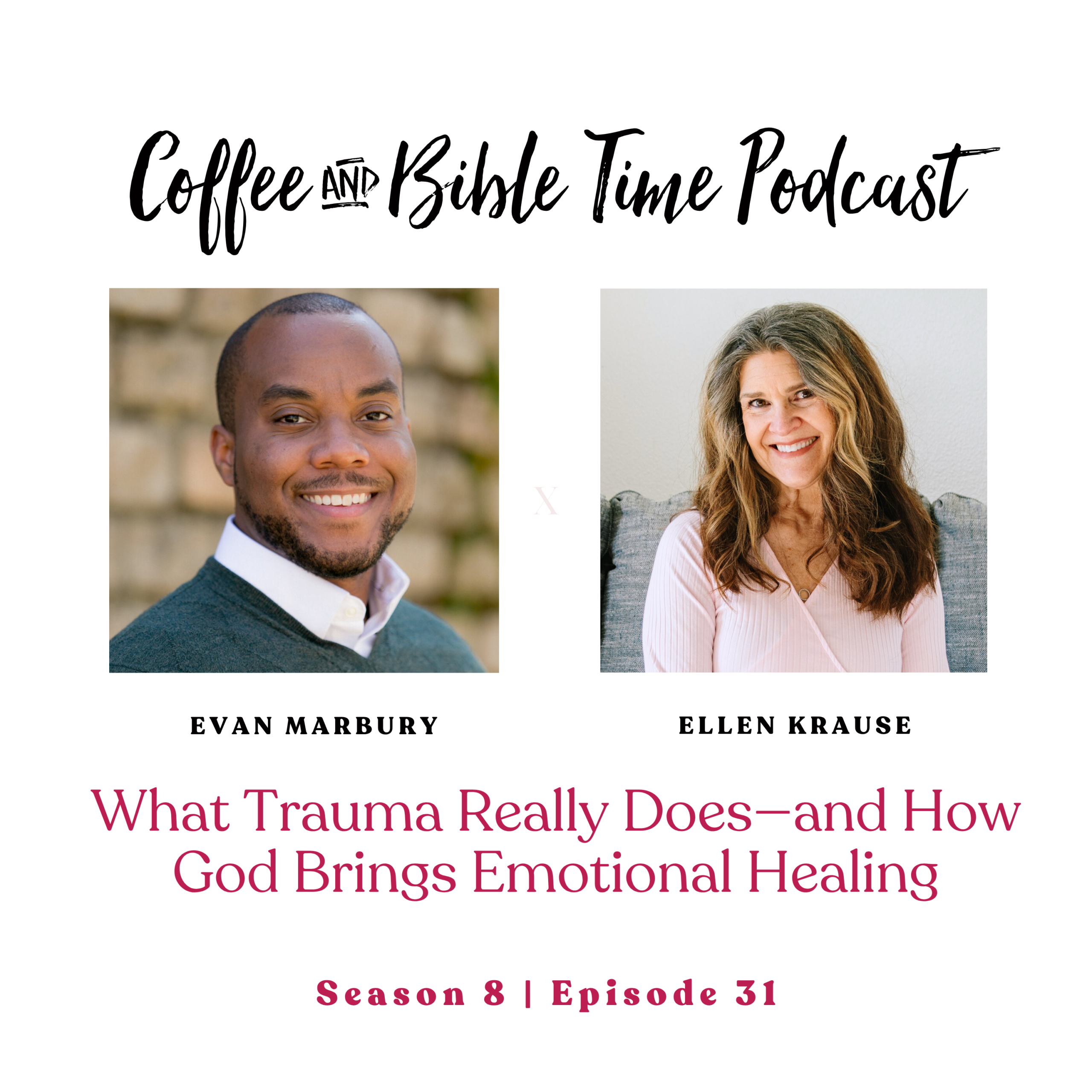

About this episode:
Many of us don’t realize how deeply trauma shapes our relationships, view of God, and everyday reactions. Past wounds can leave us feeling stuck, disconnected, or unsure how to move forward—but emotional healing is possible through Christ.
In this episode, Ellen talks with pastor and licensed therapist Dr. Evan Marbury. Together, they discuss why healing often takes more than time, how lament becomes part of God’s healing work, and what it means to pursue emotional healing without ignoring pain or bypassing it with easy answers.

 Apple Podcasts
 Spotify
TIMESTAMPS:
00:00 Moving Toward Trauma, Moving Toward Christ
00:50 Introduction
02:02 What Is Trauma?
04:15 Why Our Stories Matter
06:21 Why Every Christian Should Understand Trauma
08:11 A Ministry That Changed Everything
11:46 Becoming a Safe Person for the Hurting
18:07 Spiritual Bypassing, Lament, and Biblical Hope
21:42 Taking the First Step Toward Emotional Healing
25:23 Resources, Rapid Fire, and a Benediction
Evan Marbury [introduction]: We move towards trauma so that we can better move towards obedience in Christ, because He is our place of flourishing.
There are so many people that feel cut off from flourishing because of these wounds that they are carrying, cut off from wholeness and health. And we get the sacred opportunity to bring the marvelous light to that darkness and watch the Lord work.
Ellen Krause: Hi, friends! I’m so excited that you’re joining us today. I had such a great conversation with Evan, and I can’t wait to hear your thoughts on it too.
But before we jump in, I wanted to share this comment from a listener. Heather writes:
“I love how this podcast makes Bible study feel warm, personal, and alive. Every conversation points back to intimacy with Jesus and reminds me that time in the Word is meant to be a two-way relationship. Such a refreshing space for anyone longing to hear God’s voice more clearly.”
Thank you so much, Heather. That means so much to us that you took the time to make the comment.
We really welcome all of your thoughts and feedback. If you have something that you’d like to share—a comment, question, or testimony of how God has been working in your life—we would love to hear it and share it in a future episode.
To write in, leave a comment, review, or click the link in the show notes that says, “Send Us Fan Mail.”
I can’t wait to hear from you. Okay, back to the conversation.
Ellen Krause: Welcome back to the Coffee and Bible Time podcast. I’m Ellen, your host.
Whether we realize it or not, every single day we encounter people carrying wounds that we can’t see. Some are walking through grief, while others are recovering from abuse, betrayal, abandonment, and other experiences that have shaped the way they see themselves, other people, and even God.
And if we’re honest, many of us are carrying hurts of our own.
So how does the gospel speak into trauma? And what does true healing actually look like in Christ?
Well, our guest today is pastor and licensed therapist Dr. Evan Marbury. He holds degrees in psychology, counseling, and theology, and he’s here to offer biblical wisdom alongside practical insight for anyone seeking to care for the hurting or to better understand their own story.
Evan, we’re so thankful that you’re here. Welcome to the podcast.
Evan Marbury: Thank you. I’m so glad to be here. Thank you for the invitation.
Ellen Krause: Absolutely. Well, why don’t we start out with just first understanding what trauma actually is?
Evan Marbury: That’s a good question. This is an important question that honestly gave rise to this book.
Trauma is a type of pain. In the book, I say that there is pain that hurts and pain that alters.
Trauma is pain that alters. It is a wounding event that has led to rupture in our sense of being. It has overwhelmed us beyond our ability to cope. It has affected how we relate to ourselves, our relationships, our world, you mentioned, trauma can start to sound overused, and others might hesitate to apply it to their own experiences. We get caught up in this cycle of, “Well, that wasn’t that bad. Other people are coming and sitting down with me, I hear a lot of refrain of minimizing and exaggerating. I think where I want to be most helpful in spending our time together is: and our God.
It’s important to make that distinction because that kind of pain needs a more particular response to heal.
People say, “Time heals all wounds.” Yeah, sometimes time also can cause infections and sepsis, right?
Ellen Krause: Mm-hmm.
Evan Marbury: So there are wounds that we carry that need more than just time.
And time could actually bring confusion because you think you should be healed after all this time has passed from an experience you’ve had.
But sometimes you need time and attentive care to heal.
Ellen Krause: Absolutely.
Well, as you mentioned, trauma can start to sound overused, and others might hesitate to apply it to their own experiences. We get caught up in this cycle of, “Well, that wasn’t that bad. Other people have had it much worse.”
Evan Marbury: Yeah. Yeah.
Ellen Krause: How do you help people think about trauma without either minimizing it or exaggerating it?
Evan Marbury: Yeah. I think trauma is often conceptualized in three categories: the event, the experience, and the effect.
There’s usually some event that this is tied to, or a series of events. We all experienced the event of the COVID pandemic, for example, but we didn’t experience it the same way.
How we experience it has its own effect.
More often than not, when people are coming and sitting down with me, I hear a lot of refrain of minimizing and exaggerating. I think where I want to be most helpful in spending our time together is: What are the particularities of your story that seem affected right now?
Regardless of whether, compared to this person or that person, it’s better or worse, you’re acknowledging there’s something that is ruptured. And regardless of what it looks like in other people’s lives, it’s looking like this in your life.
I want to support you in experiencing fullness and wholeness and experiencing healing.
You’re wounded, and we don’t have to put a ranking system on your wound. We can just take the time that you think you need to experience healing.
Ellen Krause: Well, thank you so much for helping us really get to the point that what you’re feeling and what you have gone through matters, right? That’s really what I’m hearing you say.
And that we don’t need to minimize it or compare ourselves. It’s very important to address it.
What I found so interesting was that you said statistically at least half of the people we meet have experienced trauma.
So why is it important for every Christian, and not just counselors or pastors, to have a better understanding of trauma?
Evan Marbury: Yeah.
Well, for starters, it’s so that we can have a better understanding of who we are in community with.
Everyone’s story matters, and when we miss critical aspects of someone’s story, we fall short in caring for them effectively.
Therapist Michael John Cusick describes trauma-informed care as not only understanding the life experiences that shape an individual, but also how a person experiences their care.
In other words, Bible study is incredible. An encouraging word is incredible. But there’s a reason why Jesus did not just teach all the time, though He could have. He took into consideration people’s particular life experiences.
He didn’t approach blind Bartimaeus the same way as the woman at the well.
He engaged what Dietrich Bonhoeffer called the ministry of listening.
Jesus never had to ask questions, but He did, because even listening and engaging someone’s story as it is presented has its own ministry effect.
A better understanding should lead to better care of someone’s story.
It’s a really important opportunity to gain some understanding around these things.
Ellen Krause: Absolutely. It’s a way that we can love people by learning about them and their stories.
And I love that you want to help equip us to better care for people who have experienced trauma.
Well, Evan, you’ve served as a pastor and military chaplain, as well as a therapist. Was there a particular person or moment in ministry that fundamentally changed how you think about healing and resilience?
Evan Marbury: Yeah. This question actually draws me back to when I was an addiction counselor for teens and young adults in a residential recovery program.
Every single one of them had had to call the authorities. I called my supervisor. It was a very stressful ordeal as police cars, ambulances, and even fire trucks showed up, all for this one young man who was contemplating a trauma—severe trauma—and it led to them coping in destructive ways.
There was one client that was particularly agitated, and I could understand why. It turned out he was making plans to end his life.
The more I asked questions, the more he would make statements that were signaling to me that he didn’t plan to be here much longer.
So I had to call the authorities. I called my supervisor. It was a very stressful ordeal as police cars, ambulances, and even fire trucks showed up, all for this one young man who was contemplating a self-destructive decision.
I thought that after all that had gone on, these guys in this program would never trust me again. I mean, I’m the guy that snitched on someone that was hurting.
But they actually became more honest with me.
As I reflected on why that was, there were several reasons, but one that feels relevant to this question was that they knew that I took their pain and their well-being seriously.
They believed that I would do what was necessary for them to experience healing when they had grown up being used to people throwing them away for hurting too much, for being an inconvenience with their pain.
So they shared more vulnerably with me, and we talked more deeply about what recovery could look like.
That was very paradigm-shifting for me and impacted how I showed up in many of these ministry experiences and spaces that you listed.
You mentioned resilience. I talk about in the book that resilience is God-centered self-direction, and that should always be in view when you’re caring for trauma-affected people.
We move towards trauma so that we can better move towards obedience in Christ, because He is our place of flourishing.
There are so many people that feel cut off from flourishing because of these wounds that they are carrying, cut off from wholeness and health.
And we get the sacred opportunity to bring the marvelous light to that darkness and watch the Lord work.
That’s the essence of resilience. I’ve seen it time and time again, and it’s just so beautiful to see the Lord work in that way.
Ellen Krause: Hmm, absolutely. And for me, someone who’s been on that side before—to the point of wanting to end my life and process trauma—the processing of it was so incredibly helpful. And there is this recovery that is possible.
Evan Marbury: Mm-hmm.
Ellen Krause: I feel like, having processed through the things that I’ve gone through and coming out the other side, you see just how great our God is and that there’s nothing worth giving up on. There’s nothing worth giving up on because nothing’s impossible for God.
Evan Marbury: Absolutely. Yeah. You would think that people would assume that they know that, especially if they’re Christian. That’s where a lot of shame often comes in, of, “I should have more hope.”
And yet there is so much to just acknowledging, “I’m not experiencing the hope. These things are not piercing down into my soul. There’s an experience I’m having.”
I think it’s just wonderful when someone has the courage to acknowledge that.
But also, for the person that’s caring for them, to be able to receive that without trying to rush past it, because that is the place where the ministry of listening can really take effect.
Ellen Krause: Yeah, so let’s talk about that a little more because most of us aren’t therapists. We’re moms and friends and small group leaders.
How can just ordinary Christians become safe people for those carrying trauma? And maybe share with us, are we to take the first step in asking people about it if we know about it, or do we let them come to us?
Evan Marbury: Well, when I hear that question, I love the story of the Good Samaritan, that parable by Jesus, because the Samaritan was the least expected person to care for the wounded person in the ditch.
The professionals and religious experts were the ones that missed him and avoided him, and the one who culturally would have been considered the least qualified showed himself to be a neighbor.
The Samaritan did all these things to care for the wounded person where they were. He showed compassion. But the story ends with him widening the circle of care for the wounded person.
He was the first responder. He took the time and energy to see and move toward the wounded person, and he didn’t stop there. He widened the circle of care by bringing this wounded person to the innkeeper.
What’s implicit in that is a willingness to embrace the limitations in caring for this person. You are not the only person to care for them.
So how can we use the capacity that we have while also embracing the limitations that we have as well?
In the book, I talk about being mindful of your competence, your capacity, and your context when thinking about the limitations of care.
Yes, we should all care. Yes, we are all the body of Christ. Yes, we have the Holy Spirit.
And also, it is not shameful or embarrassing to say, “I don’t have the competence to address all that needs to be addressed here.”
I can be helpful—again, a first responder—but I don’t actually have the tools to bring the scope of healing that would be most helpful for you.
So I’m acknowledging my limitations. I’m not just passing you off to the professional or the therapist. I want to be part of your circle of care, but I also want to widen your circle of care so that your healing can expand to match the scope of your woundedness.
Also, you might not always have the capacity. If you’re a small group leader, if you’re a mom, there are multiple things going on.
What’s beautiful about the Samaritan is that he left. He paid for the inn stay, told the innkeeper, “Do what you need to do,” and he continued on with what he was doing in his life.
We should embrace the limits of our capacity. There are other things going on. You are not designated as a therapist to this person.
So be mindful of your capacity.
Then context is another consideration. Sometimes you need a carved-out space to really engage this well.
Is this the right context for this depth of sharing and disclosure? Those should all be curious questions.
To the extent that you’re saying, “No, this isn’t the right context,” ask, “Well, what is the ‘yes’ in that?” You’re helping them discern that together.
There’s often still some stigma around going to therapy. “Am I particularly broken if I go to a therapist? Is there something particularly wrong with me?”
I talk about therapy as an added resource among the wellspring of resources that are already in your life.
You have wonderful relationships. You have, hopefully, a wonderful community, whether that’s church or otherwise.
Right now, those resources are not spanning the scope of the healing that you need. Therapy can be an added resource that can really help you span that scope.
Once you feel like life is more manageable in these areas that feel dysfunctional, then you should feel at liberty to end therapy or make adjustments so that you can, again, engage a self-directed life.
So just stay curious in all of that, both in your caring for someone and also if you’re someone listening and saying, “Wow, do I need something more? And what does it look like to need something more? Is it okay to go after it?”
Ellen Krause: Yes. And it’s okay to need a level of therapy at one point in your life, not need it at another point, and then maybe later on need it again.
Our lives are ever-evolving, and different needs and situations arise. So there’s nothing wrong with going back, stuckness or unmanageability about life—that you’re using all the resources of maybe prayer and Scripture reading and going to church and listening to sermons or reading too, if you need to.
Evan, what would you suggest if, let’s say, there’s someone that you’re encouraging to see a therapist, and they don’t want anything to do with it? Is there any special way that you should handle that conversation? Just kind of let them be and pray about it, or…?
Evan Marbury: Well, certainly prayer is a good step.
Also, if someone is not curious, then you have an opportunity to model curiosity.
Usually, what becomes the more decisive factor in going to therapy is that there’s a sense of stuckness or unmanageability about life—that you’re using all the resources of maybe prayer and Scripture reading and going to church and listening to sermons or reading books, and there still feels like, “I’m not progressing in this area as I would want.”
I think that’s the place of saying, “Okay, well, you have not exhausted all your resources. If you’re open to it, I’d love to talk about expanding the resources that you have, one of those being therapy.”
Now, once they start talking about therapy, there are often a lot of questions about what kind of advice they might give or what background they might have.
“Well, I don’t know. How will I pay for it? Or how will I make time for it?”
All those things are really good questions.
I think of the man at the pool of Bethesda. When Jesus said, “Do you want to be healed?” the man’s response was all the reasons why he had obstacles to his healing.
And Jesus held before him, “Yeah, all those obstacles are there. Do you want to be healed?”
That was the question that was lingering, not, “What are all the obstacles to your healing that are making this slow?”
So I think that’s the place of questioning as well.
Do you want to be healed?
Yes, there might be obstacles. Yes, there might be setbacks. Yes, this has been long in the making.
Do you want to be healed?
If you want to be healed, what is the next step that actually moves toward healing, as opposed to focusing on the obstacles that make it feel like it’s impossible?
Ellen Krause: Right, right, right. That’s so helpful. So helpful.
You had mentioned that sometimes well-meaning Christians say things that perhaps don’t come across the best to someone who’s actually hurting, like, “Well, God works all things together for good,” and maybe just not truly addressing someone’s pain.
What are those biblical truths, though, that we can help someone with that wouldn’t dismiss what they’re going through?
Evan Marbury: Yeah. I like the word in that question: bypassing.
When I hear you ask that question, I think of spiritual bypassing. It’s a problem in church culture sometimes, where we want to use spiritual language—and even Scripture—to move past an issue with the least amount of disruption.
Going around it, or bypassing it, can feel more efficient and attractive than walking through it, because walking through it can often feel very hard and messy.
Trauma is not something you can bypass in healing. You have to move toward it and process through it, which is usually very inefficient.
Yes, we always have hope. And yes, all things do work together for good. That is Scripture.
And yet, we sometimes miss the ministry of listening.
Again, Bonhoeffer wrote that we need to grow in listening with the ears of God so that we can better speak the words of God.
We could be in danger of being trite and cliché if we have not also incorporated lament into our engagement.
Lament should be a spiritual practice in processing trauma because it helps us frame tragedy in a God-honoring way.
Just recently, I was talking with a young lady in my church who has been dealing with chronic illness, and we slowly walked through Psalm 13:
“How long, O Lord? Will You forget me forever? How long will You hide Your face from me? How long must I wrestle with my thoughts and, day after day, have sorrow in my heart?”
That is given to us in Scripture. That’s an act of worship—to raise those kinds of questions.
The danger of being cliché or dismissive often emerges when we don’t give the proper space for that kind of lament to happen.
Job is an example of that. His friends showed up for him, and they sat in silence together. But then they started trying to make sense of it, and they made a big mess of things.
We can be in danger of doing the same thing if we’re trying to be very neat in the progress of healing.
Healing is often very messy, very inefficient, and it should raise these questions that are birthed out of tragedy and sorrow—and that’s okay.
You can do that full of faith.
Psalm 13 is held together with Romans 8:28. “All things work together…” They don’t have to negate each other.
How can we incorporate them together?
Ellen Krause: Absolutely. You know, that reminds me of just this past week in our live Bible study that we do. We were just talking about the progression of that lament psalm—being the person experiencing pain, having prayer about it, raising questions about it, remembering what God has done in the past, and then having this heart of worship.
I think that you bringing up this idea is so important.
Evan Marbury: Yeah.
Ellen Krause: Well, if there’s someone listening to this who it’s maybe really touched their heart, that, you know, “I’m wondering if I should maybe get some help,” what would be the first step in them making that decision?
Evan Marbury: Yeah, so if it’s getting help in terms of trauma more broadly, I would wonder, what’s a trusted friend where you can be curious together?
Peter Levine, who’s a psychiatrist, says, “Trauma is not just what happens to us; it’s what happens within us in the absence of an empathetic witness.”
Trauma is a very lonely experience, and trauma recovery is a very lonely endeavor. We need someone that can move toward us in that loneliness, so that even as those feelings arise, we can reference and point to people that can be with us and not flinch, be with us and not be overtaken by the sharing of our wounds and our hurt.
So I would just encourage you to take that risky step of letting someone in. Hopefully, you have someone in your life who takes your wounds and well-being seriously.
And if not, again, I would be curious about taking the step of therapy, where there’s a professional who knows how to frame that for you and hopefully model that for you so that you can better practice that in your life.
Ellen Krause: Evan, you’ve so beautifully responded in such a way that, if you’re listening to this, I’m really encouraging you to think about what Evan said and just assess your own mental health.
Like you said, God wants to get us to the point of flourishing.
I know many people who have gone through this, and I myself have been one of them, who have been on the rocky, hard side but then also seen God do an amazing work in my life.
So I know that it’s possible.
Evan, your book, which is so good, is called Understanding Trauma and Resilience, but you almost named it Sacred Care.
I love that phrase. Why do you think caring for wounded people is sacred work?
Evan Marbury: Yeah. I talk about that in my book. I was almost there, and then we had some good conversations with my publisher, so we landed on the title that we have.
I think any kind of care is sacred work, right? That’s the danger we want to avoid—that there’s a ranking system of sacredness. Any work of the gospel is holy and sacred.
At the same time, there are times when I’m counseling people, whether as a clinician, as a pastor, or just as a friend, and we enter a threshold of vulnerability. We cross a threshold of connection, a threshold of trust.
Once I cross that threshold, I know something has changed for them. The amount of courage that they have stepped into is such an honor to behold.
It feels like when Moses took off his sandals at the burning bush. You behold the Lord’s glory, and it creates this sense of awe.
That’s what I feel when clients trust me with the most tender and vulnerable parts of their story—when they put words to these wounds for the first time, or at least the first time with me. It just means so much.
Diane Langberg says that trauma is a mission field. It is stepping into the darkness and pushing it back with God’s marvelous light.
That is truly amazing work.
So when those moments happen of particular courage and particular vulnerability, it just feels like a sacred space that is worth honoring and protecting and coming back to and taking seriously.
Ellen Krause: Yes. Yes.
Well, it’s getting to a soul level of treating someone’s most inner being.
Well, it’s just been incredible to learn more about this, Evan, from you.
Where can our listeners go to get more information about you and your book, Understanding Trauma and Resilience?
Evan Marbury: Yeah, you can go to Amazon, and you can find my book there.
You can contact me through my website, evanmarbury.com. I also do a little bit of writing there.
Besides that, I don’t do much on social media. You can find me on social media, but it will be a very, very lonely page that you would find.
I think Amazon and my website are where there’s more activity going on.
Ellen Krause: Excellent. And we will have links to both of those in our show notes.
Evan, before I let you go, I have to ask some of our rapid-fire Coffee and Bible Time questions here.
What is your go-to Bible, and what translation is it?
Evan Marbury: Yeah, so when I was ordained several years ago, my church purchased a Bible for me, and it’s just really special to me.
Anytime I preach or do any teaching, I go to that Bible, and it’s an ESV.
Ellen Krause: Excellent.
Okay, do you like to Bible journal or do any type of journaling? Do you have any favorite Bible journaling supplies?
Evan Marbury: Yeah, so I’m pretty simple with this.
I keep a journal, and I try to write in it every day as I reflect and meditate.
But I also have a second journal that I use for Scripture copying.
I’ve recently gotten into the habit of just opening a book—I’m in Philippians right now—opening the book and just writing out the verses.
I’m not doing any reflection or questioning, but just saturating myself in the Scriptures.
So I write those out, and I keep those two journals with me.
Ellen Krause: You know what? This is the second time in very recent interviews that I’ve had that people have talked about writing out the Scriptures and that it’s so helpful.
Okay, awesome.
Evan Marbury: Yeah.
Ellen Krause: Lastly, what is your favorite app or website for Bible study tools?
Evan Marbury: Yes, I have to go with Logos Bible Software for that.
It is a bit costly, but it’s a one-stop shop for a variety of Bible study and ministry tools.
I use it fairly regularly for Bible study, preaching, and even counseling. There are some counseling resources there.
So it is a cost, but it’s a worthwhile cost.
I’ve also used Blue Letter Bible, which is an online resource, and it’s free. It’s been helpful as well.
Ellen Krause: Well, we love Logos here at Coffee and Bible Time.
In fact, we definitely will put a link in our show notes where we can give our listeners a free trial. I think it’s 60 or 90 days—one of the two.
So try it out for yourself because, like you said, it’s mind-blowing how much information is in there.
I’ve also looked at the counseling materials that they have and found them very helpful as well.
Well, Evan, thank you so much for joining us, for reminding us that caring for wounded people isn’t just the work of counselors or pastors, but it’s part of our calling as believers.
I appreciate your input so much.
Evan Marbury: Yeah, absolutely.
Again, just for the listener, or just for our own souls, I ended the book with a benediction from Romans 15.
If it’s okay, I’d love to say that benediction for us and for our listeners.
It’s Romans 15:13. It says:
“May the God of hope fill you with all joy and peace as you trust in Him, so that you may overflow with hope by the power of the Holy Spirit.”
Ellen Krause: Amen. Amen.
And with that, we will close out for today.
Thank you so much for listening, and we’ll see you next time on the Coffee and Bible Time podcast.
Have a blessed day.
When Past Wounds Continue to Affect the Present
Many of us don’t realize how deeply painful experiences shape our relationships, view of God, and everyday reactions.
Though we may not use the word ‘trauma’, we can still find ourselves feeling stuck, struggling to cope, or reacting with fear, mistrust, shame, or discouragement.
Sometimes we wonder:
These questions are more common than many people realize.
And while every person’s story is unique, many of us carry wounds that have impacted the way we see ourselves, others, and even God.
In a recent Coffee and Bible Time podcast episode, Ellen Krause sat down with pastor and licensed therapist Dr. Evan Marbury to discuss what trauma really does, why emotional healing can be a complex process, and how Christ meets us in our deepest places of pain.
One of the most important reminders from their conversation is this: your pain matters, and God is not distant from it.
Understanding Trauma: Pain That Alters
When you hear the word trauma, your reaction might be to think, “what I went through wasn’t that bad. It shouldn’t be called traumatic.” But the same circumstance can affect people in many different ways.
Dr. Evan Marbury explained:
“There is pain that hurts and pain that alters. Trauma is pain that alters.”
Trauma is not simply about the event itself. It is also about how that experience affected us internally—how it changed the way we relate to ourselves, our relationships, the world around us, and God.
This distinction matters because healing requires more than simply waiting for time to pass.
As Dr. Marbury shared:
“Sometimes you need time and attentive care to heal.”
Evan Marbury
Emotional healing is not about ignoring what happened, minimizing our pain, or pretending that everything is fine. It is about allowing God to meet us honestly in our stories and bringing our wounds into His care.
God Invites Us to Bring Our Emotional Pain to Him
One of the beautiful things about Scripture is that it does not shy away from suffering.
The Bible gives us examples of people who loved God deeply while also experiencing grief, confusion, fear, and sorrow.
Psalm 13 begins with an honest cry:
“How long, O Lord? Will you forget me forever? How long will you hide your face from me?”
The psalmist does not hide his pain from God. He brings his questions directly to Him.
As Ellen points out, there is a progression in this psalm of lament:
Experiencing pain → Coming to God in prayer → Asking questions → Remembering what God has done in the past → Worshiping Him
This is a picture of real emotional healing. Emotional healing does not require us to pretend that suffering does not exist. Instead, it allows us to bring our suffering into the presence of a God who loves us.
Why Listening Is Part of Emotional Healing
A powerful theme from Dr. Marbury’s conversation is the importance of being seen and heard.
He shared:
“Trauma is not just what happens to us, it’s what happens within us in the absence of an empathetic witness.”
God created us for connection. Throughout Jesus’ ministry, we see Him notice people, listen to their stories, and respond with compassion.
Jesus did not approach every person in the same way. He met them where they were.
For those seeking emotional healing, this means we do not have to carry our struggles alone. God often brings healing through safe, wise, and compassionate people who are willing to walk alongside us.
For those supporting someone who is hurting, this means our first response does not always need to be an answer. Sometimes the most loving thing we can offer is simply our presence.
As Dr. Marbury shared:
“We need to grow in listening with the ears of God so that we can better speak the words of God.”
Evan Marbury
Emotional Healing Does Not Mean Forgetting Your Story
One misconception about emotional healing is that eventually we should be able to move past our pain as though it never happened.
But emotional healing does not mean forgetting. It means allowing God to transform the way our story affects us.
Trauma may be part of what happened to us, but it does not have to become the defining part of who we are.
Dr. Marbury described resilience as being centered on God:
“We move towards trauma so that we can better move towards obedience in Christ, because He is our place of flourishing.”
God’s desire is not simply to help us endure life. He invites us into wholeness, restoration, and deeper trust in Him.
How Can We Take Steps Toward Emotional Healing?
If you are seeking emotional healing, here are a few practical steps to consider:
1. Be honest with God about what hurts
Prayer does not require polished words. Scripture shows us that God welcomes our honest emotions, including grief, confusion, and questions.
2. Let trusted people into your story
Healing happens in community. Consider sharing with someone who will listen with compassion and take your experiences seriously.
3. Avoid rushing the process
Emotional healing is often not quick or simple. Give yourself space to process, grieve, pray, and grow.
4. Seek additional support when needed
Dr. Marbury emphasized that counseling can be a valuable resource, alongside Scripture, prayer, and Christian community. Seeking help can be a wise step toward greater health and healing.
5. Remember where true hope is found
Our wounds may shape parts of our story, but they do not define our identity. In Christ, we are loved, known, and invited into restoration.
God Meets Us in Our Wounds
If you are carrying wounds from your past, struggling to understand your emotions, or longing for deeper emotional healing, remember this: God is not overwhelmed by your pain.
He is not asking you to hide your struggles or hurry through your emotional healing. He invites you to bring your whole story to Him.
The journey toward emotional healing may include prayer, Scripture, trusted relationships, counseling, and honest reflection. But through every step, Christ remains our source of hope.
For a deeper conversation about trauma, healing, lament, and how Christians can care well for hurting people, listen to the Coffee and Bible Time podcast episode “What Trauma Really Does—and How God Heals” with Dr. Evan Marbury.
You’ll be encouraged to see that while wounds can deeply affect us, they do not have the final say—God’s redeeming love does.
“May the God of hope fill you with all joy and peace as you trust in him, so that you may overflow with hope by the power of the Holy Spirit.”
Romans 15:13
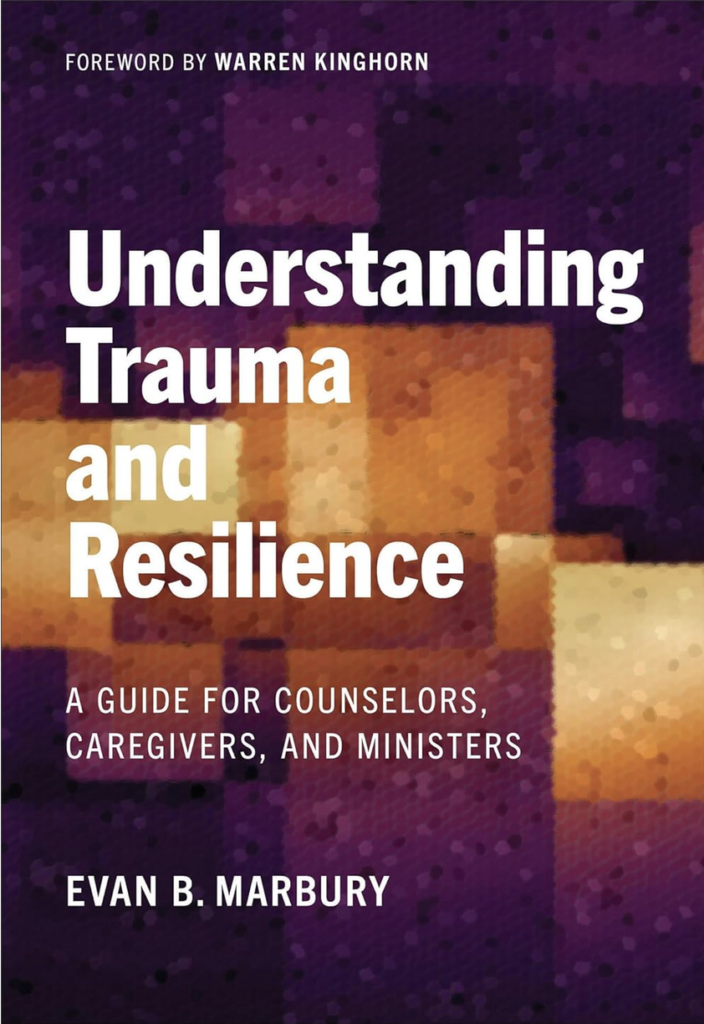
Understanding Trauma and Resilience: A Guide for Counselors, Caregivers, and Ministers
In our culture, awareness about trauma is growing, but many of us need a better understanding of it.
This accessible resource for students, therapists, ministry leaders, and caregivers introduces concepts of trauma, abuse, and trauma-informed care. Integrating psychology with theology, this book invites readers on a compelling exploration of humanity’s incredible capacity to heal despite unimaginable wounds.
Leave a Reply