
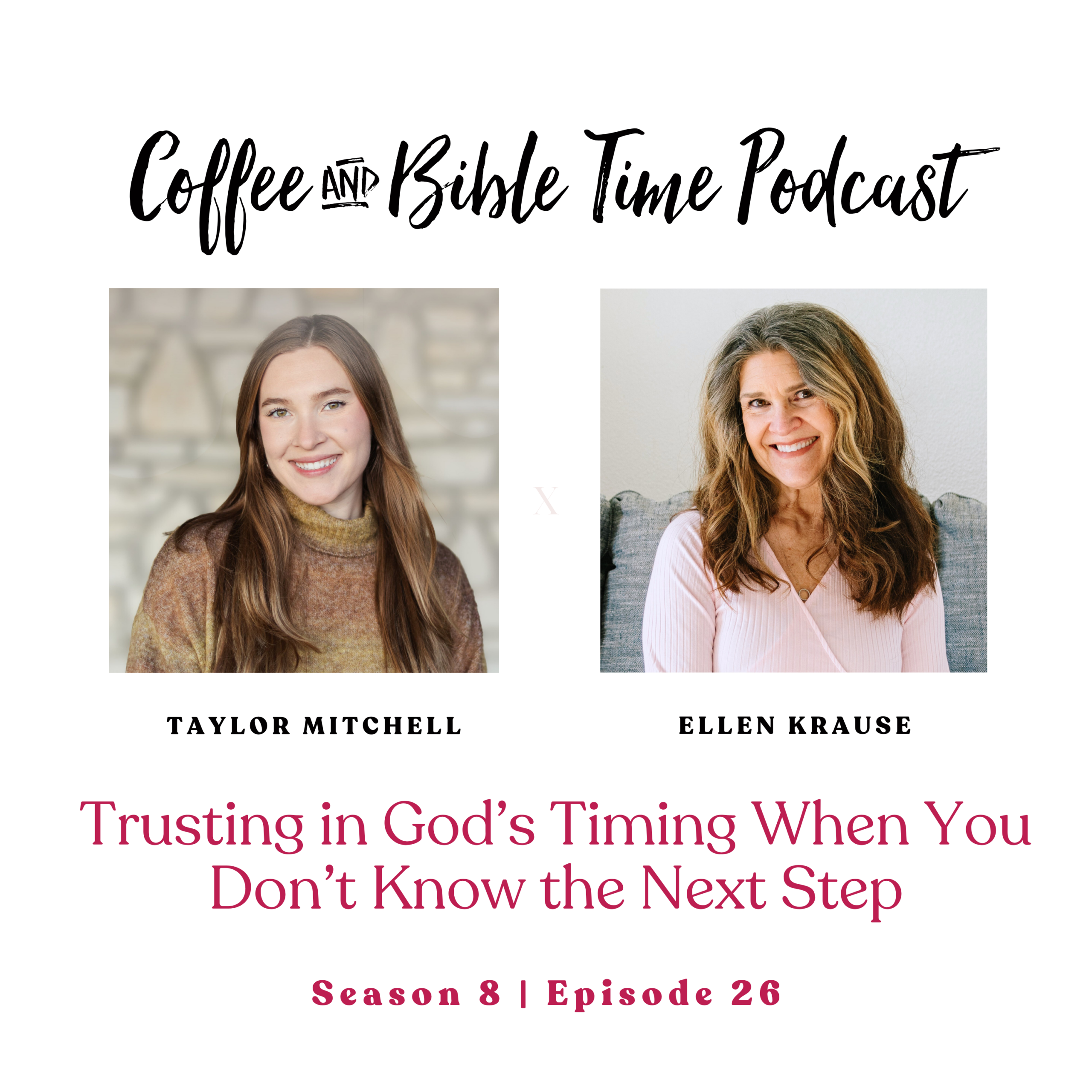

About this episode:
What if waiting isn’t wasted time—but the very place God is shaping you most?
In this episode of Coffee and Bible Time, we talk about what it looks like to stay faithful while trusting in God’s timing, especially when life feels unclear or delayed. Waiting is often misunderstood as inactivity, but Scripture shows us it is a season of active faith, emotional honesty, and daily obedience.
We discuss how to walk through waiting with wisdom, peace, and perspective.

Subscribe & Listen on:
 Apple Podcasts
 Spotify
TIMESTAMPS:
00:01 Introduction: The Challenge of Waiting on God
03:20 Active Waiting: A Biblical Perspective
05:54 Emotional Underpinnings of Waiting
08:13 Taking the Next Step In Faith
12:19 The Power of Prayer and Scripture
17:02 The Role of Mentorship in Discernment and Waiting
20:20 Surrendering Outcomes to God
24:23 Waiting With an Eternal Perspective
25:13 Reflection Questions & Encouragement for the Wait
Taylor Mitchell [Introduction]: Whatever you are going through right now, Christ holds the universe together. He knows all the things you’re going through, all of your emotions, knows every person—past, present, and future. We can trust Him. Your waiting is not wasted. God is still working, He’s still leading, He’s still faithful.
Ellen Krause: Welcome back to the Coffee and Bible Time podcast. I’m Ellen, your host.
Have you ever found yourself waiting on God for something important? Maybe you’re waiting for direction or healing, or a relationship to be restored, or a job opportunity. Whatever it might be, if we’re honest, waiting can be one of the hardest parts of the Christian life.
We often want clarity immediately. We want answers now. We want to know exactly what God is doing behind the scenes. But throughout Scripture, we see that God often does some of His deepest work in our lives during the waiting.
So, as Psalm 27:14 says, “Wait for the Lord; be strong, and let your heart take courage; wait for the Lord.”
Today, I am joined by my daughter Taylor, and we’re going to talk to you about what it practically looks like to wait on God faithfully. Hi, Tay.
Taylor Mitchell: Hello. It’s so glad to be here. I always love when I can talk with you guys on the podcast.
Today’s topic is so important because I think there’s a big misconception about waiting—that it’s just a period when we’re kind of, you know, doing nothing and we’re just kind of twiddling our thumbs a little bit and like, “Okay, God, You do Your thing, and I’ll just be over here,” living my life in such a way as I’m, you know, not really seizing the moment, but I’m just kind of letting go in a totally passive fashion.
But I think that if we allow God, if our hearts are open and we’re listening to the promptings of the Holy Spirit, God is going to shape us in the seasons of waiting. Yes, we can’t always see what He’s doing, but He wants to work in your heart. The heart work is important.
So let’s dig into this topic today.
Ellen Krause: Yes. Really, one of the first things that we need to understand is that biblical waiting is not passive.
So waiting on God doesn’t mean sitting still or doing nothing, as you alluded to. In fact, the Hebrew word often translated “wait” carries this idea of hopeful expectation. It’s a way of actively trusting.
And I want to give you this little example. A farmer doesn’t plant seeds and then spend every day digging them up to see if they’re growing, right? No. He continues watering, tending to them, weeding the beds, and trusting that growth is happening beneath the surface.
Similarly, waiting on God often looks like faithful obedience for us while trusting Him to produce the results. So there’s this attentiveness. We have an expectation that God is at work, and we also have this dependence on Him—that we are counting on Him to work.
And I love Psalm 130:5. It says, “I wait for the Lord, my soul waits, and in His word I hope.”
Taylor Mitchell: Amen.
I think that this topic of waiting—not in a passive fashion, but in a hopeful, expectation-like manner—is really hard for me because I tend to get very wrapped up in my emotions when I am in seasons of confusion, in seasons of waiting.
Because I think what is often going on that we don’t really take a lot of time to focus on is a lot of emotional undercurrents that can sweep us, if we’re not careful, away from this posture of hopeful expectation.
Because if God wants you in a season of waiting, He is going to have you in a season of waiting, okay? We can either go into it kicking and screaming, or we can go into it with a willingness in our heart to learn to trust Him, to grow in our character.
I think that, you know, me as somebody who was very interested in counseling—I was in school for it for a little bit, and I’m not in it anymore—but I’ve learned a lot of valuable things from that season. And one of those things is being mindful of your emotions when you’re going through something is extremely important, especially if you’re wanting to grow in your character.
Because these waiting seasons bring out a lot of emotions that can leave us feeling depleted.
These emotions that I’m thinking of: frustration, disappointment, anger, confusion, resentment, fear.
In these seasons where we’re constantly processing these emotions but not naming them, that can be dangerous because when we’re steeping ourselves in these emotions day in and day out, we’re breathing them in, breathing them out, and we’re not naming them, then we’re probably not bringing them to the Lord. We’re not bringing them to His feet.
And when we want to find strength in God, we have to be willing to surrender those things. Because when we are white-knuckling through seasons of waiting because our anger is the only thing we feel like is protecting us from actually feeling sadness or disappointment, we’re hurting ourselves.
So bringing emotions daily to the Lord, I think, in such a practical way, is if you have just time in the morning to journal, okay, to just take a moment and stop and think to yourself, “Okay, God, what emotions have I been really feeling lately?”
And give yourself time. Sit there. Sometimes you can feel it in your body. At least for me, I feel a lot of physical sensations in my stomach when I’m feeling anxious. That is where I feel it really bad—in my stomach.
And so take that as a signal. “Okay, God, I’m feeling anxious.”
Take time, journal that, bring it to God. And sometimes it is constantly surrendering to Him when you feel those emotions in prayer and just say, “God, I don’t want to hold on to this,” you know, with the idea that holding on to this emotion so tightly is going to change my circumstance, because I know it’s not.
And I don’t want to be in this season of waiting kicking and screaming. I want to have that hopeful expectation.
And the last thing I’ll say here, just going back to that first verse that you shared, Psalm 27:14, says, “Wait for the Lord; be strong and let your heart take courage; wait for the Lord.”
I love that line that says, “Let your heart take courage,” because it’s almost like you have to give yourself permission to let go of those feelings—fear, anxiety, anger, resentment, bitterness, all those things—to let go of that for a moment so that you can allow your heart to take courage in the Lord.
Ellen Krause: No, that is so good. And that’s really something I need to do a better job of, is just identifying my emotion during those circumstances. And that’s so important because oftentimes when we’re in this season of waiting, we also put our lives on hold.
We’re waiting for God to reveal all the steps, you know, through step ten, and we’re not even willing to take the first step.
So I love that Scripture teaches us that God gives us just enough light for the next step. He doesn’t tell us the whole future, the entire journey, but it encourages us that when we are uncertain about the future, we can continue walking faithfully in what He has already revealed.
And Psalm 119:105 is a very familiar Scripture passage, but it really speaks to this idea: “Your word is a lamp to my feet and a light to my path.”
So I’m envisioning myself in a dark place, and I can’t see the end, but that light just gives me enough for safety, for that next step.
Taylor Mitchell: Absolutely.
And I think definitely a key part of that verse is, “Your word is a lamp to my feet and a light to my path.”
When we are in God’s Word, we are going to find a lot of discernment for seasons of waiting because we’re learning about God’s character. And the more we learn about God’s character, I mean, that’s who we want to emulate, right?
And so I think something that does trip us up, like you said, Ellen, is this idea of, “Okay, I’m going to read my Bible, and it should tell me the next ten steps that I need to do to get to where I need to go.”
And it is just not going to do that.
Some faithful advice that I received from a pastor a long time ago when I had graduated college and I was so anxious—”God, what do You want me to do? I don’t want to mess this up”—and just to briefly pause here, I think that our generation can be really scared to make mistakes.
And that fear of making a mistake, be it at work, be it with friendships, family, marriages, whatever, that fear of making a mistake can paralyze you from taking a good next step.
And so the pastor told me, when I was very fearful and anxious, “You don’t have to know the entire future. Just take the next obvious God-honoring step.”
So if you are processing through something in your life right now, sometimes I think we just need the encouragement from somebody else to say: God gave you free will. And if you see a God-honoring next step to take, don’t be afraid to take a God-honoring step.
I mean, if you want to glorify God, that is a step in the right direction.
And so for me, when I was graduating college, I was like, “How do I want to serve God in my life?” And I had all these different ideas, and there wasn’t obvious clarity.
And I know with some people they do have doors that swing wide open, and it’s very clear, “Okay, God is moving me in this direction. These other doors are closed.”
For me, it was like, there’s a lot of open doors, okay? And I was paralyzed. I didn’t know what to do.
But the reality is, my heart was in the right place of, “God, I want to serve You.” And if I’m taking a step to honor Him with whatever it is—this career choice or XYZ—then the Lord sees that, and He is faithful to ultimately work out the grand story, okay?
He is the potter; we are the clay.
Ellen Krause: Absolutely.
Doing the next obvious God-honoring thing can be scary and cause us worry, but God has equipped us. When we’re waiting, we have prayer and we have His Word.
And prayer, I think, is so underutilized or undervalued. Prayer is where we can do this exchange with God. We can bring our uncertainties before Him, and in exchange, God gives us His peace.
Philippians 4:6 says, “Do not be anxious about anything, but in everything, by prayer and supplication with thanksgiving, let your requests be made known to God.”
And God hears all of our prayers. We just need to bring them forward, whether big or small.
You know, Tay, when I was younger, I remember always going first to my dad with my problems. And so many times I can remember him redirecting me and saying, “You need to give this over to your Heavenly Father.”
I mean, our dads may be great, but they’re not the King of the universe. That’s who we have to turn over these seasons of waiting and worry that might be plaguing us to.
And for me personally, I found that writing down my prayers in my prayer journal during these seasons of waiting is so therapeutic.
And I think one of the reasons is because, how you mentioned earlier, I am sharing my feelings. I’m writing them down. I’m lamenting.
Not only that, but with the prayer journal, it allows me to look back and see God’s faithfulness.
And I found that the older I get, these seasons of faithfulness are like building blocks. Over the years of my life, just one more block has been building and adding to it and showing me that I don’t have to be anxious. God’s got this.
And so I lay it before Him.
Taylor Mitchell: And Christ is your cornerstone in all of that, your firm foundation.
Ellen Krause: Yes.
Taylor Mitchell: Another verse that encourages me from Scripture is in James. It says in James 1:5, “If any of you lacks wisdom, let him ask God, who gives generously to all without reproach.”
What does that mean? That means if you go to the Lord and you ask Him for wisdom in a situation, He is not going to be like, “Nope, not today. I don’t want to give you wisdom.”
He gives generously. That is His heart, His desire, to give you wisdom in a situation.
Now, does sometimes that wisdom come with waiting? Yes.
Which, again, goes back to this whole theme of this podcast: God is not a genie in the bottle, okay? When we come to Him and assume we can throw a few coins into a wishing well and get our wish right away, He is ultimately in control.
And He does give us seasons of waiting for us to grow in character and in wisdom.
Let Scripture lead you to prayer. And be empowered by Scripture.
And going back again to that first verse that you mentioned, Psalm 27:14: “Wait for the Lord; be strong, and let your heart take courage; wait for the Lord.”
How do you let your heart take courage? By being in God’s Word and knowing the promises that He has for you in Scripture.
It does take courage to come to the Lord in prayer and to surrender and to let go.
It takes a lot. And I don’t know what you’re going through, but there is a lot of pain in seasons of waiting and a lot of real difficult emotions and things like that.
So I just want to take a moment and be honest. It’s not easy.
And we’re not talking on here from a place of, “We have it all together and we are really good at waiting,” and yada yada. No.
We’re just trying to encourage you, but we understand that it does take courage to give it to God in prayer over and over and to surrender and to leave your heart open for God to continue to do that heart surgery on us.
Because it does sometimes feel safer to close ourselves off and live in anger and resentment and fear and all that.
Sometimes it is the harder thing to do to keep your heart open to God, to keep the door open for Him to continue moving when we do not know what He’s going to do.
Ellen Krause: Definitely. And Scripture has to be the backbone of everything that we believe. It’s the source of wisdom.
And I love that God also gives us wisdom through the wise counsel of trusted believers. You know, this is near and dear to my heart, the whole idea of having a mentor that you can go to in situations where you need clarity or you need a better perspective.
I’ve had mentors in my life who have already walked the road ahead of me. You know, their stack of building blocks of God’s faithfulness is so big. So they are able to pour into me.
And what was so special to me is they took the time to listen and to pray with me. And not only that, but sometimes it was a very practical session of helping me write down the pros and cons of a situation so that I could visually see what direction was going, and wow, did that add clarity.
Other times, they would simply listen and maybe point out something that I hadn’t even considered.
So there’s a number of ways that having a mentor in your life can help feed into you. And I personally have just been enjoying so much mentoring women in our Coffee and Bible Time community. It’s been such a joy.
And I just love that God used that in my life, and now I want to be able to pour back into others and do mentoring as well.
Proverbs 15:22 says, “Without counsel plans fail, but with many advisers they succeed.”
Taylor Mitchell: Mm-hmm. I know that’s right. And I know that’s why God places us in community.
And for me, I know that’s why He gave me a mother. And dare I say, gave me a second mother with Ashley. Not by choice, of course, for me, but she was indeed a second mother, and I gleaned a lot of wisdom from her, you know, helping me over the years.
I hate to say it. I hate to say it. Hopefully she doesn’t listen to this podcast so that she hears that.
But especially with people that were close to me that spoke into me—wiser people—they have been able to call me out when I’ve been too emotionally close to a situation to see clearly.
For any person that’s been through a breakup, I mean, just use that for an example, right? Anytime you go through a breakup, or even when you’re in the infatuation stage of a relationship and you think you’re thinking really clearly, right? And everybody else around you is like, “Uh-oh, we might need…”
Ellen Krause: But red flags are going up.
Taylor Mitchell: Yeah, we might need to steer you on a different course here.
But with trusted people in your life, you are able to ask those questions. You’re able to see a new perspective that you probably can’t see yourself.
Another verse from Proverbs that is so applicable to this is Proverbs 13:20, which says, “Whoever walks with the wise becomes wise.”
And of course, conversely, if you’re not walking with the wise, you’re probably not going to get the wisdom that you need in a season, especially a season of waiting.
Maybe ask yourself: Who are you surrounding yourself with, and are they bringing you closer to the Lord in this time that you really need to be hearing from Him?
Ellen Krause: So good.
You know, I think one of the hardest parts of waiting is something that we may not be fully aware of, and that is surrendering the outcome.
We have to surrender the outcome.
Our biblical faith rests in something that is greater. And it’s not that our plans will prevail, but it’s that God’s plans will. And that can be so hard to do.
But because we have a God who is wise and loving, who’s sovereign, we can trust Him with the results.
And Proverbs 19:21 says this so well when it says, “Many are the plans of a person’s heart, but it is the Lord’s purpose that prevails.”
And you know, Tay, I really felt that way when Ashley told us that she and Johnny were praying about moving to Puerto Rico for this new opportunity.
From the time we first learned about it till the time it was implemented, it was a long waiting period.
But ultimately, what it came down to wasn’t my feelings, my emotions, my sadness, my anger, all these things. It was that I had to trust that God’s plans were for the greater good.
And that was hard to do initially, but over time we have seen that they’re exactly where they’re supposed to be.
How about you, Tay, in that situation? Would you agree?
Taylor Mitchell: Well, I think you hit the nail on the head there. You got straight to the point. You have to surrender the outcome.
No matter what season of waiting you’re in.
I mean, the one that you’re just talking about with Ashley and Johnny moving to Puerto Rico, again, going back to the emotions, were we flooded and filled with emotions that a lot of times it was easier to not admit what we were feeling or acknowledge it and bring it to the Lord? It was just easier to steep in it because it’s the only thing you feel like you can control.
And again, that sadness, that anger, you think is protecting your heart from feeling what’s really going on underneath.
And so ultimately, with that season with Ashley and Johnny moving to Puerto Rico, I mean, it’s so obvious that’s where God wants them to be. You know what I mean?
Ellen Krause: Yeah. Now it is.
Taylor Mitchell: And it’s funny to look back at just the intensity of what you feel.
There were times of denial even in the beginning where I was like, “I know where God is moving in this situation, and I don’t want to acknowledge it right now because I’m feeling so sad.”
Really, with Ashley, we’re happy that she’s there doing ministry—and Johnny, of course. It’s the sadness of not being close, if any of you guys are confused about the situation.
I mean, she moved to an island, and—
Ellen Krause: Yeah.
Taylor Mitchell: We’re in the Midwest, so it’s a long ways away.
Ellen Krause: It takes all day—a full day to get there and a full day to get back.
Taylor Mitchell: Yeah, exactly.
Ellen Krause: So the frequency with which we could see them is really diminished.
Taylor Mitchell: Right. But I think something actually you and I have been talking a lot more about recently, Ellen, is just the future that we have in heaven with the Lord—eternity, right?
Which kind of, again, puts things into perspective. Life is short here on earth.
And we may feel things very intensely for a moment, and it may feel like our waiting season is forever, but our life is a drop in the ocean compared to the eternity that we have waiting for us in heaven.
Which, again, I think points back to what we were talking about in that very first Psalm: “Let your heart take courage.”
God is in control, and He has a place for us prepared.
Waiting seasons can feel like some of the most disorienting moments in the Christian life.
You want clarity. You want direction. You want God to show you the full plan so you can move forward with confidence. But as discussed in this episode of the Coffee and Bible Time Podcast, faith rarely works that way.
Instead, spiritual growth often happens in the tension of uncertainty—where believers are called to keep walking without seeing the full path ahead. This is where trusting in God’s timing becomes not just a belief, but a daily practice of obedience, surrender, and discernment.
As Taylor Mitchell shared,
“You don’t have to know the entire future. Just take the next obvious God-honoring step.”
That simple idea reframes the entire waiting season.
Waiting Is Not Passive—It Is Active Faith
Biblical waiting doesn’t mean sitting on your hands.
As Ellen Krause explained, Scripture does not portray waiting as doing nothing, but rather as hopeful expectation:
“Biblical waiting is not passive… it carries this idea of hopeful expectation. It’s a way of actively trusting.”
This distinction matters for anyone struggling with trusting in God’s timing. Waiting is not a pause in your spiritual life—it is often the very place where God is shaping your character, deepening your dependence on Him, and refining your trust.
Rather than freezing in uncertainty, believers are invited to continue walking faithfully, even when clarity is limited.
God Gives Light for the Next Step, Not the Whole Path
One way that God grows our character (and keeps us safe) is by choosing to reveal His plan one piece at a time.
Only rarely does God show us the full roadmap. Instead, He provides enough light for the next step.
Ellen illustrated this beautifully through Psalm 119:105:
“Your word is a lamp to my feet and a light to my path.”
She explained, “I’m envisioning myself in a dark place and I can’t see the end, but that light just gives me enough for safety for that next step.”
This imagery captures the essence of trusting in God’s timing. A lamp does not illuminate the entire journey—it only shows what is immediately ahead.
Taylor expanded on this by emphasizing discernment in decision-making:
“Just take the next obvious God-honoring step.”
Taylor Mitchell
For many believers, this is where faith becomes practical. Instead of demanding full clarity, God invites obedience in the step directly in front of you.
Emotional Honesty in Waiting Seasons
Another powerful layer of this conversation is emotional awareness. Waiting often brings feelings that feel ugly, or even scary. And yet, those emotions are often left unprocessed.
Taylor shared honestly about her own experience:
“These waiting seasons bring out a lot of emotions… frustration, disappointment, anger, confusion, resentment, fear.”
She emphasized that ignoring these emotions can actually hinder spiritual growth because they remain unacknowledged before God.
A key takeaway from this episode is that trusting in God’s timing does not mean suppressing emotion—it means bringing it to Him.
A practical rhythm suggested is journaling and prayer:
This process transforms emotional turmoil into spiritual dependence.
The Role of Prayer and Scripture in Discernment
Waiting seasons require more than patience—they require discernment. And according to this episode, discernment is cultivated through Scripture and prayer.
Ellen referenced Philippians 4:6:
“Do not be anxious about anything, but in everything, by prayer and supplication with thanksgiving, let your requests be made known to God.”
Prayer is described not just as communication, but as an exchange—bringing anxiety to God and receiving His peace in return.
Taylor reinforced this by pointing to James 1:5:
“If any of you lacks wisdom, let him ask God, who gives generously…”
James 1:5
This becomes essential in trusting in God’s timing. When clarity is missing, wisdom is still available through God’s Word and Spirit-led prayer.
Wise Counsel and Community
Another major theme is the importance of community in seasons of waiting.
Ellen emphasized the role of mentors and trusted believers:
“Without counsel plans fail, but with many advisors they succeed.”
Proverbs 15:22
Taylor echoed this, sharing how others can often see what we cannot when emotions cloud judgment. Community helps anchor us when decisions feel overwhelming or unclear.
This reinforces a critical truth: trusting in God’s timing is not meant to be done in isolation.
God often uses people to provide clarity, correction, and encouragement when we are too close to a situation to see clearly.
Surrendering the Outcome
Perhaps the most difficult part of waiting is not the waiting itself, but the surrender it requires.
Ellen shared:
“We have to surrender the outcome… it is the Lord’s purpose that prevails.”
This is where faith becomes deeply personal. Surrender means releasing control over outcomes, timelines, and expectations.
Taylor added a similar reflection:
“You have to surrender the outcome no matter what season of waiting you’re in.”
This is the heart of trusting in God’s timing—believing that even when outcomes don’t match expectations, God’s purposes are still good.
Eternal Perspective Changes Everything
Toward the end of the episode, the conversation shifts to eternity, offering a powerful reset for perspective.
Taylor said:
“Our life is a drop in the ocean compared to the eternity that we have waiting for us in heaven.”
Taylor Mitchell
This eternal lens reframes waiting entirely. Delays that feel overwhelming in the moment are placed within the larger reality of eternity with God.
She also referenced Colossians 1:16, emphasizing that Christ holds all things together:
“For in him all things were created…He is before all things, and in him all things hold together.”
Colossians 1:16-17
When believers remember this, trusting in God’s timing becomes grounded not in circumstances, but in the unchanging character of Christ.
Practical Takeaways
This episode offers several actionable steps for anyone in a waiting season:

How to Trust God While You Wait
Final Encouragement
Waiting is never easy, but it is never wasted.
As Ellen reminded listeners:
“One day you will look back and realize that He was orchestrating things all along.”
Ellen Krause
And as this episode powerfully concludes, the invitation remains the same:
Keep walking. Keep praying. Keep trusting.
Because trusting in God’s timing is not about having answers for the future—it’s about knowing the One who holds it.

Finding God’s Will In Your Life
Discover spiritual guidance and practical steps with this 30-Day Scripture Journal. Learn how to find God’s will in your life, deepen your faith, and walk confidently in His plan for you.
Leave a Reply