
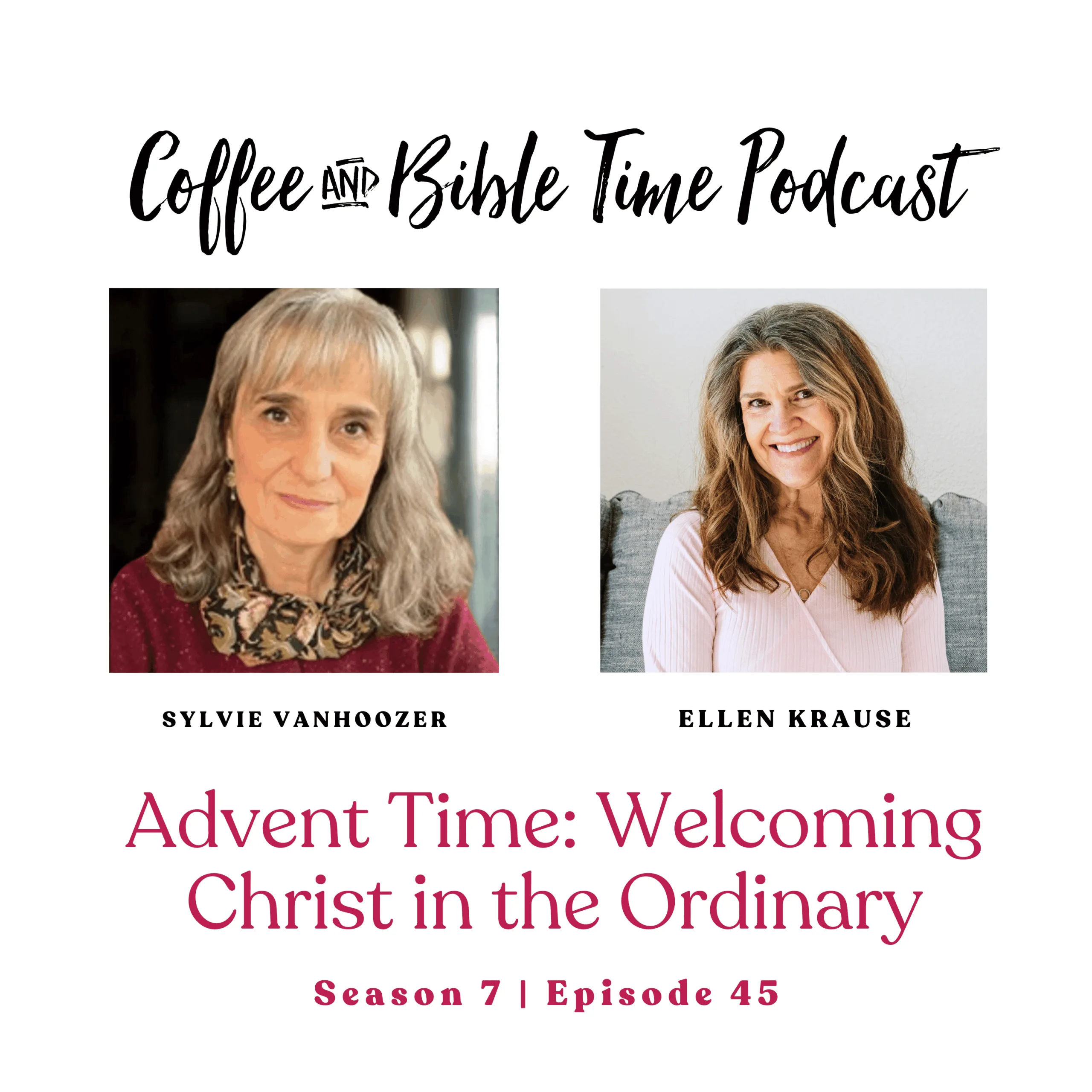

About this episode:
What if Jesus isn’t found in big, dramatic moments—but in the quiet, ordinary places you tend to overlook? In this episode, botanical artist and author Sylvie Vanhoozer shares how Advent time can reshape the way we see God in our everyday lives. Through simple practices of paying attention, noticing beauty, and welcoming Christ right where we are, Sylvie invites us into a slower, more intentional season that opens our hearts to Jesus: during Christmas and far beyond.
Subscribe & Listen on:
 Apple Podcasts
 Spotify
TIMESTAMPS:

00:02 Embracing Advent Time: A Journey of Anticipation
04:12 The Influence of Advent Time on Faith
08:47 Art and Nature: A Spiritual Connection
14:41 The Art of Paying Attention
17:37 Ordinary Saints: Lessons from the Nativity
22:31 Living the Advent Story
25:09 Cultivating an Adventish Heart
29:14 Guest Favorites & Closing
Ellen Krause:
Welcome back to the Coffee and Bible Time podcast. I’m Ellen, your host, and I am so glad that you are with us today. The weeks leading up to Christmas—what Christians throughout history have called Advent—invite us into a rhythm that feels almost counter-cultural: learning to wait, to watch, and to look for Jesus with joy, not only as we remember his birth, but as we walk with him throughout the year and anticipate his coming again.
Today, I’m joined by someone who helps us pay attention to God in beautifully creative ways: Sylvie Vanhoozer, an author and botanical artist born and raised in Provence, France. Sylvie brings together art, nature, and faith in a way that not only shapes her work but also her way of life. And she’s here to share how we, too, can practice the art of living in Advent—and far beyond it. Sylvie, welcome to the Coffee and Bible Time podcast.
Sylvie Vanhoozer:
Thank you for having me.
Ellen Krause:
Well, Sylvie, you grew up in Provence, a place that shows up vividly in your writing and art. How did your upbringing—and the landscape itself—shape your faith and spiritual imagination?
Sylvie Vanhoozer:
Yes, it certainly did—you picked that up right. My upbringing in a non-Christian home, first of all, created a longing. Something was missing. I don’t know why, but I always felt there had to be more to this life, even as a fairly young girl. The beauty of the landscape, in God’s grace, confirmed that. It bore witness to the fact that there had to be more—a Creator God out there. You know, “the heavens declare the beauty of the Lord,” and so on.
And so that created another level of longing. There had to be more. Where was that “more”? Who was it? And so on.
Another thing about my upbringing in Provence is the manger scenes that were created every year, with baby Jesus deeply, deeply, and lovingly planted by the people in our culture. Somehow, God, in his grace, used all of this to draw me to him, because I came to wonder: Is there a God? That was the “more”—the natural, general revelation. But if there is a God, then is this baby in the manger really related to him or not? And nobody had answers to that. But these questions stayed with me and helped me dare to imagine that it might be true—that there might be a Creator God of beauty, and that this baby Jesus might be related to him, of all things.
So yes, God definitely used both my upbringing and the landscape to form my faith and spiritual imagination.
Ellen Krause:
It’s so incredible just to see how God enters our lives in so many different ways. Well, something I’ve learned about you is that the Christmas season—and Advent in particular—has played such a key part in your faith journey and your coming to Jesus. Tell us a little bit more about your coming to Christ, from when you were first exposed to this manger scene to how God lifted the veil.
Sylvie Vanhoozer:
Yes—so, the manger scene again. Being the principal decoration in the French home was very helpful. The scene had a story. The manger scene was always there. The Christmas tree was always there if there were young children in a home, but not necessarily after that.
What really helped were the customs embedded in building the manger—which is not something you bring out from the basement or the attic and just set there. It’s something you build through the Advent season. And it starts with the Advent walk, which is a very traditional thing to do. Even when people don’t necessarily believe fully in the story, culturally this is still a very sacred thing for them.
So you go into nature, onto country paths or wherever, and you pick up vegetation. First of all, you reconnect with the land by doing that, which has a calming effect—especially at this time of year, which is so naturally contemplative. Then you bring in vegetation from your land with which to adorn the manger, which is a way of welcoming Jesus symbolically into your very land.
This provided plentiful opportunities for quiet, reflective contemplation—which is really a lot of the story of my life. My coming to Christ was very much through these reflections, because I didn’t have anybody to turn to. My parents were very loving—we had a beautiful home—but there were no answers to those questions there.
That’s why I write about the importance of making Advent a quiet time. God speaks in any way he wants, of course, but I think he often pays attention to people who pay attention to him. He will come; he will speak in that quietness.
And so both that, and the sense of connection to the land, and the wonder that there might be a God behind it all, gave me the proper posture in which to wait for him and really ask him: If you’re out there, speak to me. Say something. Do something.
Looking back, there is something very beautiful in that—in this idea of having the ability to “be still and know that I am God,” as the psalmist says. I think of the first garden, with Adam and Eve, where God walked and talked with them. And I think that’s a little bit what happens if we take the time, if we go out there and put ourselves in his proximity in this way and make ourselves available. He’s waiting. We often think that we are the ones waiting for God, but in another sense, he is waiting for us.
This was all very formative for me in my faith. This is where I found answers—initially just this way. And then he also finally put people in my life who had more concrete answers. Because you can see the beauty of God in nature, but you need a connection with a personal God. And that is the result of Advent—waiting for this connection. And then you have Emmanuel, who comes in the form of a baby, of all things.
Ellen Krause:
Yes, it’s incredible—the weaving of how the Advent story has touched your life. And you have such a unique background in the sense that you are a botanical artist. You’re so talented. I mean, for our listeners, we’re talking the kind of incredible, beautiful art—so detailed—that makes me think of Audubon.
Tell us a little bit—bring that into the fold here. Tell us about your artistic training and background, and how all of that started to work in with your faith.
Sylvie Vanhoozer:
Yes. Well, I’ve always been, for one thing, fascinated with the seasons. I often felt I would love to be an artist, but I didn’t think I could. So encountering botanic arts was really a grace thing.
My experience as an artist and as a writer, in a sense, both gravitate toward questions again about meaning, existence, everyday life, and ultimately a longing to belong, I think. So when I write, that’s what I’m writing about, but my art meanwhile represents the botanical world, which is very much connected to that sense of meaning: the Lord of creation and his greater story that gives us meaning.
There is meaning, too, in the way he made everything—something that in our modern world, just like slowing down at Advent, we are losing touch with because we’re so busy and so far removed from a more agrarian society.
So when I pick up a botanical subject and decide I’m going to try to draw it, I immediately contemplate not just its beauty, mystery, and intricacy—that’s already amazing—but also its place in the story of my garden, of all gardens, of the earth. Again, I’m looking at a greater story.
In Advent and in my Advent book, the artwork comes with that meaning—my own imagination, I suppose. For example, the cover of the book has a collection of natural treasures that grow in my own area. As I was thinking of that over the years, I thought: this is the place where I am now. I should be more aware of what grows here. I should be more attentive to it. I should care for it, as God asks us. I should have gratitude for it. I should see its beauty.
So all of that goes in there. It’s the mixture of my writing—I reflect on these things in my writing—but I also try to paint them, and I get this sense of gratitude as I do it.
In the Advent book, I also talk about the centuries of Christian symbolism associated with plants. That’s not to be disregarded. It connects us not just with the story of creation and God waiting for us and reconnecting with us, but also with Christians through the ages. And that’s a beautiful thing as well.
For instance, symbolism attached to evergreens—that’s why we have evergreens at Christmas: because God is ever here. It’s not too complicated, but many of us miss that, and it’s fabulous to think about.
So Advent, being the time when we wait for his Son to enter the human scene to make all things right with us again—to restore us and the heavens and the earth—that’s what gives us the ultimate meaning for our lives. The meaning we’re looking for is really joining within his mission to restore all things, if we pay attention. And that’s huge.
Ellen Krause:
Yes—if we pay attention. What a great set of words there, because I think, as you said, in this fast-paced world we live in, we just don’t do that as much.
Reading your materials and looking at your incredible art made me recently—when I was in Oklahoma City—pick up these acorns. I had never seen an acorn this huge. I was examining it so closely and just in awe.
When we’re not taking time to be out in nature, we miss the simple excellence of God’s creation.
You know, art also requires slowing down and noticing light and shadow and contour and color. In what ways does Advent require that same artistic posture and attentiveness?
Sylvie Vanhoozer:
So it is a time for training—to notice, to pay attention. I call it an apprenticeship to see Jesus, Emmanuel, to see his light. Christmas is when his light comes into the world, and we learn to see everything else by his light—not just his light itself, but everything else. By it, we see the world as it really is, and in many ways, we re-see things or unlearn what we have seen wrongly.
A funny anecdote with that: in my very first botanic art lesson, the teacher said to the whole class, “Okay, sit down and draw a leaf.” She said any leaf—“You have three minutes.”
So we all drew a leaf. She went around and looked at them and said, “Yes, just what I was thinking. You’ve all drawn very nice iconic leaves.” And we were thinking, What is that?
She said, “All your leaves are flat.” Some had maple leaves, some oak leaves—but all flat, like this. She said, “In real life, a leaf is bent. The wind is moving it, or it’s dying a little. That’s not what it looks like.”
That was the first striking lesson for me about paying attention. Sit with your leaf. Pay attention. Look at what it really looks like. It’s not going to be flat unless you’ve pressed it. Even on a tree, leaves keep turning. They have a little articulation at the base—the petiole—and precisely because of that, the leaf turns with the movement of the sun. Fascinating.
So the lesson was: we’re not observant enough. We should know this. And immediately I thought: Is there anything else in life I’m not observing enough about? Does this have any implication for my spirituality—about how I look at things as they really are?
So paying attention is something Advent gives us time to do—to relearn or to unlearn. And that’s something I try to communicate in my Advent writing.
Ellen Krause:
I love that correlation.
You write, Sylvie, that Santons—or “little saints”—that make up part of the crèche (as we in America know as the Nativity scene) depict ordinary villagers rather than extraordinary heroes. Tell us about the Nativity. What does their ordinariness teach us about the way Christ comes to us?
Sylvie Vanhoozer:
So the ordinariness suggests that Christ is not impressed by big heroes—except, of course, if he calls them to be. But he’s not impressed by influencers.
In these manger scenes, the little saints—ordinary people—come to Jesus knowing he’s not interested in externals, in fame or money or status. He calls them to him to offer their gifts, and his preference is for the least of these, the commonest of these.
They also show us that there is no difference between the sacred and the mundane—between our idea of “sacred” as something separate and the things we do every day.
So what the santons add to the crèche—and maybe I should explain a bit more about them first: once people have set out their crèche, they put out these little figurines, about three inches high, made of clay—which is important, because it’s clay from the land, with an allusion to Adam made from the earth.
During Advent, there is no Jesus in the scene. There are just the zero characters. They are busy with their everyday tasks—collecting olives from the harvest, talking with each other, making bread, exchanging goods.
Then, on Christmas night, when Jesus arrives and they hear the wonderful news, they immediately think, We have to take something. This is the King of Kings. And they present him with their daily offerings. And lo and behold, he accepts that. These offerings come from simple, mundane jobs, and they also bring their tools, which adds another layer of meaning: they dedicate all they do to him. It is an act of dedication.
There’s something really beautiful about that.
And I think the big difference between the traditional manger scene in most of the world—which is very historically correct, with the Holy Family and the Magi and the shepherds in a Bethlehem setting—and ours is that we build the scene. We plant it into our own land. The scene is a way of inviting Jesus into our land, our places. It’s an act of hospitality to Jesus.
But on top of him coming to us, the santons spontaneously, joyfully respond by coming to him. And the santons are called “little saints,” which I interpret as everyday saints—us.
It’s this incredible, wondrous exchange at the heart of the manger. It’s not just about a holy scene set apart. It’s about Jesus here, and we respond to him.
And it’s not about proving to him how good we are or how wonderful we are or how much money we have. It’s about being responsible in our everyday little jobs and mundane activities.
It is very, very powerful.
Ellen Krause:
Yes, I can envision it. As I was reading your devotional, you have some very interesting activities—like crumpling brown paper for hills and placing the little saints farther back because they haven’t arrived yet. And I never even thought about not putting Jesus in until Christmas Eve. I love how it’s given me such a fuller picture of the actual event.
You describe, Sylvie, that Advent is a tableau vivant, or living picture. How do you hope readers will enter that living picture you described? And what does that look like in daily life?
Sylvie Vanhoozer:
I think it’s about learning to contextualize the story of Jesus. It’s so easy to think of him in particular categories—maybe in the manger for Christmas, or in church on Sunday, or even just in our quiet times. But I propose doing daily activities to help us think, realize, and appropriate the fact that he’s not distant but right here.
So it gives us a fresh way of looking at Advent, and I hope my readers will start seeing themselves for what they truly are: everyday saints. We, too, are little saints. All we need to do is come to Jesus with our offerings from our own mundane lives and vocations, presenting everything that we have, everything we do, and everything we are to him—and dedicating it to him.
That’s what I hope this scene creates in people’s imagination. What would I be if I were one of these little saints? What character would I be? Am I the baker? They are mundane, simple little people—but there are others: a mayor, a wealthy man. Everybody has something to do. The stranger in our land is there as well.
But the point is not making big splashes—it’s coming with a product of our daily life, even when what we do is not remunerated. Standing at a kitchen sink—that too is something we can do as unto him. And that is important. That gives us that spirit of servanthood and of caring for others.
I also think this is a way of making ready for the arrival of Jesus anytime and anywhere we happen to be. We often think of getting ready for his second coming, but I’m talking about getting ready for him in the present moment of our everyday.
Ellen Krause:
Thank you for expanding our understanding of what I think we often limit ourselves to.
Sylvie, if a reader could walk away from your devotional The Art of Living in Advent with just one shift of heart or vision, what would you hope that would be?
Sylvie Vanhoozer:
I talk about “adventishness,” and I’ll explain a little bit, but it’s really all about learning how to welcome Jesus in all of our lives.
In the book, I have four weeks, which are four areas in which to train ourselves to learn to expect him. They’re all called The Art of Joyful Waiting in…
The first is The Art of Joyful Waiting in Our Places—by noticing the vegetation, the weather patterns, the food at our table, and learning not to take them for granted. Being grateful and wondering whether we can do more to care for what we’ve been given. That is a way of expecting his presence.
The second week is about learning to expect him in our lives and our stories; seeing the thread in your own life where Jesus was there, even when things didn’t make sense because of illness, stillness, or other seasons.
Then there is learning to see him in solitude. Advent provides quiet time, and we call this our quiet time every day. Some of us have seasons when we don’t meet with him and feel disconnected. Advent—if we quiet down—can be the time to reflect, to gather, to put a date with him on the calendar daily, to pray more, to read Scripture more.
The other place where we need to learn to wait for him and expect him is in fellowship with others.
So it’s really the art of joyfully watching and waiting for Christ to come—first at Advent and Christmas, but then always, in all seasons of our life.
Advent is not only about remembering the past—Jesus in Bethlehem, though that’s important. And it’s not even just about anticipating the future return of Jesus—the second Advent. It’s very much about the present—about not missing those daily Advent moments when Christ comes to us. He is always already there.
And I call this being Adventish—forming an Adventish attitude.
Ellen Krause:
I love that term. That’s a new word you made up—but yes, I want to be that too. And truly, listening to you has stirred my heart to be more present in this season, and always, as you said.
Where can our listeners go to learn more about you and your new book?
Sylvie Vanhoozer:
I have a website called The Art of Living in Season, and that’s about it.
Ellen Krause:
Very good! We’ll make sure we put a link to that in the show notes.
Before we go, I have to ask you some of our favorite questions here. What is your go-to Bible? What translation is it?
Sylvie Vanhoozer:
I like the—well, the only one I use is the ESV Study Bible. I love the amount of information there is. Yes.
Ellen Krause:
It’s an excellent one. How about—do you have any favorite Bible journaling supplies, since you’re an artist?
Sylvie Vanhoozer:
Yes, I’m very old-fashioned, I’m afraid. I have one of these little booklets about this size—it’s just a tiny little booklet—because I like to ponder when I read. I don’t journal on and on. I just try to take the “pearl” daily, whether it’s a verse that speaks to me. Then I’ll write it down and want to go back to it frequently.
It’s small enough to carry in my purse—I can just grab it and go. If I have to stand in line somewhere, I can do that instead of fiddling with my cell phone.
I write with a very fine mechanical pen because—maybe it’s the artist in me—I like to apply myself, because these thoughts are important. It’s about my communication with God and his communication with me. And I think I approach it differently if I apply myself.
Ellen Krause:
Mm, I love that—your little notebook of pearls. That’s a great tip.
Okay, lastly, what is your favorite app or website for Bible study tools?
Sylvie Vanhoozer:
I use YouVersion for Bible study. I mainly use it to read the Bible when I don’t have my physical Bible and I’m outside the house. But I love how quickly we can switch translations. I can go to The Message, I can go to my French Bible—very helpful. They have all sorts of other things, but I mainly focus on that.
Ellen Krause:
Well, I’m going to give a little shout-out to YouVersion as well. I was just in Oklahoma for their celebration of one billion downloads. My gosh—Incredible. God is working. It’s in every country around the world, and they look forward to two billion in five years from now. I think your suggestion is spot-on.
Well, Sylvie, thank you so much for being here today, for sharing your reflections with us. I appreciate it.
Sylvie Vanhoozer:
Thank you for having me. It was a delight to talk.
Ellen Krause:
And to all of you listening, thank you for joining us as well. I hope this conversation encourages you to slow down, pay attention, and notice the quiet ways Christ meets you in your everyday life. If this episode blessed you, be sure to share it with a friend and check out the links in the show notes to learn more about Sylvie’s work.
Until next time, may you walk through your days with open eyes and hearts, and a deep sense of God’s presence with you. God bless.
Advent Time: A Living Picture
The weeks leading up to Christmas—what Christians throughout history have called Advent—is more than a buildup to our favorite holiday, or the busiest few weeks on our calendar.
ad·vent
/ˈadˌvent/ noun
- the arrival of a notable person, thing, or event. E.g., “the advent of television”
- the first season of the Christian church year, leading up to Christmas and including the four preceding Sundays. noun: Advent
- Christian theology: the coming or second coming of Christ. noun: Advent
Someone from Provence, France—like our guest, Sylvie Vanhoozer— might describe Advent time as a tableau vivant, or “living picture” that God invites us into.
We often keep the story of Jesus in certain categories: confined to the manger at Christmas, the tomb at Easter, the sanctuary on Sundays, or in the quiet of our devotional times. But Advent calls us to place him squarely in the middle of our real lives.
To enter the “living picture” of Advent time is to slow down and remember that God is not distant. He comes into our world—our kitchens, our commutes, our routines—with the same tenderness and humility with which he entered the very first Advent night.
Becoming Everyday Saints
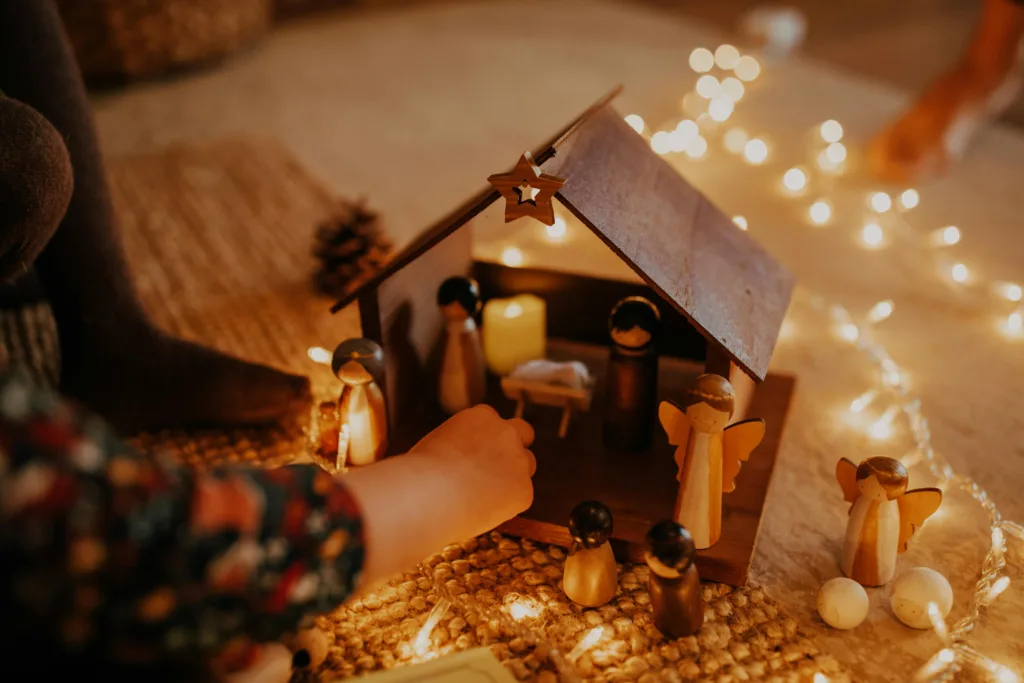
In the French tradition, santons (the “little saints” placed around the manger during Advent time) aren’t kings or princes, but ordinary villagers who approach Jesus with offerings from their daily work: bread, freshly-harvested olives, work tools. There’s nothing extraordinary about them; they’re regular people you might see on your next trip into town.
In this way, the “little saints” direct us to something profound about Jesus: he doesn’t call the people we expect.
You might be interested:
12 Day Christmas Bible Reading Plan + Printable
This free Bible reading plan will walk you through Scriptures that highlight the promises of God, the birth of Jesus, and the hope of His coming again.
[The santon’s] ordinariness suggests that Christ is not impressed by influencers or heroes. He accepts the daily offerings of simple, mundane work—and that is very powerful.
Sylvie Vanhoozer
As believers, we should see ourselves in these little saints—not called to impress, but to offer Jesus what we are already holding in our hands. Even unnoticed tasks become an offering of love when given to him.
Giving Jesus Our Attention in Advent Time
Advent time is also a season of learning to see differently. Sylvie shared a story from her botanical art training: the day her teacher asked the class to draw a leaf.
All of the students, including Sylvie, chose a different leaf to depict—oak, maple, sycamore—but they had thing in common: they were all flat. Their teacher told them, “In real life, a leaf is never flat. It bends. It turns. It follows the sun.”
Sylvie said, “Immediately I wondered…is there anything else in life that I’m not observing enough? Does this have implications for how I see spiritually?”
Yes. This is the essence of advent time.
This call to spiritual attentiveness begins in Scripture:
“Be still, and know that I am God.”
Psalm 46:10
Advent time teaches us to stop rushing, stop assuming, and start noticing: to see the world as it really is and Christ as He really comes.
Cultivating “Adventishness“
In her book, Sylvie introduces the concept of adventishness—a posture of joyful expectation in the here and now.
“Even in the first garden with Adam and Eve, God walked in the garden with them and talked with them. And I think that’s a little bit what happens if we take the time… and make ourselves available, he’s waiting.”
Sylvie Vanhoozer
She invites us to practice this in four simple ways during advent time:

4 Ways to Wait For Jesus in Advent
1. Waiting in Our Places
Notice the land you live on—the trees, the weather, the food on your table. Let gratitude awaken you to the God who is ever-present, like the evergreens we cherish at Christmas.
2. Waiting in Our Stories
Trace the thread of Jesus’ presence through your life—even the seasons of stillness, confusion, or sorrow.
He has always been there, shaping and holding your story.
3. Waiting in Solitude
Just as He came to us, find time to go to Him. Let the hush of winter remind you to pray, listen, and be still with God in the quiet.
4. Waiting in Community
Look for Christ in others—in conversations, in shared meals, in acts of service. He comes to us through the ordinary people he places in our path.
An Invitation to Ordinary Saints in Advent Time
At the center of advent time is this: Christ comes to us in the everyday. The “little saints” of the French nativity remind us that our small offerings—our routines, our responsibilities, our unseen acts of love—are precious to Him.
As Sylvie said:
We too are little saints. And we, all we need to do is come to Jesus with our offerings from our own mundane lives and vocations.
Sylvie Vanhoozer
This Advent time, may we slow down, pay attention, and step into the living picture of God’s presence all around us.
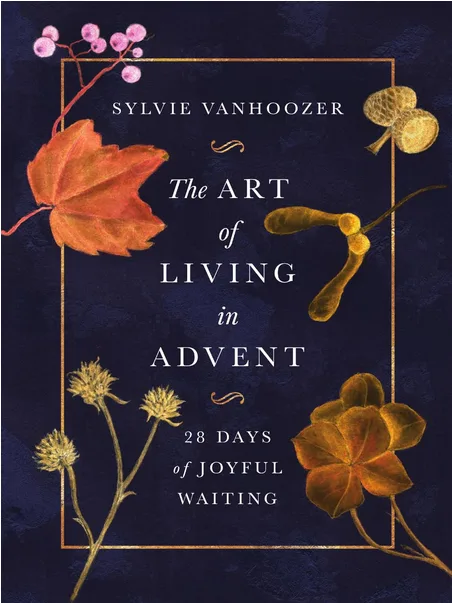
The Art of Living in Advent
Step into the Advent season with this beautifully crafted daily devotional by Sylvie Vanhoozer, blending Scripture, history, art, and reflection to enrich your spiritual preparation for Christmas.
Centered around the traditional French santons, or “little saints,” this book invites you to imagine Christ’s presence in your daily life―right where you are. Through thoughtful devotions, original artwork, and prompts for prayer and reflection, this devotional offers a creative and meaningful way to deepen your faith this Advent.
Leave a Reply