
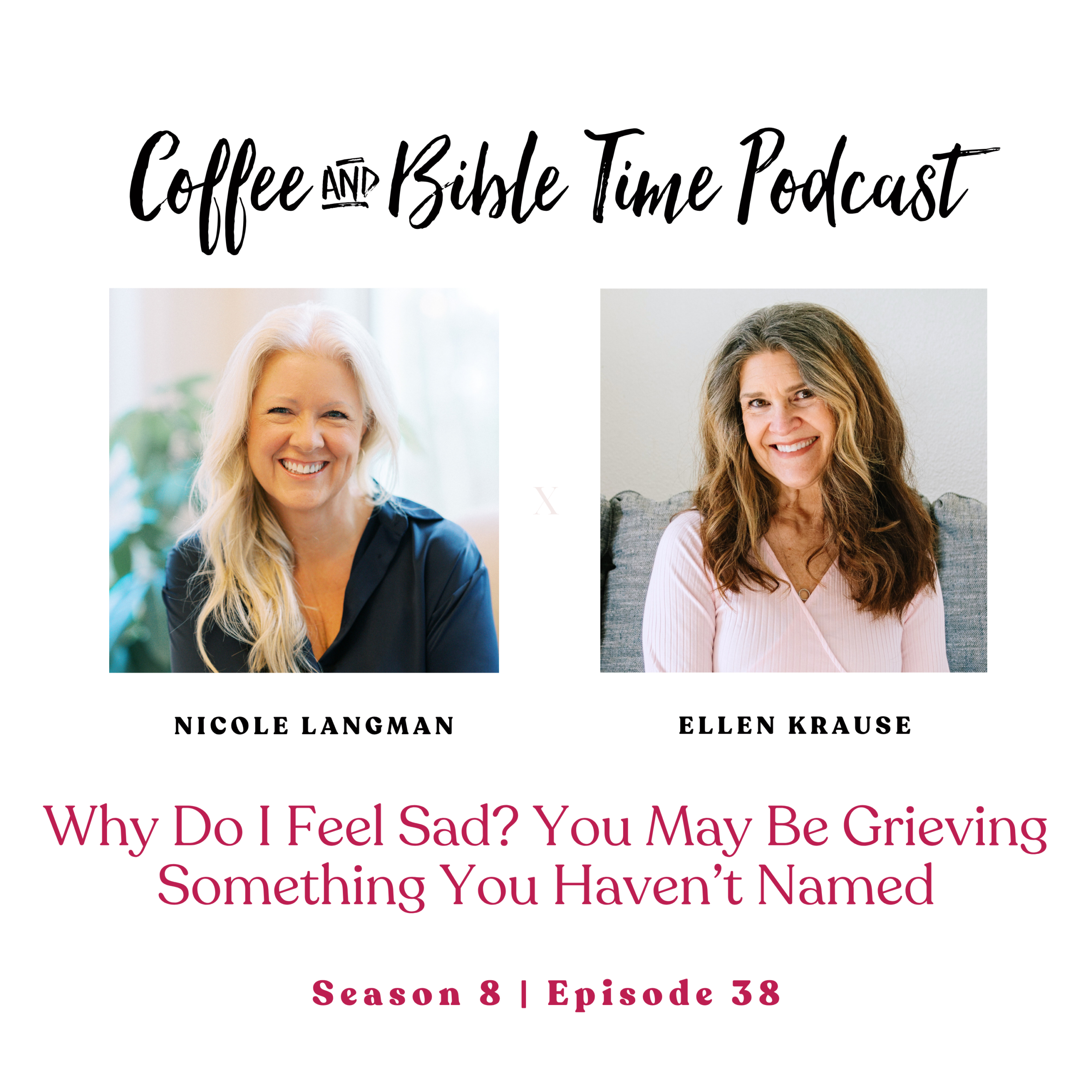

About this episode:
Sudden sadness. Unexpected tears. Irritability that seems to come out of nowhere. If you’ve found yourself asking, “Why do I feel sad?”, you may be experiencing grief—even if no funeral was involved.
In this conversation, Ellen and licensed therapist Nicole Langman explore the often-overlooked losses that can leave us grieving even when no one has died.

 Apple Podcasts
 Spotify
TIMESTAMPS:
00:00 You’re Allowed to Grieve Losses No One Talks About
02:59 What Can We Grieve Besides Death?
05:08 Why You Don’t Have to Compare Your Grief
06:40 The Anger, Relief, Guilt, and Shame of Grief
08:49 How to Recognize Grief You Haven’t Named
10:09 When Grief Starts Affecting Your Identity
11:33 Why Naming Your Grief Matters
14:13 What to Do When You’re Asking God “Why?”
16:39 How Scripture Can Help You Grieve
20:55 Practical Steps for Moving Through Grief
Nicole Langman: How many women have come through my door and they’ve told me this story, and I’ve said, “Wow, it sounds to me like you’re grieving.” And they just had this, like, “Oh my goodness, I am grieving.”
I’m grieving the life I didn’t ask for. I’m grieving the choices made against me. I’m grieving the dreams that didn’t get fulfilled. I’m grieving some of the losses that other people don’t acknowledge.
I’m grieving that. I’m grieving, and I’m scared, right? I’m scared of outcomes. Let yourself acknowledge that.
Ellen Krause: Hi, friends. Before we dive into today’s conversation, I wanted to share this comment from a listener who tuned into my conversation with Cheryl Marshall.
She says:
“What a great listen today! Just what I needed. I loved the Scripture references, and I am going to journal about this podcast and write all the Scripture to use for future me.”
Thank you so much for sharing that with us. And I couldn’t agree more.
My conversation with Cheryl was such an encouragement for anyone who wants to learn to worship God with their whole heart, mind, and soul.
If you haven’t listened yet, you should check it out. I’ll include a link to it in the show notes.
Okay, back to the conversation.
Ellen Krause: Welcome back to the Coffee and Bible Time podcast. I’m Ellen, your host.
Have you ever experienced a loss that didn’t involve a funeral or receiving casseroles, but you still were grieving? Maybe it was a relationship that ended, a diagnosis that changed everything, or just the realization that your life looks very different than what you thought it would.
Sometimes we know we’re hurting, but we don’t even realize that what we’re experiencing is grief. And we may feel like we’re just supposed to move on or be grateful or trust God and push through.
Well, today we’re going to have a really important conversation about the losses that we don’t always know how to name, what healthy grief can look like, and how we can bring those hard emotions to God.
My guest today is Nicole Langman. Nicole is a licensed therapist, social worker, writer, and speaker who has spent years walking alongside people through some of life’s most difficult seasons.
She’s here today to help us wrestle through some of these tough questions. Nicole, I am so glad that you have joined us here today.
Nicole Langman: Hi, Ellen. Thank you for having me. I’m so grateful to be here.
Ellen Krause: Well, Nicole, as a licensed therapist, you have spent countless hours sitting with people who are going through some really difficult circumstances.
What are some of the things that you see people grieving from that just don’t get talked about a lot?
Nicole Langman: Well, I’m working with women mostly. So women come through my door, and most of the women who are grieving are grieving some sort of relationship breakdown.
Most recently, I had a woman come through the door, and she was talking about her relationship with her mother-in-law.
She grew up without a mom in her life, and she was so yearning for that mother-daughter connection. And she had anticipated this relationship would be something it wasn’t. And she’s really grieving the disappointment of that and the pain of that.
I know a lot of women are facing infertility. And I’ve had the privilege of walking alongside families as they go through the adoption process and fostering experience. There’s tremendous grief in those areas of our lives.
If our child has a disability or a mental health issue or a diagnosis or an addiction, there’s grief in that. We don’t talk about those things the same way.
And, of course, we can go back to estrangements in our families or divorce, infidelity, rejection. The umbrella is huge over the things that we grieve.
But what’s happened over the years is we have long given death kind of the high-water mark of loss, and then we’ve measured so much of our other losses up against it, which kind of minimizes things for us, doesn’t it?
So it’s very important to grieve the things that are happening that don’t involve death. And that’s why I wrote this book.
Ellen Krause: And I’m so thankful that you have, that you’ve really addressed this, because I know for me personally, I was just thinking, like, what are my own examples of this?
Even when my kids got married, because it was such a mixed emotion of being so excited for them, but at the same time, I’m grieving a loss of letting go of that child who I’ve spent, you know, the last 30 years raising.
And even another one, just having one of my children move far away doing ministry work, which is a beautiful thing, which, you know—
Nicole Langman: Yes.
Ellen Krause: —it is one of those things like, you shouldn’t feel sad about that because they’re in God’s will. But at the same time, you do, right?
Nicole Langman: It’s a beautiful example. Everything you’ve just said there is exactly right.
Isn’t it incredible how joy and sorrow can coexist, where you’re proud of them and you’re excited for them, and you can kind of turn them over into God’s care and just be, you know, proud of them and also grieve for the seasons that have changed and the relationships that kind of inevitably move into different chapters almost?
So they can coexist. Joy and sorrow can coexist, but that is definitely grief-worthy and important to grieve without comparing it up against anything else.
Ellen Krause: Yes, absolutely. Well, sometimes we can feel guilty for being sad.
Nicole Langman: Yeah.
Ellen Krause: Because we could start the comparison thing where we see someone else who’s far worse off than us, we think. Why do you think that we do that?
Nicole Langman: Yeah, it’s a good question. I feel in so many ways that it’s almost inevitable that we do kind of measure because we’ve been cultured to measure and compare.
I think it’s very, very important that we stay away from that comparison game in as much as we possibly can because it actually minimizes and harms us further.
But we do tend to, as a society, value fairness. We don’t have to match pain levels. There doesn’t have to be, ‘Her pain level and my pain level have to somehow be noticed.’
And it’s only fair that, you know, she’s allowed to grieve more, that she can have the casseroles and the ceremonies, and it’s only fair that she gets more attention because of her loss.
We don’t have to look at this as whether this is fair or not. If we grieve, if we’re grieving, if we’ve experienced loss, then it’s very important to give ourselves the space that we need in order to do that heavy lifting, the heavy work of grief.
Someone else’s loss doesn’t cancel out our own.
Ellen Krause: That’s so helpful. We talked a little bit about how, you know, joy and grief, you can experience at the same time.
What are some of the other emotions that people feel in grief that they’re surprised or perhaps even ashamed to have?
Nicole Langman: This is a very important conversation because grief is one of the most complex human experiences and human emotions because it brings in all the other emotions.
So often people will show up and they’ll be very angry. It creates irritability and short-fused experiences. People find themselves to be having knee-jerk reactions.
And so the anger that flares up in grief can be quite shocking for people.
Another thing that can be surprising is this sense of relief.
Depending on what the circumstance is or what the situation is, there can actually be this sense of relief that a lot of folks who come through my door are very surprised about.
And, of course, there’s the guilt and the shame that can be associated with grief as well. Sometimes we judge ourselves for how we’re handling certain things, or we judge our own experiences.
And that self-judgment can heap some shame on us.
And often other folks can facilitate some of that shame by how they respond to what we’re going through. Like you said, the shoulds.
Ellen Krause: Mm-hmm.
Nicole Langman: Like someone will say, “Well, you should be excited for your kids.” Yes, but I’m also grieving.
And here’s another thing that shows up often is that there’s a sense of, “I should be feeling a certain way, so therefore I can’t experience other things.”
So if I have a good day, does that mean this loss doesn’t matter?
God has created us so complex and so able to experience a whole gamut of emotions at the same time.
So letting ourselves experience that without the guilt trips or the shame that we could heap on ourselves in that.
Ellen Krause: That’s so liberating. It really is.
And I know because I had actually seen a therapist when I was going through all of these things and trying to process it.
Nicole Langman: Yeah, good idea.
Ellen Krause: And that was such a tremendous help.
Well, let’s talk a little bit about acknowledging our grief. I mentioned at the beginning, sometimes people don’t even realize perhaps that they’re experiencing some kind of grief.
How can we tell when there is something in our life or our past that we should actually stop and grieve?
Nicole Langman: I’m just gonna reckon that I think probably every single one of us has something.
Because here’s the thing that shows up a lot of times: There’s certain places in people’s lives that they’re afraid to go back and revisit, even in their memories or in conversations, or places that they might avoid going to.
It could flare up just as a memory or just a sore spot. Someone starts mentioning something, and there’s an emotional experience around that.
I don’t know if this has ever happened to you where someone’s talking about something and all of a sudden you’re in tears, and you’re like, “What’s that?”
Okay, that’s probably an area that’s a sore spot.
That potentially could be a reminder to go back, visit that a little bit, spend some time with it.
You know, grief is exhausting. And so a lot of us are spending a lot of time emotionally exhausted.
So if you’ve been through something recently and you just find yourself just dragging yourself through your days, it will often show up as just a need for deeper rest, more quiet time, saying no to things that might busy us or distract us, and letting ourselves really linger in some of the grief work that needs to be done.
Ellen Krause: Yes, that’s so, so helpful.
And if you’re listening to this, like Nicole mentioned, you’re not alone. We all have something.
How does grief, Nicole, affect our identity?
Nicole Langman: I’m gonna just be really honest about how this can show up for us.
We only grieve what we value. We only grieve something that has mattered.
So in that itself, that is identity-shifting as well. Like, I often talk about the life-rearranging changes in our life that are very grief-worthy when you become an empty nester, or you had dreams of parenthood and it doesn’t look the way you’d hoped it would, or dreams for your children, right?
If you’re a parent of a child with a disability, all of these pieces connect to our identity.
And Lisa Terkeurst says that we can’t wave the victim flag and the victor flag at the same time.
I think that’s a beautiful reminder that when we go through seasons of loss and pain and grief-worthy, life-rearranging experiences, we have to be very careful that we don’t let that cling so tight to our identity that we find ourselves almost being victimized or a victim of the loss.
And very quickly, our grief can become an idol and part of our identity.
And so we have to be really intentional about integrating beautiful rhythms of healing practices as a Christian that involves prayer and meditating on God’s Word, spending time with Christian folks, all of those things that we can make sure that grief can be a part of our life, but it’s not the whole of our life.
Ellen Krause: Yes, yes. I can see how that’s so important because it could literally just engulf you.
Nicole Langman: Mm-hmm.
Ellen Krause: Let’s talk a little bit about putting words to grief. Tell us why it’s so important to actually name what we’re feeling.
Nicole Langman: Mm-hmm. Well, part of the work, I think, of growing in our emotional intelligence is identifying how we feel.
And when we can look at that, “I feel sad today,” and then pull back the layers, why?
Why do I feel sad? So for some people, it might be just looking at the calendar. Like, there are certain days on my calendar that are sharper than others, but I might not necessarily be paying attention to that.
I woke up this year on July 20th, which was the anniversary of losing my mom, and I just woke up just feeling heavy. And I didn’t know why at first. And I’m a therapist. I had to kind of look at, well, right, this day on the calendar is a hard day.
Right. And so letting ourselves almost identify what is that, what is happening for us, noticing our emotions and not running around and trying to necessarily distract ourselves, but just peeling back the layers.
What is happening for me? Identifying, “I feel sad. I feel angry.” And let’s look at what is that and why.
And so when we can start identifying what’s happening for us, we can then tell other people what’s happening for us. And because inevitably people kind of live in the wake of our experience too, right?
So if we’re going through our day angry or disregulated or a little bit hostile or irritable or just weepy, and people are wondering what’s happening, we can at least say, “Here’s what’s happening for me. This is how I’m feeling today.”
And we don’t want to be slaves to our emotions because emotions make a terrible compass.
Noticing our emotions is one thing. Living by them and being a slave to them is a totally different event.
So that’s part of the work of just healing and growing, because that’s what resilience is—not just bouncing back, but becoming better because of what’s happened to us.
Ellen Krause: Mm. And the repercussions if we don’t are significant, right?
Nicole Langman: Yeah.
Ellen Krause: Significant.
Nicole Langman: Depression, right? Unmanaged grief, unworked-through grief can easily become depression, anger.
It seeps into the aspects of our life that, you know, really aren’t up for grabs, and it can influence our relationships, it influences our well-being.
And you know what else? It influences our relationship with the Lord.
And I think we have to be really aware of how that shows up in our lives as well. If I’m not managing my emotions and I’m not bringing my stuff to God, it can become a barrier in my relationship with Him, right?
And so these are the things we can turn over to Him and say, “I am brokenhearted. I am wounded. I am missing. I am lonely. I didn’t want it to look this way.”
And, “I’m kind of mad about it.” These are all parts of the turning over to Him, the grief work that helps us stay connected to the source of hope and healing and joy and peace, and also helps grow us in our ability to interact with others around us.
Ellen Krause: Well, that’s very good reason to walk through these and bring our emotions forward.
Let’s talk about God and our disappointment. When something really painful happens, like divorce or the loss of a friendship or financial struggles, it can be hard to understand.
Where is God in all of this? What would you say to someone who’s asking that question? Why, God, would You allow this?
Nicole Langman: Mm-hmm. And I think that’s the age-old question, isn’t it? We have these big why questions for God.
And I’ll tell you, in my own experience, there was no answer that would have made sense from a human perspective. And I think that’s the question that I often kind of pose back: Is there anything He could tell you that would help you make sense of this?
When we ask God why, “Why me? Why is this happening in my family or my life?” Is there anything He could say because of this, this, and this that would really make that pain go away?
And for me, in my life, there wasn’t an answer that He could have come up with that I would have really been able to say, “Well, then that makes it all better then, right?”
The question I think that really changes things for us is when we say, “I may never, on this side of heaven, understand why.
But what I’d like to know now is, God, what do You want to do with it in my life?”
Because we’re purpose-driven, right? We’re meaning-makers as humans.
If we can just decide that, “God, You stand outside of all of this. You know the why. I do not. But I trust You anyways.”
Help me to, instead of ask why, ask what now.
“What now, God? What are we going to do with this?”
And I remember when I was face down on the floor and I was like, “Why did this happen? What is going on? I’m never going to be able to trust another man again.”
And very clearly in my heart, I felt these words: “You don’t need to worry about that right now. You just need to trust Me.”
There was no answer to the why that would have made me feel better. But I decided in that moment that I can do that. I can trust Him.
And when I trust Him, then I don’t need all the answers to the why. I just need to be obedient and faithful and following Him through this.
And that’s—it’s a hard answer because there isn’t a why that will satisfy, an answer that will satisfy.
But what we know is true is that God is close to the brokenhearted. He steps in on our pain. He shows up when we are in sorrow and suffering in the most beautiful ways.
And we can trust Him with all the pieces that are hard to make sense of.
Ellen Krause: Yes. There were two verses that someone used to encourage you in one of the chapters that you wrote. And I just want to share them with our listeners.
The first one was Psalm 56, verse 8, which is David’s words to God, where he says:
“You keep track of all my sorrows. You have collected all my tears in your bottle. You have recorded each one in your book.”
And then Psalm 18, verse 6 that says:
“But in my distress I cried out to the Lord. Yes, I prayed to my God for help. He heard me from His sanctuary. My cry to Him reached His ears.”
Those verses are so comforting. How would you encourage people to use the Scriptures in helping ourselves and one another?
Nicole Langman: I love that you read those. They make me emotional even now just listening to it, Ellen.
I’m so grateful for David, for the Psalms, for his words, his authentic cries, his soul cries to the Lord, where he’s telling God, “This is how I feel. This is how I feel.”
And then he circles back and it’s like, “And yet You count my tears, You collect them up in Your bottle. I know that my cries reach Your ears.”
He’s so convinced that God is near. And may we have that kind of faith that he had, that remembering who God is, that He is near, that He is close, that He’s collecting our tears, that He weeps with us, that He sings over us, that He loves us like every good parent.
He saddles up close to us and holds us. And it doesn’t necessarily mean that all the pain’s taken away, not at all, but that we are never alone in it.
One of my favorite things to do is to write out the verse, like each of those Psalms. I’d write it out kind of like double-spaced. And then I would circle the words that stand out.
I would underline the words that I want to explore more. And then I would kind of make little, almost like word webs from them. Like, “What does this mean?” I’d research what this means and why that matters.
This is a living Word, right? We know that this is the living Word.
Ellen Krause: Yes.
Nicole Langman: And words jump out at us sometimes in seasons. How many times I’ve read the same thing over and over, but on those moments, they jump out at me.
There’s a reason for that. So we want to just listen deep to what it is that God’s trying to tell us if our attention is drawn to it.
There’s a reason for that. And so highlight that, write it out, and let yourself do that deep dive into one Scripture, one passage that grabs you.
There’s a reason for that. And those ones were ones that obviously are—and they continue to be—highlighted in all of my Bibles.
Ellen Krause: Yes, yes. Love those. And those are two great verses, too, you can use to encourage someone else.
Well, in John 11:35 is the shortest verse of the Bible. It says, “Jesus wept.” How can we find encouragement just in Jesus’ reactions to circumstances, knowing that He was fully human and fully God?
Nicole Langman: Love the image of this, that He would weep. This is not just a tear that He had to dab away. This was a weep.
And I don’t know about you, but I have those weeping moments where I am broken open. Jesus wept.
When we let ourselves notice what that would have looked like, He wept. His body would have heaved with the weeping. He would have been covered in His own kind of, you know, tears and kind of ugly cry moment.
He did it. We can do that.
And for whatever reason…I don’t know. It just brings me such comfort to picture Him weeping. And in my face on the floor, ugly cries, to know that He was there weeping with—this isn’t what He wants either, right?
He’s devastated for His children too.
I’ve just been so comforted by that, that we could just let ourselves connect with Him in that way. The human of a God who comes down and close to us and weeps with us, it’s just the most beautiful thing I can think of.
Ellen Krause: Yes. And so it’s so important to bring our grief to God, and He knows what that’s like. And it can help get us through some really tough times.
Let’s talk a little bit about some practical things that people can do. If someone’s listening right now who’s realizing, you know, maybe this has perked up some things of like, “I actually am grieving this,” whatever that might be. But they don’t really know what to do with it.
Where should they start?
Nicole Langman: This is a great start. Noticing it and naming it. Naming what it is. This is grief.
And how many women have come through my door and they’ve told me this story, and I’ve said, “Wow, it sounds to me like you’re grieving.” And they just had this, like, “My goodness, I am grieving.”
When you just let yourself find a word for it, it almost kind of takes away some of the fog or the confusion of what it might be, and just say, “This is it. I’m grieving.”
I’m grieving the life I didn’t ask for. I’m grieving the choices made against me. I’m grieving the dreams that didn’t get fulfilled. I’m grieving some of the losses that are so quiet in the background that other people don’t acknowledge.
I’m grieving that. I’m grieving, and I’m scared, right? I’m scared of outcomes. Let yourself acknowledge that and write it out.
There is a lot of therapy in writing it out. I’m grieving this. I’m disappointed about this. I wish this was different.
And then part two of that is tell God about it. And in fact, I said to God, “I hate this in my life. And I don’t understand it. And I don’t want it. And I hate it.”
That was liberating for me just to tell Him how I felt about that.
So write it out, know what it is you’re talking about, identify the grief, tell God how you feel.
And then I would really encourage people to talk to somebody. I want you to know I’ve come to a place where I understand that this thing is grief.
So for me, I have one child, and she’s a beautiful, beautiful woman. And she battles with mental health issues. She wouldn’t mind me telling you that. She’s also a woman with a diagnosis, a disability. She’s on the autism spectrum.
I felt really guilty grieving that. But the truth is, I grieve that every day.
And so I had to be honest with God, and I had to be honest with somebody else about that. I had to be honest with myself about it.
And if you need to talk to somebody, which you said earlier, which is so, so healthy and smart, find a counselor. If you’re a Christian, it’s nice to have a Christian counselor for sure.
It’s preferable to talk with someone about this thing that you’re grieving because grief that isn’t attended to tends to percolate and get a little bit nasty and can get bigger and obviously, we know, infiltrate our lives in some unhealthy ways.
And so we want to seek counseling about it as well. Talk to a safe, trusted friend, a pastor perhaps, and move your body.
A really great outlet for grief is movement. So go for a walk. Go for a brisk walk if you can. Get your heart rate up. Twenty minutes a day would be super helpful.
If it’s housework, if it’s a dance party with your grandkids or your dog or whatever that looks like, move your body as often as you can for a minimum of 20 minutes to get some of those pain chemicals out so that you can make room for some of the maybe the serotonin and the different stuff that we’re looking for by movement.
So movement is very healthy with grief.
Ellen Krause: Well, those are all just wonderful practical steps that we can take to get the process moving forward and just knowing that, as you mentioned, you can continue to grieve, but it doesn’t have to weigh you down.
Nicole Langman: Yeah, that’s right. Yeah.
Ellen Krause: Well, Nicole, you’ve written this amazing book called This Isn’t the Story I Wanted, which is so apropos. It includes real-life examples, people that have gone through all types of various things.
You have prayer, therapeutic questions, reflection sections, and journal prompts. It’s just so awesome. Where can our listeners go to learn more about you and your new book?
Nicole Langman: Yeah, thank you for that, Ellen. It’s available in every place you buy books, Amazon, Barnes & Noble, and my publisher, Kregel, they’ve got them for sale in there as well.
So grateful to Kregel for the incredible work that they’ve done.
The other thing, too, is on my website you can find some more information about the book. And right now I’m giving away a devotional that accompanies the book. It’s a five-day devotional you can download for free from my website, NicoleLangman.com, and it’s just a little bit of added pieces to the book as well.
One of the interesting things of feedback from folks has been that they appreciate that the book is written with chapters that stand alone.
So because grief can clog up our ability to concentrate and to follow the storyline along, we can sometimes get lost, and we read a chapter and then tomorrow we try to read the next chapter and we don’t remember what happened the day before because it’s gone from us.
Whereas every chapter stands alone, you can just pick up wherever you want in this book, which is a really helpful therapeutic strategy as well.
And I would love for people to be following along on socials as well because there’s lots of tidbits on there, too. So on Instagram and Facebook.
Ellen Krause: Well, we will make sure we include all of those links in our show notes.
Nicole Langman: Thank you, Ellen.
Ellen Krause: Before I let you go, though, I have to ask you our favorite questions here.
Nicole Langman: Yes.
Ellen Krause: What is your go-to Bible, and what translation is it?
Nicole Langman: Right now I am digging into the ESV translation. I love the English Standard Version.
And I have just picked up—my former Bible was stolen in a truck, my truck. And so I’ve just picked up—I know, I’ve just picked up a new Filament-enabled Bible, which I’d never tried before.
So that is so fun, which offers the online study presence, which is pretty cool.
Ellen Krause: Yes, those are super cool. All right. Very interesting.
Nicole Langman: Yes.
Ellen Krause: Okay. I hope the person that took it, like, it’s gonna change their life. [laughs]
Nicole Langman: [laughs] No. I know, me too, me too. Yeah.
Ellen Krause: Do you have any favorite Bible journaling supplies? I know you’ve told us to write a lot of things down.
Nicole Langman: Yes, I love the transparent sticky notes. I write all in my Bibles. I’m years and years of writing in tears and prayers all written in, but the transparent sticky notes make it so you can actually add layers.
You can add layers inside as well if you don’t have enough writing room. I love them.
Ellen Krause: What a great tip. Okay, lastly, what’s your favorite app or website for Bible study tools?
Nicole Langman: Well, I love the Logos Bible study tools for my writing and my speaking. And I also love the Blue Letter app as well.
Plus, I’m really enjoying this Filament study that you can kind of get some of the study notes. And the Bible Project has incredible resources.
So I dabble in all of those areas. Yeah.
Ellen Krause: Yes. All tremendous, tremendous resources.
Well, Nicole, thank you so much for being here and just helping us put some words to this idea that grief doesn’t only apply to a death, right?
It’s so much more than that. And that we can really take action to make a difference in our lives once we address that.
So thank you for your encouragement.
Nicole Langman: Thank you for having me, Ellen. What a treat to spend time with you. Thank you for this.
Ellen Krause: And—you’re welcome! And to our listeners, if you’re carrying a grief you haven’t really acknowledged, I just want to remind you, you don’t have to minimize your pain, and you don’t have to walk through it alone.
God sees you, He is with you, and He is not finished writing your story.
Well, thank you so much for joining us on the podcast today. We’ll see you next time. Have a blessed day.
Sudden sadness. Unexpected tears. Irritability that seems to come out of nowhere. If you’ve found yourself asking, “Why do I feel sad?”, you may be experiencing grief—even if no one has died.
We often associate grief with a funeral or the loss of a loved one. But what about the relationship that didn’t turn out the way you hoped? The dream that never became reality? The child who grew up and moved away? The friendship that ended?
These experiences—any many others—can bring real grief, even if no one’s bringing you casseroles.
In a recent conversation on The Coffee and Bible Time Podcast, Ellen Krause talked with licensed therapist, social worker, writer, and speaker Nicole Langman about the hidden grief many of us carry—and what we can do when we don’t even realize we’re grieving.
Why Do I Feel Sad? It May Be More Than You Realize
When you’re wondering, “Why do I feel sad?”, it’s natural to look for an obvious explanation.
But maybe nothing particularly bad happened today. Maybe you’re actually in a good season. Maybe you have plenty to be thankful for.
So why do you feel heavy, emotional, or unexpectedly sad?
Nicole offers an important perspective: sometimes sadness is pointing us toward a loss we haven’t fully acknowledged.
“We only grieve what we value. We only grieve something that has mattered.”
That means your grief doesn’t have to make sense to everyone else to be real.
As Nicole explains, “We have long given death kind of the high-water mark of loss,” which can cause us to minimize other forms of grief.
So if you’re asking, “Why do I feel sad for no reason?”, it may be worth slowing down and asking a different question:
What might I be grieving?
Sometimes Joy and Grief Exist at the Same Time
One of the most misunderstood aspects of grief is that it doesn’t always look like sadness.
Nicole explains that grief can bring anger, irritability, guilt, shame, and even relief.
Ellen shared her own experience of watching her children grow up, get married, and move away. Those things can be beautiful and worthy of celebration—and still involve loss.
Nicole responded with this beautiful reminder:
“Isn’t it incredible how joy and sorrow can coexist?”
They can.
You can be thrilled for your child and grieve the end of a season of parenting. You can trust that God is leading someone you love and still miss them terribly. You can be grateful for your life and still grieve what you hoped it would look like.
Feeling sad doesn’t mean you’re ungrateful.
And experiencing grief doesn’t mean you don’t trust God.
Sometimes two seemingly opposite emotions can be true at the same time.
Stop Comparing Your Grief to Someone Else’s
Another reason we may struggle to answer “Why do I feel sad?” is that we don’t think we have permission to feel sad.
We see someone else’s circumstances and think, They have it so much worse than I do. So we tell ourselves that our pain isn’t significant enough to matter.
But Nicole encourages us to step away from that comparison.
“Someone else’s loss doesn’t cancel out our own.”
Nicole Langman
Your grief doesn’t have to compete with someone else’s grief.
There doesn’t have to be a ranking system for pain. You don’t need to prove that your loss is “bad enough” before you’re allowed to acknowledge it.
If something mattered to you, its loss can matter too.
How Do I Know If I’m Grieving?
Sometimes grief is obvious. Other times, it hides beneath our everyday emotions.
Nicole suggests paying attention to the places in your life that feel particularly tender. Maybe a certain memory makes you unexpectedly emotional. Maybe a particular date on the calendar brings a heaviness you can’t explain. Maybe someone mentions a subject and suddenly you feel like crying.
Those reactions may be clues.
Nicole shares that she once woke up feeling unusually heavy and had to stop and consider what was happening. She realized it was the anniversary of her mother’s death.
She had to name what was happening.
“This day on the calendar is a hard day.”
If you’re wondering, “Why do I feel sad?”, try paying attention instead of immediately distracting yourself.
Ask:
You may not discover an answer immediately. That’s okay.
The goal isn’t to force an explanation. It’s to become curious about what your heart may be trying to tell you.
Name What You’re Grieving
Nicole’s practical advice is simple but powerful: name it.
She has seen women come into her office describing difficult experiences, only to realize something important when she puts words to it for them:
“Wow, it sounds to me like you’re grieving.”
And suddenly, they realize, I am grieving.
Nicole encourages us to write it down:
“I’m grieving the life I didn’t ask for. I’m grieving the choices made against me. I’m grieving the dreams that didn’t get fulfilled.”
There can be something freeing about giving your experience a name.
Instead of simply thinking, Why do I feel sad?, you may be able to say:
I’m sad because I’m grieving something I deeply valued.
That doesn’t necessarily make the pain disappear. But it can bring clarity to what you’re experiencing.
Bring Your Grief Honestly to God
As Christians, we can sometimes feel pressure to have the “right” response to suffering.
We’re supposed to trust God. We’re supposed to be grateful. We’re supposed to have faith.
But Scripture gives us permission to bring our honest emotions to God.
Psalm 56:8 says:
“You keep track of all my sorrows. You have collected all my tears in your bottle. You have recorded each one in your book.”
Psalm 56:8
God sees your pain.
The Psalms are filled with honest cries to God. Nicole points to David as an example of someone who could express exactly how he felt while still trusting who God is.
And when you’re disappointed with God, you don’t have to pretend otherwise.
Nicole shared how liberating it was for her to tell God honestly:
“I hate this in my life. And I don’t understand it. And I don’t want it.”
When You Don’t Understand Why, Ask “What Now?”
One of the most meaningful parts of this conversation comes when Nicole addresses the question we often ask in the middle of suffering:
Why, God?
Why did this happen?
Why my family?
Why this relationship?
Why didn’t things turn out differently?
Nicole doesn’t offer a simple answer to those questions. Instead, she suggests a different question:
“I may never, on this side of heaven, understand why. But what I’d like to know now is, God, what do You want to do with it in my life?”
Nicole Langman
Instead of only asking why, we can begin asking what now?
It doesn’t erase the loss. But it can help us move forward without needing to understand everything first.
What Can I Do When I Feel Sad?
If you’ve been asking “Why do I feel sad?”, here are a few practical steps from Nicole’s conversation to consider.

6 Things To Do When You Feel Sad
1. Name what you’re feeling
Don’t rush past the emotion. Try putting words to it: I’m sad. I’m angry. I’m disappointed. I’m grieving.
2. Ask what’s underneath the sadness
Look for the loss, change, disappointment, or unmet expectation that might be connected to what you’re feeling.
3. Write it down
Nicole recommends writing out what you’re grieving and being honest about what you wish were different.
4. Tell God the truth
Bring your actual emotions to God—not the emotions you think you’re supposed to have.
5. Talk to someone you trust
A trusted friend, pastor, or counselor can help you process grief that feels difficult to carry alone.
6. Give yourself space to rest and move
Nicole also recommends making room for rest and quiet, while incorporating movement into your routine.
Most importantly, remember that you don’t have to minimize your pain simply because someone else has experienced something worse.
God Is Near in Your Grief
If you’re asking “Why do I feel sad?”, perhaps one of the most important things to remember is that sadness doesn’t make you a bad Christian.
Grief doesn’t mean you’ve failed to trust God.
You can be grieving and still have hope. You can be disappointed and still have faith. You can cry and still believe that God is good.
Psalm 18:6 says:
“But in my distress I cried out to the Lord. Yes, I prayed to my God for help. He heard me from His sanctuary. My cry to Him reached His ears.”
Psalm 18:6
And then there is the simple, powerful reminder found in John 11:35:
“Jesus wept.”
John 11:35
So if you’re carrying a grief you haven’t known how to name, you don’t have to push it away or compare it to someone else’s pain. You can acknowledge it. You can name it. You can write it down. And you can bring it to God.
As Nicole reminds us, “We only grieve what we value.”
Maybe the sadness you’re experiencing is telling you that something mattered deeply to you.
And maybe this is an invitation—not to stay stuck in grief, but to bring that grief into the presence of the God who sees every tear.
Listen to the Full Conversation
Want to hear more from Nicole Langman about recognizing hidden grief, processing difficult emotions, and bringing disappointment to God? Listen to the full Coffee and Bible Time podcast episode, where Ellen and Nicole talk about the losses we don’t always know how to name and the hope we can find as we walk through them.
Nicole Langman is a licensed therapist, social worker, writer, and speaker and the author of This Isn’t the Story I Wanted.
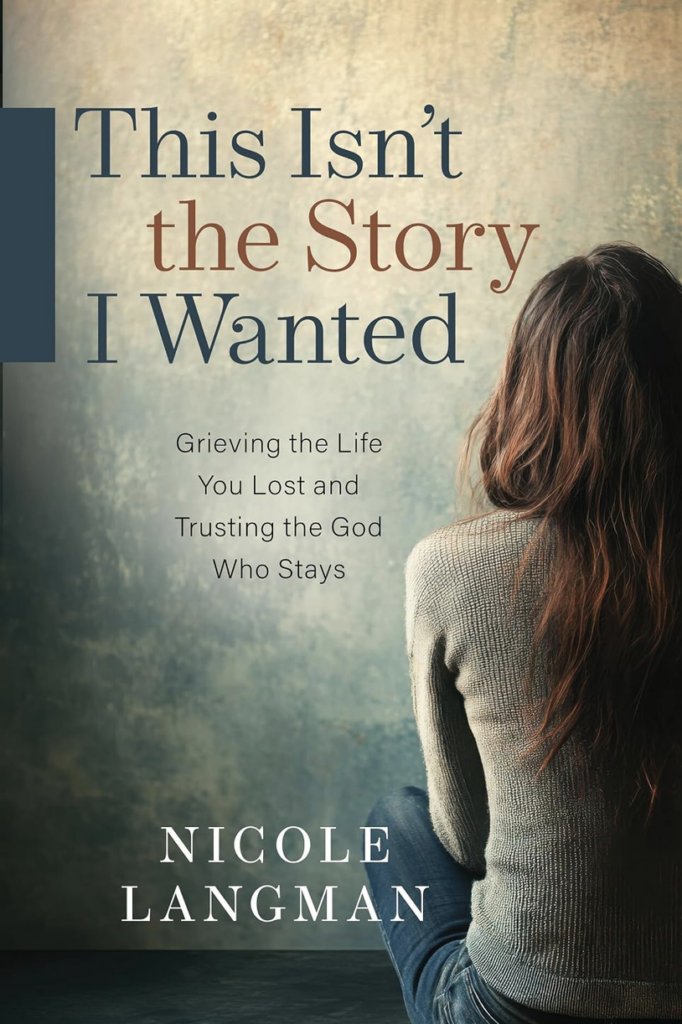
This Isn’t the Story I Wanted
What do you do when the life you planned is no longer the life you’re living?
In This Isn’t the Story I Wanted, therapist, social worker, and speaker Nicole Langman gently reminds you that grief isn’t reserved for death alone.
Written in short, devotional-style chapters, this book can be picked up whenever you need a moment of encouragement or hope.
With biblical wisdom, tender understanding, and a therapeutic approach, Nicole invites you to name your pain, process your losses, and discover that God is present even in the stories you never would have chosen.
Leave a Reply